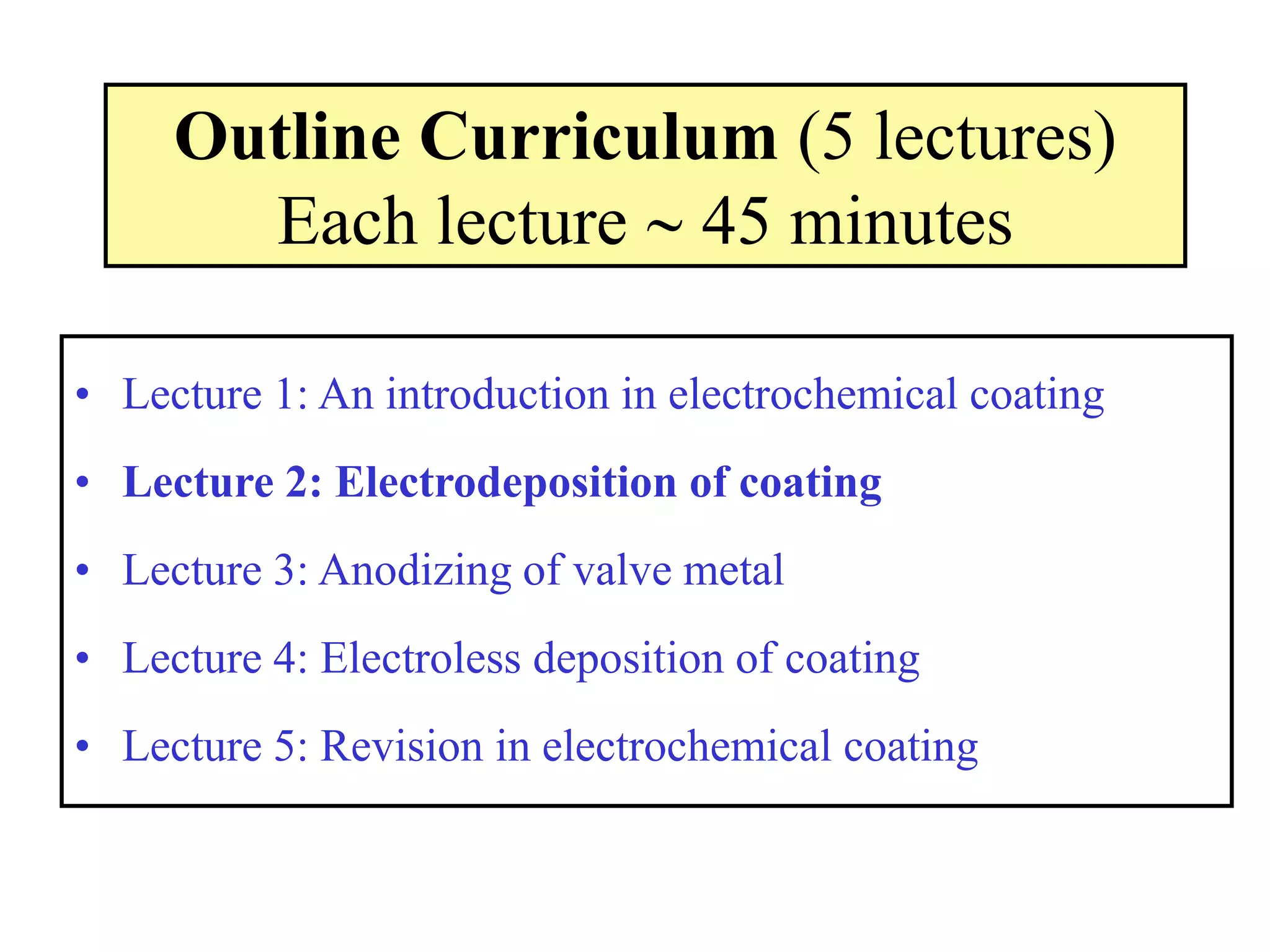
Outline Curriculum (5 lectures)
Each lecture  45 minutes
• Lecture 1: An introduction in electrochemical coating
• Lecture 2: Electrodeposition of coating
• Lecture 3: Anodizing of valve metal
• Lecture 4: Electroless deposition of coating
• Lecture 5: Revision in electrochemical coating
Lecture 2 of 5
Electrodeposition of Coating
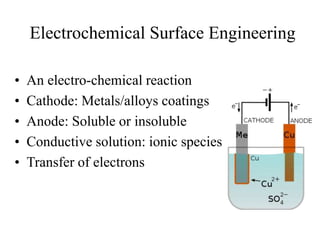
Electrochemical Surface Engineering
• An electro-chemical reaction
• Cathode: Metals/alloys coatings
• Anode: Soluble or insoluble
• Conductive solution: ionic species
• Transfer of electrons
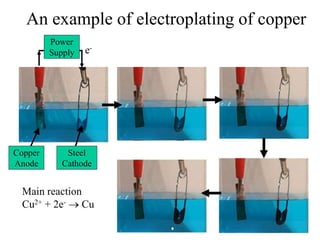
An example of electroplating of copper
Power
Supply
Copper
Anode
Steel
Cathode
e-
Main reaction
Cu2+ + 2e-  Cu
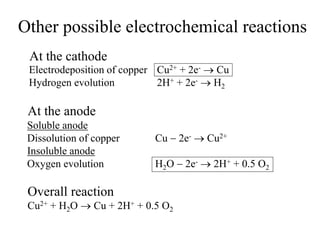
Other possible electrochemical reactions
At the cathode
Electrodeposition of copper Cu2+ + 2e-  Cu
Hydrogen evolution 2H+ + 2e-  H2
At the anode
Soluble anode
Dissolution of copper Cu  2e-  Cu2+
Insoluble anode
Oxygen evolution H2O  2e-  2H+ + 0.5 O2
Overall reaction
Cu2+ + H2O  Cu + 2H+ + 0.5 O2
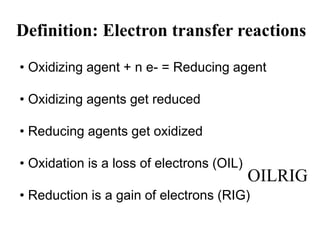
Definition: Electron transfer reactions
• Oxidizing agent + n e- = Reducing agent
• Oxidizing agents get reduced
• Reducing agents get oxidized
• Oxidation is a loss of electrons (OIL)
• Reduction is a gain of electrons (RIG)
OILRIG
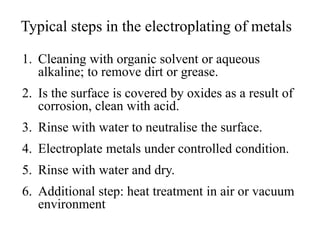
Typical steps in the electroplating of metals
1. Cleaning with organic solvent or aqueous
alkaline; to remove dirt or grease.
2. Is the surface is covered by oxides as a result of
corrosion, clean with acid.
3. Rinse with water to neutralise the surface.
4. Electroplate metals under controlled condition.
5. Rinse with water and dry.
6. Additional step: heat treatment in air or vacuum
environment
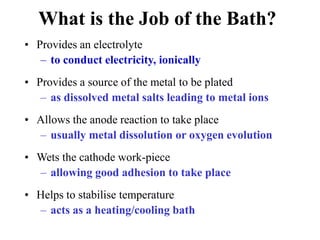
What is the Job of the Bath?
• Provides an electrolyte
– to conduct electricity, ionically
• Provides a source of the metal to be plated
– as dissolved metal salts leading to metal ions
• Allows the anode reaction to take place
– usually metal dissolution or oxygen evolution
• Wets the cathode work-piece
– allowing good adhesion to take place
• Helps to stabilise temperature
– acts as a heating/cooling bath
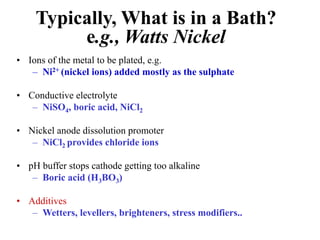
Typically, What is in a Bath?
e.g., Watts Nickel
• Ions of the metal to be plated, e.g.
– Ni2+ (nickel ions) added mostly as the sulphate
• Conductive electrolyte
– NiSO4, boric acid, NiCl2
• Nickel anode dissolution promoter
– NiCl2 provides chloride ions
• pH buffer stops cathode getting too alkaline
– Boric acid (H3BO3)
• Additives
– Wetters, levellers, brighteners, stress modifiers..
Current efficiency
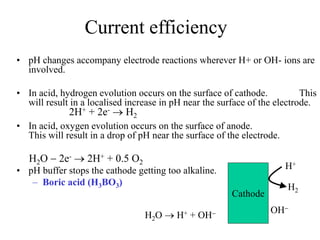
• pH changes accompany electrode reactions wherever H+ or OH- ions are
involved.
• In acid, hydrogen evolution occurs on the surface of cathode. This
will result in a localised increase in pH near the surface of the electrode.
• In acid, oxygen evolution occurs on the surface of anode.
This will result in a drop of pH near the surface of the electrode.
• pH buffer stops the cathode getting too alkaline.
– Boric acid (H3BO3)
2H+ + 2e-  H2
H2O  2e-  2H+ + 0.5 O2
Cathode
H+
H2
OH
H2O  H+ + OH
Current efficiency
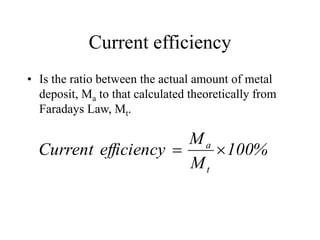
• Is the ratio between the actual amount of metal
deposit, Ma to that calculated theoretically from
Faradays Law, Mt.
%
100
M
M
efficiency
Current
t
a


Parameters that may influence the
quality of electrodeposits
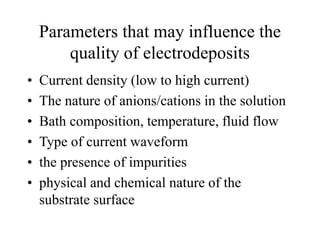
• Current density (low to high current)
• The nature of anions/cations in the solution
• Bath composition, temperature, fluid flow
• Type of current waveform
• the presence of impurities
• physical and chemical nature of the
substrate surface
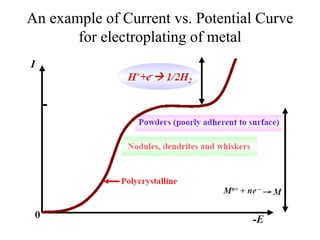
An example of Current vs. Potential Curve
for electroplating of metal
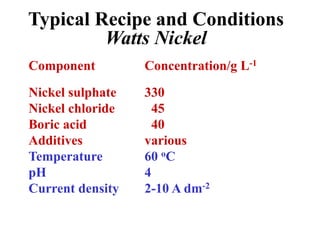
Typical Recipe and Conditions
Watts Nickel
Component Concentration/g L-1
Nickel sulphate 330
Nickel chloride 45
Boric acid 40
Additives various
Temperature 60 oC
pH 4
Current density 2-10 A dm-2
Faraday’s Laws of Electrolysis
Amount of material = amount of electrical energy
zF
q
n 
n = amount of material
q = electrical charge
z = number of electrons
F = Faraday constant
]
mol
C
[
]
C
[
]
mol
[ 1


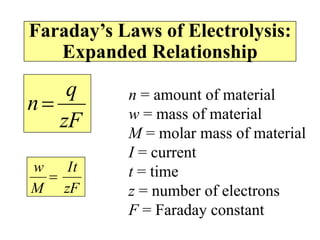
Faraday’s Laws of Electrolysis:
Expanded Relationship
zF
q
n
zF
It
M
w

n = amount of material
w = mass of material
M = molar mass of material
I = current
t = time
z = number of electrons
F = Faraday constant
Current, Current density, Surface area
A
I
j 
j = current density [mA cm-2]
I = current [A]
A = surface area of the electrode [cm2]
jelectroplate = electroplating current density (metal electroplate)
jcorrosion = corrosion current density (metal corrosion/dissolution)
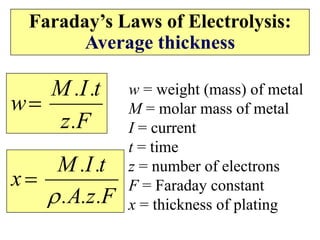
Faraday’s Laws of Electrolysis:
Average thickness
F
.
z
t
.
I
.
M
w
w = weight (mass) of metal
M = molar mass of metal
I = current
t = time
z = number of electrons
F = Faraday constant
x = thickness of plating
F
.
z
.
A
.
t
.
I
.
M
x


Faraday’s Laws of Electrolysis:
Average deposit thickness
F
.
z
.
A
.
t
.
I
.
M
x


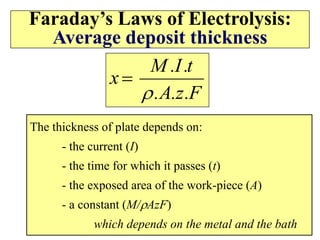
The thickness of plate depends on:
- the current (I)
- the time for which it passes (t)
- the exposed area of the work-piece (A)
- a constant (M/AzF)
which depends on the metal and the bath
Faraday’s Laws of Electrolysis:
Question - Nickel Plating
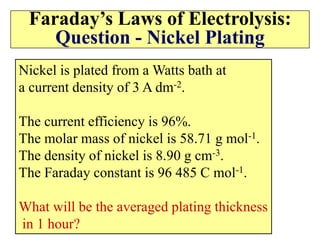
Nickel is plated from a Watts bath at
a current density of 3 A dm-2.
The current efficiency is 96%.
The molar mass of nickel is 58.71 g mol-1.
The density of nickel is 8.90 g cm-3.
The Faraday constant is 96 485 C mol-1.
What will be the averaged plating thickness
in 1 hour?
Faraday’s Laws of Electrolysis:
Answer - Nickel Plating
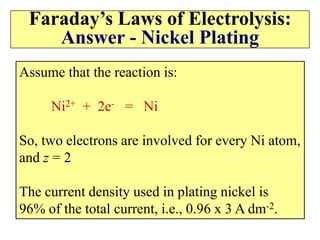
Assume that the reaction is:
Ni2+ + 2e- = Ni
So, two electrons are involved for every Ni atom,
and z = 2
The current density used in plating nickel is
96% of the total current, i.e., 0.96 x 3 A dm-2.
Faraday’s Laws of Electrolysis:
Answer - Nickel Plating
F
.
z
.
A
.
t
.
I
.
M
x


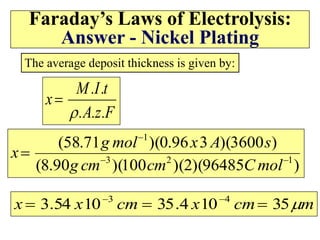
The average deposit thickness is given by:
)
96485
)(
2
)(
100
)(
90
.
8
(
)
3600
)(
3
96
.
0
)(
71
.
58
(
1
2
3
1




mol
C
cm
cm
g
s
A
x
mol
g
x
m
cm
x
cm
x
x 
35
10
4
.
35
10
54
.
3 4
3


 

• Electrodeposition is a versatile coating technique.
• There is a high degree of control over deposit thickness.
• Many metals can be electroplated from aqueous baths.
• So can some alloys, conductive polymers and composites.
• Rates of electroplating can be expressed via Faraday’s
Laws of electrolysis.
Thank you for your attention!
Summary

lecture-2-electrodeposition-of-coating.ppt

  • 1.
    Outline Curriculum (5lectures) Each lecture  45 minutes • Lecture 1: An introduction in electrochemical coating • Lecture 2: Electrodeposition of coating • Lecture 3: Anodizing of valve metal • Lecture 4: Electroless deposition of coating • Lecture 5: Revision in electrochemical coating
  • 2.
    Lecture 2 of5 Electrodeposition of Coating
  • 3.
    Electrochemical Surface Engineering •An electro-chemical reaction • Cathode: Metals/alloys coatings • Anode: Soluble or insoluble • Conductive solution: ionic species • Transfer of electrons
  • 4.
    An example ofelectroplating of copper Power Supply Copper Anode Steel Cathode e- Main reaction Cu2+ + 2e-  Cu
  • 5.
    Other possible electrochemicalreactions At the cathode Electrodeposition of copper Cu2+ + 2e-  Cu Hydrogen evolution 2H+ + 2e-  H2 At the anode Soluble anode Dissolution of copper Cu  2e-  Cu2+ Insoluble anode Oxygen evolution H2O  2e-  2H+ + 0.5 O2 Overall reaction Cu2+ + H2O  Cu + 2H+ + 0.5 O2
  • 6.
    Definition: Electron transferreactions • Oxidizing agent + n e- = Reducing agent • Oxidizing agents get reduced • Reducing agents get oxidized • Oxidation is a loss of electrons (OIL) • Reduction is a gain of electrons (RIG) OILRIG
  • 7.
    Typical steps inthe electroplating of metals 1. Cleaning with organic solvent or aqueous alkaline; to remove dirt or grease. 2. Is the surface is covered by oxides as a result of corrosion, clean with acid. 3. Rinse with water to neutralise the surface. 4. Electroplate metals under controlled condition. 5. Rinse with water and dry. 6. Additional step: heat treatment in air or vacuum environment
  • 8.
    What is theJob of the Bath? • Provides an electrolyte – to conduct electricity, ionically • Provides a source of the metal to be plated – as dissolved metal salts leading to metal ions • Allows the anode reaction to take place – usually metal dissolution or oxygen evolution • Wets the cathode work-piece – allowing good adhesion to take place • Helps to stabilise temperature – acts as a heating/cooling bath
  • 9.
    Typically, What isin a Bath? e.g., Watts Nickel • Ions of the metal to be plated, e.g. – Ni2+ (nickel ions) added mostly as the sulphate • Conductive electrolyte – NiSO4, boric acid, NiCl2 • Nickel anode dissolution promoter – NiCl2 provides chloride ions • pH buffer stops cathode getting too alkaline – Boric acid (H3BO3) • Additives – Wetters, levellers, brighteners, stress modifiers..
  • 10.
    Current efficiency • pHchanges accompany electrode reactions wherever H+ or OH- ions are involved. • In acid, hydrogen evolution occurs on the surface of cathode. This will result in a localised increase in pH near the surface of the electrode. • In acid, oxygen evolution occurs on the surface of anode. This will result in a drop of pH near the surface of the electrode. • pH buffer stops the cathode getting too alkaline. – Boric acid (H3BO3) 2H+ + 2e-  H2 H2O  2e-  2H+ + 0.5 O2 Cathode H+ H2 OH H2O  H+ + OH
  • 11.
    Current efficiency • Isthe ratio between the actual amount of metal deposit, Ma to that calculated theoretically from Faradays Law, Mt. % 100 M M efficiency Current t a  
  • 12.
    Parameters that mayinfluence the quality of electrodeposits • Current density (low to high current) • The nature of anions/cations in the solution • Bath composition, temperature, fluid flow • Type of current waveform • the presence of impurities • physical and chemical nature of the substrate surface
  • 13.
    An example ofCurrent vs. Potential Curve for electroplating of metal
  • 14.
    Typical Recipe andConditions Watts Nickel Component Concentration/g L-1 Nickel sulphate 330 Nickel chloride 45 Boric acid 40 Additives various Temperature 60 oC pH 4 Current density 2-10 A dm-2
  • 15.
    Faraday’s Laws ofElectrolysis Amount of material = amount of electrical energy zF q n  n = amount of material q = electrical charge z = number of electrons F = Faraday constant ] mol C [ ] C [ ] mol [ 1  
  • 16.
    Faraday’s Laws ofElectrolysis: Expanded Relationship zF q n zF It M w  n = amount of material w = mass of material M = molar mass of material I = current t = time z = number of electrons F = Faraday constant
  • 17.
    Current, Current density,Surface area A I j  j = current density [mA cm-2] I = current [A] A = surface area of the electrode [cm2] jelectroplate = electroplating current density (metal electroplate) jcorrosion = corrosion current density (metal corrosion/dissolution)
  • 18.
    Faraday’s Laws ofElectrolysis: Average thickness F . z t . I . M w w = weight (mass) of metal M = molar mass of metal I = current t = time z = number of electrons F = Faraday constant x = thickness of plating F . z . A . t . I . M x  
  • 19.
    Faraday’s Laws ofElectrolysis: Average deposit thickness F . z . A . t . I . M x   The thickness of plate depends on: - the current (I) - the time for which it passes (t) - the exposed area of the work-piece (A) - a constant (M/AzF) which depends on the metal and the bath
  • 20.
    Faraday’s Laws ofElectrolysis: Question - Nickel Plating Nickel is plated from a Watts bath at a current density of 3 A dm-2. The current efficiency is 96%. The molar mass of nickel is 58.71 g mol-1. The density of nickel is 8.90 g cm-3. The Faraday constant is 96 485 C mol-1. What will be the averaged plating thickness in 1 hour?
  • 21.
    Faraday’s Laws ofElectrolysis: Answer - Nickel Plating Assume that the reaction is: Ni2+ + 2e- = Ni So, two electrons are involved for every Ni atom, and z = 2 The current density used in plating nickel is 96% of the total current, i.e., 0.96 x 3 A dm-2.
  • 22.
    Faraday’s Laws ofElectrolysis: Answer - Nickel Plating F . z . A . t . I . M x   The average deposit thickness is given by: ) 96485 )( 2 )( 100 )( 90 . 8 ( ) 3600 )( 3 96 . 0 )( 71 . 58 ( 1 2 3 1     mol C cm cm g s A x mol g x m cm x cm x x  35 10 4 . 35 10 54 . 3 4 3     
  • 23.
    • Electrodeposition isa versatile coating technique. • There is a high degree of control over deposit thickness. • Many metals can be electroplated from aqueous baths. • So can some alloys, conductive polymers and composites. • Rates of electroplating can be expressed via Faraday’s Laws of electrolysis. Thank you for your attention! Summary