CORROSION
 OXIDATION
 CORROSION
 PREVENTION AGAINST CORROSION
Principles and Prevention of Corrosion
D.A. Jones
Prentice-Hall, Englewood-Cliffs (1996)
Attack of Environment on Materials
 Metals get oxidized
 Polymers react with oxygen and degrade
 Ceramic refractories may dissolved in contact with molten materials
 Materials may undergo irradiation damage
Oxidation
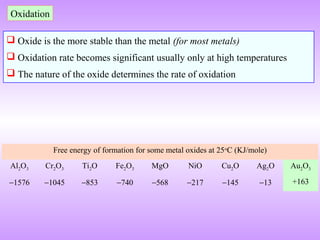
 Oxide is the more stable than the metal (for most metals)
 Oxidation rate becomes significant usually only at high temperatures
 The nature of the oxide determines the rate of oxidation
Free energy of formation for some metal oxides at 25o
C (KJ/mole)
Al2O3 Cr2O3 Ti2O Fe2O3 MgO NiO Cu2O Ag2O Au2O3
−1576 −1045 −853 −740 −568 −217 −145 −13 +163
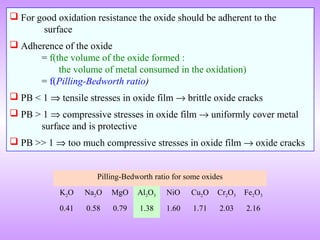
 For good oxidation resistance the oxide should be adherent to the
surface
 Adherence of the oxide
= f(the volume of the oxide formed :
the volume of metal consumed in the oxidation)
= f(Pilling-Bedworth ratio)
 PB < 1 ⇒ tensile stresses in oxide film → brittle oxide cracks
 PB > 1 ⇒ compressive stresses in oxide film → uniformly cover metal
surface and is protective
 PB >> 1 ⇒ too much compressive stresses in oxide film → oxide cracks
Pilling-Bedworth ratio for some oxides
K2O Na2O MgO Al2O3 NiO Cu2O Cr2O3 Fe2O3
0.41 0.58 0.79 1.38 1.60 1.71 2.03 2.16
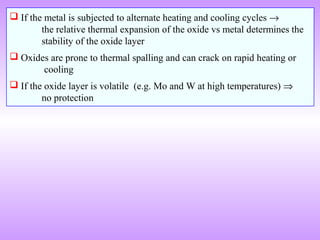
 If the metal is subjected to alternate heating and cooling cycles →
the relative thermal expansion of the oxide vs metal determines the
stability of the oxide layer
 Oxides are prone to thermal spalling and can crack on rapid heating or
cooling
 If the oxide layer is volatile (e.g. Mo and W at high temperatures) ⇒
no protection
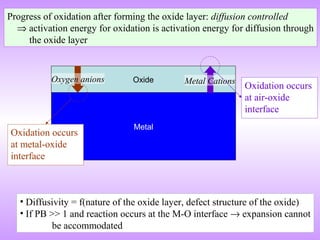
Progress of oxidation after forming the oxide layer: diffusion controlled
⇒ activation energy for oxidation is activation energy for diffusion through
the oxide layer
Oxide
Metal
Oxygen anions Metal Cations
Oxidation occurs
at air-oxide
interface
Oxidation occurs
at metal-oxide
interface
• Diffusivity = f(nature of the oxide layer, defect structure of the oxide)
• If PB >> 1 and reaction occurs at the M-O interface → expansion cannot
be accommodated
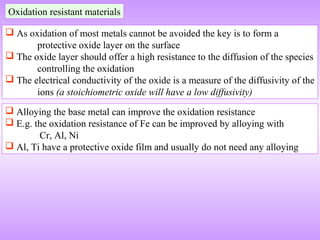
Oxidation resistant materials
 As oxidation of most metals cannot be avoided the key is to form a
protective oxide layer on the surface
 The oxide layer should offer a high resistance to the diffusion of the species
controlling the oxidation
 The electrical conductivity of the oxide is a measure of the diffusivity of the
ions (a stoichiometric oxide will have a low diffusivity)
 Alloying the base metal can improve the oxidation resistance
 E.g. the oxidation resistance of Fe can be improved by alloying with
Cr, Al, Ni
 Al, Ti have a protective oxide film and usually do not need any alloying
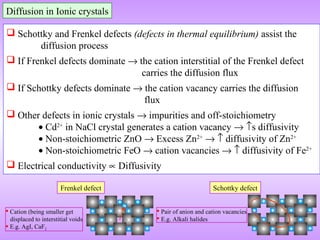
 Schottky and Frenkel defects (defects in thermal equilibrium) assist the
diffusion process
 If Frenkel defects dominate → the cation interstitial of the Frenkel defect
carries the diffusion flux
 If Schottky defects dominate → the cation vacancy carries the diffusion
flux
 Other defects in ionic crystals → impurities and off-stoichiometry
• Cd2+
in NaCl crystal generates a cation vacancy → ↑s diffusivity
• Non-stoichiometric ZnO → Excess Zn2+
→ ↑ diffusivity of Zn2+
• Non-stoichiometric FeO → cation vacancies → ↑ diffusivity of Fe2+
 Electrical conductivity ∝ Diffusivity
Diffusion in Ionic crystals
Frenkel defect
 Cation (being smaller get
displaced to interstitial voids
 E.g. AgI, CaF2
Schottky defect
 Pair of anion and cation vacancies
 E.g. Alkali halides
 A protective Cr2O3 layer forms on the surface of Fe
σ(Cr2O3) = 0.001 σ(Fe2O3)
 Upto 10 % Cr alloyed steel is used in oil refinery components
 Cr > 12% → stainless steels → oxidation resistance upto 1000o
C
→ turbine blades, furnace parts, valves for IC engines
 Cr > 17% → oxidation resistance above 1000o
C
 18-8 stainless steel (18%Cr, 8%Ni) → excellent corrosion resistance
 Kanthal (24% Cr, 5.5%Al, 2%Co) → furnace windings (1300o
C)
Alloying of Fe with Cr
Other oxidation resistant alloys
 Nichrome (80%Ni, 20%Cr) → excellent oxidation resistance
 Inconel (76%Ni, 16%Cr, 7%Fe)
Corrosion
THE ELECTRODE POTENTIAL
 When an electrode (e.g. Fe) is immersed in a solvent (e.g. H2O) some metal ions
leave the electrode and –ve charge builds up in the electrode
 The solvent becomes +ve and the opposing electrical layers lead to a dynamic
equilibrium wherein there is no further (net) dissolution of the electrode
 The potential developed by the electrode in equilibrium is a property of the
metal of electrode → the electrode potential
 The electrode potential is measured with the electrode in contact with a solution
containing an unit concentration of the ions of the same metal with the standard
hydrogen electrode as the counter electrode (whose potential is taken to be zero)
Metal
ions-ve
+ve
System Potential in V
Noble end Au / Au3+
+1.5
Ag / Ag+
+0.80
Cu / Cu2+
+0.34
H2 / H+
0.0
Pb / Pb2+
−0.13
Ni / Ni2+
−0.25
Fe / Fe2+
−0.44
Cr / Cr3+
−0.74
Zn / Zn2+
−0.76
Al / Al3+
− 1.66
Active end Li / Li+
−3.05
Standard electrode potential of metals
Standard potential at 25o
C
Increasingprope
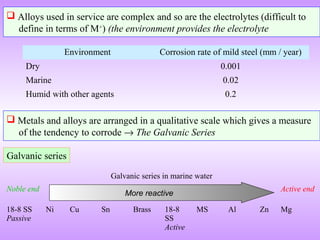
Galvanic series
 Alloys used in service are complex and so are the electrolytes (difficult to
define in terms of M+
) (the environment provides the electrolyte
 Metals and alloys are arranged in a qualitative scale which gives a measure
of the tendency to corrode → The Galvanic Series
Environment Corrosion rate of mild steel (mm / year)
Dry 0.001
Marine 0.02
Humid with other agents 0.2
Galvanic series in marine water
Noble end Active end
18-8 SS
Passive
Ni Cu Sn Brass 18-8
SS
Active
MS Al Zn Mg
More reactive
Galvanic Cell
Anode
Zn
(−0.76)
Cathode
Cu
(+0.34)
e−
flow
Zn → Zn2+
+ 2e−
oxidation
Cu2+
+ 2e−
→ Cu
Reduction
or
2H+
+ 2e−
→ H2
or
O2 + 2H2O + 4e−
→ 4OH−
Zn will corrode at the expense of Cu
How can galvanic cells form?
Anodic/cathodic phases at the
microstructural level
Differences in the concentration of the
Metal ion
Anodic/cathodic electrodes
Differences in the concentration of
oxygen
Difference in the residual stress levels
 Different phases (even of the same metal) can form a galvanic couple at the
microstructural level (In steel Cementite is noble as compared to Ferrite)
 Galvanic cell may be set up due to concentration differences of the metal ion in the
electrolyte → A concentration cell
Metal ion deficient → anodic
Metal ion excess → cathodic
 A concentration cell can form due to differences in oxygen concentration
Oxygen deficient region → anodic
Oxygen rich region → cathodic
 A galvanic cell can form due to different residual stresses in the same metal
Stressed region more active → anodic
Stress free region → cathodic
O2 + 2H2O + 4e−
→ 4OH−
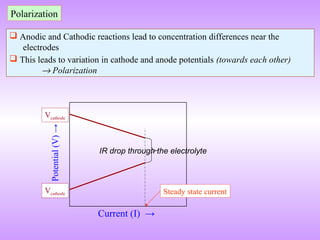
Polarization
 Anodic and Cathodic reactions lead to concentration differences near the
electrodes
 This leads to variation in cathode and anode potentials (towards each other)
→ Polarization
Current (I) →
Potential(V)→
Vcathode
Vcathode Steady state current
IR drop through the electrolyte
Passivation
 Iron dissolves in dilute nitric acid, but not in concentrated nitric acid
 The concentrated acid oxidizes the surface of iron and produces a thin protective
oxide layer (dilute acid is not able to do so)
 ↑ potential of a metal electrode → ↑ in current density (I/A)
 On current density reaching a critical value → fall in current density
(then remains constant) → Passivation
Prevention of Corrosion
Basic goal → • protect the metal • avoid localized corrosion
 When possible chose a nobler metal
 Avoid electrical / physical contact between metals with very different electrode
potentials (avoid formation of a galvanic couple)
 If dissimilar metals are in contact make sure that the anodic metal has a larger
surface area / volume
 In case of microstructural level galvanic couple, try to use a course
microstructure (where possible) to reduce number of galvanic cells formed
 Modify the base metal by alloying
 Protect the surface by various means
 Modify the fluid in contact with the metal
• Remove a cathodic reactant (e.g. water)
• Add inhibitors which from a protective layer
 Cathodic protection
• Use a sacrificial anode (as a coating or in electrical contact)
• Use an external DC source in connection with a inert/expendable electrode

Corrosion

  • 1.
    CORROSION  OXIDATION  CORROSION PREVENTION AGAINST CORROSION Principles and Prevention of Corrosion D.A. Jones Prentice-Hall, Englewood-Cliffs (1996)
  • 2.
    Attack of Environmenton Materials  Metals get oxidized  Polymers react with oxygen and degrade  Ceramic refractories may dissolved in contact with molten materials  Materials may undergo irradiation damage
  • 3.
    Oxidation  Oxide isthe more stable than the metal (for most metals)  Oxidation rate becomes significant usually only at high temperatures  The nature of the oxide determines the rate of oxidation Free energy of formation for some metal oxides at 25o C (KJ/mole) Al2O3 Cr2O3 Ti2O Fe2O3 MgO NiO Cu2O Ag2O Au2O3 −1576 −1045 −853 −740 −568 −217 −145 −13 +163
  • 4.
     For goodoxidation resistance the oxide should be adherent to the surface  Adherence of the oxide = f(the volume of the oxide formed : the volume of metal consumed in the oxidation) = f(Pilling-Bedworth ratio)  PB < 1 ⇒ tensile stresses in oxide film → brittle oxide cracks  PB > 1 ⇒ compressive stresses in oxide film → uniformly cover metal surface and is protective  PB >> 1 ⇒ too much compressive stresses in oxide film → oxide cracks Pilling-Bedworth ratio for some oxides K2O Na2O MgO Al2O3 NiO Cu2O Cr2O3 Fe2O3 0.41 0.58 0.79 1.38 1.60 1.71 2.03 2.16
  • 5.
     If themetal is subjected to alternate heating and cooling cycles → the relative thermal expansion of the oxide vs metal determines the stability of the oxide layer  Oxides are prone to thermal spalling and can crack on rapid heating or cooling  If the oxide layer is volatile (e.g. Mo and W at high temperatures) ⇒ no protection
  • 6.
    Progress of oxidationafter forming the oxide layer: diffusion controlled ⇒ activation energy for oxidation is activation energy for diffusion through the oxide layer Oxide Metal Oxygen anions Metal Cations Oxidation occurs at air-oxide interface Oxidation occurs at metal-oxide interface • Diffusivity = f(nature of the oxide layer, defect structure of the oxide) • If PB >> 1 and reaction occurs at the M-O interface → expansion cannot be accommodated
  • 7.
    Oxidation resistant materials As oxidation of most metals cannot be avoided the key is to form a protective oxide layer on the surface  The oxide layer should offer a high resistance to the diffusion of the species controlling the oxidation  The electrical conductivity of the oxide is a measure of the diffusivity of the ions (a stoichiometric oxide will have a low diffusivity)  Alloying the base metal can improve the oxidation resistance  E.g. the oxidation resistance of Fe can be improved by alloying with Cr, Al, Ni  Al, Ti have a protective oxide film and usually do not need any alloying
  • 8.
     Schottky andFrenkel defects (defects in thermal equilibrium) assist the diffusion process  If Frenkel defects dominate → the cation interstitial of the Frenkel defect carries the diffusion flux  If Schottky defects dominate → the cation vacancy carries the diffusion flux  Other defects in ionic crystals → impurities and off-stoichiometry • Cd2+ in NaCl crystal generates a cation vacancy → ↑s diffusivity • Non-stoichiometric ZnO → Excess Zn2+ → ↑ diffusivity of Zn2+ • Non-stoichiometric FeO → cation vacancies → ↑ diffusivity of Fe2+  Electrical conductivity ∝ Diffusivity Diffusion in Ionic crystals Frenkel defect  Cation (being smaller get displaced to interstitial voids  E.g. AgI, CaF2 Schottky defect  Pair of anion and cation vacancies  E.g. Alkali halides
  • 9.
     A protectiveCr2O3 layer forms on the surface of Fe σ(Cr2O3) = 0.001 σ(Fe2O3)  Upto 10 % Cr alloyed steel is used in oil refinery components  Cr > 12% → stainless steels → oxidation resistance upto 1000o C → turbine blades, furnace parts, valves for IC engines  Cr > 17% → oxidation resistance above 1000o C  18-8 stainless steel (18%Cr, 8%Ni) → excellent corrosion resistance  Kanthal (24% Cr, 5.5%Al, 2%Co) → furnace windings (1300o C) Alloying of Fe with Cr Other oxidation resistant alloys  Nichrome (80%Ni, 20%Cr) → excellent oxidation resistance  Inconel (76%Ni, 16%Cr, 7%Fe)
  • 10.
    Corrosion THE ELECTRODE POTENTIAL When an electrode (e.g. Fe) is immersed in a solvent (e.g. H2O) some metal ions leave the electrode and –ve charge builds up in the electrode  The solvent becomes +ve and the opposing electrical layers lead to a dynamic equilibrium wherein there is no further (net) dissolution of the electrode  The potential developed by the electrode in equilibrium is a property of the metal of electrode → the electrode potential  The electrode potential is measured with the electrode in contact with a solution containing an unit concentration of the ions of the same metal with the standard hydrogen electrode as the counter electrode (whose potential is taken to be zero) Metal ions-ve +ve
  • 11.
    System Potential inV Noble end Au / Au3+ +1.5 Ag / Ag+ +0.80 Cu / Cu2+ +0.34 H2 / H+ 0.0 Pb / Pb2+ −0.13 Ni / Ni2+ −0.25 Fe / Fe2+ −0.44 Cr / Cr3+ −0.74 Zn / Zn2+ −0.76 Al / Al3+ − 1.66 Active end Li / Li+ −3.05 Standard electrode potential of metals Standard potential at 25o C Increasingprope
  • 12.
    Galvanic series  Alloysused in service are complex and so are the electrolytes (difficult to define in terms of M+ ) (the environment provides the electrolyte  Metals and alloys are arranged in a qualitative scale which gives a measure of the tendency to corrode → The Galvanic Series Environment Corrosion rate of mild steel (mm / year) Dry 0.001 Marine 0.02 Humid with other agents 0.2 Galvanic series in marine water Noble end Active end 18-8 SS Passive Ni Cu Sn Brass 18-8 SS Active MS Al Zn Mg More reactive
  • 13.
    Galvanic Cell Anode Zn (−0.76) Cathode Cu (+0.34) e− flow Zn →Zn2+ + 2e− oxidation Cu2+ + 2e− → Cu Reduction or 2H+ + 2e− → H2 or O2 + 2H2O + 4e− → 4OH− Zn will corrode at the expense of Cu
  • 14.
    How can galvaniccells form? Anodic/cathodic phases at the microstructural level Differences in the concentration of the Metal ion Anodic/cathodic electrodes Differences in the concentration of oxygen Difference in the residual stress levels
  • 15.
     Different phases(even of the same metal) can form a galvanic couple at the microstructural level (In steel Cementite is noble as compared to Ferrite)  Galvanic cell may be set up due to concentration differences of the metal ion in the electrolyte → A concentration cell Metal ion deficient → anodic Metal ion excess → cathodic  A concentration cell can form due to differences in oxygen concentration Oxygen deficient region → anodic Oxygen rich region → cathodic  A galvanic cell can form due to different residual stresses in the same metal Stressed region more active → anodic Stress free region → cathodic O2 + 2H2O + 4e− → 4OH−
  • 16.
    Polarization  Anodic andCathodic reactions lead to concentration differences near the electrodes  This leads to variation in cathode and anode potentials (towards each other) → Polarization Current (I) → Potential(V)→ Vcathode Vcathode Steady state current IR drop through the electrolyte
  • 17.
    Passivation  Iron dissolvesin dilute nitric acid, but not in concentrated nitric acid  The concentrated acid oxidizes the surface of iron and produces a thin protective oxide layer (dilute acid is not able to do so)  ↑ potential of a metal electrode → ↑ in current density (I/A)  On current density reaching a critical value → fall in current density (then remains constant) → Passivation
  • 18.
    Prevention of Corrosion Basicgoal → • protect the metal • avoid localized corrosion  When possible chose a nobler metal  Avoid electrical / physical contact between metals with very different electrode potentials (avoid formation of a galvanic couple)  If dissimilar metals are in contact make sure that the anodic metal has a larger surface area / volume  In case of microstructural level galvanic couple, try to use a course microstructure (where possible) to reduce number of galvanic cells formed  Modify the base metal by alloying  Protect the surface by various means  Modify the fluid in contact with the metal • Remove a cathodic reactant (e.g. water) • Add inhibitors which from a protective layer  Cathodic protection • Use a sacrificial anode (as a coating or in electrical contact) • Use an external DC source in connection with a inert/expendable electrode