Chapter 4
The Market Many definitions: A physical place where a product is bought and sold All the buyers and sellers of a particular good or services The demand that exists for a particular product or service Process by which a buyer and seller arrive at a mutually acceptable price and quantity
Demand The quantity of a good or service that buyers will purchase at various prices during a given period of time Demand exists only if there is a desire to buy and the financial resources needed to make the purchase. Quantity demanded depends on the price. Law of Demand: the quantity demanded varies inversely with the price, as long as other things do not change.
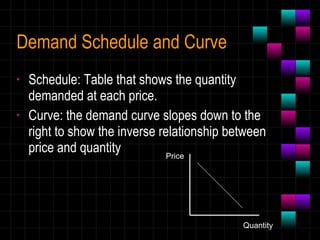
Demand Schedule and Curve   Schedule: Table that shows the quantity demanded at each price. Curve: the demand curve slopes down to the right to show the inverse relationship between price and quantity Quantity Price
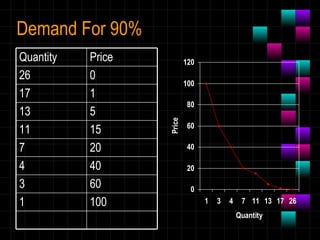
Demand For 90% 100 1 60 3 40 4 20 7 15 11 5 13 1 17 0 26 Price Quantity
Demand Determinants Buyer’s Income:  For normal products increased income = increased demand,  For inferior products increased income = decreased demand Buyer’s Preferences/Consumer’s Taste A change in consumers tastes and preferences also affects demand. Eg. Nutrition, fashion, safety. Buyer’s expectations Expectation of future price changes will alter current demand (e.g. gas price increase in the immediate future will cause consumer to fill their tanks earlier)
Demand Determinants Other prices Price of a complementary good -  A price increase (decrease) in one product causes a decrease (increase) in the demand for its complement  Price of a substitute good -  A price increase (decrease) in one product causes an increase (decrease) in the demand for its substitute Number of buyers More buyers = more demand & fewer buyers = less demand
Demand vs. Quantity Demanded Demand: Demand is the range of quantities that buyers are willing and able to buy at a range of demand prices. It is ALL points that make up a demand curve. Quantity Demanded: Quantity demand is a specific quantity that buyers are willing and able to buy at a specific demand price. It is but ONE point on a demand curve.
Changes in Demand Change in Demand: A change in demand is a change in the ENTIRE demand relation. This means changing, moving, and shifting the entire demand curve. The entire set of prices and quantities is changing. In other words, this is a shift of the demand curve. A change in demand is caused by a change in the five demand determinants. Change in Quantity Demanded: A change in quantity demanded is a change from one price-quantity pair on an existing demand curve to a new price-quantity pair on the SAME demand curve. In other words, this is a movement along the demand curve. A change in quantity demanded is caused by a change in price.
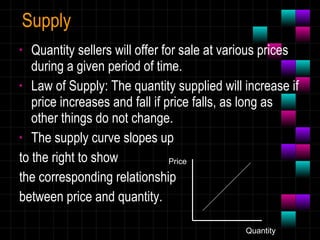
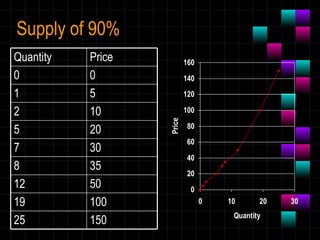
Supply Quantity sellers will offer for sale at various prices during a given period of time. Law of Supply: The quantity supplied will increase if price increases and fall if price falls, as long as other things do not change. The supply curve slopes up  to the right to show  the corresponding relationship  between price and quantity. Quantity Price
Supply of 90% 150 25 100 19 50 12 35 8 30 7 20 5 10 2 5 1 0 0 Price Quantity
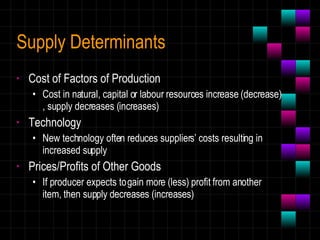
Supply Determinants Cost of Factors of Production Cost in natural, capital or labour resources increase (decrease) , supply decreases (increases) Technology New technology often reduces suppliers’ costs resulting in increased supply Prices/Profits of Other Goods If producer expects to gain more (less) profit from another item, then supply decreases (increases)
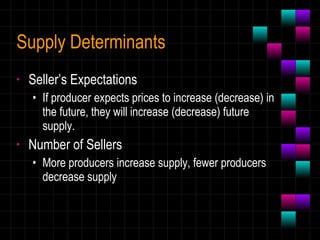
Supply Determinants Seller’s Expectations If producer expects prices to increase (decrease) in the future, they will increase (decrease) future supply. Number of Sellers More producers increase supply, fewer producers decrease supply
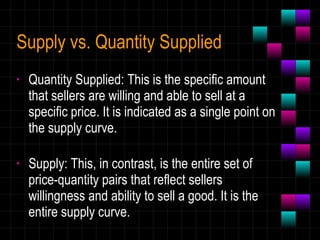
Supply vs. Quantity Supplied Quantity Supplied: This is the specific amount that sellers are willing and able to sell at a specific price. It is indicated as a single point on the supply curve. Supply: This, in contrast, is the entire set of price-quantity pairs that reflect sellers willingness and ability to sell a good. It is the entire supply curve.
Changes in Supply A Change in Quantity Supplied: This is a change in the specific amount of the good that sellers are willing and able to sell. It is caused by a change in the supply price and is indicated by a movement along the supply curve from one point to another. A Change in Supply: This a change in the overall supply relation, a change in all price-quantity pairs. It is caused by a change in one of the five supply determinants and is indicated by a shift of the supply curve.
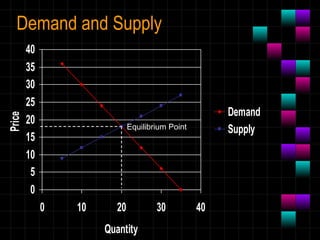
Demand   and   Supply Equilibrium Point
Market   Equilibrium Equilibrium price (or market clearing price) is the price set by the interaction of supply and demand in which the absence of surpluses or shortages in the market means there is no tendency for the price to change.
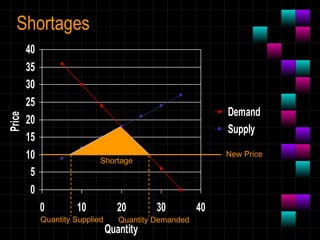
Shortages Shortage New Price Quantity Supplied Quantity Demanded
Shortage In a shortage, the price is too low resulting in an lack of goods.  Consumers demand more than suppliers will produce. The supplier will increase prices until the equilibrium price is reached.
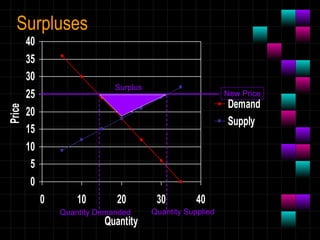
Surpluses Surplus New Price Quantity Supplied Quantity Demanded
Surplus In a surplus, the price is too high resulting in excess goods.  Suppliers produce more than customers demand. The supplier will decrease prices until the equilibrium price is reached.
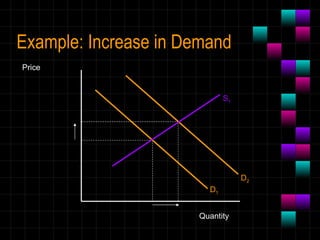
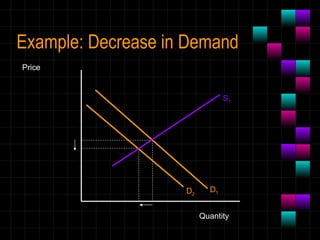
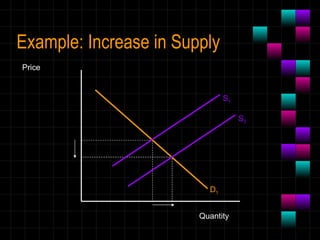
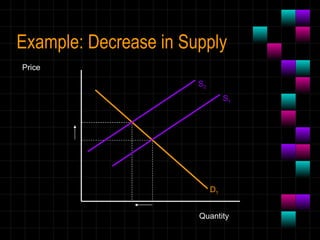
Equilibrium Point and Changes in Determinants A change in a demand determinant will shift the demand curve and change the quantity supplied A change is a supply determinant will shift the supply curve and change the quantity demanded.
Example: Increase in Demand Quantity Price D 1 D 2 S 1
Example: Decrease in Demand Quantity Price D 1 D 2 S 1
Example: Increase in Supply Quantity Price D 1 S 1 S 2
Example: Decrease in Supply Quantity Price D 1 S 1 S 2
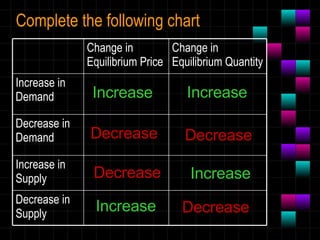
Complete the following chart Increase Increase Decrease Increase Decrease Decrease Decrease Increase Decrease in Supply Increase in Supply Decrease in Demand Increase in Demand Change in Equilibrium Quantity Change in Equilibrium Price
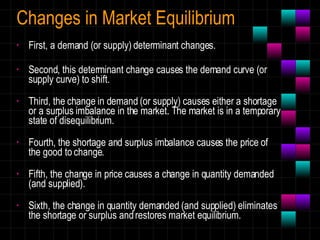
Changes   in   Market   Equilibrium First, a demand (or supply) determinant changes. Second, this determinant change causes the demand curve (or supply curve) to shift. Third, the change in demand (or supply) causes either a shortage or a surplus imbalance in the market. The market is in a temporary state of disequilibrium. Fourth, the shortage and surplus imbalance causes the price of the good to change. Fifth, the change in price causes a change in quantity demanded (and supplied). Sixth, the change in quantity demanded (and supplied) eliminates the shortage or surplus and restores market equilibrium.

Supply and Demand

  • 1.
  • 2.
    The Market Manydefinitions: A physical place where a product is bought and sold All the buyers and sellers of a particular good or services The demand that exists for a particular product or service Process by which a buyer and seller arrive at a mutually acceptable price and quantity
  • 3.
    Demand The quantityof a good or service that buyers will purchase at various prices during a given period of time Demand exists only if there is a desire to buy and the financial resources needed to make the purchase. Quantity demanded depends on the price. Law of Demand: the quantity demanded varies inversely with the price, as long as other things do not change.
  • 4.
    Demand Schedule andCurve Schedule: Table that shows the quantity demanded at each price. Curve: the demand curve slopes down to the right to show the inverse relationship between price and quantity Quantity Price
  • 5.
    Demand For 90%100 1 60 3 40 4 20 7 15 11 5 13 1 17 0 26 Price Quantity
  • 6.
    Demand Determinants Buyer’sIncome: For normal products increased income = increased demand, For inferior products increased income = decreased demand Buyer’s Preferences/Consumer’s Taste A change in consumers tastes and preferences also affects demand. Eg. Nutrition, fashion, safety. Buyer’s expectations Expectation of future price changes will alter current demand (e.g. gas price increase in the immediate future will cause consumer to fill their tanks earlier)
  • 7.
    Demand Determinants Otherprices Price of a complementary good - A price increase (decrease) in one product causes a decrease (increase) in the demand for its complement Price of a substitute good - A price increase (decrease) in one product causes an increase (decrease) in the demand for its substitute Number of buyers More buyers = more demand & fewer buyers = less demand
  • 8.
    Demand vs. QuantityDemanded Demand: Demand is the range of quantities that buyers are willing and able to buy at a range of demand prices. It is ALL points that make up a demand curve. Quantity Demanded: Quantity demand is a specific quantity that buyers are willing and able to buy at a specific demand price. It is but ONE point on a demand curve.
  • 9.
    Changes in DemandChange in Demand: A change in demand is a change in the ENTIRE demand relation. This means changing, moving, and shifting the entire demand curve. The entire set of prices and quantities is changing. In other words, this is a shift of the demand curve. A change in demand is caused by a change in the five demand determinants. Change in Quantity Demanded: A change in quantity demanded is a change from one price-quantity pair on an existing demand curve to a new price-quantity pair on the SAME demand curve. In other words, this is a movement along the demand curve. A change in quantity demanded is caused by a change in price.
  • 10.
    Supply Quantity sellerswill offer for sale at various prices during a given period of time. Law of Supply: The quantity supplied will increase if price increases and fall if price falls, as long as other things do not change. The supply curve slopes up to the right to show the corresponding relationship between price and quantity. Quantity Price
  • 11.
    Supply of 90%150 25 100 19 50 12 35 8 30 7 20 5 10 2 5 1 0 0 Price Quantity
  • 12.
    Supply Determinants Costof Factors of Production Cost in natural, capital or labour resources increase (decrease) , supply decreases (increases) Technology New technology often reduces suppliers’ costs resulting in increased supply Prices/Profits of Other Goods If producer expects to gain more (less) profit from another item, then supply decreases (increases)
  • 13.
    Supply Determinants Seller’sExpectations If producer expects prices to increase (decrease) in the future, they will increase (decrease) future supply. Number of Sellers More producers increase supply, fewer producers decrease supply
  • 14.
    Supply vs. QuantitySupplied Quantity Supplied: This is the specific amount that sellers are willing and able to sell at a specific price. It is indicated as a single point on the supply curve. Supply: This, in contrast, is the entire set of price-quantity pairs that reflect sellers willingness and ability to sell a good. It is the entire supply curve.
  • 15.
    Changes in SupplyA Change in Quantity Supplied: This is a change in the specific amount of the good that sellers are willing and able to sell. It is caused by a change in the supply price and is indicated by a movement along the supply curve from one point to another. A Change in Supply: This a change in the overall supply relation, a change in all price-quantity pairs. It is caused by a change in one of the five supply determinants and is indicated by a shift of the supply curve.
  • 16.
    Demand and Supply Equilibrium Point
  • 17.
    Market Equilibrium Equilibrium price (or market clearing price) is the price set by the interaction of supply and demand in which the absence of surpluses or shortages in the market means there is no tendency for the price to change.
  • 18.
    Shortages Shortage NewPrice Quantity Supplied Quantity Demanded
  • 19.
    Shortage In ashortage, the price is too low resulting in an lack of goods. Consumers demand more than suppliers will produce. The supplier will increase prices until the equilibrium price is reached.
  • 20.
    Surpluses Surplus NewPrice Quantity Supplied Quantity Demanded
  • 21.
    Surplus In asurplus, the price is too high resulting in excess goods. Suppliers produce more than customers demand. The supplier will decrease prices until the equilibrium price is reached.
  • 22.
    Equilibrium Point andChanges in Determinants A change in a demand determinant will shift the demand curve and change the quantity supplied A change is a supply determinant will shift the supply curve and change the quantity demanded.
  • 23.
    Example: Increase inDemand Quantity Price D 1 D 2 S 1
  • 24.
    Example: Decrease inDemand Quantity Price D 1 D 2 S 1
  • 25.
    Example: Increase inSupply Quantity Price D 1 S 1 S 2
  • 26.
    Example: Decrease inSupply Quantity Price D 1 S 1 S 2
  • 27.
    Complete the followingchart Increase Increase Decrease Increase Decrease Decrease Decrease Increase Decrease in Supply Increase in Supply Decrease in Demand Increase in Demand Change in Equilibrium Quantity Change in Equilibrium Price
  • 28.
    Changes in Market Equilibrium First, a demand (or supply) determinant changes. Second, this determinant change causes the demand curve (or supply curve) to shift. Third, the change in demand (or supply) causes either a shortage or a surplus imbalance in the market. The market is in a temporary state of disequilibrium. Fourth, the shortage and surplus imbalance causes the price of the good to change. Fifth, the change in price causes a change in quantity demanded (and supplied). Sixth, the change in quantity demanded (and supplied) eliminates the shortage or surplus and restores market equilibrium.