Presentation
On
Inventory Management
Shree Medical and Technical college,
Bharatpur-12, Chitwan
Presented by:
Sanjay kumar yadav
B. Pharm., 8th sem.1/18/2020 1
Table of content
1. Introduction
2. Objectives
3. Advantages of inventory management
4. Techniques of inventory management
- ABC method
- VED method
- EOQ method
- FIFO analysis
- FEFO analysis
5. References
Introduction
 Inventory management is the “Operation of
contineously arranging receipt and issues in such a
way to ensure that stock balance in quantity and
value are adequate to support the current rate of
consumption at all times, with due regard to
economy.”
 It defines as a proper control over maintenance of
stock in store department.
Objectives
• Maintaining adequate stock so as to avoid production held
up, loss of revenue and increase in cost at emergency.
• To avoid excess investment in stock.
• To operate hospital pharmacy at low cost.
• To provide better service to patients by maintaining
contineous supply of medicine.
• To prevent shortage in supply and over-stocking of items.
• Find the bulk discount while purchasing.
Advantages of inventory management
Ensures an adequate supply of materials
Minimizes inventory costs
Facilitates purchasing economies
Eliminates duplication in ordering
Provides a check against the loss of materials
Facilitates cost accounting activities
Enables management in cost comparison
Techniques of inventory management
1. ABC method
2. VED method
3. EOQ method
4. FIFO analysis
5. FEFO analysis
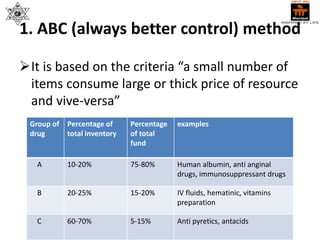
1. ABC (always better control) method
It is based on the criteria “a small number of
items consume large or thick price of resource
and vive-versa”
Group of
drug
Percentage of
total inventory
Percentage
of total
fund
examples
A 10-20% 75-80% Human albumin, anti anginal
drugs, immunosuppressant drugs
B 20-25% 15-20% IV fluids, hematinic, vitamins
preparation
C 60-70% 5-15% Anti pyretics, antacids
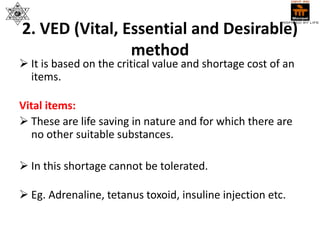
2. VED (Vital, Essential and Desirable)
method
 It is based on the critical value and shortage cost of an
items.
Vital items:
 These are life saving in nature and for which there are
no other suitable substances.
 In this shortage cannot be tolerated.
 Eg. Adrenaline, tetanus toxoid, insuline injection etc.
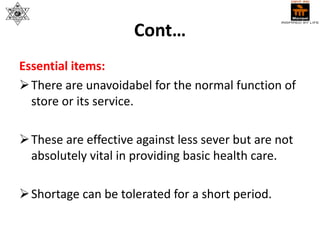
Cont…
Essential items:
There are unavoidabel for the normal function of
store or its service.
These are effective against less sever but are not
absolutely vital in providing basic health care.
Shortage can be tolerated for a short period.
Cont…
Desirable items:
These are required by pharmacy but they do
not affect the quality of service to patients.
They are used for minor or self limiting illness.
Shortage will not adversely affect but may be
using more resources.
3. EOQ (Economic Order Quantity)
Method
• It is the number of units per order to be
purchased which will minimize both carrying
cost and ordering cost.
• EOQ is the amount of inventory to be ordered
at one time for purposed of minimizing annual
inventory cost.
4. FIFO analysis
First-In, First-Out, is important for companies
that distribute products with expiration dates.
 It is a safe practice that ensures your products
will not expire or go bad.
 With FIFO, the oldest products are used or
picked first, ensuring product quality and
safety.
5. FEFO analysis
First Expired, First-Out, is similar to FIFO in
that items closest to the expiration will be
shipped first.
The “E” refers to the expiration date of the
product.
In order for the FEFO methodology to be used,
items must have serial or lot numbers on
them and the item has to be posted to
inventory with an expiration date.
References
1. https://www.slideshare.net/EdwardHilton2/a
n-introduction-to-fifo-lifo
2. https://www.slideshare.net/DivyaeSherry/ab
c-analysis-and-fifo-and-lifo-of-stanley-
furniture-hypothetical
3. https://www.unex.com/fifo-vs-fefo-whats-
the-difference/
1/18/2020 15

Inventory management

  • 1.
    Presentation On Inventory Management Shree Medicaland Technical college, Bharatpur-12, Chitwan Presented by: Sanjay kumar yadav B. Pharm., 8th sem.1/18/2020 1
  • 2.
    Table of content 1.Introduction 2. Objectives 3. Advantages of inventory management 4. Techniques of inventory management - ABC method - VED method - EOQ method - FIFO analysis - FEFO analysis 5. References
  • 3.
    Introduction  Inventory managementis the “Operation of contineously arranging receipt and issues in such a way to ensure that stock balance in quantity and value are adequate to support the current rate of consumption at all times, with due regard to economy.”  It defines as a proper control over maintenance of stock in store department.
  • 4.
    Objectives • Maintaining adequatestock so as to avoid production held up, loss of revenue and increase in cost at emergency. • To avoid excess investment in stock. • To operate hospital pharmacy at low cost. • To provide better service to patients by maintaining contineous supply of medicine. • To prevent shortage in supply and over-stocking of items. • Find the bulk discount while purchasing.
  • 5.
    Advantages of inventorymanagement Ensures an adequate supply of materials Minimizes inventory costs Facilitates purchasing economies Eliminates duplication in ordering Provides a check against the loss of materials Facilitates cost accounting activities Enables management in cost comparison
  • 6.
    Techniques of inventorymanagement 1. ABC method 2. VED method 3. EOQ method 4. FIFO analysis 5. FEFO analysis
  • 7.
    1. ABC (alwaysbetter control) method It is based on the criteria “a small number of items consume large or thick price of resource and vive-versa” Group of drug Percentage of total inventory Percentage of total fund examples A 10-20% 75-80% Human albumin, anti anginal drugs, immunosuppressant drugs B 20-25% 15-20% IV fluids, hematinic, vitamins preparation C 60-70% 5-15% Anti pyretics, antacids
  • 8.
    2. VED (Vital,Essential and Desirable) method  It is based on the critical value and shortage cost of an items. Vital items:  These are life saving in nature and for which there are no other suitable substances.  In this shortage cannot be tolerated.  Eg. Adrenaline, tetanus toxoid, insuline injection etc.
  • 9.
    Cont… Essential items: There areunavoidabel for the normal function of store or its service. These are effective against less sever but are not absolutely vital in providing basic health care. Shortage can be tolerated for a short period.
  • 10.
    Cont… Desirable items: These arerequired by pharmacy but they do not affect the quality of service to patients. They are used for minor or self limiting illness. Shortage will not adversely affect but may be using more resources.
  • 11.
    3. EOQ (EconomicOrder Quantity) Method • It is the number of units per order to be purchased which will minimize both carrying cost and ordering cost. • EOQ is the amount of inventory to be ordered at one time for purposed of minimizing annual inventory cost.
  • 12.
    4. FIFO analysis First-In,First-Out, is important for companies that distribute products with expiration dates.  It is a safe practice that ensures your products will not expire or go bad.  With FIFO, the oldest products are used or picked first, ensuring product quality and safety.
  • 13.
    5. FEFO analysis FirstExpired, First-Out, is similar to FIFO in that items closest to the expiration will be shipped first. The “E” refers to the expiration date of the product. In order for the FEFO methodology to be used, items must have serial or lot numbers on them and the item has to be posted to inventory with an expiration date.
  • 14.
  • 15.

Editor's Notes

  • #13  When products are picked for an order, newer arrived products slide forward from the back to replace the just-picked item. Replenishment occurs from the back of the shelves.
  • #14 The serial or lot-numbered items to be picked are sorted with the FEFO methodology, i.e. the items are listed in the order of expiration, so items closest to expiration are picked first. This is useful for pharmaceuticals and medical products that can expire quickly, but can cause significant issues if shipped past the expiration date.