Monetary Policy
Monetary Policy The process by which the government affects the economy by influencing the expansion of money and credit Carried out in Canada by the Bank of Canada
Easy and Tight Money Easy money: characterized by low interest rates, availability of credit and growth of money supply Used to curb a recession Tight money: characterized by high interest rates, difficulty in acquiring credit and a decrease of the money supply Used to restrain an economy in times of inflation
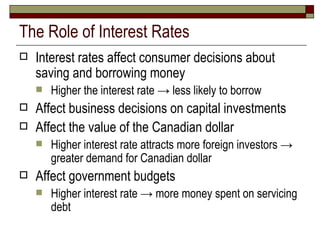
The Role of Interest Rates Interest rates affect consumer decisions about saving and borrowing money Higher the interest rate -> less likely to borrow Affect business decisions on capital investments Affect the value of the Canadian dollar Higher interest rate attracts more foreign investors -> greater demand for Canadian dollar Affect government budgets Higher interest rate -> more money spent on servicing debt
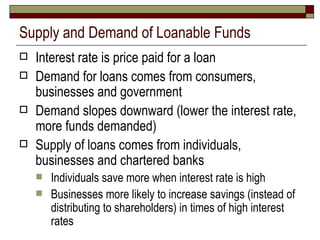
Supply and Demand of Loanable Funds Interest rate is price paid for a loan Demand for loans comes from consumers, businesses and government Demand slopes downward (lower the interest rate, more funds demanded) Supply of loans comes from individuals, businesses and chartered banks Individuals save more when interest rate is high Businesses more likely to increase savings (instead of distributing to shareholders) in times of high interest rates
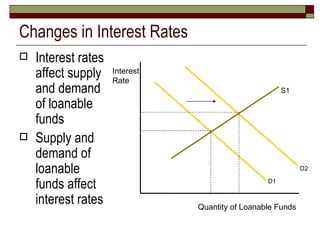
Changes in Interest Rates Interest rates affect supply and demand of loanable funds Supply and demand of loanable funds affect interest rates Quantity of Loanable Funds Interest Rate D1 D2 S1
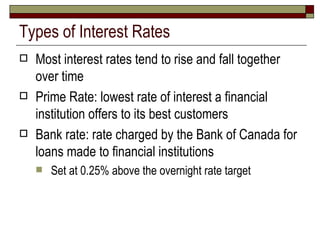
Types of Interest Rates Most interest rates tend to rise and fall together over time Prime Rate: lowest rate of interest a financial institution offers to its best customers Bank rate: rate charged by the Bank of Canada for loans made to financial institutions Set at 0.25% above the overnight rate target
Inflation Premium Built into interest rate charged Nominal rate: includes inflation premium and allowance for risk and creditworthiness  Real rate of interest = nominal rate of interest – expected rate of inflation
Canada’s Monetary Policy Two key points: Flexible exchange rate:  allows an independent monetary policy suited to the needs of our economy and acts as a "shock absorber."  Inflation-control target:  provides a precise goal against which to measure the conduct of monetary policy, increasing the Bank's public accountability.  Target between 1% to 3%
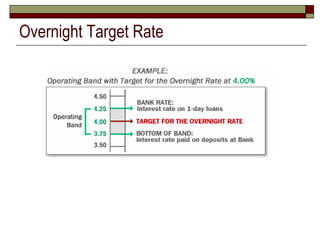
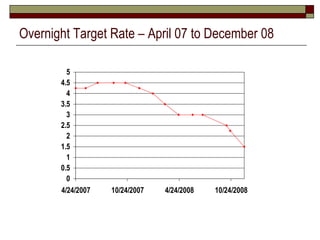
Tools of Monetary Policy The Overnight Target Rate Main tool of monetary policy The rate at which banks lend money to one another Midpoint of the operating band (interest rates within a 0.5% range)  low end of the bank is the rate the Bank of Canada pays on deposits High end is the rate the Bank of Canada charges on loans to banks If the rate increases, banks are encouraged to raise their interest rates, tightening the money supply Opposite is true for lowering the rate
Overnight Target Rate
Overnight Target Rate – April 07 to December 08
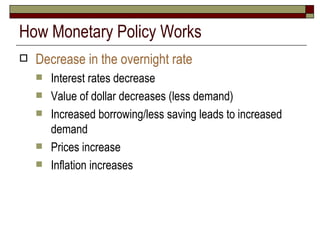
How Monetary Policy Works Decrease in the overnight rate Interest rates decrease Value of dollar decreases (less demand) Increased borrowing/less saving leads to increased demand Prices increase Inflation increases
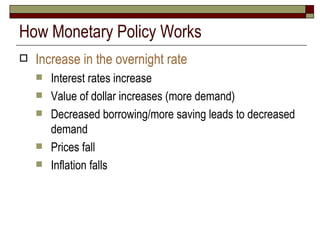
How Monetary Policy Works Increase in the overnight rate Interest rates increase Value of dollar increases (more demand) Decreased borrowing/more saving leads to decreased demand Prices fall Inflation falls
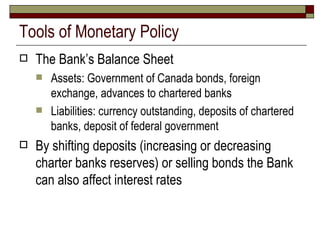
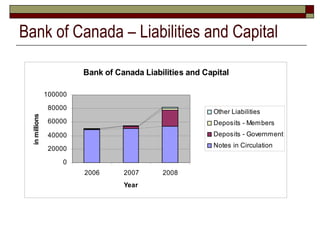
Tools of Monetary Policy The Bank’s Balance Sheet Assets: Government of Canada bonds, foreign exchange, advances to chartered banks Liabilities: currency outstanding, deposits of chartered banks, deposit of federal government By shifting deposits (increasing or decreasing charter banks reserves) or selling bonds the Bank can also affect interest rates
Quantitative Easing Marketplace video
Monetary Policy Variables Bank of Canada Statistics and Graphs
 
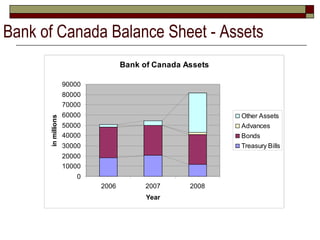
Bank of Canada Balance Sheet - Assets
Bank of Canada – Liabilities and Capital
Chairman game http:// www.frbsf.org/education/activities/chairman/index.html
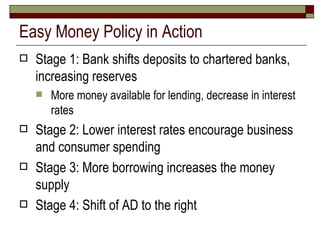
Easy Money Policy in Action Stage 1: Bank shifts deposits to chartered banks, increasing reserves More money available for lending, decrease in interest rates Stage 2: Lower interest rates encourage business and consumer spending Stage 3: More borrowing increases the money supply Stage 4: Shift of AD to the right
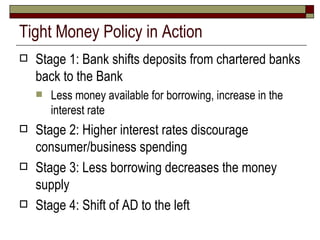
Tight Money Policy in Action Stage 1: Bank shifts deposits from chartered banks back to the Bank Less money available for borrowing, increase in the interest rate Stage 2: Higher interest rates discourage consumer/business spending Stage 3: Less borrowing decreases the money supply Stage 4: Shift of AD to the left

Monetary Policy

  • 1.
  • 2.
    Monetary Policy Theprocess by which the government affects the economy by influencing the expansion of money and credit Carried out in Canada by the Bank of Canada
  • 3.
    Easy and TightMoney Easy money: characterized by low interest rates, availability of credit and growth of money supply Used to curb a recession Tight money: characterized by high interest rates, difficulty in acquiring credit and a decrease of the money supply Used to restrain an economy in times of inflation
  • 4.
    The Role ofInterest Rates Interest rates affect consumer decisions about saving and borrowing money Higher the interest rate -> less likely to borrow Affect business decisions on capital investments Affect the value of the Canadian dollar Higher interest rate attracts more foreign investors -> greater demand for Canadian dollar Affect government budgets Higher interest rate -> more money spent on servicing debt
  • 5.
    Supply and Demandof Loanable Funds Interest rate is price paid for a loan Demand for loans comes from consumers, businesses and government Demand slopes downward (lower the interest rate, more funds demanded) Supply of loans comes from individuals, businesses and chartered banks Individuals save more when interest rate is high Businesses more likely to increase savings (instead of distributing to shareholders) in times of high interest rates
  • 6.
    Changes in InterestRates Interest rates affect supply and demand of loanable funds Supply and demand of loanable funds affect interest rates Quantity of Loanable Funds Interest Rate D1 D2 S1
  • 7.
    Types of InterestRates Most interest rates tend to rise and fall together over time Prime Rate: lowest rate of interest a financial institution offers to its best customers Bank rate: rate charged by the Bank of Canada for loans made to financial institutions Set at 0.25% above the overnight rate target
  • 8.
    Inflation Premium Builtinto interest rate charged Nominal rate: includes inflation premium and allowance for risk and creditworthiness Real rate of interest = nominal rate of interest – expected rate of inflation
  • 9.
    Canada’s Monetary PolicyTwo key points: Flexible exchange rate: allows an independent monetary policy suited to the needs of our economy and acts as a "shock absorber." Inflation-control target: provides a precise goal against which to measure the conduct of monetary policy, increasing the Bank's public accountability. Target between 1% to 3%
  • 10.
    Tools of MonetaryPolicy The Overnight Target Rate Main tool of monetary policy The rate at which banks lend money to one another Midpoint of the operating band (interest rates within a 0.5% range) low end of the bank is the rate the Bank of Canada pays on deposits High end is the rate the Bank of Canada charges on loans to banks If the rate increases, banks are encouraged to raise their interest rates, tightening the money supply Opposite is true for lowering the rate
  • 11.
  • 12.
    Overnight Target Rate– April 07 to December 08
  • 13.
    How Monetary PolicyWorks Decrease in the overnight rate Interest rates decrease Value of dollar decreases (less demand) Increased borrowing/less saving leads to increased demand Prices increase Inflation increases
  • 14.
    How Monetary PolicyWorks Increase in the overnight rate Interest rates increase Value of dollar increases (more demand) Decreased borrowing/more saving leads to decreased demand Prices fall Inflation falls
  • 15.
    Tools of MonetaryPolicy The Bank’s Balance Sheet Assets: Government of Canada bonds, foreign exchange, advances to chartered banks Liabilities: currency outstanding, deposits of chartered banks, deposit of federal government By shifting deposits (increasing or decreasing charter banks reserves) or selling bonds the Bank can also affect interest rates
  • 16.
  • 17.
    Monetary Policy VariablesBank of Canada Statistics and Graphs
  • 18.
  • 19.
    Bank of CanadaBalance Sheet - Assets
  • 20.
    Bank of Canada– Liabilities and Capital
  • 21.
    Chairman game http://www.frbsf.org/education/activities/chairman/index.html
  • 22.
    Easy Money Policyin Action Stage 1: Bank shifts deposits to chartered banks, increasing reserves More money available for lending, decrease in interest rates Stage 2: Lower interest rates encourage business and consumer spending Stage 3: More borrowing increases the money supply Stage 4: Shift of AD to the right
  • 23.
    Tight Money Policyin Action Stage 1: Bank shifts deposits from chartered banks back to the Bank Less money available for borrowing, increase in the interest rate Stage 2: Higher interest rates discourage consumer/business spending Stage 3: Less borrowing decreases the money supply Stage 4: Shift of AD to the left