Demand, Supply  and Equilibrium INSPIRING CREATIVE AND  INNOVATIVE  MINDS
Demand A market consists of: Buyers (demand) Sellers (supply) Exchange Effective demand =  the quantity of a commodity which consumers will purchase at a given price per time period.
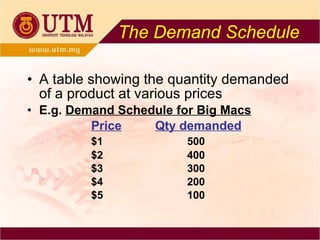
A table showing the quantity demanded of a product at various prices E.g.  Demand Schedule for Big Macs Price Qty demanded $1 500 $2 400 $3 300 $4 200 $5 100 The Demand Schedule
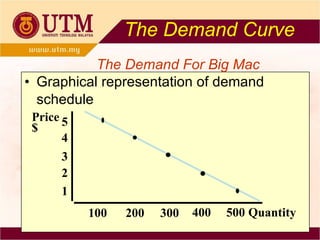
Graphical representation of demand schedule The Demand Curve Price Quantity $ 5 2 1 3 4 100 200 300 400 500 The Demand For Big Mac
The Law of Demand As price increases the quantity demanded decreases,  conversely , as price decreases the quantity demanded increases.
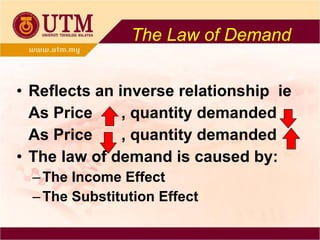
Reflects an inverse relationship  ie As Price    , quantity demanded As Price   , quantity demanded The law of demand is caused by: The Income Effect The Substitution Effect The Law of Demand
As prices increase, consumers will purchase fewer goods and services. Their  purchasing power   (or real income)  decreases Quantity demanded decreases. As prices decrease, the  purchasing power  of consumers increases Quantity demanded increases. The Income Effect
The Substitution Effect As prices increase, consumers  generally  purchase more of a substitute product whose price is lower. A  substitute product   is a product that performs a similar function and satisfies the same consumer need/want e.g.  Tea/ Coffee Butter/Margarine If the price of butter  increases , the quantity demanded will  fall  as consumers will  substitute  butter with margarine.
Supply Definition: the quantity of a product which producers offer to the market at a certain price per unit of time.
The Law of Supply As price increases the quantity supplied increases,  conversely as price decreases the quantity supplied decreases.
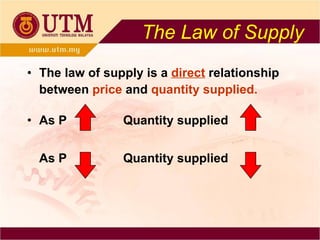
The law of supply is a  direct   relationship between  price   and  quantity supplied. As P Quantity supplied As P Quantity supplied The Law of Supply
The Logic of the law   of supply Producers will seek to maximise their profits. ie   Supplying more at higher prices and less at lower prices.
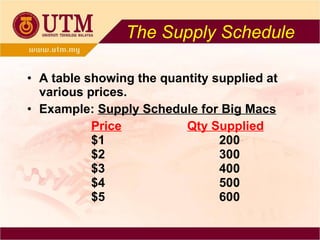
A table showing the quantity supplied at various prices. Example:  Supply Schedule for Big Macs Price Qty Supplied $1 200 $2 300 $3 400 $4 500 $5 600 The Supply Schedule
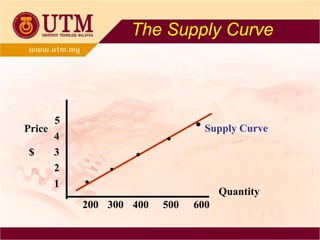
Price Quantity $ Supply Curve 1 2 3 4 5 200 300 400 500 600 The Supply Curve
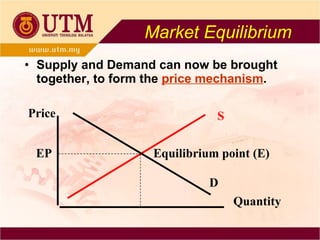
Supply and Demand can now be brought together, to form the  price mechanism . Price Quantity S D Equilibrium point (E) EP Market Equilibrium
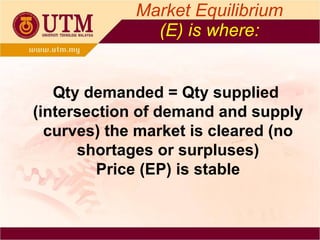
Market Equilibrium   (E) is where: Qty demanded = Qty supplied  (intersection of demand and supply curves) the market is cleared (no shortages or surpluses) Price (EP) is stable
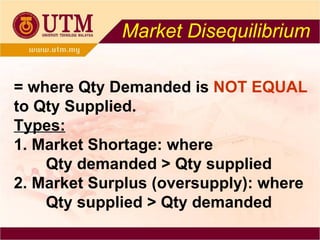
Market Disequilibrium = where Qty Demanded is  NOT EQUAL   to Qty Supplied. Types: 1. Market Shortage:  where Qty demanded > Qty supplied 2. Market Surplus (oversupply):  where Qty supplied > Qty demanded
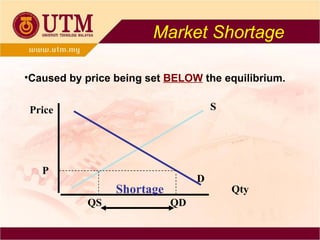
Price Qty S D P QS QD Shortage Market Shortage Caused by price being set  BELOW  the equilibrium.
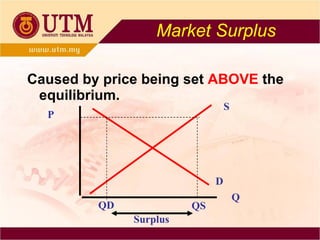
Caused by price being set  ABOVE   the equilibrium. P Q S D QD QS Surplus Market Surplus
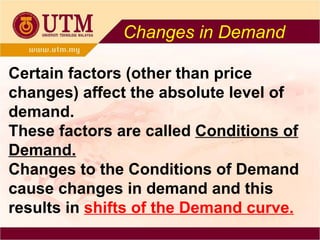
Changes in Demand Certain factors (other than price changes) affect the absolute level of demand. These factors are called  Conditions of Demand. Changes to the Conditions of Demand cause changes in demand and this results in  shifts of the Demand curve.
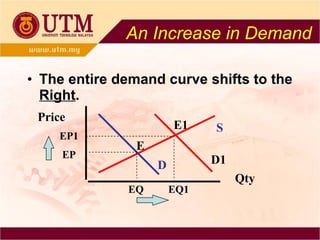
The entire demand curve shifts to the  Right . Qty Price D D1 S E E1 EP EP1 EQ EQ1 An Increase in Demand
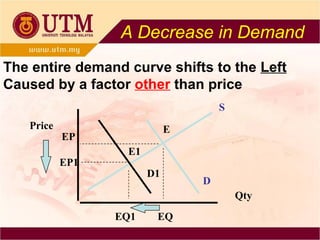
EQ1 EQ A Decrease in Demand The entire demand curve shifts to the  Left Caused by a factor   other   than price Price Qty S D D1 E E1 EP EP1
Conditions of Demand Change in tastes Improvements in Technology Real Income  Change in Population Change in the price of Substitutes A change in the price of other goods Expectations of the future Advertising
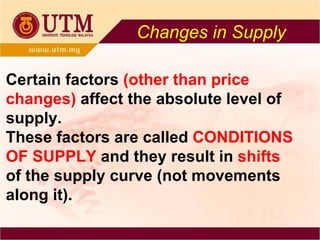
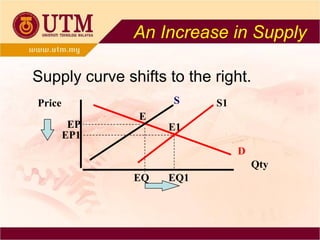
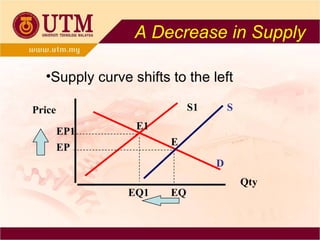
Changes in Supply Certain factors  (other than price   changes)  affect the absolute level of supply. These factors are called  CONDITIONS OF SUPPLY   and they result in  shifts  of the supply curve  (not movements along it).
Price Qty S D S1 E E1 EP EP1 EQ EQ1 An Increase in Supply Supply curve shifts to the right.
Price Qty S D S1 E E1 EP1 EP EQ1 EQ A Decrease in Supply Supply curve shifts to the left
Conditions of Supply Improvements in technology A change in production costs A change in the price of alternative  products Weather and seasons

Lecture3

  • 1.
    Demand, Supply and Equilibrium INSPIRING CREATIVE AND INNOVATIVE MINDS
  • 2.
    Demand A marketconsists of: Buyers (demand) Sellers (supply) Exchange Effective demand = the quantity of a commodity which consumers will purchase at a given price per time period.
  • 3.
    A table showingthe quantity demanded of a product at various prices E.g. Demand Schedule for Big Macs Price Qty demanded $1 500 $2 400 $3 300 $4 200 $5 100 The Demand Schedule
  • 4.
    Graphical representation ofdemand schedule The Demand Curve Price Quantity $ 5 2 1 3 4 100 200 300 400 500 The Demand For Big Mac
  • 5.
    The Law ofDemand As price increases the quantity demanded decreases, conversely , as price decreases the quantity demanded increases.
  • 6.
    Reflects an inverserelationship ie As Price , quantity demanded As Price , quantity demanded The law of demand is caused by: The Income Effect The Substitution Effect The Law of Demand
  • 7.
    As prices increase,consumers will purchase fewer goods and services. Their purchasing power (or real income) decreases Quantity demanded decreases. As prices decrease, the purchasing power of consumers increases Quantity demanded increases. The Income Effect
  • 8.
    The Substitution EffectAs prices increase, consumers generally purchase more of a substitute product whose price is lower. A substitute product is a product that performs a similar function and satisfies the same consumer need/want e.g. Tea/ Coffee Butter/Margarine If the price of butter increases , the quantity demanded will fall as consumers will substitute butter with margarine.
  • 9.
    Supply Definition: thequantity of a product which producers offer to the market at a certain price per unit of time.
  • 10.
    The Law ofSupply As price increases the quantity supplied increases, conversely as price decreases the quantity supplied decreases.
  • 11.
    The law ofsupply is a direct relationship between price and quantity supplied. As P Quantity supplied As P Quantity supplied The Law of Supply
  • 12.
    The Logic ofthe law of supply Producers will seek to maximise their profits. ie Supplying more at higher prices and less at lower prices.
  • 13.
    A table showingthe quantity supplied at various prices. Example: Supply Schedule for Big Macs Price Qty Supplied $1 200 $2 300 $3 400 $4 500 $5 600 The Supply Schedule
  • 14.
    Price Quantity $Supply Curve 1 2 3 4 5 200 300 400 500 600 The Supply Curve
  • 15.
    Supply and Demandcan now be brought together, to form the price mechanism . Price Quantity S D Equilibrium point (E) EP Market Equilibrium
  • 16.
    Market Equilibrium (E) is where: Qty demanded = Qty supplied (intersection of demand and supply curves) the market is cleared (no shortages or surpluses) Price (EP) is stable
  • 17.
    Market Disequilibrium =where Qty Demanded is NOT EQUAL to Qty Supplied. Types: 1. Market Shortage: where Qty demanded > Qty supplied 2. Market Surplus (oversupply): where Qty supplied > Qty demanded
  • 18.
    Price Qty SD P QS QD Shortage Market Shortage Caused by price being set BELOW the equilibrium.
  • 19.
    Caused by pricebeing set ABOVE the equilibrium. P Q S D QD QS Surplus Market Surplus
  • 20.
    Changes in DemandCertain factors (other than price changes) affect the absolute level of demand. These factors are called Conditions of Demand. Changes to the Conditions of Demand cause changes in demand and this results in shifts of the Demand curve.
  • 21.
    The entire demandcurve shifts to the Right . Qty Price D D1 S E E1 EP EP1 EQ EQ1 An Increase in Demand
  • 22.
    EQ1 EQ ADecrease in Demand The entire demand curve shifts to the Left Caused by a factor other than price Price Qty S D D1 E E1 EP EP1
  • 23.
    Conditions of DemandChange in tastes Improvements in Technology Real Income Change in Population Change in the price of Substitutes A change in the price of other goods Expectations of the future Advertising
  • 24.
    Changes in SupplyCertain factors (other than price changes) affect the absolute level of supply. These factors are called CONDITIONS OF SUPPLY and they result in shifts of the supply curve (not movements along it).
  • 25.
    Price Qty SD S1 E E1 EP EP1 EQ EQ1 An Increase in Supply Supply curve shifts to the right.
  • 26.
    Price Qty SD S1 E E1 EP1 EP EQ1 EQ A Decrease in Supply Supply curve shifts to the left
  • 27.
    Conditions of SupplyImprovements in technology A change in production costs A change in the price of alternative products Weather and seasons

Editor's Notes