Personal Finance
What is Money? What is Money clip
What is money? A form of legal tender that is an accepted form of payment in exchange for goods and services. Coins Paper Bills Cheques and credit cards are not legal tender! Stores are not required to accept them as payment.
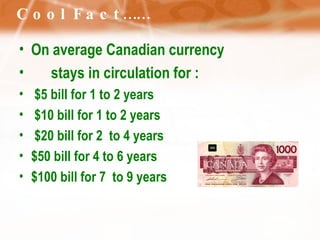
Cool Fact…… On average Canadian currency  stays in circulation for : $5 bill for 1 to 2 years  $10 bill for 1 to 2 years  $20 bill for 2  to 4 years $50 bill for 4 to 6 years  $100 bill for 7  to 9 years
Functions of Money Medium of Exchange No need to barter Standard of Value  Measured in dollars Store of Value Can be used at a later date
How do we earn money? Allowances Money paid for performing certain tasks (usually at home) Employment Income Money paid for work performed on the job Savings and Investment Income Interest and Capital Gains
Types of Income Gross pay: the total amount of money earned Net pay: the total amount received after deductions Disposable Income: Amount of income left after taxes have been paid.  Discretionary income: The amount of an individual's income available for spending after the essentials (such as food, clothing, and shelter) have been paid.
Introduction Don't buy stuff
Spending Fixed expenses: Those bills you have to pay and that tend to be the same amount month-to-month or year-to-year.  Variable expenses: The amounts that vary from month to month and over which you have some control.  Spending may be planned or impulsive
Budgeting Phase 1:  Assess your personal and financial situation (needs, values, life situation). Phase 2:  Set personal and financial goals. Phase 3:  Create a budget for fixed and variable expenses based on projected income. Phase 4:  Monitor current spending (saving, investing) patterns. Phase 5:  Compare your budget to what you have actually spent. Phase 6:  Review financial progress and revise budgeted amounts.
Goal Setting Be Realistic A student working part-time is not likely to be able to afford a new car every couple of years. Be Stated in Specifics “ I plan/want to save $5,000 for a down payment to buy a house.” Have a Time Frame “ I plan/want to pay off my credit card within the next 18 months.” State the Action to be Taken “ I plan/want to start an automatic deposit savings account with monthly withdrawals from my checking account.”
Taxes Canada has a progressive income tax system – the more money you make, the higher percentage of your income you pay in taxes People pay both federal and provincial income taxes CPP Contributions: 4.95% to a maximum of $2,118.60 EI Contributions: 1.73% to a maximum of 731.79
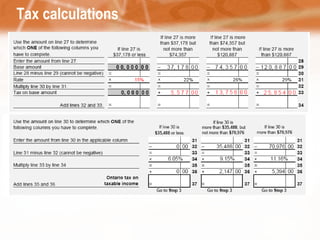
Tax calculations
Housing – Renting vs. Buying How often do you expect to move in the future?  If you plan on moving a lot, renting is a better idea How stable is you employment situation?  If you employment is not stable, don’t buy a house How much can you afford to pay for housing?  most mortgage companies will only allow your housing costs to equal 33% of your gross income.  Housing costs may include your rent or mortgage payment, property taxes, utilities, and 50% of condo fees if applicable. In addition, if your total debt servicing costs (housing costs plus all of your other monthly debt payments) exceed 40% of your gross income you won't qualify for a mortgage.
Why do people save? People save money so that they can: Buy large items, such as a home or a car.  Handle surprises and emergencies. Retire in comfort. When you stop working, you may live mostly on your savings. Most people need to save many years to have enough money.  Help family and loved ones.  Remember: Saving is a habit
How much should I save? Your amount of savings depends on your family situation, amount of debt (particularly high interest debt) and future plans Experts recommend having, at minimum, enough money saved to cover one month of essential expenses (fixed expenses, food, etc.) If you have high interest debt, aim for the minimum savings amount and use the rest to pay off debt. If you have little to no debt, other than mortgage debt, save three to six months worth of expenses.
Where should I store my money? You want your savings to be liquid enough to access in an emergency but not too easily accessed or you might spend it. Your savings account should: Pay decent interest,  Be devoid of fees,  Not be too easy to access, and  Not be too difficult to access.  Pay yourself first – create an automatic withdrawal from you chequing account at least once a month.
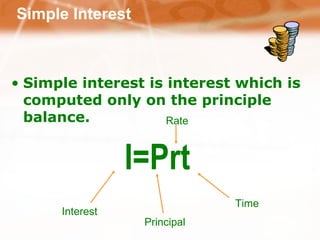
Simple Interest Simple interest is interest  which is computed only on the principle balance . I=Prt Interest Principal Rate Time
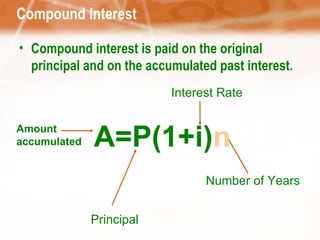
Compound Interest Compound interest is paid on the original principal and on the accumulated past interest.  Principal Interest Rate Number of Years Amount accumulated A=P(1+i) n
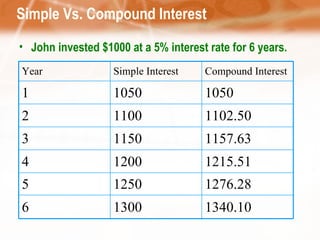
Simple Vs. Compound Interest John invested $1000 at a 5% interest rate for 6 years.  Year Simple Interest Compound Interest 1 1050 1050 2 1100 1102.50 3 1150 1157.63 4 1200 1215.51 5 1250 1276.28 6 1300 1340.10
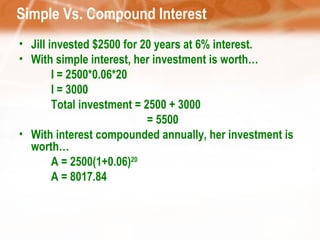
Simple Vs. Compound Interest  Jill invested $2500 for 20 years at 6% interest. With simple interest, her investment is worth… I = 2500*0.06*20 I = 3000 Total investment = 2500 + 3000 = 5500 With interest compounded annually, her investment is worth… A = 2500(1+0.06) 20 A = 8017.84
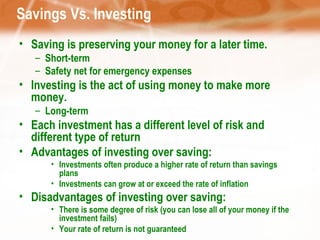
Savings Vs. Investing Saving is preserving your money for a later time. Short-term Safety net for emergency expenses Investing is t he act of using money to make more money.  Long-term Each investment has a different level of risk and different type of return Advantages of investing over saving: Investments often produce a higher rate of return than savings plans Investments can grow at or exceed the rate of inflation Disadvantages of investing over saving: There is some degree of risk (you can lose all of your money if the investment fails) Your rate of return is not guaranteed
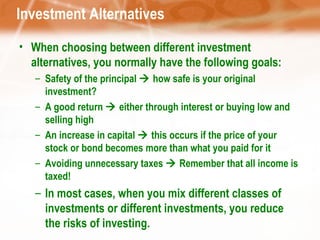
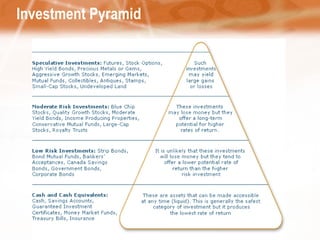
Investment Alternatives When choosing between different investment alternatives, you normally have the following goals: Safety of the principal    how safe is your original investment? A good return    either through interest or buying low and selling high An increase in capital    this occurs if the price of your stock or bond becomes more than what you paid for it Avoiding unnecessary taxes    Remember that all income is taxed! In most cases, when you mix different classes of investments or different investments, you reduce the risks of investing.
Investment Pyramid
Credit The privilege of using someone else’s money for a period of time “ Buy now, pay later” A  creditor  is any person or business who grants a loan or sells on credit A  debtor  is any person or business that buys on credit or receives a loan
Learning About Credit Credit Video
Credit Responsibilities Borrow only what you can repay. Read and understand the credit contract. Pay debts promptly. Notify creditor if you cannot meet payments. Report lost or stolen credit cards promptly. Never give your card number over the phone unless you initiated the call or are certain of the caller’s identity.
How much can you borrow? Never borrow more than 20% of your yearly net income Monthly payments shouldn’t exceed 10% of your monthly net income
Advantages and Disadvantages of Credit Advantages: Able to buy needed items now Don’t have to carry cash Creates a record of purchases More convenient than writing checks Consolidates bills into one payment Builds a credit history Disadvantages: Interest (higher cost of items) May require additional fees Financial difficulties may arise if one loses track of how much has been spent each month Increased impulse buying may occur
How Credit Cards Work Credit Card Debt http://www.ic.gc.ca/epic/site/oca-bc.nsf/en/ca01812e.html
Types of Credit Charge Accounts A contract between a consumer and a retailer for sales in the retailer’s stores Can only use the cards at the issuing store Credit Cards Revolving credit accounts with a set credit limit Monthly payments are required Interest is paid on the balance
Types of Credit Installment Sales Credit A credit plan that requires the purchaser to make a down payment and fixed regular payments with financing (interest) charges added to the purchase price The seller retains ownership until the product is paid in full Eg.  Purchasing a car
Types of Credit Consumer Loans Loans from financial institutions Term Loans  – the borrower agrees to make fixed monthly payments over a set period of time including interest  Includes leasing Demand Loans  – the borrower can repay the loan at any time before the due date with interest  Mortgage Loans A long-term credit plan for buying property 20-25 years for re-payment The property is the collateral for the loan Student Loans  – Granted by the government to help with the rising cost of college / university
What to do when you have debt You must face the enemy:   Tell others about your debt. If you're in "over your head" with credit-card debt, cut up your cards now. If necessary, keep one card for emergencies. Call your one remaining credit card company and ask them to lower your limit to a level that's adequate for emergencies — and nothing else. Pay as much as you can each month — and always pay more than the minimum.  Pay off the card with the highest interest rate first, and the rest in descending order. Always manage your cards to provide the lowest interest rates, switching cards every six months if necessary. Make a point to understand all the inner workings of your card(s) − fees, grace periods, everything.  Honour all debts equally − whether you owe the money to Mastercard or a family member.  Once you pay off one card, you must apply that card's payment toward your next highest-rate card.  If you really cannot accomplish this yourself, enlist the aid of outside agencies.  Make sure to never let this happen again  Once all debts are paid off, apply the payment money toward your future.
Building a Credit History Establish a steady work record. Pay all bills promptly. Open a checking account and don’t bounce checks. Open a savings account and make regular deposits. Apply for a local store credit card and make regular monthly payments. Apply for a small loan using your savings account as collateral. Get a co-signer on a loan and pay back the loan as agreed.
The Three Cs of Credit Character - will you repay the debt? refers to an individual’s personal reliability is capable of holding a regular job for a reasonable length of time has been reliable at that particular job has a particular job skill is willing to accept financial responsibility has a bank account has stability in current address
3 Cs of Credit Capacity - can you repay the debt? refers to the applicant’s ability to repay the loan can offer assurance his or her present job and income level are likely to last into the future is able to meet all other debts and obligations – household bills, food, car payment, mortgage, rent, etc.

Personal Finance

  • 1.
  • 2.
    What is Money?What is Money clip
  • 3.
    What is money?A form of legal tender that is an accepted form of payment in exchange for goods and services. Coins Paper Bills Cheques and credit cards are not legal tender! Stores are not required to accept them as payment.
  • 4.
    Cool Fact…… Onaverage Canadian currency stays in circulation for : $5 bill for 1 to 2 years $10 bill for 1 to 2 years $20 bill for 2 to 4 years $50 bill for 4 to 6 years $100 bill for 7 to 9 years
  • 5.
    Functions of MoneyMedium of Exchange No need to barter Standard of Value Measured in dollars Store of Value Can be used at a later date
  • 6.
    How do weearn money? Allowances Money paid for performing certain tasks (usually at home) Employment Income Money paid for work performed on the job Savings and Investment Income Interest and Capital Gains
  • 7.
    Types of IncomeGross pay: the total amount of money earned Net pay: the total amount received after deductions Disposable Income: Amount of income left after taxes have been paid. Discretionary income: The amount of an individual's income available for spending after the essentials (such as food, clothing, and shelter) have been paid.
  • 8.
  • 9.
    Spending Fixed expenses:Those bills you have to pay and that tend to be the same amount month-to-month or year-to-year. Variable expenses: The amounts that vary from month to month and over which you have some control. Spending may be planned or impulsive
  • 10.
    Budgeting Phase 1: Assess your personal and financial situation (needs, values, life situation). Phase 2: Set personal and financial goals. Phase 3: Create a budget for fixed and variable expenses based on projected income. Phase 4: Monitor current spending (saving, investing) patterns. Phase 5: Compare your budget to what you have actually spent. Phase 6: Review financial progress and revise budgeted amounts.
  • 11.
    Goal Setting BeRealistic A student working part-time is not likely to be able to afford a new car every couple of years. Be Stated in Specifics “ I plan/want to save $5,000 for a down payment to buy a house.” Have a Time Frame “ I plan/want to pay off my credit card within the next 18 months.” State the Action to be Taken “ I plan/want to start an automatic deposit savings account with monthly withdrawals from my checking account.”
  • 12.
    Taxes Canada hasa progressive income tax system – the more money you make, the higher percentage of your income you pay in taxes People pay both federal and provincial income taxes CPP Contributions: 4.95% to a maximum of $2,118.60 EI Contributions: 1.73% to a maximum of 731.79
  • 13.
  • 14.
    Housing – Rentingvs. Buying How often do you expect to move in the future? If you plan on moving a lot, renting is a better idea How stable is you employment situation? If you employment is not stable, don’t buy a house How much can you afford to pay for housing? most mortgage companies will only allow your housing costs to equal 33% of your gross income. Housing costs may include your rent or mortgage payment, property taxes, utilities, and 50% of condo fees if applicable. In addition, if your total debt servicing costs (housing costs plus all of your other monthly debt payments) exceed 40% of your gross income you won't qualify for a mortgage.
  • 15.
    Why do peoplesave? People save money so that they can: Buy large items, such as a home or a car. Handle surprises and emergencies. Retire in comfort. When you stop working, you may live mostly on your savings. Most people need to save many years to have enough money. Help family and loved ones. Remember: Saving is a habit
  • 16.
    How much shouldI save? Your amount of savings depends on your family situation, amount of debt (particularly high interest debt) and future plans Experts recommend having, at minimum, enough money saved to cover one month of essential expenses (fixed expenses, food, etc.) If you have high interest debt, aim for the minimum savings amount and use the rest to pay off debt. If you have little to no debt, other than mortgage debt, save three to six months worth of expenses.
  • 17.
    Where should Istore my money? You want your savings to be liquid enough to access in an emergency but not too easily accessed or you might spend it. Your savings account should: Pay decent interest, Be devoid of fees, Not be too easy to access, and Not be too difficult to access. Pay yourself first – create an automatic withdrawal from you chequing account at least once a month.
  • 18.
    Simple Interest Simpleinterest is interest which is computed only on the principle balance . I=Prt Interest Principal Rate Time
  • 19.
    Compound Interest Compoundinterest is paid on the original principal and on the accumulated past interest. Principal Interest Rate Number of Years Amount accumulated A=P(1+i) n
  • 20.
    Simple Vs. CompoundInterest John invested $1000 at a 5% interest rate for 6 years. Year Simple Interest Compound Interest 1 1050 1050 2 1100 1102.50 3 1150 1157.63 4 1200 1215.51 5 1250 1276.28 6 1300 1340.10
  • 21.
    Simple Vs. CompoundInterest Jill invested $2500 for 20 years at 6% interest. With simple interest, her investment is worth… I = 2500*0.06*20 I = 3000 Total investment = 2500 + 3000 = 5500 With interest compounded annually, her investment is worth… A = 2500(1+0.06) 20 A = 8017.84
  • 22.
    Savings Vs. InvestingSaving is preserving your money for a later time. Short-term Safety net for emergency expenses Investing is t he act of using money to make more money. Long-term Each investment has a different level of risk and different type of return Advantages of investing over saving: Investments often produce a higher rate of return than savings plans Investments can grow at or exceed the rate of inflation Disadvantages of investing over saving: There is some degree of risk (you can lose all of your money if the investment fails) Your rate of return is not guaranteed
  • 23.
    Investment Alternatives Whenchoosing between different investment alternatives, you normally have the following goals: Safety of the principal  how safe is your original investment? A good return  either through interest or buying low and selling high An increase in capital  this occurs if the price of your stock or bond becomes more than what you paid for it Avoiding unnecessary taxes  Remember that all income is taxed! In most cases, when you mix different classes of investments or different investments, you reduce the risks of investing.
  • 24.
  • 25.
    Credit The privilegeof using someone else’s money for a period of time “ Buy now, pay later” A creditor is any person or business who grants a loan or sells on credit A debtor is any person or business that buys on credit or receives a loan
  • 26.
  • 27.
    Credit Responsibilities Borrowonly what you can repay. Read and understand the credit contract. Pay debts promptly. Notify creditor if you cannot meet payments. Report lost or stolen credit cards promptly. Never give your card number over the phone unless you initiated the call or are certain of the caller’s identity.
  • 28.
    How much canyou borrow? Never borrow more than 20% of your yearly net income Monthly payments shouldn’t exceed 10% of your monthly net income
  • 29.
    Advantages and Disadvantagesof Credit Advantages: Able to buy needed items now Don’t have to carry cash Creates a record of purchases More convenient than writing checks Consolidates bills into one payment Builds a credit history Disadvantages: Interest (higher cost of items) May require additional fees Financial difficulties may arise if one loses track of how much has been spent each month Increased impulse buying may occur
  • 30.
    How Credit CardsWork Credit Card Debt http://www.ic.gc.ca/epic/site/oca-bc.nsf/en/ca01812e.html
  • 31.
    Types of CreditCharge Accounts A contract between a consumer and a retailer for sales in the retailer’s stores Can only use the cards at the issuing store Credit Cards Revolving credit accounts with a set credit limit Monthly payments are required Interest is paid on the balance
  • 32.
    Types of CreditInstallment Sales Credit A credit plan that requires the purchaser to make a down payment and fixed regular payments with financing (interest) charges added to the purchase price The seller retains ownership until the product is paid in full Eg. Purchasing a car
  • 33.
    Types of CreditConsumer Loans Loans from financial institutions Term Loans – the borrower agrees to make fixed monthly payments over a set period of time including interest Includes leasing Demand Loans – the borrower can repay the loan at any time before the due date with interest Mortgage Loans A long-term credit plan for buying property 20-25 years for re-payment The property is the collateral for the loan Student Loans – Granted by the government to help with the rising cost of college / university
  • 34.
    What to dowhen you have debt You must face the enemy:   Tell others about your debt. If you're in "over your head" with credit-card debt, cut up your cards now. If necessary, keep one card for emergencies. Call your one remaining credit card company and ask them to lower your limit to a level that's adequate for emergencies — and nothing else. Pay as much as you can each month — and always pay more than the minimum. Pay off the card with the highest interest rate first, and the rest in descending order. Always manage your cards to provide the lowest interest rates, switching cards every six months if necessary. Make a point to understand all the inner workings of your card(s) − fees, grace periods, everything. Honour all debts equally − whether you owe the money to Mastercard or a family member. Once you pay off one card, you must apply that card's payment toward your next highest-rate card. If you really cannot accomplish this yourself, enlist the aid of outside agencies. Make sure to never let this happen again Once all debts are paid off, apply the payment money toward your future.
  • 35.
    Building a CreditHistory Establish a steady work record. Pay all bills promptly. Open a checking account and don’t bounce checks. Open a savings account and make regular deposits. Apply for a local store credit card and make regular monthly payments. Apply for a small loan using your savings account as collateral. Get a co-signer on a loan and pay back the loan as agreed.
  • 36.
    The Three Csof Credit Character - will you repay the debt? refers to an individual’s personal reliability is capable of holding a regular job for a reasonable length of time has been reliable at that particular job has a particular job skill is willing to accept financial responsibility has a bank account has stability in current address
  • 37.
    3 Cs ofCredit Capacity - can you repay the debt? refers to the applicant’s ability to repay the loan can offer assurance his or her present job and income level are likely to last into the future is able to meet all other debts and obligations – household bills, food, car payment, mortgage, rent, etc.