Corporations
Characteristics of Corporations Separate legal entity Limited liability of shareholders Ownership rights are transferable Continuous life Shareholders are not corporate agents Ease of capital accumulation Governmental regulation Corporate taxation
Procedures The company: obtains a certificate of incorporation from the federal or provincial government,  sells shares to its subscribers,  elects a board of directors and  establishes a set of bylaws regarding the internal activities of the corporation .
Board of Directors Corporate management includes a board of directors who are elected at the company's annual shareholders' meeting by the shareholders who have one vote for each share of stock owned. In practice, many shareholders delegate their voting rights to an agent by signing a legal document called a proxy. The board of directors has final authority for corporate affairs: however, the board usually limits itself to establishing policy and delegates daily business decisions to the administrative officers.
Financial Statements Income Statement: Income tax expense occurs in a corporation. Net income in a corporation means  income after tax. Statement of Retained Earnings: Statement of Retained Earnings replaces Statement of Changes in Owner’s Equity from a proprietorship. Measures changes resulting from Net Income (increases to Retained Earnings) and Dividends (decreases to Retained Earnings).  Information about shareholders’ investments not included  Balance Sheet: Shareholders’ equity in a corporation is divided into Share Capital  (shareholder’s investments) and Retained Earnings (from Statement of Retained Earnings).  Total shareholders’ equity is the sum of these two categories.
Organizational Costs Any setup charges such as legal fees or promoter's fees are called organization costs and will be treated as an intangible asset to be amortized over any reasonable period or not more than 40 years.  One half of this cost may be expensed for tax purposes at a 10% declining-balance basis.
Share Capital Market value per share—the price at which a shares are bought or sold.  Influenced by expected future earnings, dividends, growth, and other company and economic events. The buying and selling of shares between investors does not impact the corporation’s shareholders’ equity accounts .
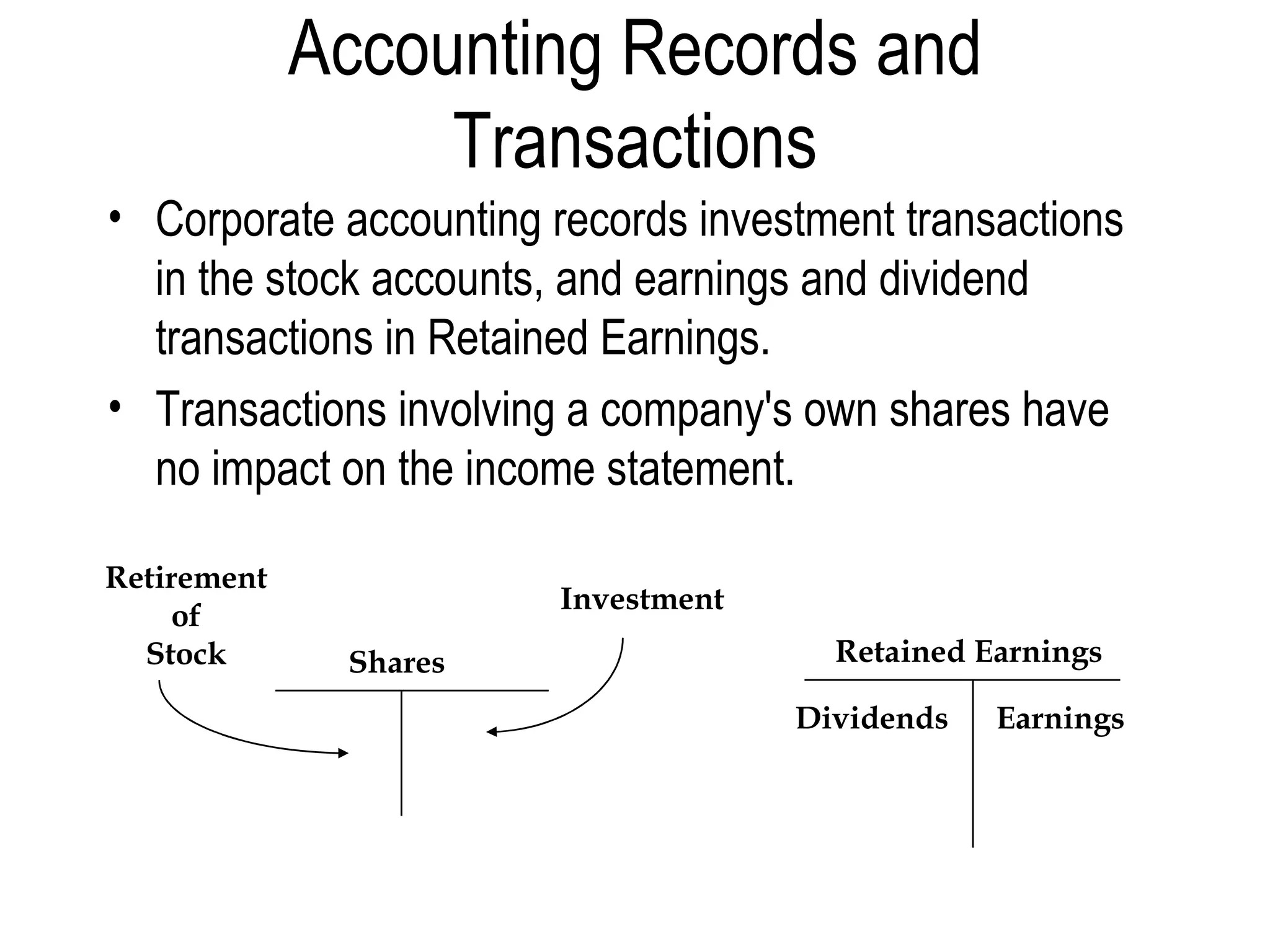
Accounting Records and Transactions Corporate accounting records investment transactions in the stock accounts, and earnings and dividend transactions in Retained Earnings. Transactions involving a company's own shares have no impact on the income statement. Investment Shares Retirement of Stock Retained Earnings Earnings Dividends
Investments Shares are commonly issued in exchange for cash. Example: Assume on June 5, Dillon Snowboards’ issued 30,000 common shares at $10 per share for a total of  $300,000. Cash 300,000   Common Shares 300,000 To record issuance of 30,000 common shares
Non-cash Assets A corporation can receive assets other than cash in exchange for its shares. The corporation records the assets acquired at the assets’ fair market value as of the date of the transaction. Example: Land valued at $105,000 is exchanged for 4,000 common shares. Land 105,000   Common Shares 105,000 To record issuance of 4,000 common shares
Preferred Shares Preferred shares, another class of corporation shares Preferred shares often include a preference for payment of dividends and sometimes for distribution of assets in liquidation. A separate account is used to record preferred shares. Example: Assume Dillon Snowboards’ issued 5,000 preferred shares at $25 per share for a total of  $125,000. Cash 125,000   Preferred Shares 125,000 To record issuance of 5,000 preferred shares
Dividends Distribution of earnings. Cause Retained Earnings to decrease. To pay a cash dividend the corporation must have a sufficient balance in retained earnings and the cash necessary to pay the dividend. Regular cash dividends provide a return to investors and almost always affect the stock’s market value. Three important dates: Date of declaration: Record liability for dividend Date of record: No entry recorded Date of payment: Record payment of cash to shareholders
Example – Method One Example – Directors declare a $1 dividend on 5,000 outstanding common shares. When the dividend is paid, the following journal entry is required: Retained Earnings 5,000   Dividend Payable 5,000 To record dividend declared on common shares. Dividend Payable  5,000   Cash 5,000 To record payment of dividend.
Example – Method Two Directors declare a $1 dividend on 5,000 outstanding common shares. When the dividend is paid, the following journal entry is required: At the end of the period another entry is required: Cash Dividends Declared 5,000   Dividend Payable 5,000 To record dividend declared on common shares. Dividend Payable  5,000   Cash 5,000 To record payment of dividend. Retained Earnings  5,000   Cash Dividends Declared 5,000 To record payment of dividend.
Preferred Dividends Preferred dividends are generally limited to a fixed amount and must be paid before the common shareholder may receive dividends. The Balance Sheet Equity section discloses the dividend either as a percentage or as a stated amount per share .
Cumulative Preferred Shares  Cumulative preferred shares entitles preferred shareholders to receive all of their past as well as current dividends before the common shareholders may receive any dividends.  Non-cumulative preferred shares are entitled to only the current dividends if declared and has no claim to any previous period's dividends which were not declared. Unpaid dividends, called dividends in arrears, appear on the balance sheet only when declared; however, a footnote is required to disclose these amounts.
Participating Preferred Shares Participating preferred shares may entitle the preferred shareholders to additional dividends in excess of their stated amount.  If the preferred shares are $9 fully participating, and the common shareholders receive a $12 dividend on their shares, the preferred shareholders are entitled to an additional $3 bringing the dividend for both classes of shares to $12.
Convertible Preferred Shares Convertible preferred shares carry a right to exchange preferred shares for a fixed number of common shares. This conversion privilege offers a shareholder a higher potential for return.
Why Preferred Shares Are Issued A major purpose for issuing preferred shares is leverage for the common shareholder.  It is a way to raise capital without sharing control.  The preferred shareholder earns a fixed return and any excess (or deficit) in profits is a return to the common shareholder.

Corporations

  • 1.
  • 2.
    Characteristics of CorporationsSeparate legal entity Limited liability of shareholders Ownership rights are transferable Continuous life Shareholders are not corporate agents Ease of capital accumulation Governmental regulation Corporate taxation
  • 3.
    Procedures The company:obtains a certificate of incorporation from the federal or provincial government, sells shares to its subscribers, elects a board of directors and establishes a set of bylaws regarding the internal activities of the corporation .
  • 4.
    Board of DirectorsCorporate management includes a board of directors who are elected at the company's annual shareholders' meeting by the shareholders who have one vote for each share of stock owned. In practice, many shareholders delegate their voting rights to an agent by signing a legal document called a proxy. The board of directors has final authority for corporate affairs: however, the board usually limits itself to establishing policy and delegates daily business decisions to the administrative officers.
  • 5.
    Financial Statements IncomeStatement: Income tax expense occurs in a corporation. Net income in a corporation means income after tax. Statement of Retained Earnings: Statement of Retained Earnings replaces Statement of Changes in Owner’s Equity from a proprietorship. Measures changes resulting from Net Income (increases to Retained Earnings) and Dividends (decreases to Retained Earnings). Information about shareholders’ investments not included Balance Sheet: Shareholders’ equity in a corporation is divided into Share Capital (shareholder’s investments) and Retained Earnings (from Statement of Retained Earnings). Total shareholders’ equity is the sum of these two categories.
  • 6.
    Organizational Costs Anysetup charges such as legal fees or promoter's fees are called organization costs and will be treated as an intangible asset to be amortized over any reasonable period or not more than 40 years. One half of this cost may be expensed for tax purposes at a 10% declining-balance basis.
  • 7.
    Share Capital Marketvalue per share—the price at which a shares are bought or sold. Influenced by expected future earnings, dividends, growth, and other company and economic events. The buying and selling of shares between investors does not impact the corporation’s shareholders’ equity accounts .
  • 8.
    Accounting Records andTransactions Corporate accounting records investment transactions in the stock accounts, and earnings and dividend transactions in Retained Earnings. Transactions involving a company's own shares have no impact on the income statement. Investment Shares Retirement of Stock Retained Earnings Earnings Dividends
  • 9.
    Investments Shares arecommonly issued in exchange for cash. Example: Assume on June 5, Dillon Snowboards’ issued 30,000 common shares at $10 per share for a total of $300,000. Cash 300,000 Common Shares 300,000 To record issuance of 30,000 common shares
  • 10.
    Non-cash Assets Acorporation can receive assets other than cash in exchange for its shares. The corporation records the assets acquired at the assets’ fair market value as of the date of the transaction. Example: Land valued at $105,000 is exchanged for 4,000 common shares. Land 105,000 Common Shares 105,000 To record issuance of 4,000 common shares
  • 11.
    Preferred Shares Preferredshares, another class of corporation shares Preferred shares often include a preference for payment of dividends and sometimes for distribution of assets in liquidation. A separate account is used to record preferred shares. Example: Assume Dillon Snowboards’ issued 5,000 preferred shares at $25 per share for a total of $125,000. Cash 125,000 Preferred Shares 125,000 To record issuance of 5,000 preferred shares
  • 12.
    Dividends Distribution ofearnings. Cause Retained Earnings to decrease. To pay a cash dividend the corporation must have a sufficient balance in retained earnings and the cash necessary to pay the dividend. Regular cash dividends provide a return to investors and almost always affect the stock’s market value. Three important dates: Date of declaration: Record liability for dividend Date of record: No entry recorded Date of payment: Record payment of cash to shareholders
  • 13.
    Example – MethodOne Example – Directors declare a $1 dividend on 5,000 outstanding common shares. When the dividend is paid, the following journal entry is required: Retained Earnings 5,000 Dividend Payable 5,000 To record dividend declared on common shares. Dividend Payable 5,000 Cash 5,000 To record payment of dividend.
  • 14.
    Example – MethodTwo Directors declare a $1 dividend on 5,000 outstanding common shares. When the dividend is paid, the following journal entry is required: At the end of the period another entry is required: Cash Dividends Declared 5,000 Dividend Payable 5,000 To record dividend declared on common shares. Dividend Payable 5,000 Cash 5,000 To record payment of dividend. Retained Earnings 5,000 Cash Dividends Declared 5,000 To record payment of dividend.
  • 15.
    Preferred Dividends Preferreddividends are generally limited to a fixed amount and must be paid before the common shareholder may receive dividends. The Balance Sheet Equity section discloses the dividend either as a percentage or as a stated amount per share .
  • 16.
    Cumulative Preferred Shares Cumulative preferred shares entitles preferred shareholders to receive all of their past as well as current dividends before the common shareholders may receive any dividends. Non-cumulative preferred shares are entitled to only the current dividends if declared and has no claim to any previous period's dividends which were not declared. Unpaid dividends, called dividends in arrears, appear on the balance sheet only when declared; however, a footnote is required to disclose these amounts.
  • 17.
    Participating Preferred SharesParticipating preferred shares may entitle the preferred shareholders to additional dividends in excess of their stated amount. If the preferred shares are $9 fully participating, and the common shareholders receive a $12 dividend on their shares, the preferred shareholders are entitled to an additional $3 bringing the dividend for both classes of shares to $12.
  • 18.
    Convertible Preferred SharesConvertible preferred shares carry a right to exchange preferred shares for a fixed number of common shares. This conversion privilege offers a shareholder a higher potential for return.
  • 19.
    Why Preferred SharesAre Issued A major purpose for issuing preferred shares is leverage for the common shareholder. It is a way to raise capital without sharing control. The preferred shareholder earns a fixed return and any excess (or deficit) in profits is a return to the common shareholder.