Presented by:
Ilamdin khatti
2k13/BBA/19
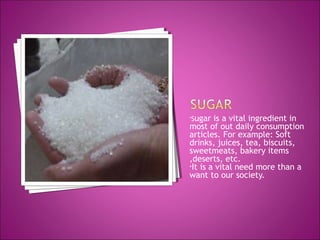
•Sugar is a vital ingredient in
most of out daily consumption
articles. For example: Soft
drinks, juices, tea, biscuits,
sweetmeats, bakery items
,deserts, etc.
•It is a vital need more than a
want to our society.
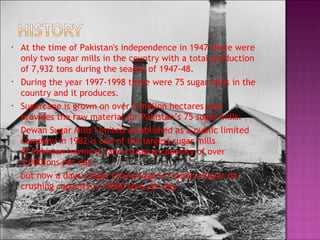
• At the time of Pakistan's independence in 1947 there were
only two sugar mills in the country with a total production
of 7,932 tons during the season of 1947-48.
• During the year 1997-1998 there were 75 sugar mills in the
country and it produces.
• Sugarcane is grown on over a million hectares and
provides the raw material for Pakistan’s 75 sugar mills.
• Dewan Sugar Mills Limited established as a public limited
company in 1982 is one of the largest sugar mills
of Pakistan having a cane crushing capacity of over
9,000tons per day.
• but now a days sunger chang suger in tando allayar its
crushing capacity is 15000 tons per day
• The Second Largest agro based industry after
Textiles.
• Pakistan is an important cane producing
country and is ranked fifth in world cane
acreage and 15th in sugar production.
 Today there are 82 functional sugar mills in
the country out of which 45 are in Punjab,
32in Sindh and 5 in Khyber Pakhtonkhwa. In-
 Khoski sugar mill established 1965 by
Rahmaniyan group and its constructed by
England engineers and its parts purchased
from England
 Its first Crushing star in 1971
 Its ceremony inauguration held by general
yahya khan
 Some of the major processing equipment are
4 Boiler Houses, Power House, Process House
and Mill House.
 800 employees are working
 Crushing Capacity is 4,500 Ton per day
 Anwar majeed is chairman
 Its belong to omni groug
 There are 9 suger mills under
 Its owner is Asif ali zardari
 Head office is 1st floor, Block-2, Hockey Club
of Pakistan Stadium, Liaquat Barracks,
Karachi.
• Cleaning
• Slicing
• Juice extraction pressing
• Purification
• Evaporation
• Crystallization
• REFINERY
• SEPARATION AND PACKAGING
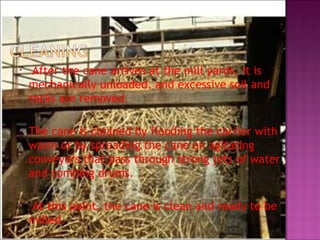
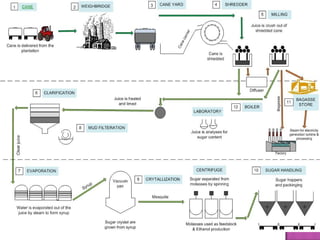
• After the cane arrives at the mill yards, it is
mechanically unloaded, and excessive soil and
rocks are removed.
• The cane is cleaned by flooding the carrier with
warm or by spreading the cane on agitating
conveyors that pass through strong jets of water
and combing drums.
• At this point, the cane is clean and ready to be
milled.
 After the cleaning process, a machine led by a
series of rotating knives, shreds the cane into
pieces. This is known as "grinding.“
 During grinding, hot water is sprayed on to the
sugarcane to dissolve any remaining hard sugar.
The smaller pieces of cane are then spread out
on a conveyer belt.
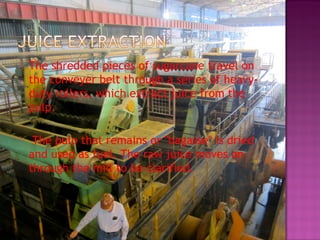
 The shredded pieces of sugarcane travel on
the conveyer belt through a series of heavy-
duty rollers, which extract juice from the
pulp.
 The pulp that remains or "bagasse" is dried
and used as fuel. The raw juice moves on
through the mill to be clarified.
 The juice from the mills, a dark green color, is
acid and turbid. The clarification (or defecation)
process is designed to remove both soluble and
insoluble impurities (such as sand, soil, and
ground rock) that have not been removed by
preliminary screening.
 The process employs lime and heat as the
clarifying agents.
• Carbon dioxide and the milk of a lime are
added to the liquid sugar mixture and it is
heated to the boiling point, as the process of
clarifying begins.
• As the carbon dioxide travels through the liquid
it forms calcium carbonate, which attracts
non-sugar debris (fats, gums, and wax) from
the juice, and pulls them away from the sugar
juice. The juice is then pushed through a series
of filters to remove any remaining impurities.
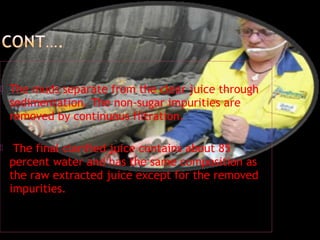
 The muds separate from the clear juice through
sedimentation. The non-sugar impurities are
removed by continuous filtration.
 The final clarified juice contains about 85
percent water and has the same composition as
the raw extracted juice except for the removed
impurities.
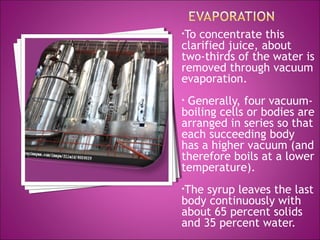
•To concentrate this
clarified juice, about
two-thirds of the water is
removed through vacuum
evaporation.
• Generally, four vacuum-
boiling cells or bodies are
arranged in series so that
each succeeding body
has a higher vacuum (and
therefore boils at a lower
temperature).
•The syrup leaves the last
body continuously with
about 65 percent solids
and 35 percent water.
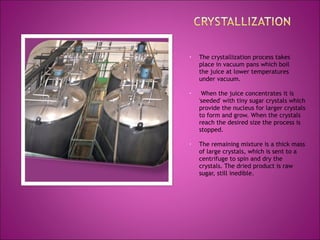
• The crystallization process takes
place in vacuum pans which boil
the juice at lower temperatures
under vacuum.
• When the juice concentrates it is
'seeded' with tiny sugar crystals which
provide the nucleus for larger crystals
to form and grow. When the crystals
reach the desired size the process is
stopped.
• The remaining mixture is a thick mass
of large crystals, which is sent to a
centrifuge to spin and dry the
crystals. The dried product is raw
sugar, still inedible.
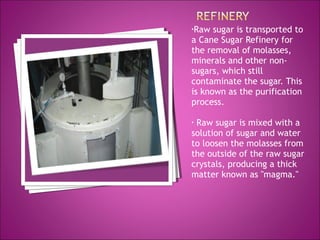
•Raw sugar is transported to
a Cane Sugar Refinery for
the removal of molasses,
minerals and other non-
sugars, which still
contaminate the sugar. This
is known as the purification
process.
• Raw sugar is mixed with a
solution of sugar and water
to loosen the molasses from
the outside of the raw sugar
crystals, producing a thick
matter known as "magma."
• Large machines then spin the magma, which
separate the molasses from the crystals.
Crystals are promptly washed, dissolved and
filtered to remove impurities.
• The golden syrup which is produced is then
sent through filters to remove the color and
water. What's left is a concentrated, clear
syrup, which is again fed into a vacuum pan.
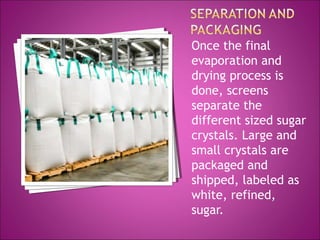
Once the final
evaporation and
drying process is
done, screens
separate the
different sized sugar
crystals. Large and
small crystals are
packaged and
shipped, labeled as
white, refined,
sugar.
Suger production process by ilamdin

Suger production process by ilamdin

  • 2.
  • 3.
    •Sugar is avital ingredient in most of out daily consumption articles. For example: Soft drinks, juices, tea, biscuits, sweetmeats, bakery items ,deserts, etc. •It is a vital need more than a want to our society.
  • 4.
    • At thetime of Pakistan's independence in 1947 there were only two sugar mills in the country with a total production of 7,932 tons during the season of 1947-48. • During the year 1997-1998 there were 75 sugar mills in the country and it produces. • Sugarcane is grown on over a million hectares and provides the raw material for Pakistan’s 75 sugar mills. • Dewan Sugar Mills Limited established as a public limited company in 1982 is one of the largest sugar mills of Pakistan having a cane crushing capacity of over 9,000tons per day. • but now a days sunger chang suger in tando allayar its crushing capacity is 15000 tons per day
  • 5.
    • The SecondLargest agro based industry after Textiles. • Pakistan is an important cane producing country and is ranked fifth in world cane acreage and 15th in sugar production.  Today there are 82 functional sugar mills in the country out of which 45 are in Punjab, 32in Sindh and 5 in Khyber Pakhtonkhwa. In-
  • 6.
     Khoski sugarmill established 1965 by Rahmaniyan group and its constructed by England engineers and its parts purchased from England  Its first Crushing star in 1971  Its ceremony inauguration held by general yahya khan  Some of the major processing equipment are 4 Boiler Houses, Power House, Process House and Mill House.
  • 7.
     800 employeesare working  Crushing Capacity is 4,500 Ton per day  Anwar majeed is chairman  Its belong to omni groug  There are 9 suger mills under  Its owner is Asif ali zardari  Head office is 1st floor, Block-2, Hockey Club of Pakistan Stadium, Liaquat Barracks, Karachi.
  • 8.
    • Cleaning • Slicing •Juice extraction pressing • Purification • Evaporation • Crystallization • REFINERY • SEPARATION AND PACKAGING
  • 9.
    • After thecane arrives at the mill yards, it is mechanically unloaded, and excessive soil and rocks are removed. • The cane is cleaned by flooding the carrier with warm or by spreading the cane on agitating conveyors that pass through strong jets of water and combing drums. • At this point, the cane is clean and ready to be milled.
  • 10.
     After thecleaning process, a machine led by a series of rotating knives, shreds the cane into pieces. This is known as "grinding.“  During grinding, hot water is sprayed on to the sugarcane to dissolve any remaining hard sugar. The smaller pieces of cane are then spread out on a conveyer belt.
  • 11.
     The shreddedpieces of sugarcane travel on the conveyer belt through a series of heavy- duty rollers, which extract juice from the pulp.  The pulp that remains or "bagasse" is dried and used as fuel. The raw juice moves on through the mill to be clarified.
  • 12.
     The juicefrom the mills, a dark green color, is acid and turbid. The clarification (or defecation) process is designed to remove both soluble and insoluble impurities (such as sand, soil, and ground rock) that have not been removed by preliminary screening.  The process employs lime and heat as the clarifying agents.
  • 13.
    • Carbon dioxideand the milk of a lime are added to the liquid sugar mixture and it is heated to the boiling point, as the process of clarifying begins. • As the carbon dioxide travels through the liquid it forms calcium carbonate, which attracts non-sugar debris (fats, gums, and wax) from the juice, and pulls them away from the sugar juice. The juice is then pushed through a series of filters to remove any remaining impurities.
  • 14.
     The mudsseparate from the clear juice through sedimentation. The non-sugar impurities are removed by continuous filtration.  The final clarified juice contains about 85 percent water and has the same composition as the raw extracted juice except for the removed impurities.
  • 15.
    •To concentrate this clarifiedjuice, about two-thirds of the water is removed through vacuum evaporation. • Generally, four vacuum- boiling cells or bodies are arranged in series so that each succeeding body has a higher vacuum (and therefore boils at a lower temperature). •The syrup leaves the last body continuously with about 65 percent solids and 35 percent water.
  • 16.
    • The crystallizationprocess takes place in vacuum pans which boil the juice at lower temperatures under vacuum. • When the juice concentrates it is 'seeded' with tiny sugar crystals which provide the nucleus for larger crystals to form and grow. When the crystals reach the desired size the process is stopped. • The remaining mixture is a thick mass of large crystals, which is sent to a centrifuge to spin and dry the crystals. The dried product is raw sugar, still inedible.
  • 17.
    •Raw sugar istransported to a Cane Sugar Refinery for the removal of molasses, minerals and other non- sugars, which still contaminate the sugar. This is known as the purification process. • Raw sugar is mixed with a solution of sugar and water to loosen the molasses from the outside of the raw sugar crystals, producing a thick matter known as "magma."
  • 18.
    • Large machinesthen spin the magma, which separate the molasses from the crystals. Crystals are promptly washed, dissolved and filtered to remove impurities. • The golden syrup which is produced is then sent through filters to remove the color and water. What's left is a concentrated, clear syrup, which is again fed into a vacuum pan.
  • 19.
    Once the final evaporationand drying process is done, screens separate the different sized sugar crystals. Large and small crystals are packaged and shipped, labeled as white, refined, sugar.