Clarifiers
Presented By:
Ghulam Murtaza
Presented To:
Engr. Waqas Qamar
Roll No:
12063123-046
Contents……
 What is clarifier???
 Types of Clarifier
 Working Principle
 Primary Clarifier
 Sludge Process
Continu…..
 Secondary Clarifier
 Designing Parameters (Calculations)
What is clarifier???
 Clarifiers are settling tanks built for continuous removal of
solids being deposited by sedimentation.
 A clarifier is generally used to remove solid particulates or
suspended solids from liquid for clarification.
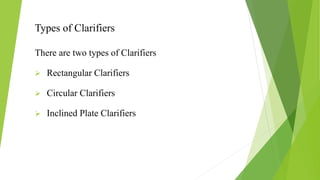
Types of Clarifiers
There are two types of Clarifiers
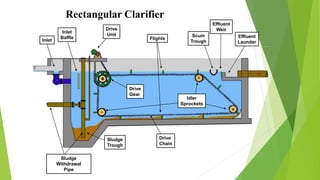
 Rectangular Clarifiers
 Circular Clarifiers
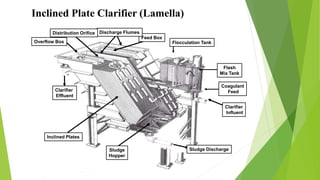
 Inclined Plate Clarifiers
Effluent
Launder
Effluent
Weir
Scum
Trough
Flights
Drive
Unit
Drive
Chain
Drive
Gear
Idler
Sprockets
Sludge
Withdrawal
Pipe
Sludge
Trough
Inlet
Baffle
Inlet
Rectangular Clarifier
Overflow Box
Clarifier
Influent
Sludge Discharge
Clarifier
Effluent
Sludge
Hopper
Flocculation Tank
Flash
Mix Tank
Coagulant
Feed
Feed Box
Discharge FlumesDistribution Orifice
Inclined Plates
Inclined Plate Clarifier (Lamella)
Circular Clarifiers Operation
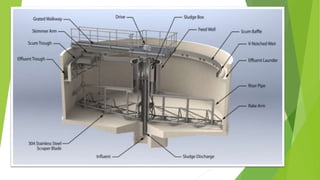
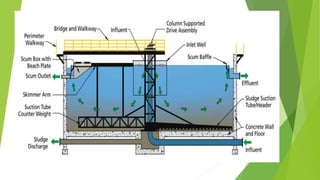
 Circular clarifiers use slowly rotating rake arms to separate
solid particulate.
 A liquid feed with suspended solids is fed into a tank with
a diameter of 5 to 500 feet.
 As the particles settle, angled rake arms move the
concentrated slurry toward the center of the tank, where it
is removed.
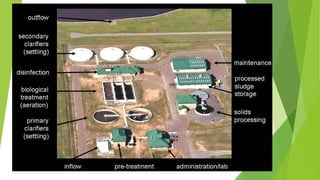
Primary Clarifier
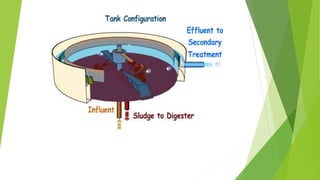
 Primary clarification is the physical treatment process of
removing solids before biological treatment.
 Floatable material (scum) are removed from the surface by
skimmers and settle able solids (sludge) are collected on
the bottom by a rakes.
 The expected range for percent removal in a primary
clarifier is 90%-95% settle able solids, 40%-60%
suspended solids
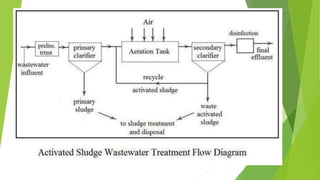
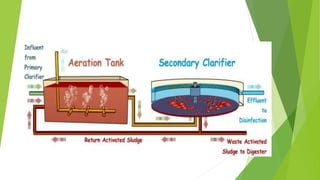
Activated sludge Process
 The activated sludge process is widely used for biological
wastewater treatment all over the world.
 An activated sludge wastewater treatment system always has an
aeration tank and secondary clarifier, which function as a unit to
remove organic matter and suspended solids from the
wastewater.
Secondary Clarifier
 Microorganisms such as bacteria and protozoa can use the small
particles and dissolved organic matter not removed in primary
clarifier as food.
 In a secondary clarifier which operates in the same manner as the
primary clarifier described previously. Some of the solids
collected in the secondary clarifier (return activated sludge) are
sent back to the aeration tank.
Cont….
 secondary clarifier effectively separates the biological floc
and colloidal solids to produce wastewater with very low
levels of organic material and suspended matter.
Efficiency of solid Removal related to
Characteristics of solid
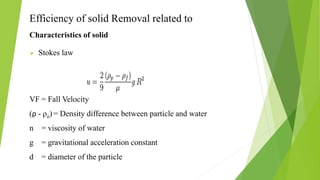
 Stokes law
VF = Fall Velocity
(ρ - ρo) = Density difference between particle and water
n = viscosity of water
g = gravitational acceleration constant
d = diameter of the particle
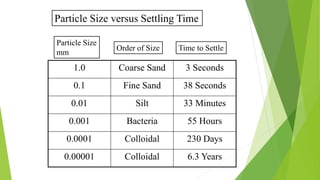
Particle Size versus Settling Time
Particle Size
mm
Order of Size Time to Settle
1.0 Coarse Sand 3 Seconds
0.1 Fine Sand 38 Seconds
0.01 Silt 33 Minutes
0.001 Bacteria 55 Hours
0.0001 Colloidal 230 Days
0.00001 Colloidal 6.3 Years
Calculations (Designing Parameters)
 Hydraulic Loading
 Solid Loading
Hydraulic Loading
 Detention Time (DT)
The time it takes for a water to
travel from inlet to outlet.
Typical Design Value = 2 – 3 Hours
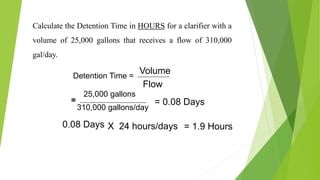
Calculate the Detention Time in HOURS for a clarifier with a
volume of 25,000 gallons that receives a flow of 310,000
gal/day.
Detention Time =
Volume
Flow
=
25,000 gallons
310,000 gallons/day
= 0.08 Days
0.08 Days X 24 hours/days = 1.9 Hours
Hydraulic Loading
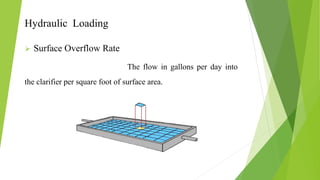
 Surface Overflow Rate
The flow in gallons per day into
the clarifier per square foot of surface area.
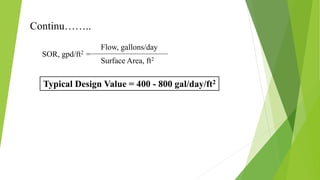
Continu……..
SOR, gpd/ft2 =
Flow, gallons/day
Surface Area, ft2
Typical Design Value = 400 - 800 gal/day/ft2
SOR, gpd/ft2 =
Flow, gallons/day
Surface Area, ft2
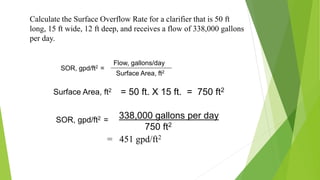
Calculate the Surface Overflow Rate for a clarifier that is 50 ft
long, 15 ft wide, 12 ft deep, and receives a flow of 338,000 gallons
per day.
= 50 ft. X 15 ft. = 750 ft2Surface Area, ft2
338,000 gallons per day
750 ft2
SOR, gpd/ft2 =
= 451 gpd/ft2
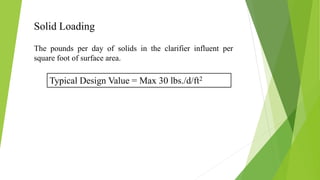
Solid Loading
The pounds per day of solids in the clarifier influent per
square foot of surface area.
Typical Design Value = Max 30 lbs./d/ft2
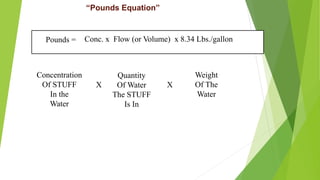
Pounds =
Concentration
Of STUFF
In the
Water
Conc. x Flow (or Volume) x 8.34 Lbs./gallon
X
Quantity
Of Water
The STUFF
Is In
Weight
Of The
Water
X
“Pounds Equation”
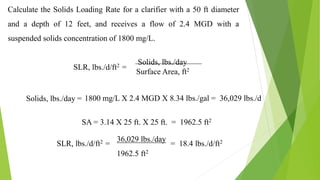
SLR, lbs./d/ft2 =
Solids, lbs./day
Surface Area, ft2
Calculate the Solids Loading Rate for a clarifier with a 50 ft diameter
and a depth of 12 feet, and receives a flow of 2.4 MGD with a
suspended solids concentration of 1800 mg/L.
SA = 3.14 X 25 ft. X 25 ft. = 1962.5 ft2
1800 mg/L X 2.4 MGD X 8.34 lbs./gal = 36,029 lbs./d
36,029 lbs./day
1962.5 ft2
= 18.4 lbs./d/ft2
Solids, lbs./day =
SLR, lbs./d/ft2 =

Circular clarifiers

  • 1.
    Clarifiers Presented By: Ghulam Murtaza PresentedTo: Engr. Waqas Qamar Roll No: 12063123-046
  • 2.
    Contents……  What isclarifier???  Types of Clarifier  Working Principle  Primary Clarifier  Sludge Process
  • 3.
    Continu…..  Secondary Clarifier Designing Parameters (Calculations)
  • 5.
    What is clarifier??? Clarifiers are settling tanks built for continuous removal of solids being deposited by sedimentation.  A clarifier is generally used to remove solid particulates or suspended solids from liquid for clarification.
  • 6.
    Types of Clarifiers Thereare two types of Clarifiers  Rectangular Clarifiers  Circular Clarifiers  Inclined Plate Clarifiers
  • 7.
  • 8.
    Overflow Box Clarifier Influent Sludge Discharge Clarifier Effluent Sludge Hopper FlocculationTank Flash Mix Tank Coagulant Feed Feed Box Discharge FlumesDistribution Orifice Inclined Plates Inclined Plate Clarifier (Lamella)
  • 9.
    Circular Clarifiers Operation Circular clarifiers use slowly rotating rake arms to separate solid particulate.  A liquid feed with suspended solids is fed into a tank with a diameter of 5 to 500 feet.  As the particles settle, angled rake arms move the concentrated slurry toward the center of the tank, where it is removed.
  • 10.
    Primary Clarifier  Primaryclarification is the physical treatment process of removing solids before biological treatment.  Floatable material (scum) are removed from the surface by skimmers and settle able solids (sludge) are collected on the bottom by a rakes.  The expected range for percent removal in a primary clarifier is 90%-95% settle able solids, 40%-60% suspended solids
  • 13.
    Activated sludge Process The activated sludge process is widely used for biological wastewater treatment all over the world.  An activated sludge wastewater treatment system always has an aeration tank and secondary clarifier, which function as a unit to remove organic matter and suspended solids from the wastewater.
  • 16.
    Secondary Clarifier  Microorganismssuch as bacteria and protozoa can use the small particles and dissolved organic matter not removed in primary clarifier as food.  In a secondary clarifier which operates in the same manner as the primary clarifier described previously. Some of the solids collected in the secondary clarifier (return activated sludge) are sent back to the aeration tank.
  • 17.
    Cont….  secondary clarifiereffectively separates the biological floc and colloidal solids to produce wastewater with very low levels of organic material and suspended matter.
  • 19.
    Efficiency of solidRemoval related to Characteristics of solid  Stokes law VF = Fall Velocity (ρ - ρo) = Density difference between particle and water n = viscosity of water g = gravitational acceleration constant d = diameter of the particle
  • 20.
    Particle Size versusSettling Time Particle Size mm Order of Size Time to Settle 1.0 Coarse Sand 3 Seconds 0.1 Fine Sand 38 Seconds 0.01 Silt 33 Minutes 0.001 Bacteria 55 Hours 0.0001 Colloidal 230 Days 0.00001 Colloidal 6.3 Years
  • 21.
    Calculations (Designing Parameters) Hydraulic Loading  Solid Loading
  • 22.
    Hydraulic Loading  DetentionTime (DT) The time it takes for a water to travel from inlet to outlet. Typical Design Value = 2 – 3 Hours
  • 23.
    Calculate the DetentionTime in HOURS for a clarifier with a volume of 25,000 gallons that receives a flow of 310,000 gal/day. Detention Time = Volume Flow = 25,000 gallons 310,000 gallons/day = 0.08 Days 0.08 Days X 24 hours/days = 1.9 Hours
  • 24.
    Hydraulic Loading  SurfaceOverflow Rate The flow in gallons per day into the clarifier per square foot of surface area.
  • 25.
    Continu…….. SOR, gpd/ft2 = Flow,gallons/day Surface Area, ft2 Typical Design Value = 400 - 800 gal/day/ft2
  • 26.
    SOR, gpd/ft2 = Flow,gallons/day Surface Area, ft2 Calculate the Surface Overflow Rate for a clarifier that is 50 ft long, 15 ft wide, 12 ft deep, and receives a flow of 338,000 gallons per day. = 50 ft. X 15 ft. = 750 ft2Surface Area, ft2 338,000 gallons per day 750 ft2 SOR, gpd/ft2 = = 451 gpd/ft2
  • 27.
    Solid Loading The poundsper day of solids in the clarifier influent per square foot of surface area. Typical Design Value = Max 30 lbs./d/ft2
  • 28.
    Pounds = Concentration Of STUFF Inthe Water Conc. x Flow (or Volume) x 8.34 Lbs./gallon X Quantity Of Water The STUFF Is In Weight Of The Water X “Pounds Equation”
  • 29.
    SLR, lbs./d/ft2 = Solids,lbs./day Surface Area, ft2 Calculate the Solids Loading Rate for a clarifier with a 50 ft diameter and a depth of 12 feet, and receives a flow of 2.4 MGD with a suspended solids concentration of 1800 mg/L. SA = 3.14 X 25 ft. X 25 ft. = 1962.5 ft2 1800 mg/L X 2.4 MGD X 8.34 lbs./gal = 36,029 lbs./d 36,029 lbs./day 1962.5 ft2 = 18.4 lbs./d/ft2 Solids, lbs./day = SLR, lbs./d/ft2 =