Sugar Industry Introduction. History of Sugar. Sugar Manufacturing Process .
What is Sugar? What we call sugar, the chemist knows as 'sucrose', in the grouping called carbohydrates.  The simplest of the sugars is glucose, C 6 H 12 O 6 Sucrose, C 12 H 22 O 11 , is a condensation molecule made up of two glucose molecules [less a water molecule to make the chemistry work].
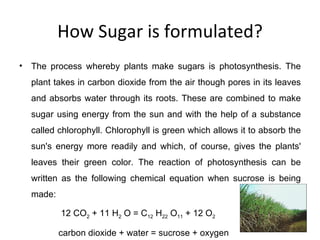
How Sugar is formulated? The process whereby plants make sugars is photosynthesis. The plant takes in carbon dioxide from the air though pores in its leaves and absorbs water through its roots. These are combined to make sugar using energy from the sun and with the help of a substance called chlorophyll. Chlorophyll is green which allows it to absorb the sun's energy more readily and which, of course, gives the plants' leaves their green color. The reaction of photosynthesis can be written as the following chemical equation when sucrose is being made: 12 CO 2  + 11 H 2  O = C 12  H 22  O 11  + 12 O 2   carbon dioxide + water = sucrose + oxygen
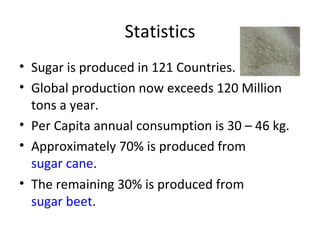
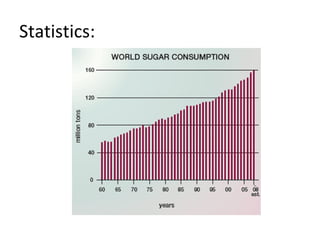
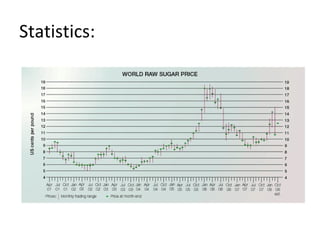
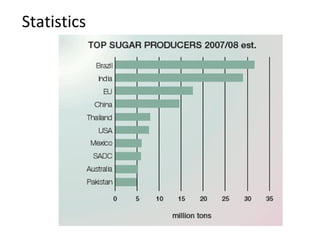
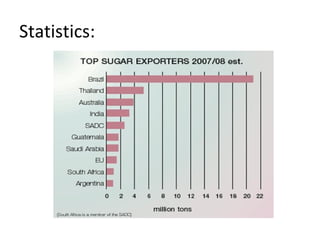
Statistics Sugar is produced in 121 Countries.  Global production now exceeds 120 Million tons a year.  Per Capita annual consumption is 30 – 46 kg. Approximately 70% is produced from  sugar cane . The remaining 30% is produced from  sugar beet .
Statistics:
Statistics:
Statistics
Statistics:
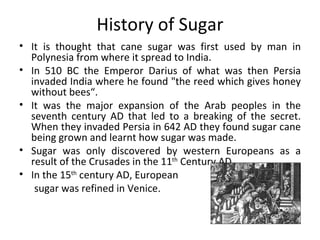
History of Sugar It is thought that cane sugar was first used by man in Polynesia from where it spread to India.  In 510 BC the Emperor Darius of what was then Persia invaded India where he found "the reed which gives honey without bees“. It was the major expansion of the Arab peoples in the seventh century AD that led to a breaking of the secret. When they invaded Persia in 642 AD they found sugar cane being grown and learnt how sugar was made.  Sugar was only discovered by western Europeans as a result of the Crusades in the 11 th  Century AD. In the 15 th  century AD, European  sugar was refined in Venice.
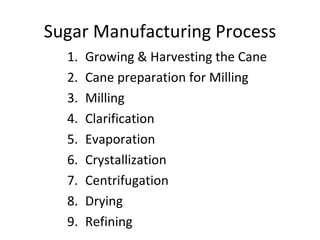
Sugar Manufacturing Process Growing & Harvesting the Cane Cane preparation for Milling Milling Clarification Evaporation Crystallization Centrifugation Drying Refining

Sugar Industry

  • 1.
    Sugar Industry Introduction.History of Sugar. Sugar Manufacturing Process .
  • 2.
    What is Sugar?What we call sugar, the chemist knows as 'sucrose', in the grouping called carbohydrates. The simplest of the sugars is glucose, C 6 H 12 O 6 Sucrose, C 12 H 22 O 11 , is a condensation molecule made up of two glucose molecules [less a water molecule to make the chemistry work].
  • 3.
    How Sugar isformulated? The process whereby plants make sugars is photosynthesis. The plant takes in carbon dioxide from the air though pores in its leaves and absorbs water through its roots. These are combined to make sugar using energy from the sun and with the help of a substance called chlorophyll. Chlorophyll is green which allows it to absorb the sun's energy more readily and which, of course, gives the plants' leaves their green color. The reaction of photosynthesis can be written as the following chemical equation when sucrose is being made: 12 CO 2 + 11 H 2 O = C 12 H 22 O 11 + 12 O 2 carbon dioxide + water = sucrose + oxygen
  • 4.
    Statistics Sugar isproduced in 121 Countries. Global production now exceeds 120 Million tons a year. Per Capita annual consumption is 30 – 46 kg. Approximately 70% is produced from sugar cane . The remaining 30% is produced from sugar beet .
  • 5.
  • 6.
  • 7.
  • 8.
  • 9.
    History of SugarIt is thought that cane sugar was first used by man in Polynesia from where it spread to India. In 510 BC the Emperor Darius of what was then Persia invaded India where he found "the reed which gives honey without bees“. It was the major expansion of the Arab peoples in the seventh century AD that led to a breaking of the secret. When they invaded Persia in 642 AD they found sugar cane being grown and learnt how sugar was made. Sugar was only discovered by western Europeans as a result of the Crusades in the 11 th Century AD. In the 15 th century AD, European sugar was refined in Venice.
  • 10.
    Sugar Manufacturing ProcessGrowing & Harvesting the Cane Cane preparation for Milling Milling Clarification Evaporation Crystallization Centrifugation Drying Refining