“Increase productivity of sugarcane by
trench method planting technique”
EXT- 411 (RAWE)
Presented To,
Dr. B. Jirli
Prof. O.P. Mishra
Presented by,
Gopi Raj
Id. No. -14054
B.Sc.(Ag.) Part – 4th year
India is 2nd largest producer of sugarcane
next to Brazil
India single largest producers of traditional
cane sugar Sweetners, Khandsari and Gur
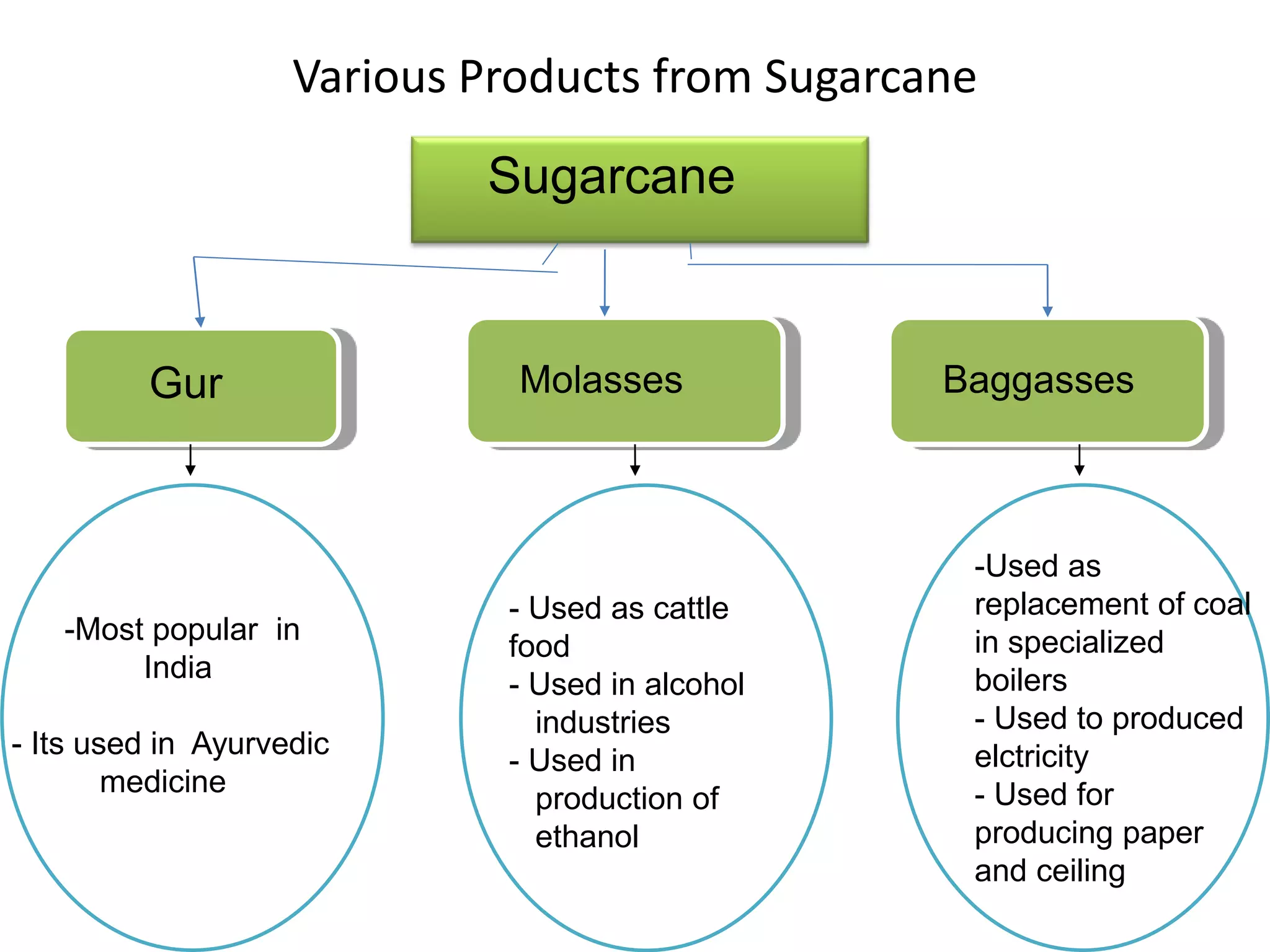
Various Products from Sugarcane
Sugarcane
Gur Molasses Baggasses
-Most popular in
India
- Its used in Ayurvedic
medicine
- Used as cattle
food
- Used in alcohol
industries
- Used in
production of
ethanol
-Used as
replacement of coal
in specialized
boilers
- Used to produced
elctricity
- Used for
producing paper
and ceiling
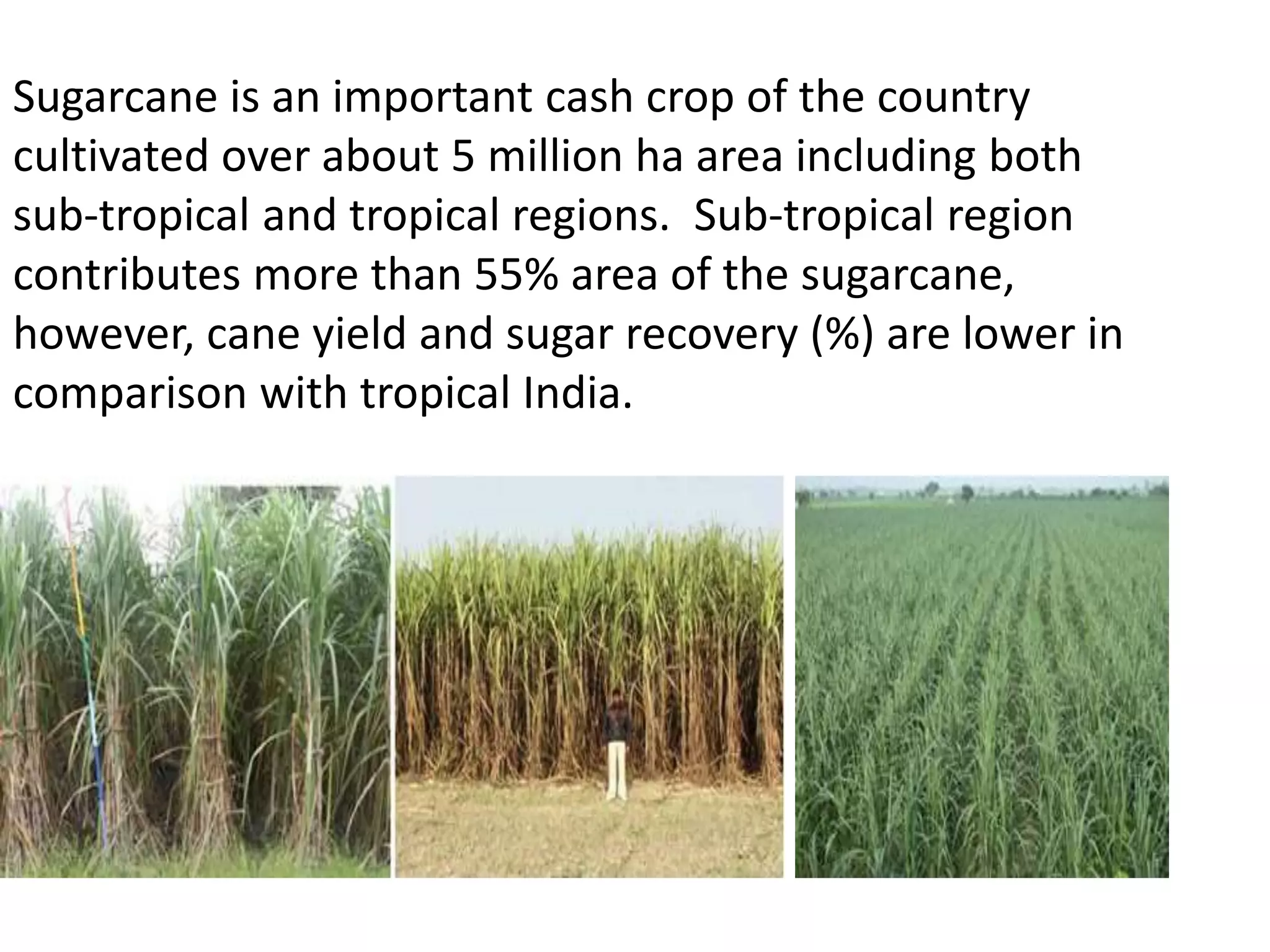
Sugarcane is an important cash crop of the country
cultivated over about 5 million ha area including both
sub-tropical and tropical regions. Sub-tropical region
contributes more than 55% area of the sugarcane,
however, cane yield and sugar recovery (%) are lower in
comparison with tropical India.
Problems
Agricultural perspective
. Water is major problem.
• Farmers who have ready
access to cash or credit,
irrigation and water supply,
fertilizer and pesticides
can farm sugarcane.
• In Maharashtra -60% of water is used to irrigate 500,000
hectares of sugarcane .
- This means other crops get little water or no water at al
Lodging leads to several problem
. Lodging in sugarcane is very common and a serious
problem in coastal belts where the wind velocity is very
high.
.Lodging is also very common in tall varieties ,top growth
is heavy, and where the growth habit is not erect ,and
varieties with less fiber content .
.Lodged canes are easily infested by certain pests
and diseases
.Damaged by rats and rodents .
.Difficult to irrigate and harvest the crop.
Solutions
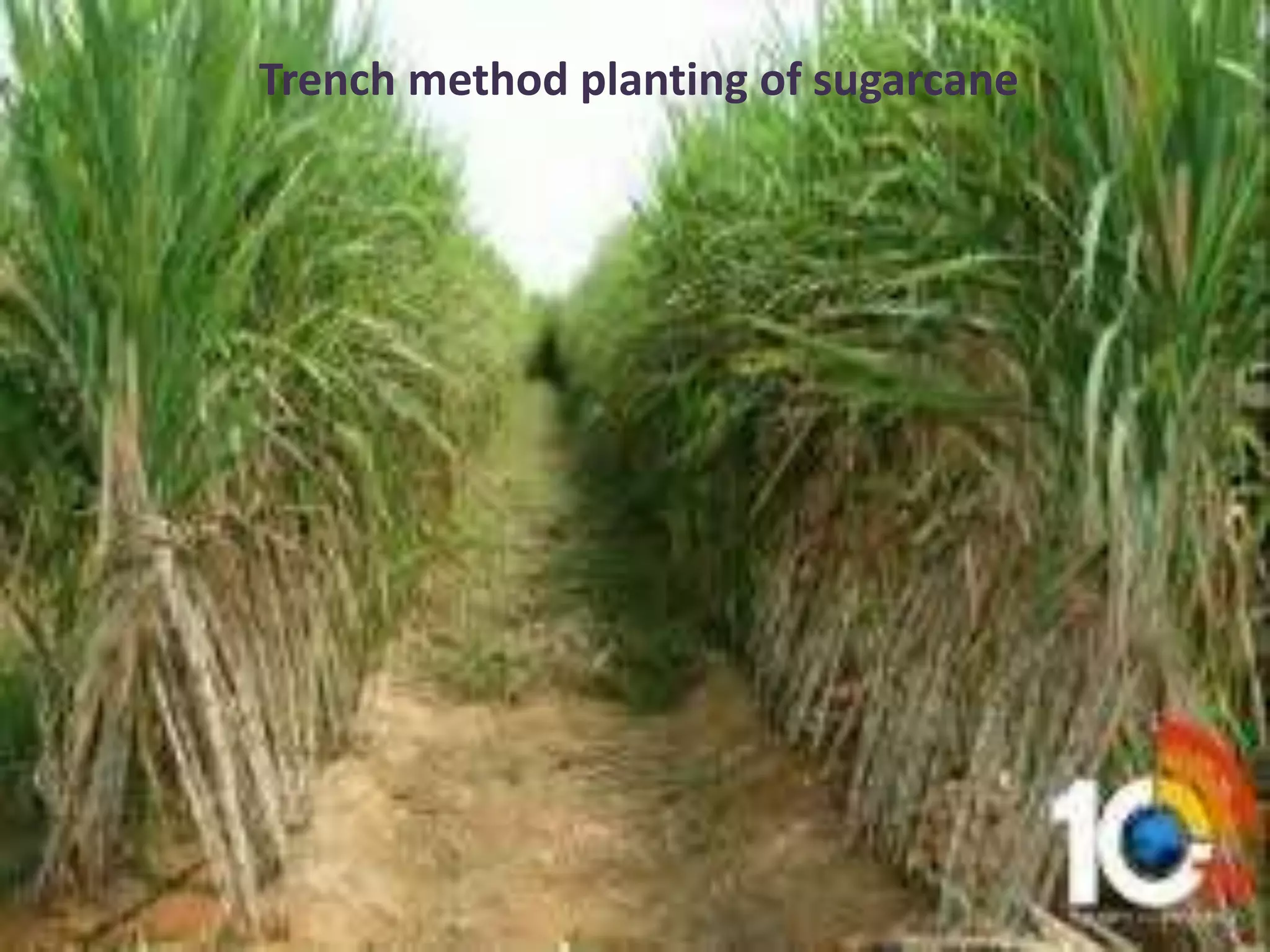
Trench method planting of sugarcane
1. Heavy earthing up.
2. Propping by trash twisting
3. Paired row planting with earthingnj up or
propping the paired rows.
4. Deep trench planting
5. Selection of varieties resistant for lodging
6. Raising wind breaks along the field broder.
7. Application of potassium
To prevent lodging the following operations
can be taken up
Soils
 Sugarcane can be economically grown in well
drained soils ranging from sandy loam to clay
loam.
 Problem soils (Saline, sodic and water logged) are
not suitable for sugarcane growing.
Seed Bed Preparation
– Plough back residue of proceeding
crop.
– Incorporation of FYM.
– Apply half to one bag urea to
facilitate bacterial activity.
– Allow 1 to 2 weeks for weathering.
– Chiseling to break hard pan.
– Leveling.
– Pulverizing to have granular
structure of the soil.
Seed Selection
• Seed should be taken from
1. True to type crop.
2. well matured crop (more than
8 months age).
3. Erect and healthy crop,
preferably not more than 12
months age.
4. Pest free plant crop.
5. Cane having healthy un-
sprouted buds and no aerial
roots.
• Top one-third of cane,
having more glucose, is
better as seed.
Seed treatment
• Setts should be dipped for 5
minutes in 0.25% solution of
Benlate or vitavax or Aglol or
Aeriton or Dithane M45 or
any other suitable fungicide.
Time of Planting
Spring Sowing:
• February-March.
• March is the best time for cane planting.
• Late planting may result in poor germination due
to high temperature.
September sowing:
• Entire month of September is recommended.
• Late planting may cause reduction in germination
due to low temperature.
Planting Methods
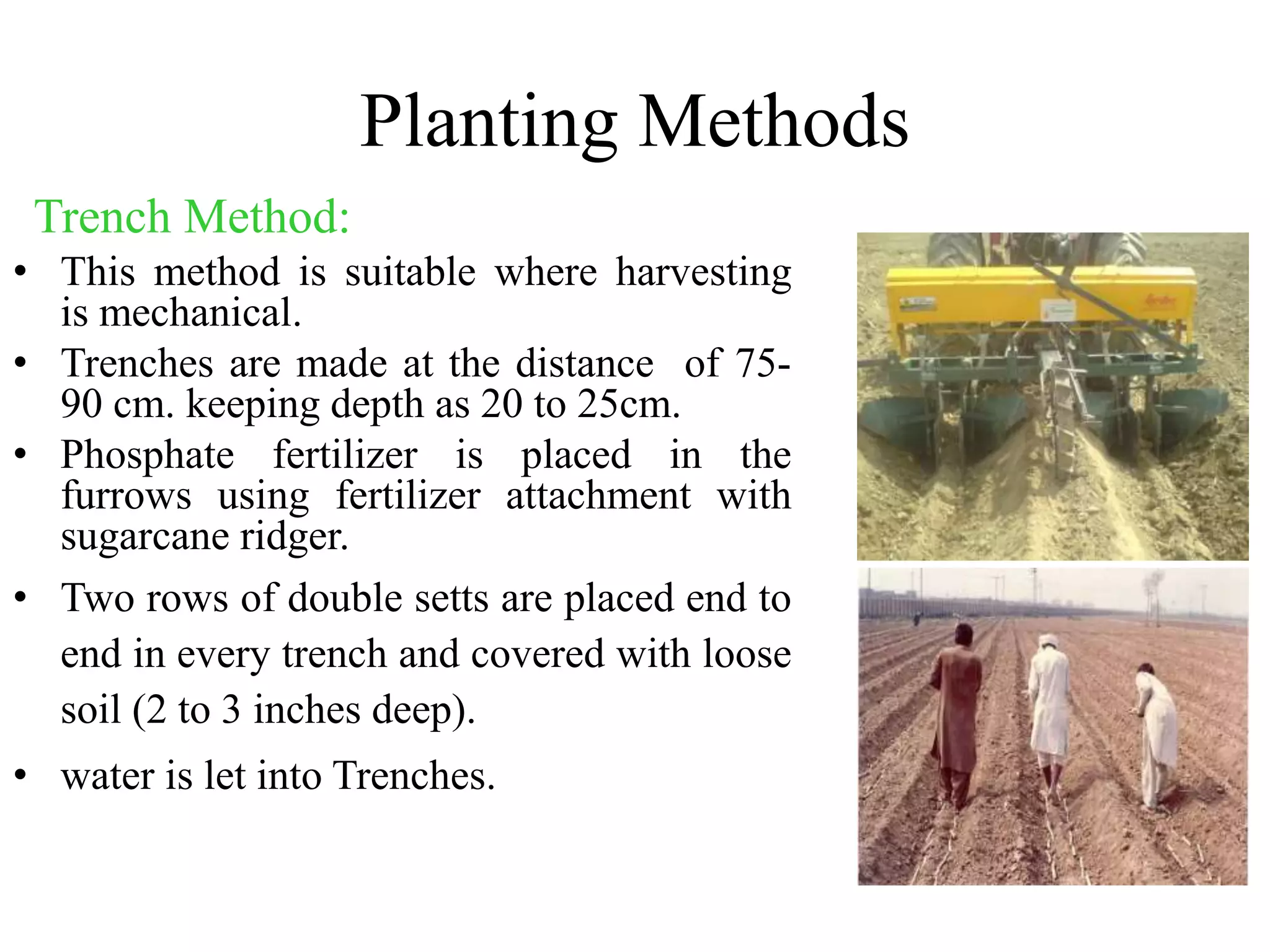
Trench Method:
• This method is suitable where harvesting
is mechanical.
• Trenches are made at the distance of 75-
90 cm. keeping depth as 20 to 25cm.
• Phosphate fertilizer is placed in the
furrows using fertilizer attachment with
sugarcane ridger.
• Two rows of double setts are placed end to
end in every trench and covered with loose
soil (2 to 3 inches deep).
• water is let into Trenches.
Recommended Varieties
CO 0238 (KARAN 4 ) PROMISING EARLY VARIETY FOR NORTH
WESTERN ZONE
-
Co 0239
Co 0118
- Early variety
-Early variety
Co 0238 (Karan 4) is a high yielding and high sugar content
variety, derived from the cross Co LK 8102 x Co 775. This
variety was evolved at the Sugarcane Breeding Institute,
Regional Centre, Karnal and released by the Central Sub-
committee on Crop Standards, Notification and Release of
Varieties during 2009 as an early maturing variety for
commercial cultivation in North-West Zone (NWZ)
comprising the states of Haryana, Punjab, Western and
Central Uttar Pradesh, Uttarakhand and Rajasthan.
During 2015-16 season, one mill in Sitapur district
of UP has recorded the highest sugar recovery
(12.1%) on 21st December, 2015, which is the
highest ever recorded in sub-tropical India. With
the spread of this news of historic impact of Co
0238 on sugar recovery in UP, the ICAR – Sugarcane
Breeding Institute is flooded with demands of seed
of Co 0238 from many states like Maharashtra,
Tamil Nadu and Andhra Pradesh. This is a reversal
of trend i.e. demand of a sub-tropical sugarcane
variety in tropical India, observed for the first time
in the history of sugarcane industry in the country.
IRRIGATION
 To have uniform distribution of
water precise land levelling is
necessary.
 First irrigation should
immediately be applied after
sowing.
 Second and third irrigations are
required at about 6-8 days interval
to facilitate germination.
 Number of irrigations required
varies widely with varying
rainfall patterns and temperatures.
Nutrient
Kg/ha. 207.5 52.5 280 0.0625 4.0 1.25
P K Sulphur Iron ZincN
Nutrient uptake by sugarcane crop to produce target yield 1000 q/ha
1. All NPK, sulphur, borax , ferrous sulphate , zinc sulphate
were applied as basal application and mix with soil just
Before application in trench .
2. 30 kg urea at 30-35 days after sowing (DAS).
3. 40 kg urea and , 30 kg MOP and 5kg mono zinc at 50-60 DAS
4. 45 kg urea and 30 kg MOP at 90-100 DAS .
Particulars /ha Farmers practices Trench method Result
Seed rate (q/ha) 62.5 80 Increase seed rate
Germination % 38 64 Increase germination
Mother shoots /ha 450000 870000 increased
Input Rs./ha 13000 18000 increased
Expense on irrigation 2750 2200 reduced
logging more less reduced
Trench method v/s farmer practice comparison
Possibility of inter
cropping
less more increased
Economic analysis
steps Trench method cost (Rs.) Flat bed method cost (Rs.)
Preparation of field 6700 6700
Planting of setts 8500 5000
Setts (weight) (80 qt*340)=27200 (62qt*340)=21080
Fertilizer application 16563 8000
Irrigation 2200 2750
Earthing up 15*300=4500 (15 Labour) 10*300=3000 (10 labour)
Harvesting and
transportation
20000 (Rs.20/qt) 13500 (Rs.20/qt)
Total cost of production 85663 60030
Production 1000qt*340= Rs.340000 675*340=229500
Net profit 340000 – 85663=254337 229500-60030=169470
Advance income 84867
steps Trench method cost (Rs.) Flat bed method cost (Rs.)
Preparation of field 6700 6700
Planting of setts 8500 5000
Setts (weight) (80 qt*340)=27200 (62qt*340)=21080
Fertilizer application 16563 8000
Irrigation 2200 2750
Earthing up 15*300=4500 (15 Labour) 10*300=3000 (10 labour)
Harvesting and
transportation
20000 (Rs.20/qt) 13500 (Rs.20/qt)
The field demonstrations were conducted at 128 farmers’
fields in District Pilibhit Uttar Pradesh having Tarai soil and
atmospheric conditions in two consecutive seasons. All the
farmers adopted trench method for planting of sugarcane
during both the seasons and also were used site specific
nutrient management (SSNM) formula.This formula was
subsidized to farmers and ensures supply of all required
nutrient from fertilizers. This method shows improved
germination from 38 to 64 percent. The yield data were
recorded on average of total demonstrations which were
1000 q/ha productivity.This was about to double
productivity of the district.
SUCCESS STORY
Sugarcane institutions
Indian institute of sugarcane research,(IISR)- Lucknow (UP.)
National sugar institute- Kanpur(UP.)
Sugarcane breeding institute-Coimbatore(Tamilnadu)
UP Council of sugarcane research -shahjahanpur
Sugarcane trench method planting

Sugarcane trench method planting

  • 1.
    “Increase productivity ofsugarcane by trench method planting technique” EXT- 411 (RAWE) Presented To, Dr. B. Jirli Prof. O.P. Mishra Presented by, Gopi Raj Id. No. -14054 B.Sc.(Ag.) Part – 4th year
  • 2.
    India is 2ndlargest producer of sugarcane next to Brazil
  • 3.
    India single largestproducers of traditional cane sugar Sweetners, Khandsari and Gur
  • 4.
    Various Products fromSugarcane Sugarcane Gur Molasses Baggasses -Most popular in India - Its used in Ayurvedic medicine - Used as cattle food - Used in alcohol industries - Used in production of ethanol -Used as replacement of coal in specialized boilers - Used to produced elctricity - Used for producing paper and ceiling
  • 5.
    Sugarcane is animportant cash crop of the country cultivated over about 5 million ha area including both sub-tropical and tropical regions. Sub-tropical region contributes more than 55% area of the sugarcane, however, cane yield and sugar recovery (%) are lower in comparison with tropical India.
  • 7.
  • 8.
    Agricultural perspective . Wateris major problem. • Farmers who have ready access to cash or credit, irrigation and water supply, fertilizer and pesticides can farm sugarcane. • In Maharashtra -60% of water is used to irrigate 500,000 hectares of sugarcane . - This means other crops get little water or no water at al
  • 9.
    Lodging leads toseveral problem . Lodging in sugarcane is very common and a serious problem in coastal belts where the wind velocity is very high. .Lodging is also very common in tall varieties ,top growth is heavy, and where the growth habit is not erect ,and varieties with less fiber content . .Lodged canes are easily infested by certain pests and diseases .Damaged by rats and rodents . .Difficult to irrigate and harvest the crop.
  • 10.
  • 11.
  • 12.
    1. Heavy earthingup. 2. Propping by trash twisting 3. Paired row planting with earthingnj up or propping the paired rows. 4. Deep trench planting 5. Selection of varieties resistant for lodging 6. Raising wind breaks along the field broder. 7. Application of potassium To prevent lodging the following operations can be taken up
  • 13.
    Soils  Sugarcane canbe economically grown in well drained soils ranging from sandy loam to clay loam.  Problem soils (Saline, sodic and water logged) are not suitable for sugarcane growing.
  • 14.
    Seed Bed Preparation –Plough back residue of proceeding crop. – Incorporation of FYM. – Apply half to one bag urea to facilitate bacterial activity. – Allow 1 to 2 weeks for weathering. – Chiseling to break hard pan. – Leveling. – Pulverizing to have granular structure of the soil.
  • 15.
    Seed Selection • Seedshould be taken from 1. True to type crop. 2. well matured crop (more than 8 months age). 3. Erect and healthy crop, preferably not more than 12 months age. 4. Pest free plant crop. 5. Cane having healthy un- sprouted buds and no aerial roots. • Top one-third of cane, having more glucose, is better as seed.
  • 16.
    Seed treatment • Settsshould be dipped for 5 minutes in 0.25% solution of Benlate or vitavax or Aglol or Aeriton or Dithane M45 or any other suitable fungicide.
  • 17.
    Time of Planting SpringSowing: • February-March. • March is the best time for cane planting. • Late planting may result in poor germination due to high temperature. September sowing: • Entire month of September is recommended. • Late planting may cause reduction in germination due to low temperature.
  • 18.
    Planting Methods Trench Method: •This method is suitable where harvesting is mechanical. • Trenches are made at the distance of 75- 90 cm. keeping depth as 20 to 25cm. • Phosphate fertilizer is placed in the furrows using fertilizer attachment with sugarcane ridger. • Two rows of double setts are placed end to end in every trench and covered with loose soil (2 to 3 inches deep). • water is let into Trenches.
  • 19.
    Recommended Varieties CO 0238(KARAN 4 ) PROMISING EARLY VARIETY FOR NORTH WESTERN ZONE - Co 0239 Co 0118 - Early variety -Early variety
  • 20.
    Co 0238 (Karan4) is a high yielding and high sugar content variety, derived from the cross Co LK 8102 x Co 775. This variety was evolved at the Sugarcane Breeding Institute, Regional Centre, Karnal and released by the Central Sub- committee on Crop Standards, Notification and Release of Varieties during 2009 as an early maturing variety for commercial cultivation in North-West Zone (NWZ) comprising the states of Haryana, Punjab, Western and Central Uttar Pradesh, Uttarakhand and Rajasthan.
  • 21.
    During 2015-16 season,one mill in Sitapur district of UP has recorded the highest sugar recovery (12.1%) on 21st December, 2015, which is the highest ever recorded in sub-tropical India. With the spread of this news of historic impact of Co 0238 on sugar recovery in UP, the ICAR – Sugarcane Breeding Institute is flooded with demands of seed of Co 0238 from many states like Maharashtra, Tamil Nadu and Andhra Pradesh. This is a reversal of trend i.e. demand of a sub-tropical sugarcane variety in tropical India, observed for the first time in the history of sugarcane industry in the country.
  • 22.
    IRRIGATION  To haveuniform distribution of water precise land levelling is necessary.  First irrigation should immediately be applied after sowing.  Second and third irrigations are required at about 6-8 days interval to facilitate germination.  Number of irrigations required varies widely with varying rainfall patterns and temperatures.
  • 23.
    Nutrient Kg/ha. 207.5 52.5280 0.0625 4.0 1.25 P K Sulphur Iron ZincN Nutrient uptake by sugarcane crop to produce target yield 1000 q/ha
  • 24.
    1. All NPK,sulphur, borax , ferrous sulphate , zinc sulphate were applied as basal application and mix with soil just Before application in trench . 2. 30 kg urea at 30-35 days after sowing (DAS). 3. 40 kg urea and , 30 kg MOP and 5kg mono zinc at 50-60 DAS 4. 45 kg urea and 30 kg MOP at 90-100 DAS .
  • 26.
    Particulars /ha Farmerspractices Trench method Result Seed rate (q/ha) 62.5 80 Increase seed rate Germination % 38 64 Increase germination Mother shoots /ha 450000 870000 increased Input Rs./ha 13000 18000 increased Expense on irrigation 2750 2200 reduced logging more less reduced Trench method v/s farmer practice comparison Possibility of inter cropping less more increased
  • 27.
    Economic analysis steps Trenchmethod cost (Rs.) Flat bed method cost (Rs.) Preparation of field 6700 6700 Planting of setts 8500 5000 Setts (weight) (80 qt*340)=27200 (62qt*340)=21080 Fertilizer application 16563 8000 Irrigation 2200 2750 Earthing up 15*300=4500 (15 Labour) 10*300=3000 (10 labour) Harvesting and transportation 20000 (Rs.20/qt) 13500 (Rs.20/qt) Total cost of production 85663 60030 Production 1000qt*340= Rs.340000 675*340=229500 Net profit 340000 – 85663=254337 229500-60030=169470 Advance income 84867 steps Trench method cost (Rs.) Flat bed method cost (Rs.) Preparation of field 6700 6700 Planting of setts 8500 5000 Setts (weight) (80 qt*340)=27200 (62qt*340)=21080 Fertilizer application 16563 8000 Irrigation 2200 2750 Earthing up 15*300=4500 (15 Labour) 10*300=3000 (10 labour) Harvesting and transportation 20000 (Rs.20/qt) 13500 (Rs.20/qt)
  • 28.
    The field demonstrationswere conducted at 128 farmers’ fields in District Pilibhit Uttar Pradesh having Tarai soil and atmospheric conditions in two consecutive seasons. All the farmers adopted trench method for planting of sugarcane during both the seasons and also were used site specific nutrient management (SSNM) formula.This formula was subsidized to farmers and ensures supply of all required nutrient from fertilizers. This method shows improved germination from 38 to 64 percent. The yield data were recorded on average of total demonstrations which were 1000 q/ha productivity.This was about to double productivity of the district. SUCCESS STORY
  • 29.
    Sugarcane institutions Indian instituteof sugarcane research,(IISR)- Lucknow (UP.) National sugar institute- Kanpur(UP.) Sugarcane breeding institute-Coimbatore(Tamilnadu) UP Council of sugarcane research -shahjahanpur