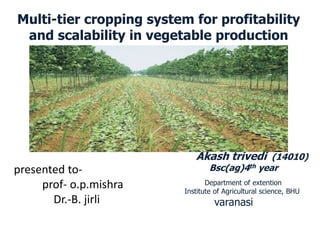
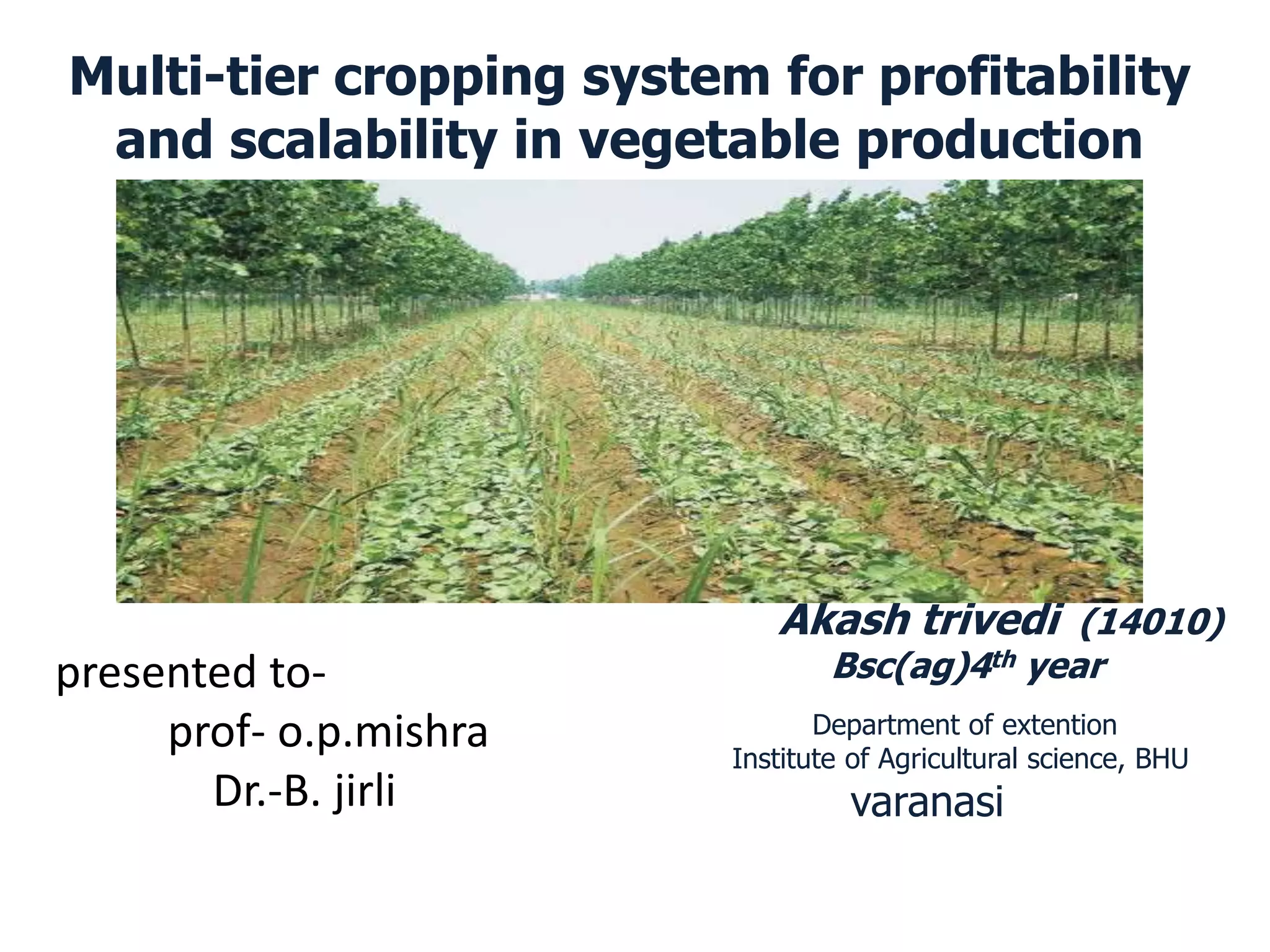
Multi-tier cropping system for profitability
and scalability in vegetable production
Akash trivedi (14010)
Bsc(ag)4th year
Department of extention
Institute of Agricultural science, BHU
varanasi
presented to-
prof- o.p.mishra
Dr.-B. jirli
The average size of holdings was 2.28 hectares in 1970-71
which was reduced to 1.82 hectares in 1980-81 and 1.50
hectares in 1995-96. The size of the holdings will further
decrease with the infinite Sub-division of the land
holdings.
The problem of small and fragmented holdings is more
serious in densely populated and intensively cultivated
states like Kerala, West Bengal, Bihar and eastern part of
Uttar Pradesh where the average size of land holdings is
less than one hectare and in certain parts it is less than
even 0.5 hectare. The main reason for this sad state of
affairs is our inheritance laws. The land belonging to the
father is equally distributed among his sons. This
distribution of land does not entail a collection or
consolidated one, but its nature is fragmented.
Situation of land holding in india
Two or more crops of different heights are grown
simultaneously on a piece of land in a certain period.
Sunlight, nutrient, land, water, and space are utilized in
the most efficient and economic way.
Increased biological diversity and higher production
stability (Singh et al., 2014).
Improve soil health and physical property of soil.
Multi-storied /multi-tier/ multi-layer cropping system
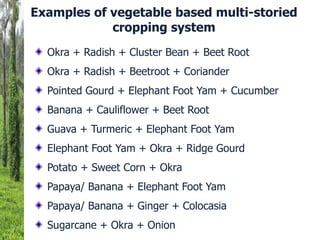
Okra + Radish + Cluster Bean + Beet Root
Okra + Radish + Beetroot + Coriander
Pointed Gourd + Elephant Foot Yam + Cucumber
Banana + Cauliflower + Beet Root
Guava + Turmeric + Elephant Foot Yam
Elephant Foot Yam + Okra + Ridge Gourd
Potato + Sweet Corn + Okra
Papaya/ Banana + Elephant Foot Yam
Papaya/ Banana + Ginger + Colocasia
Sugarcane + Okra + Onion
Examples of vegetable based multi-storied
cropping system
Better use of growth resources including sunlight, nutrient and
water.
Yield stability (suppress the growth of weeds).
Ecological stability i.e. improved soil health and agro-ecosystem.
Flow of income during cropping periods.
Other miscellaneous benefits like distribution of labour, physical
support of one crop to another and home gardening leading to
more food supply.
Advantages of multi-storied cropping system
Labour intensive.
Chemical control of weeds, pests and diseases may be
difficult.
Difficulty in mechanization.
Adverse competitive effect or by allelopathy.
Disadvantages of multi-storied cropping
Elephant foot yam: A profitable crop for vegetable
based multi-tier cropping system
Pointed gourd + Elephant foot yam + Cowpea/ bitter gourd
Selection of varieties:
Elephant foot yam : Gajendra, Sree Padma, Kusum
Pointed gourd : Rajendra Parwal-1, Rajendra Parwal-2
Bitter gourd : Pusa Do Mausami, Pusa Vishesh
Cowpea : Kashi Kanchan, Kashi Gauri, Arka Garima
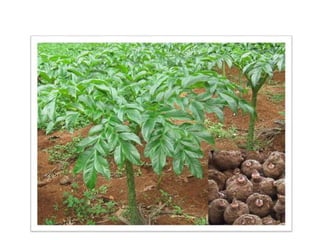
Introduction
• Common name – Elephant-foot-yam, Suran,
Amorphophallus, Kuch, Jimmikand.
• Botanical name – Amorphophallus campanulatus
Amorphophallus paeoniifolius
• Origin – Tropical Asia and Africa (India & Sri Lanka)
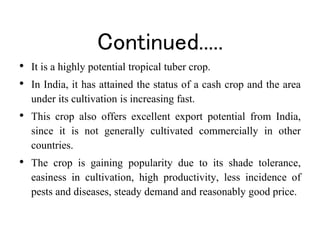
Continued.....
• It is a highly potential tropical tuber crop.
• In India, it has attained the status of a cash crop and the area
under its cultivation is increasing fast.
• This crop also offers excellent export potential from India,
since it is not generally cultivated commercially in other
countries.
• The crop is gaining popularity due to its shade tolerance,
easiness in cultivation, high productivity, less incidence of
pests and diseases, steady demand and reasonably good price.
Distribution
• It has now become a very popular vegetable in certain
areas of the tropical and subtropical regions.
• It is a crop of South-East Asian origin, growing wild in
the Philippines, Malaysia, and Indonesia and South-
eastern Asian countries.
• It is commercially grown in India, Sri Lanka, China,
Malaysia, Java, Philippines and Ceylon.
• In India, it is cultivated on large scale in Andhra Pradesh,
Bihar, Gujarat, Maharashtra and West Bengal.
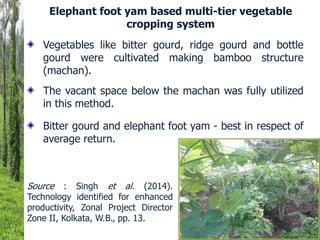
Elephant foot yam based multi-tier vegetable
cropping system
Source : Singh et al. (2014).
Technology identified for enhanced
productivity, Zonal Project Director
Zone II, Kolkata, W.B., pp. 13.
Vegetables like bitter gourd, ridge gourd and bottle
gourd were cultivated making bamboo structure
(machan).
The vacant space below the machan was fully utilized
in this method.
Bitter gourd and elephant foot yam - best in respect of
average return.
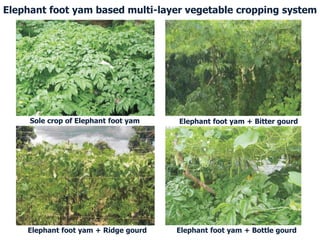
Sole crop of Elephant foot yam Elephant foot yam + Bitter gourd
Elephant foot yam + Ridge gourd Elephant foot yam + Bottle gourd
Elephant foot yam based multi-layer vegetable cropping system
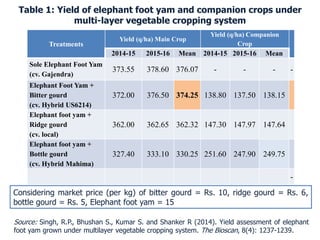
Considering market price (per kg) of bitter gourd = Rs. 10, ridge gourd = Rs. 6,
bottle gourd = Rs. 5, Elephant foot yam = 15
Treatments
Yield (q/ha) Main Crop
Yield (q/ha) Companion
Crop
2014-15 2015-16 Mean 2014-15 2015-16 Mean
Sole Elephant Foot Yam
(cv. Gajendra)
373.55 378.60 376.07 - - - -
Elephant Foot Yam +
Bitter gourd
(cv. Hybrid US6214)
372.00 376.50 374.25 138.80 137.50 138.15
Elephant foot yam +
Ridge gourd
(cv. local)
362.00 362.65 362.32 147.30 147.97 147.64
Elephant foot yam +
Bottle gourd
(cv. Hybrid Mahima)
327.40 333.10 330.25 251.60 247.90 249.75
-
Source: Singh, R.P., Bhushan S., Kumar S. and Shanker R (2014). Yield assessment of elephant
foot yam grown under multilayer vegetable cropping system. The Bioscan, 8(4): 1237-1239.
Table 1: Yield of elephant foot yam and companion crops under
multi-layer vegetable cropping system
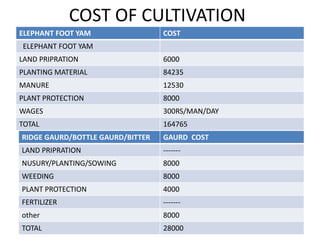
COST OF CULTIVATION
ELEPHANT FOOT YAM COST
ELEPHANT FOOT YAM
LAND PRIPRATION 6000
PLANTING MATERIAL 84235
MANURE 12530
PLANT PROTECTION 8000
WAGES 300RS/MAN/DAY
TOTAL 164765
RIDGE GAURD/BOTTLE GAURD/BITTER GAURD COST
LAND PRIPRATION -------
NUSURY/PLANTING/SOWING 8000
WEEDING 8000
PLANT PROTECTION 4000
FERTILIZER -------
other 8000
TOTAL 28000
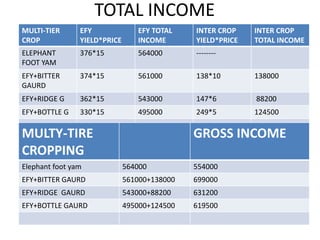
TOTAL INCOME
MULTI-TIER
CROP
EFY
YIELD*PRICE
EFY TOTAL
INCOME
INTER CROP
YIELD*PRICE
INTER CROP
TOTAL INCOME
ELEPHANT
FOOT YAM
376*15 564000 --------
EFY+BITTER
GAURD
374*15 561000 138*10 138000
EFY+RIDGE G 362*15 543000 147*6 88200
EFY+BOTTLE G 330*15 495000 249*5 124500
MULTY-TIRE
CROPPING
GROSS INCOME
Elephant foot yam 564000 554000
EFY+BITTER GAURD 561000+138000 699000
EFY+RIDGE GAURD 543000+88200 631200
EFY+BOTTLE GAURD 495000+124500 619500
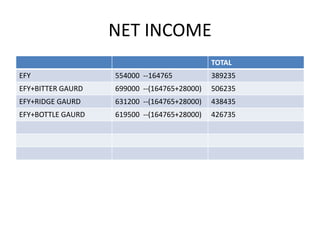
NET INCOME
TOTAL
EFY 554000 --164765 389235
EFY+BITTER GAURD 699000 --(164765+28000) 506235
EFY+RIDGE GAURD 631200 --(164765+28000) 438435
EFY+BOTTLE GAURD 619500 --(164765+28000) 426735
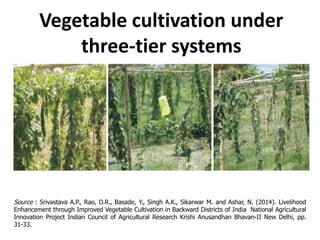
Vegetable cultivation under
three-tier systems
Source : Srivastava A.P., Rao, D.R., Basade, Y., Singh A.K., Sikarwar M. and Ashar, N. (2014). Livelihood
Enhancement through Improved Vegetable Cultivation in Backward Districts of India National Agricultural
Innovation Project Indian Council of Agricultural Research Krishi Anusandhan Bhavan-II New Delhi, pp.
31-33.
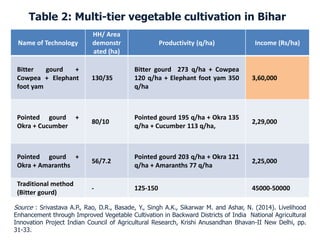
Name of Technology
HH/ Area
demonstr
ated (ha)
Productivity (q/ha) Income (Rs/ha)
Bitter gourd +
Cowpea + Elephant
foot yam
130/35
Bitter gourd 273 q/ha + Cowpea
120 q/ha + Elephant foot yam 350
q/ha
3,60,000
Pointed gourd +
Okra + Cucumber
80/10
Pointed gourd 195 q/ha + Okra 135
q/ha + Cucumber 113 q/ha,
2,29,000
Pointed gourd +
Okra + Amaranths
56/7.2
Pointed gourd 203 q/ha + Okra 121
q/ha + Amaranths 77 q/ha
2,25,000
Traditional method
(Bitter gourd)
- 125-150 45000-50000
Table 2: Multi-tier vegetable cultivation in Bihar
Source : Srivastava A.P., Rao, D.R., Basade, Y., Singh A.K., Sikarwar M. and Ashar, N. (2014). Livelihood
Enhancement through Improved Vegetable Cultivation in Backward Districts of India National Agricultural
Innovation Project Indian Council of Agricultural Research, Krishi Anusandhan Bhavan-II New Delhi, pp.
31-33.
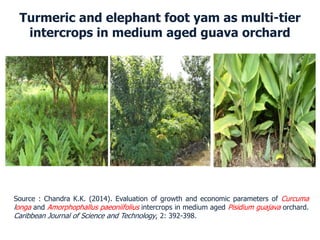
Turmeric and elephant foot yam as multi-tier
intercrops in medium aged guava orchard
Source : Chandra K.K. (2014). Evaluation of growth and economic parameters of Curcuma
longa and Amorphophallus paeoniifolius intercrops in medium aged Pisidium guajava orchard.
Caribbean Journal of Science and Technology, 2: 392-398.
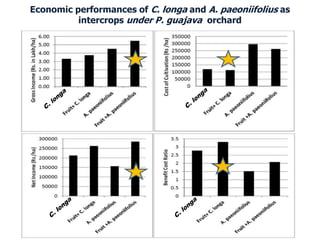
Economic performances of C. longa and A. paeoniifolius as
intercrops under P. guajava orchard
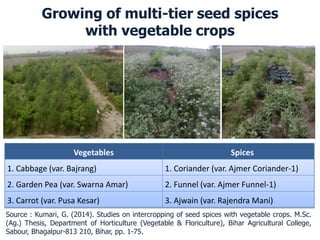
Growing of multi-tier seed spices
with vegetable crops
Source : Kumari, G. (2014). Studies on intercropping of seed spices with vegetable crops. M.Sc.
(Ag.) Thesis, Department of Horticulture (Vegetable & Floriculture), Bihar Agricultural College,
Sabour, Bhagalpur-813 210, Bihar, pp. 1-75.
Vegetables Spices
1. Cabbage (var. Bajrang) 1. Coriander (var. Ajmer Coriander-1)
2. Garden Pea (var. Swarna Amar) 2. Funnel (var. Ajmer Funnel-1)
3. Carrot (var. Pusa Kesar) 3. Ajwain (var. Rajendra Mani)
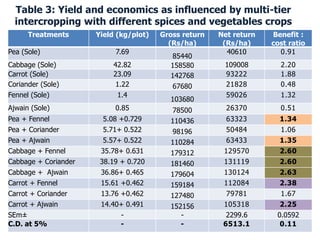
Treatments Yield (kg/plot) Gross return
(Rs/ha)
Net return
(Rs/ha)
Benefit :
cost ratio
Pea (Sole) 7.69
85440
40610 0.91
Cabbage (Sole) 42.82 158580 109008 2.20
Carrot (Sole) 23.09 142768 93222 1.88
Coriander (Sole) 1.22 67680 21828 0.48
Fennel (Sole) 1.4
103680
59026 1.32
Ajwain (Sole) 0.85 78500 26370 0.51
Pea + Fennel 5.08 +0.729 110436 63323 1.34
Pea + Coriander 5.71+ 0.522 98196 50484 1.06
Pea + Ajwain 5.57+ 0.522 110284 63433 1.35
Cabbage + Fennel 35.78+ 0.631 179312 129570 2.60
Cabbage + Coriander 38.19 + 0.720 181460 131119 2.60
Cabbage + Ajwain 36.86+ 0.465 179604 130124 2.63
Carrot + Fennel 15.61 +0.462 159184 112084 2.38
Carrot + Coriander 13.76 +0.462 127480 79781 1.67
Carrot + Ajwain 14.40+ 0.491 152156 105318 2.25
SEm± - - 2299.6 0.0592
C.D. at 5% - - 6513.1 0.11
Table 3: Yield and economics as influenced by multi-tier
intercropping with different spices and vegetables crops
Vegetables having high yield potential and short duration in
nature are the most suitable multi-tier intercrops.
Provides income, employment and enough food for consumption.
Better and sustainable use of the inputs, i.e., soil, water, air,
space, solar radiation, etc.
Reduce insecurity of mono-cropping.
Higher production, economic return and resource utilization.
Channelizing the dynamic energy of rural youth towards
conventional farming for higher income generation and livelihood
security.
Summary and conclusion
Multi tier cropping system

Multi tier cropping system

  • 1.
    Multi-tier cropping systemfor profitability and scalability in vegetable production Akash trivedi (14010) Bsc(ag)4th year Department of extention Institute of Agricultural science, BHU varanasi presented to- prof- o.p.mishra Dr.-B. jirli
  • 2.
    The average sizeof holdings was 2.28 hectares in 1970-71 which was reduced to 1.82 hectares in 1980-81 and 1.50 hectares in 1995-96. The size of the holdings will further decrease with the infinite Sub-division of the land holdings. The problem of small and fragmented holdings is more serious in densely populated and intensively cultivated states like Kerala, West Bengal, Bihar and eastern part of Uttar Pradesh where the average size of land holdings is less than one hectare and in certain parts it is less than even 0.5 hectare. The main reason for this sad state of affairs is our inheritance laws. The land belonging to the father is equally distributed among his sons. This distribution of land does not entail a collection or consolidated one, but its nature is fragmented. Situation of land holding in india
  • 3.
    Two or morecrops of different heights are grown simultaneously on a piece of land in a certain period. Sunlight, nutrient, land, water, and space are utilized in the most efficient and economic way. Increased biological diversity and higher production stability (Singh et al., 2014). Improve soil health and physical property of soil. Multi-storied /multi-tier/ multi-layer cropping system
  • 4.
    Okra + Radish+ Cluster Bean + Beet Root Okra + Radish + Beetroot + Coriander Pointed Gourd + Elephant Foot Yam + Cucumber Banana + Cauliflower + Beet Root Guava + Turmeric + Elephant Foot Yam Elephant Foot Yam + Okra + Ridge Gourd Potato + Sweet Corn + Okra Papaya/ Banana + Elephant Foot Yam Papaya/ Banana + Ginger + Colocasia Sugarcane + Okra + Onion Examples of vegetable based multi-storied cropping system
  • 5.
    Better use ofgrowth resources including sunlight, nutrient and water. Yield stability (suppress the growth of weeds). Ecological stability i.e. improved soil health and agro-ecosystem. Flow of income during cropping periods. Other miscellaneous benefits like distribution of labour, physical support of one crop to another and home gardening leading to more food supply. Advantages of multi-storied cropping system
  • 6.
    Labour intensive. Chemical controlof weeds, pests and diseases may be difficult. Difficulty in mechanization. Adverse competitive effect or by allelopathy. Disadvantages of multi-storied cropping
  • 7.
    Elephant foot yam:A profitable crop for vegetable based multi-tier cropping system Pointed gourd + Elephant foot yam + Cowpea/ bitter gourd Selection of varieties: Elephant foot yam : Gajendra, Sree Padma, Kusum Pointed gourd : Rajendra Parwal-1, Rajendra Parwal-2 Bitter gourd : Pusa Do Mausami, Pusa Vishesh Cowpea : Kashi Kanchan, Kashi Gauri, Arka Garima
  • 8.
    Introduction • Common name– Elephant-foot-yam, Suran, Amorphophallus, Kuch, Jimmikand. • Botanical name – Amorphophallus campanulatus Amorphophallus paeoniifolius • Origin – Tropical Asia and Africa (India & Sri Lanka)
  • 10.
    Continued..... • It isa highly potential tropical tuber crop. • In India, it has attained the status of a cash crop and the area under its cultivation is increasing fast. • This crop also offers excellent export potential from India, since it is not generally cultivated commercially in other countries. • The crop is gaining popularity due to its shade tolerance, easiness in cultivation, high productivity, less incidence of pests and diseases, steady demand and reasonably good price.
  • 11.
    Distribution • It hasnow become a very popular vegetable in certain areas of the tropical and subtropical regions. • It is a crop of South-East Asian origin, growing wild in the Philippines, Malaysia, and Indonesia and South- eastern Asian countries. • It is commercially grown in India, Sri Lanka, China, Malaysia, Java, Philippines and Ceylon. • In India, it is cultivated on large scale in Andhra Pradesh, Bihar, Gujarat, Maharashtra and West Bengal.
  • 12.
    Elephant foot yambased multi-tier vegetable cropping system Source : Singh et al. (2014). Technology identified for enhanced productivity, Zonal Project Director Zone II, Kolkata, W.B., pp. 13. Vegetables like bitter gourd, ridge gourd and bottle gourd were cultivated making bamboo structure (machan). The vacant space below the machan was fully utilized in this method. Bitter gourd and elephant foot yam - best in respect of average return.
  • 13.
    Sole crop ofElephant foot yam Elephant foot yam + Bitter gourd Elephant foot yam + Ridge gourd Elephant foot yam + Bottle gourd Elephant foot yam based multi-layer vegetable cropping system
  • 14.
    Considering market price(per kg) of bitter gourd = Rs. 10, ridge gourd = Rs. 6, bottle gourd = Rs. 5, Elephant foot yam = 15 Treatments Yield (q/ha) Main Crop Yield (q/ha) Companion Crop 2014-15 2015-16 Mean 2014-15 2015-16 Mean Sole Elephant Foot Yam (cv. Gajendra) 373.55 378.60 376.07 - - - - Elephant Foot Yam + Bitter gourd (cv. Hybrid US6214) 372.00 376.50 374.25 138.80 137.50 138.15 Elephant foot yam + Ridge gourd (cv. local) 362.00 362.65 362.32 147.30 147.97 147.64 Elephant foot yam + Bottle gourd (cv. Hybrid Mahima) 327.40 333.10 330.25 251.60 247.90 249.75 - Source: Singh, R.P., Bhushan S., Kumar S. and Shanker R (2014). Yield assessment of elephant foot yam grown under multilayer vegetable cropping system. The Bioscan, 8(4): 1237-1239. Table 1: Yield of elephant foot yam and companion crops under multi-layer vegetable cropping system
  • 15.
    COST OF CULTIVATION ELEPHANTFOOT YAM COST ELEPHANT FOOT YAM LAND PRIPRATION 6000 PLANTING MATERIAL 84235 MANURE 12530 PLANT PROTECTION 8000 WAGES 300RS/MAN/DAY TOTAL 164765 RIDGE GAURD/BOTTLE GAURD/BITTER GAURD COST LAND PRIPRATION ------- NUSURY/PLANTING/SOWING 8000 WEEDING 8000 PLANT PROTECTION 4000 FERTILIZER ------- other 8000 TOTAL 28000
  • 16.
    TOTAL INCOME MULTI-TIER CROP EFY YIELD*PRICE EFY TOTAL INCOME INTERCROP YIELD*PRICE INTER CROP TOTAL INCOME ELEPHANT FOOT YAM 376*15 564000 -------- EFY+BITTER GAURD 374*15 561000 138*10 138000 EFY+RIDGE G 362*15 543000 147*6 88200 EFY+BOTTLE G 330*15 495000 249*5 124500 MULTY-TIRE CROPPING GROSS INCOME Elephant foot yam 564000 554000 EFY+BITTER GAURD 561000+138000 699000 EFY+RIDGE GAURD 543000+88200 631200 EFY+BOTTLE GAURD 495000+124500 619500
  • 17.
    NET INCOME TOTAL EFY 554000--164765 389235 EFY+BITTER GAURD 699000 --(164765+28000) 506235 EFY+RIDGE GAURD 631200 --(164765+28000) 438435 EFY+BOTTLE GAURD 619500 --(164765+28000) 426735
  • 18.
    Vegetable cultivation under three-tiersystems Source : Srivastava A.P., Rao, D.R., Basade, Y., Singh A.K., Sikarwar M. and Ashar, N. (2014). Livelihood Enhancement through Improved Vegetable Cultivation in Backward Districts of India National Agricultural Innovation Project Indian Council of Agricultural Research Krishi Anusandhan Bhavan-II New Delhi, pp. 31-33.
  • 19.
    Name of Technology HH/Area demonstr ated (ha) Productivity (q/ha) Income (Rs/ha) Bitter gourd + Cowpea + Elephant foot yam 130/35 Bitter gourd 273 q/ha + Cowpea 120 q/ha + Elephant foot yam 350 q/ha 3,60,000 Pointed gourd + Okra + Cucumber 80/10 Pointed gourd 195 q/ha + Okra 135 q/ha + Cucumber 113 q/ha, 2,29,000 Pointed gourd + Okra + Amaranths 56/7.2 Pointed gourd 203 q/ha + Okra 121 q/ha + Amaranths 77 q/ha 2,25,000 Traditional method (Bitter gourd) - 125-150 45000-50000 Table 2: Multi-tier vegetable cultivation in Bihar Source : Srivastava A.P., Rao, D.R., Basade, Y., Singh A.K., Sikarwar M. and Ashar, N. (2014). Livelihood Enhancement through Improved Vegetable Cultivation in Backward Districts of India National Agricultural Innovation Project Indian Council of Agricultural Research, Krishi Anusandhan Bhavan-II New Delhi, pp. 31-33.
  • 20.
    Turmeric and elephantfoot yam as multi-tier intercrops in medium aged guava orchard Source : Chandra K.K. (2014). Evaluation of growth and economic parameters of Curcuma longa and Amorphophallus paeoniifolius intercrops in medium aged Pisidium guajava orchard. Caribbean Journal of Science and Technology, 2: 392-398.
  • 21.
    Economic performances ofC. longa and A. paeoniifolius as intercrops under P. guajava orchard
  • 22.
    Growing of multi-tierseed spices with vegetable crops Source : Kumari, G. (2014). Studies on intercropping of seed spices with vegetable crops. M.Sc. (Ag.) Thesis, Department of Horticulture (Vegetable & Floriculture), Bihar Agricultural College, Sabour, Bhagalpur-813 210, Bihar, pp. 1-75. Vegetables Spices 1. Cabbage (var. Bajrang) 1. Coriander (var. Ajmer Coriander-1) 2. Garden Pea (var. Swarna Amar) 2. Funnel (var. Ajmer Funnel-1) 3. Carrot (var. Pusa Kesar) 3. Ajwain (var. Rajendra Mani)
  • 23.
    Treatments Yield (kg/plot)Gross return (Rs/ha) Net return (Rs/ha) Benefit : cost ratio Pea (Sole) 7.69 85440 40610 0.91 Cabbage (Sole) 42.82 158580 109008 2.20 Carrot (Sole) 23.09 142768 93222 1.88 Coriander (Sole) 1.22 67680 21828 0.48 Fennel (Sole) 1.4 103680 59026 1.32 Ajwain (Sole) 0.85 78500 26370 0.51 Pea + Fennel 5.08 +0.729 110436 63323 1.34 Pea + Coriander 5.71+ 0.522 98196 50484 1.06 Pea + Ajwain 5.57+ 0.522 110284 63433 1.35 Cabbage + Fennel 35.78+ 0.631 179312 129570 2.60 Cabbage + Coriander 38.19 + 0.720 181460 131119 2.60 Cabbage + Ajwain 36.86+ 0.465 179604 130124 2.63 Carrot + Fennel 15.61 +0.462 159184 112084 2.38 Carrot + Coriander 13.76 +0.462 127480 79781 1.67 Carrot + Ajwain 14.40+ 0.491 152156 105318 2.25 SEm± - - 2299.6 0.0592 C.D. at 5% - - 6513.1 0.11 Table 3: Yield and economics as influenced by multi-tier intercropping with different spices and vegetables crops
  • 24.
    Vegetables having highyield potential and short duration in nature are the most suitable multi-tier intercrops. Provides income, employment and enough food for consumption. Better and sustainable use of the inputs, i.e., soil, water, air, space, solar radiation, etc. Reduce insecurity of mono-cropping. Higher production, economic return and resource utilization. Channelizing the dynamic energy of rural youth towards conventional farming for higher income generation and livelihood security. Summary and conclusion