SUGARCANE
(Saccharum sp.)
Submitted to:Dr. Gargi Goswami
Dr. Deepa Joshi
Submitted by: Sunil Kumar
Id-16013
Sugarcane
 Botanical name- Saccharum officinarum L.
 Family - Poaceae
 Origin - New Guinea
 Chromosome no.(2n)- 80
INTRODUCTION։-
 Sugarcane is main source of sugar in India and holds a prominent position as a cash crop.
 India ranks first in sugar production in the world(1979).
 Sugar juice is used for making white sugar, brown sugar (khandsari) and jiggery (gur).
 The main byproducts of the sugarcane industry are bagasse and molasses.
 Bagasse is mainly used as a fuel and also used for the production of compressed fibre
board, paper, plastics and furfural.
 Molasses is used in distilleries for the manufacture of ethyl alcohol, butyl alcohol, citric
acid etc.
 Green tops of cane are a good source of fodder for cattle.
 Pressmud is used as a manure in alkaline and saline soils.
AREA AND DISTRIBUTION:-
 Sugarcane is grown over the land surface of the earth
between latitudes 35ºn and 35ºs.
 The important sugarcane producing countries in the world
are India, Brazil, Cuba, Mexico, Pakistan, china,
Philippines and Thailand.
 In India, Uttar Pradesh has the largest acrease under
sugarcane, but production per hectare is the highest in
Tamil Nadu.
CLASSIFICATION:-
 Sugarcane belongs to the genus Saccharum in the family Poaceae.
 Cultivated sugarcane is classified into three species.
1. Saccharum officinarum
2. Saccharum sinense
3. Seccharum barberi
 Saccharum officinarum:-
These are thick and juicy canes good for chewing purpuse also.
These are generally resistant to smut but are susceptible to red rot and mosaic diseases.
This species canes are indigenous to the New Guinea.
 Saccharum sinense:-
The species is characterised by long and thin stalks, broad leaves, low to medium sucrose
content and early maturity.
Internodes of these canes are long and more or less zigzag and nodes are prominent.
Origin-North-Eastern India.
 Saccharum barberi :-
It is characterised by short and thin stalks, narrow leaves, low to medium sucrose content,
early maturity.
Origin-North-Eastern India
Adsali Sugarcane
 Adsali planting is mainly followed in low rainfall areas of Maharashtra .
 Planting is done in July – August and the crop remains for 18 month in the field .
 Adsali planting is done on the sides of ridges and not at the bottom if there is
continuous rain to avoid water logging condition.
Eksali sugarcane
 Spring planted crop is known as suru in Maharashtra and eksali in Gujarat and
Andhra Pradesh .
 The planting is done in Feb-March in northern India and Jan-Feb in Peninsular India
 The crop remains for 12 month in the field,
CLIMATIC REQUIREMENTS:-
 Sugarcane is a tropical plant. It grows most in those regions where
the climate is more or less tropical but it can grow in subtropical
too as in north India.
 Average mean temp. of 26 to 32ºc is best suited for the growth of
sugarcane.
 Temperature above 50ºc arrest its growth; those below 20ºc slow it
down.
 Low temp. Reduces tilling.
 A rainfall of 75 to 120 cm required per annum.
 Plant grown under long day conditions produce more dry matter.
SOIL
 Sugarcane can be grown on all types of soils ranging
from sandy loam to clay loam.
 It, however, thrives best on well drained loamy soils.
 It can also be raised successfully on lighter soils
provided there is a adequate irrigation facilities.
 Saline, alkaline, and acidic soils are not at all suitable
for this crop.
VARIETIES:-
state Early ripening varieties Mid-late ripening varieties
Andhra Pradesh CoC 671,Co 7704, BO 90,BO 99 Co 7219,Co 7805,Co 8021
Bihar BO 90,BO 99, BO 102,BO 120 BO 91,BO 104,BO 108,BO 110
Haryana CoH 56, CoJ 64, CoH 99 CoH 35, CoS 767, Co 1158
Karnataka Co 419, Co 6415, Co 7219 Co 449, Co 740, Co 62175
Maharashtra Co 419, Co 7219 Co 678, Co 740, Co 7527,
Punjab CoJ 64, CoJ 83,CoJ 86 CoJ 79, CoJ 84, CoJ 83
Tamil Nadu CoC 671, CoC 771, CoC 8001 CoC 772, CoC 773,CoC
774,CoC 775
Uttar Pradesh CoJ 64, CoS 687,CoS 8436, CoS
88230, CoS 90265
CoS 8432, CoP 84212, CoS
88216
Water logged area of U.P
―
Up 9529, Up 9530, CoS 94636
Cropping system
 In North India, Sugarcane is generally grown after harvest
of cotton, paddy, maize, sorghum, potato, pea, wheat,
etc . The common cropping systems followed in North
India are given below.
 Maize –Potato-Sugarcane 2 Year
 Maize – Sugarcane- Wheat 2 year
 Rice – Sugarcane- Wheat 2 year
 Sorghum(fodder)-Potato-Sugarcane-Wheat 3 year
 Rice- chick pea-Sugarcane-ratoon-wheat 3 year
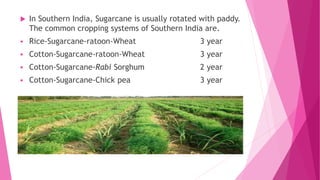
 In Southern India, Sugarcane is usually rotated with paddy.
The common cropping systems of Southern India are.
 Rice-Sugarcane-ratoon-Wheat 3 year
 Cotton-Sugarcane-ratoon-Wheat 3 year
 Cotton-Sugarcane-Rabi Sorghum 2 year
 Cotton-Sugarcane-Chick pea 3 year
Field Preparation
 Sugarcane requires a very thorough and clean preparation
of land.
 Sugarcane needs deep tillage .
 Deep ploughing specially in heavy soils help in the root
system penetrating deep in to the soil.
 At least one or two deep ploughings and one cross
ploughing with a mould board plough is essential.
 Planking should be done to make the field smooth and
clod-free.
SEED AND SOWING
Seed Selection
 Healthy seed material, free from pests and diseases like
red rot, wilt, smut, ratoon stunting etc., should be
selected for seed purpose.
 The top one-third to half portion of a cane being
comparatively immature has buds of high viability and is
best for sowing.
 Bottom portion of cane is rich in sugar and takes a long
time in germination.
 Seed cane should be taken from well mannered, erect
and healthy crop of not more than 10-12 months age.
Seed Preparation and Treatment
 Before planting, the dry leaves of the cane stalks are
removed by hand In order to avoid any possible damage
to buds.
 Thereafter cane is cut into three budded setts usually
30 to 45 cm long. About 35000 to 40000 setts are
needed to plant one hectare which can be obtained
from about 75-80 q of cane.
 To prevent the seed setts being attacked by fungal
diseases and also to improve germination, the seed
setts are dipped into 0.5 per cent solution of Agallol
(3%) or 0.25 per cent solution of Aretan (6%) or Tafasan
(6%) before planting.
Time of Planting
 In India, Sugarcane is planted thrice a year in October (autumn),
February-March (spring) and July (adsali).
 Adsali planting is quite common in Maharashtra.
 Autumn and spring plantings are more common in northern India.
 Under North Indian conditions, Sugarcane is planted in spring.
 March is the best time for cane planting in Punjab and Haryana.
 February-March in Uttar Pradesh and January-February in Bihar.
 In Tamil Nadu, Andhra Pradesh, Maharashtra and Karnataka cane
planting is done in December-February.
Methods of Planting
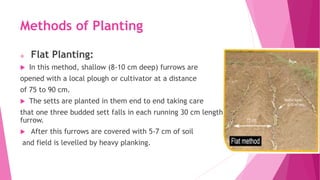
 Flat Planting:
 In this method, shallow (8-10 cm deep) furrows are
opened with a local plough or cultivator at a distance
of 75 to 90 cm.
 The setts are planted in them end to end taking care
that one three budded sett falls in each running 30 cm length of
furrow.
 After this furrows are covered with 5-7 cm of soil
and field is levelled by heavy planking.
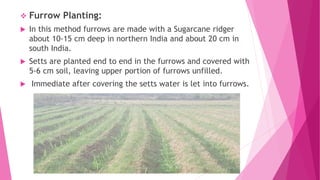
 Furrow Planting:
 In this method furrows are made with a Sugarcane ridger
about 10-15 cm deep in northern India and about 20 cm in
south India.
 Setts are planted end to end in the furrows and covered with
5-6 cm soil, leaving upper portion of furrows unfilled.
 Immediate after covering the setts water is let into furrows.
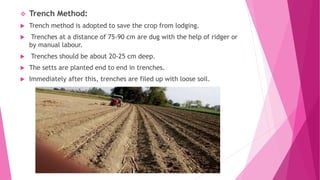
 Trench Method:
 Trench method is adopted to save the crop from lodging.
 Trenches at a distance of 75-90 cm are dug with the help of ridger or
by manual labour.
 Trenches should be about 20-25 cm deep.
 The setts are planted end to end in trenches.
 Immediately after this, trenches are filed up with loose soil.
MANURES AND FERTILISERS
 Sugarcane is a heavy feeder crop.
 FYM is added one month before planting @ 10-12
ton/ha.
 For general 300:80:80 kg/ha NPK and 80 kg Calcium /ha
are applied .
 Nitrogen is applied in split doses .
 The application of fertilizers at the early stage of plant
growth is advantageous , and increase sucrose contents
in juice.
WEED CONTROL
 Weed control in sugarcane is accomplished by adopting mechanical or
chemical methods .
 2,4-D is very effective against broadleaf weeds .It should be applied
25-30 days after planting or before the weed attain 3-4 leaf stage @
1kg a.i./500-600L of water.
 To control weeds in spring cane , spray 2 kg a.i. of atrazine 500-600 L
of water /ha just after planting controls almost all the weeds.
WATER MANAGEMENT
 Judicious use of water is one of the main factors which
governs the cane yields and sugar recovery.
 The life cycle of sugarcane plant is divided into four
distinct phases namely
1. Germination phase (from planting to 60th day).
2. Formative phase (from 60th day of planting to
130th day).
3. Grand phase (from 130th to 250th day).
4. Maturity phase (250th to 365th day).
 The water requirement during formative phase and grand
growth phase is maximum.
 The water requirement of the crop varies greatly with growth
phase and environmental conditions, particularly climate and soil
type.
 The total water requirement for sugarcane varies from 200-300
cm.
 In northern India , autumn cane requires on an average seven
irrigations, while spring planted crop may be irrigated only six
times.
 In drier climate and light soils, the crop may require 8 to 10
irrigations.
 In each irrigation, 3 acre inch of water should be applied.
EARTHING AND TYING
 Earthing is needed where crop is planted by flat system.
 Earthing should be done in the month of June-July after giving final top
dressing of nitrogenous fertiliser. About 15 centimetre high loose soil dug from
the centre of rows should be put along the lines of sugarcane.
 Earthing up of the crop prevents lodging or the cane.
 Varieties of sugarcane that possess soft rinds and are raised under good crop
management frequently lodge and therefore need tying up.
 This is done by tying together the canes of several clumps. Tying should be
done in August when cane reaches about 2 metres height.

Earthing up in sugarcane Tying in sugarcane
DISEASES
 Red rot
caused by -Collectotrichum falcatum
In the initial stages, loss of colour and withering of leaves,
third and fourth from the top, is seen. In the later stages,
the stalk becomes dry, wrinkled and hollow
CONTROL:- Do not ratoon the diseased crop
Dip the setts in 0.25 per cent solution of mercurial
compounds tike Agallol or Aretan for five minutes
 Smut
Caused by:-Ustilago scitaminea
. The disease appears in the form of a
'long, black whip-like structure at the apex of the stalk
Control:-Use only smut free canes for planting.
No ratoon should be kept where the incidence of disease is
high.
 Red Stripe
Caused by:- Xanthomonas rubrilineans.
. The affected leaves show bright red streaks which
are long and narrow and run along the length of the
leaves.
Control:- Rogue out the affected tops of the canes
and burn them. Select well drained fields for cane
planting.
Insect Pest
 Early Shoot Borer and Root Borer
Control :-Spray 1.5 litres of Endosulfan 35 EC or
Monocrotophos 36 EC (Nuvacron) in 600 litres of water
when eggs or moths are visible in the field.
 Sugarcane Whitefly
Control :-Spray the crop with 1.5 litres of Endosulfan
35 EC or Monocrotophos (Nuvacron) 36 EC in 1000
litres of water per hectare.
HARVESTING
 The sugar content of juice continues to rise till about the
end of March. The maturity of sugarcane is generally
recognised by the lower leaves gradually withering up and
leaving fewer green leaves at the top.
 Stalks are cut at the ground level, preferably after digging
down the earthed up ridges.
 The dried leaves are stripped off from the cane and green
top is cut from the topmost part of the cane and clean
canes are tied up in bundles.
RATOONING
 Ratooning is a practice of growing a crop from the stubbles of
previous crop.
 It is economical to take only one ratoon.
 The second and subsequent ratoons are not advised because of
the risk of pests and diseases accumulating and being carried
to the next crop
 Harvest the canes as close to the ground as possible to
promote better sprouting.
Yield
 The average yield of 11 to 12 months old plant crop in
northern India ranges from 400 to 500 quintals of cane.
 A good crop under good management may yield about 800
to 1000 quintals per hectare.
 The 18 month (adsali) crop in southern India especially in
Maharashtra and Tamil Nadu usually give a 1000 to 1200
quintals of cane per hectare.
 Ratoon crop ordinarily give a somewhat lower yield than
the plant crop.
References
 Singh, Chhida. Singh, Kumar. Singh, Rajbir. 2003. Modern Techniques of
Raising Field Crops.(Edn.2nd). Oxford & IBH Publishing Co. Pvt. Ltd. New
Delhi. p(465-489).


Sugarcane

  • 1.
    SUGARCANE (Saccharum sp.) Submitted to:Dr.Gargi Goswami Dr. Deepa Joshi Submitted by: Sunil Kumar Id-16013
  • 2.
    Sugarcane  Botanical name-Saccharum officinarum L.  Family - Poaceae  Origin - New Guinea  Chromosome no.(2n)- 80
  • 3.
    INTRODUCTION։-  Sugarcane ismain source of sugar in India and holds a prominent position as a cash crop.  India ranks first in sugar production in the world(1979).  Sugar juice is used for making white sugar, brown sugar (khandsari) and jiggery (gur).  The main byproducts of the sugarcane industry are bagasse and molasses.  Bagasse is mainly used as a fuel and also used for the production of compressed fibre board, paper, plastics and furfural.  Molasses is used in distilleries for the manufacture of ethyl alcohol, butyl alcohol, citric acid etc.  Green tops of cane are a good source of fodder for cattle.  Pressmud is used as a manure in alkaline and saline soils.
  • 4.
    AREA AND DISTRIBUTION:- Sugarcane is grown over the land surface of the earth between latitudes 35ºn and 35ºs.  The important sugarcane producing countries in the world are India, Brazil, Cuba, Mexico, Pakistan, china, Philippines and Thailand.  In India, Uttar Pradesh has the largest acrease under sugarcane, but production per hectare is the highest in Tamil Nadu.
  • 5.
    CLASSIFICATION:-  Sugarcane belongsto the genus Saccharum in the family Poaceae.  Cultivated sugarcane is classified into three species. 1. Saccharum officinarum 2. Saccharum sinense 3. Seccharum barberi  Saccharum officinarum:- These are thick and juicy canes good for chewing purpuse also. These are generally resistant to smut but are susceptible to red rot and mosaic diseases. This species canes are indigenous to the New Guinea.
  • 6.
     Saccharum sinense:- Thespecies is characterised by long and thin stalks, broad leaves, low to medium sucrose content and early maturity. Internodes of these canes are long and more or less zigzag and nodes are prominent. Origin-North-Eastern India.  Saccharum barberi :- It is characterised by short and thin stalks, narrow leaves, low to medium sucrose content, early maturity. Origin-North-Eastern India
  • 7.
    Adsali Sugarcane  Adsaliplanting is mainly followed in low rainfall areas of Maharashtra .  Planting is done in July – August and the crop remains for 18 month in the field .  Adsali planting is done on the sides of ridges and not at the bottom if there is continuous rain to avoid water logging condition. Eksali sugarcane  Spring planted crop is known as suru in Maharashtra and eksali in Gujarat and Andhra Pradesh .  The planting is done in Feb-March in northern India and Jan-Feb in Peninsular India  The crop remains for 12 month in the field,
  • 8.
    CLIMATIC REQUIREMENTS:-  Sugarcaneis a tropical plant. It grows most in those regions where the climate is more or less tropical but it can grow in subtropical too as in north India.  Average mean temp. of 26 to 32ºc is best suited for the growth of sugarcane.  Temperature above 50ºc arrest its growth; those below 20ºc slow it down.  Low temp. Reduces tilling.  A rainfall of 75 to 120 cm required per annum.  Plant grown under long day conditions produce more dry matter.
  • 9.
    SOIL  Sugarcane canbe grown on all types of soils ranging from sandy loam to clay loam.  It, however, thrives best on well drained loamy soils.  It can also be raised successfully on lighter soils provided there is a adequate irrigation facilities.  Saline, alkaline, and acidic soils are not at all suitable for this crop.
  • 10.
    VARIETIES:- state Early ripeningvarieties Mid-late ripening varieties Andhra Pradesh CoC 671,Co 7704, BO 90,BO 99 Co 7219,Co 7805,Co 8021 Bihar BO 90,BO 99, BO 102,BO 120 BO 91,BO 104,BO 108,BO 110 Haryana CoH 56, CoJ 64, CoH 99 CoH 35, CoS 767, Co 1158 Karnataka Co 419, Co 6415, Co 7219 Co 449, Co 740, Co 62175 Maharashtra Co 419, Co 7219 Co 678, Co 740, Co 7527, Punjab CoJ 64, CoJ 83,CoJ 86 CoJ 79, CoJ 84, CoJ 83 Tamil Nadu CoC 671, CoC 771, CoC 8001 CoC 772, CoC 773,CoC 774,CoC 775 Uttar Pradesh CoJ 64, CoS 687,CoS 8436, CoS 88230, CoS 90265 CoS 8432, CoP 84212, CoS 88216 Water logged area of U.P ― Up 9529, Up 9530, CoS 94636
  • 11.
    Cropping system  InNorth India, Sugarcane is generally grown after harvest of cotton, paddy, maize, sorghum, potato, pea, wheat, etc . The common cropping systems followed in North India are given below.  Maize –Potato-Sugarcane 2 Year  Maize – Sugarcane- Wheat 2 year  Rice – Sugarcane- Wheat 2 year  Sorghum(fodder)-Potato-Sugarcane-Wheat 3 year  Rice- chick pea-Sugarcane-ratoon-wheat 3 year
  • 12.
     In SouthernIndia, Sugarcane is usually rotated with paddy. The common cropping systems of Southern India are.  Rice-Sugarcane-ratoon-Wheat 3 year  Cotton-Sugarcane-ratoon-Wheat 3 year  Cotton-Sugarcane-Rabi Sorghum 2 year  Cotton-Sugarcane-Chick pea 3 year
  • 13.
    Field Preparation  Sugarcanerequires a very thorough and clean preparation of land.  Sugarcane needs deep tillage .  Deep ploughing specially in heavy soils help in the root system penetrating deep in to the soil.  At least one or two deep ploughings and one cross ploughing with a mould board plough is essential.  Planking should be done to make the field smooth and clod-free.
  • 14.
    SEED AND SOWING SeedSelection  Healthy seed material, free from pests and diseases like red rot, wilt, smut, ratoon stunting etc., should be selected for seed purpose.  The top one-third to half portion of a cane being comparatively immature has buds of high viability and is best for sowing.  Bottom portion of cane is rich in sugar and takes a long time in germination.  Seed cane should be taken from well mannered, erect and healthy crop of not more than 10-12 months age.
  • 15.
    Seed Preparation andTreatment  Before planting, the dry leaves of the cane stalks are removed by hand In order to avoid any possible damage to buds.  Thereafter cane is cut into three budded setts usually 30 to 45 cm long. About 35000 to 40000 setts are needed to plant one hectare which can be obtained from about 75-80 q of cane.  To prevent the seed setts being attacked by fungal diseases and also to improve germination, the seed setts are dipped into 0.5 per cent solution of Agallol (3%) or 0.25 per cent solution of Aretan (6%) or Tafasan (6%) before planting.
  • 16.
    Time of Planting In India, Sugarcane is planted thrice a year in October (autumn), February-March (spring) and July (adsali).  Adsali planting is quite common in Maharashtra.  Autumn and spring plantings are more common in northern India.  Under North Indian conditions, Sugarcane is planted in spring.  March is the best time for cane planting in Punjab and Haryana.  February-March in Uttar Pradesh and January-February in Bihar.  In Tamil Nadu, Andhra Pradesh, Maharashtra and Karnataka cane planting is done in December-February.
  • 17.
    Methods of Planting Flat Planting:  In this method, shallow (8-10 cm deep) furrows are opened with a local plough or cultivator at a distance of 75 to 90 cm.  The setts are planted in them end to end taking care that one three budded sett falls in each running 30 cm length of furrow.  After this furrows are covered with 5-7 cm of soil and field is levelled by heavy planking.
  • 18.
     Furrow Planting: In this method furrows are made with a Sugarcane ridger about 10-15 cm deep in northern India and about 20 cm in south India.  Setts are planted end to end in the furrows and covered with 5-6 cm soil, leaving upper portion of furrows unfilled.  Immediate after covering the setts water is let into furrows.
  • 19.
     Trench Method: Trench method is adopted to save the crop from lodging.  Trenches at a distance of 75-90 cm are dug with the help of ridger or by manual labour.  Trenches should be about 20-25 cm deep.  The setts are planted end to end in trenches.  Immediately after this, trenches are filed up with loose soil.
  • 20.
    MANURES AND FERTILISERS Sugarcane is a heavy feeder crop.  FYM is added one month before planting @ 10-12 ton/ha.  For general 300:80:80 kg/ha NPK and 80 kg Calcium /ha are applied .  Nitrogen is applied in split doses .  The application of fertilizers at the early stage of plant growth is advantageous , and increase sucrose contents in juice.
  • 21.
    WEED CONTROL  Weedcontrol in sugarcane is accomplished by adopting mechanical or chemical methods .  2,4-D is very effective against broadleaf weeds .It should be applied 25-30 days after planting or before the weed attain 3-4 leaf stage @ 1kg a.i./500-600L of water.  To control weeds in spring cane , spray 2 kg a.i. of atrazine 500-600 L of water /ha just after planting controls almost all the weeds.
  • 22.
    WATER MANAGEMENT  Judicioususe of water is one of the main factors which governs the cane yields and sugar recovery.  The life cycle of sugarcane plant is divided into four distinct phases namely 1. Germination phase (from planting to 60th day). 2. Formative phase (from 60th day of planting to 130th day). 3. Grand phase (from 130th to 250th day). 4. Maturity phase (250th to 365th day).  The water requirement during formative phase and grand growth phase is maximum.
  • 23.
     The waterrequirement of the crop varies greatly with growth phase and environmental conditions, particularly climate and soil type.  The total water requirement for sugarcane varies from 200-300 cm.  In northern India , autumn cane requires on an average seven irrigations, while spring planted crop may be irrigated only six times.  In drier climate and light soils, the crop may require 8 to 10 irrigations.  In each irrigation, 3 acre inch of water should be applied.
  • 24.
    EARTHING AND TYING Earthing is needed where crop is planted by flat system.  Earthing should be done in the month of June-July after giving final top dressing of nitrogenous fertiliser. About 15 centimetre high loose soil dug from the centre of rows should be put along the lines of sugarcane.  Earthing up of the crop prevents lodging or the cane.  Varieties of sugarcane that possess soft rinds and are raised under good crop management frequently lodge and therefore need tying up.  This is done by tying together the canes of several clumps. Tying should be done in August when cane reaches about 2 metres height.
  • 25.
     Earthing up insugarcane Tying in sugarcane
  • 26.
    DISEASES  Red rot causedby -Collectotrichum falcatum In the initial stages, loss of colour and withering of leaves, third and fourth from the top, is seen. In the later stages, the stalk becomes dry, wrinkled and hollow CONTROL:- Do not ratoon the diseased crop Dip the setts in 0.25 per cent solution of mercurial compounds tike Agallol or Aretan for five minutes
  • 27.
     Smut Caused by:-Ustilagoscitaminea . The disease appears in the form of a 'long, black whip-like structure at the apex of the stalk Control:-Use only smut free canes for planting. No ratoon should be kept where the incidence of disease is high.
  • 28.
     Red Stripe Causedby:- Xanthomonas rubrilineans. . The affected leaves show bright red streaks which are long and narrow and run along the length of the leaves. Control:- Rogue out the affected tops of the canes and burn them. Select well drained fields for cane planting.
  • 29.
    Insect Pest  EarlyShoot Borer and Root Borer Control :-Spray 1.5 litres of Endosulfan 35 EC or Monocrotophos 36 EC (Nuvacron) in 600 litres of water when eggs or moths are visible in the field.  Sugarcane Whitefly Control :-Spray the crop with 1.5 litres of Endosulfan 35 EC or Monocrotophos (Nuvacron) 36 EC in 1000 litres of water per hectare.
  • 30.
    HARVESTING  The sugarcontent of juice continues to rise till about the end of March. The maturity of sugarcane is generally recognised by the lower leaves gradually withering up and leaving fewer green leaves at the top.  Stalks are cut at the ground level, preferably after digging down the earthed up ridges.  The dried leaves are stripped off from the cane and green top is cut from the topmost part of the cane and clean canes are tied up in bundles.
  • 31.
    RATOONING  Ratooning isa practice of growing a crop from the stubbles of previous crop.  It is economical to take only one ratoon.  The second and subsequent ratoons are not advised because of the risk of pests and diseases accumulating and being carried to the next crop  Harvest the canes as close to the ground as possible to promote better sprouting.
  • 32.
    Yield  The averageyield of 11 to 12 months old plant crop in northern India ranges from 400 to 500 quintals of cane.  A good crop under good management may yield about 800 to 1000 quintals per hectare.  The 18 month (adsali) crop in southern India especially in Maharashtra and Tamil Nadu usually give a 1000 to 1200 quintals of cane per hectare.  Ratoon crop ordinarily give a somewhat lower yield than the plant crop.
  • 33.
    References  Singh, Chhida.Singh, Kumar. Singh, Rajbir. 2003. Modern Techniques of Raising Field Crops.(Edn.2nd). Oxford & IBH Publishing Co. Pvt. Ltd. New Delhi. p(465-489).
  • 34.