Presented by
Shreya Gupta
ID 14146
IAS,BHU
 It is good method for planting sugarcane.
 Yield of sugarcane is 70t/ha in India ,while
theoretical potential yield is 474t/ha.
 ICAR-IISR had developed this technique
(1984)
 Population of main shoot is increased and
tillers are reduced.
 Objective :To increase yield (double).
 Leave 65 cm space around the boundary of the field.
 Mark the field at 105 cm both length and width wise.
 At the cross section of these lines, dig pit of 75 cm
diameter and 30 cm depth with pit digger machine.
 Cane stalks of 2 budded setts is dipped in 0.2 per cent
solution of bavistin (2 g Bavistin in one liter of water).
 In each pit, apply mixture of 3 kg FYM + 20 g DAP + 8
g urea + 16 g MoP + 2g ZnSO4 and mix it with soil.
 Put 20 two-budded setts in a similar pattern as of
spokes in a cyclewheel.
 Spray the solution of 5 liters Chlorpyriphos 20 EC
dissolved in 1500-1600 liters of water on setts for one
ha area.
 Interconnect each pit with narrow channel
manually for irrigating the pits.
 Now cover the setts with 2-5 cm of soil layer.
 Apply light irrigation just after planting.
 Do first filling of pits with dug out soil at 4th leaf
stage (35-40 days after planting in spring
planting), apply light irrigation and topdress 16 g
urea per pit when soil moisture reaches at
workable condition.
 Apply urea @ 16 g per pit and, apply Furadan 3 G
@ 33 kg per ha.The gap of at least 3-4 days must
be kept in application of urea and Furadan.
 Fill the pits with dug out soil completely.
 Carry earthing –up before onset of monsoon.
 Tie cane in each clump in the 1st -2nd week of
August with lower dry leaves.
 In September, tie the clumps of opposite
rows together.
 Remove lower dry leaves.
 Harvest the cane close to the ground level to
take good ratoon crop.
ICGS- Irrigation at critical growth stages, IWUE – Irrigation
water use efficiency
Technology Germination (%)2008-09
Ring pit method of planting 72.8
Skip furrow method of irrigation 37.5
ICGS 39.8
Farmers' Practice 33.6
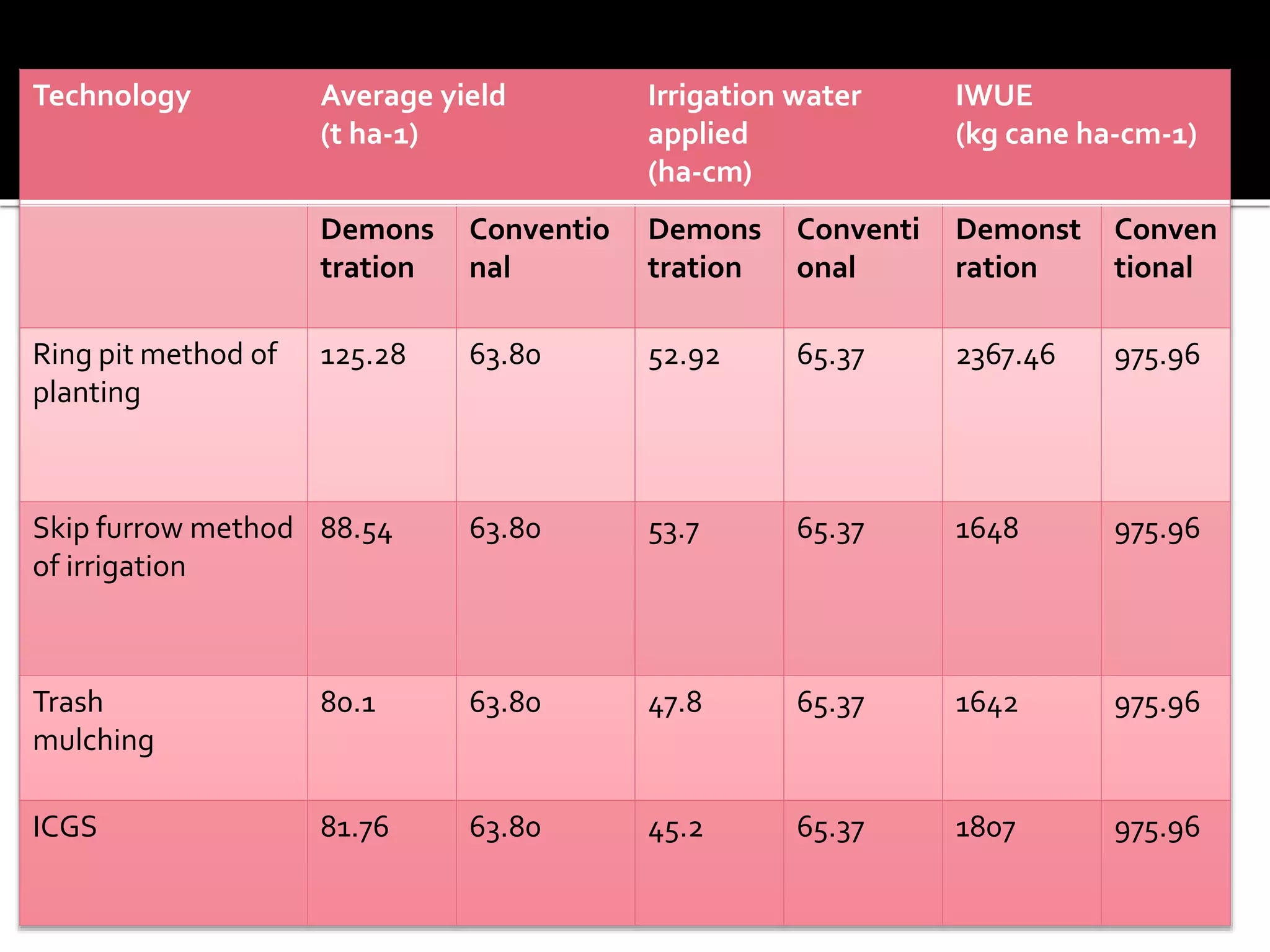
Technology Average yield
(t ha-1)
Irrigation water
applied
(ha-cm)
IWUE
(kg cane ha-cm-1)
Demons
tration
Conventio
nal
Demons
tration
Conventi
onal
Demonst
ration
Conven
tional
Ring pit method of
planting
125.28 63.80 52.92 65.37 2367.46 975.96
Skip furrow method
of irrigation
88.54 63.80 53.7 65.37 1648 975.96
Trash
mulching
80.1 63.80 47.8 65.37 1642 975.96
ICGS 81.76 63.80 45.2 65.37 1807 975.96
Technology Benefit :cost(2008-09)
Ring pit method of planting 2.03
Skip furrow method of irrigation 1.96
ICGS 1.45
Farmers' Practice 1.29
 Mr I.Varatharajan, a farmer in Somenahalli village of
Dharmapuri district,Tamil Nadu, has got a yield of over 300
tonnes in a hectare.
 MrVaratharajan was awarded the best farmer award by the
Tamil Nadu Agricultural University, Coimbatore.
 Under the conventional system, the setts are grown in rows of
90 cm spacing and are arranged in a series without adequate
spacing.
 The germinated setts are very thin in appearance and ultimately
affect the number of canes in each setts and its development.
 According to Mr.Varatharajan,the pits are dug using specially
designed tractor drawn power tillers.
 The pits are then filled with top soil, 5 kg of farmyard manure
(FYM), 100 gms gypsum and 125 gms super phosphate and
watered well before planting.
 MrVaratharajan has spent about Rs. 1,30,000 per
hectare and has earned about Rs. 2 lakh as net income
in his first harvest.
 Under the conventional system, farmers inTamil
Nadu are at present harvesting about 130 tonnes a
hectare which yields a net income of
about Rs. 1,43,000.
 Under pit method one can expect to harvest nearly 10
ratoon crops with a yield of about 60-70 tonnes during
every ratoon harvest compared to the conventional
method where only one or two ratoon harvest is
possible," said MrVaratharajan.
 The growth of the crop was vigorous and they matured
at the eighth month after planting.
 Due to the equal spacing maintained on all the sides
the plants grew steadily and the nutrition supplied
through drip fertigation reduced the crop duration.
 The continuous supply of nutrition and spacing induces
the early physiological maturity that was the major
benefit the farmer.
 All the shoots are of the same age, so there is uniform
growth and sugar accumulation in the canes.
 The most important factor was that the sugarcane setts
were placed at a depth, which were always moist,
hence, in case of drought, or non-availability of water
the yield was not affected.
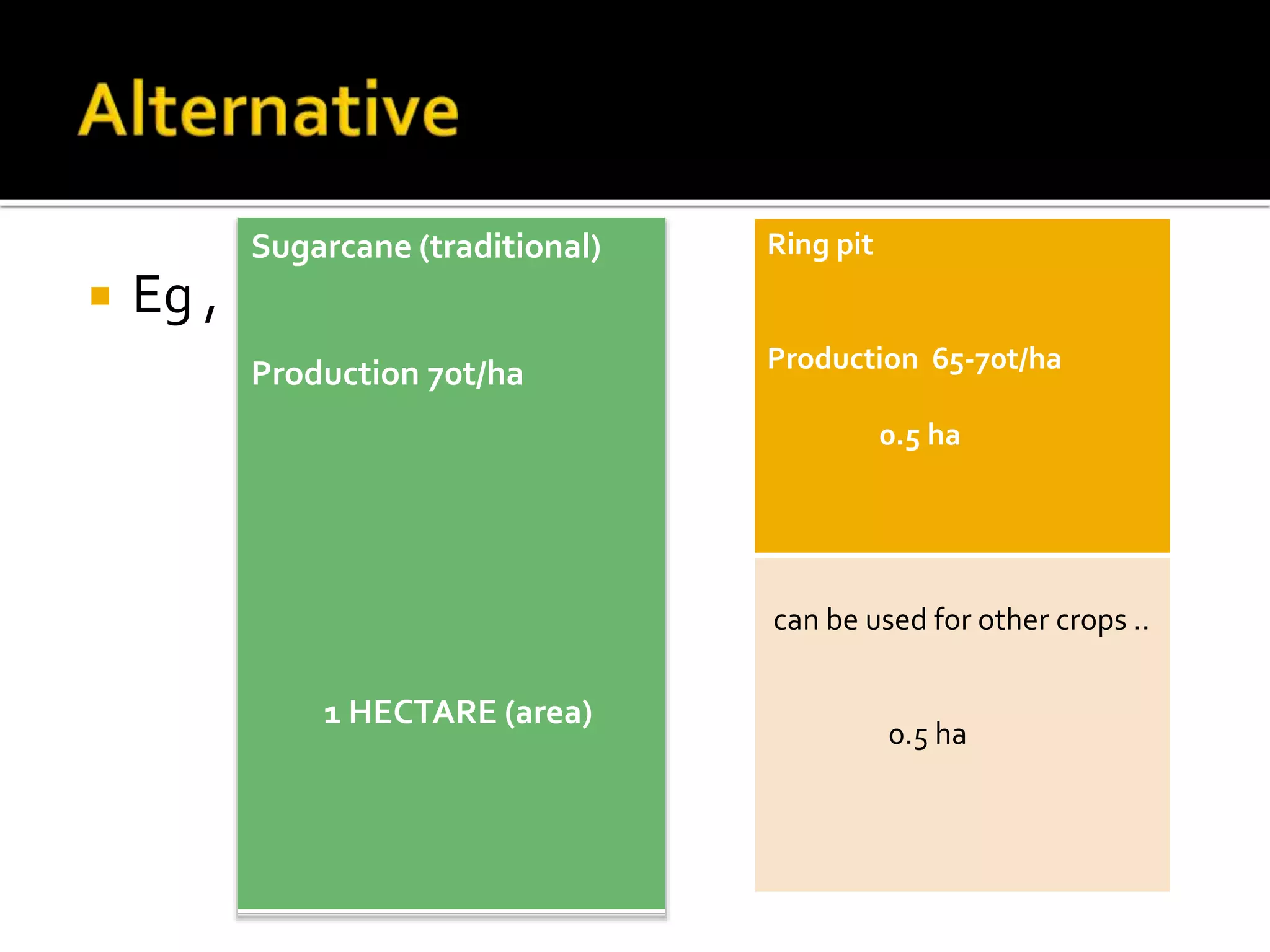
 Eg ,
Sugarcane (traditional)
Production 70t/ha
1 HECTARE (area)
Ring pit
Production 65-70t/ha
0.5 ha
can be used for other crops ..
0.5 ha
 Mother shoot technology or no tiller technology
Specifications:
- Pit diameter : 75 cm
- Depth : 30 cm
- Centre to centre : 105 cm
- No. of pits/ha : 9000
 Suitable for
 drought prone areas, undulating topography, light
textured soils, saline - sodic soils, multiple ratooning
and high yielding, tall and thick cane varieties.
Ring pit method of sugarcane

Ring pit method of sugarcane

  • 1.
  • 2.
     It isgood method for planting sugarcane.  Yield of sugarcane is 70t/ha in India ,while theoretical potential yield is 474t/ha.  ICAR-IISR had developed this technique (1984)  Population of main shoot is increased and tillers are reduced.  Objective :To increase yield (double).
  • 3.
     Leave 65cm space around the boundary of the field.  Mark the field at 105 cm both length and width wise.  At the cross section of these lines, dig pit of 75 cm diameter and 30 cm depth with pit digger machine.  Cane stalks of 2 budded setts is dipped in 0.2 per cent solution of bavistin (2 g Bavistin in one liter of water).  In each pit, apply mixture of 3 kg FYM + 20 g DAP + 8 g urea + 16 g MoP + 2g ZnSO4 and mix it with soil.  Put 20 two-budded setts in a similar pattern as of spokes in a cyclewheel.  Spray the solution of 5 liters Chlorpyriphos 20 EC dissolved in 1500-1600 liters of water on setts for one ha area.
  • 4.
     Interconnect eachpit with narrow channel manually for irrigating the pits.  Now cover the setts with 2-5 cm of soil layer.  Apply light irrigation just after planting.  Do first filling of pits with dug out soil at 4th leaf stage (35-40 days after planting in spring planting), apply light irrigation and topdress 16 g urea per pit when soil moisture reaches at workable condition.  Apply urea @ 16 g per pit and, apply Furadan 3 G @ 33 kg per ha.The gap of at least 3-4 days must be kept in application of urea and Furadan.  Fill the pits with dug out soil completely.  Carry earthing –up before onset of monsoon.
  • 5.
     Tie canein each clump in the 1st -2nd week of August with lower dry leaves.  In September, tie the clumps of opposite rows together.  Remove lower dry leaves.  Harvest the cane close to the ground level to take good ratoon crop.
  • 9.
    ICGS- Irrigation atcritical growth stages, IWUE – Irrigation water use efficiency Technology Germination (%)2008-09 Ring pit method of planting 72.8 Skip furrow method of irrigation 37.5 ICGS 39.8 Farmers' Practice 33.6
  • 10.
    Technology Average yield (tha-1) Irrigation water applied (ha-cm) IWUE (kg cane ha-cm-1) Demons tration Conventio nal Demons tration Conventi onal Demonst ration Conven tional Ring pit method of planting 125.28 63.80 52.92 65.37 2367.46 975.96 Skip furrow method of irrigation 88.54 63.80 53.7 65.37 1648 975.96 Trash mulching 80.1 63.80 47.8 65.37 1642 975.96 ICGS 81.76 63.80 45.2 65.37 1807 975.96
  • 11.
    Technology Benefit :cost(2008-09) Ringpit method of planting 2.03 Skip furrow method of irrigation 1.96 ICGS 1.45 Farmers' Practice 1.29
  • 12.
     Mr I.Varatharajan,a farmer in Somenahalli village of Dharmapuri district,Tamil Nadu, has got a yield of over 300 tonnes in a hectare.  MrVaratharajan was awarded the best farmer award by the Tamil Nadu Agricultural University, Coimbatore.  Under the conventional system, the setts are grown in rows of 90 cm spacing and are arranged in a series without adequate spacing.  The germinated setts are very thin in appearance and ultimately affect the number of canes in each setts and its development.  According to Mr.Varatharajan,the pits are dug using specially designed tractor drawn power tillers.  The pits are then filled with top soil, 5 kg of farmyard manure (FYM), 100 gms gypsum and 125 gms super phosphate and watered well before planting.
  • 13.
     MrVaratharajan hasspent about Rs. 1,30,000 per hectare and has earned about Rs. 2 lakh as net income in his first harvest.  Under the conventional system, farmers inTamil Nadu are at present harvesting about 130 tonnes a hectare which yields a net income of about Rs. 1,43,000.  Under pit method one can expect to harvest nearly 10 ratoon crops with a yield of about 60-70 tonnes during every ratoon harvest compared to the conventional method where only one or two ratoon harvest is possible," said MrVaratharajan.
  • 14.
     The growthof the crop was vigorous and they matured at the eighth month after planting.  Due to the equal spacing maintained on all the sides the plants grew steadily and the nutrition supplied through drip fertigation reduced the crop duration.  The continuous supply of nutrition and spacing induces the early physiological maturity that was the major benefit the farmer.  All the shoots are of the same age, so there is uniform growth and sugar accumulation in the canes.  The most important factor was that the sugarcane setts were placed at a depth, which were always moist, hence, in case of drought, or non-availability of water the yield was not affected.
  • 15.
     Eg , Sugarcane(traditional) Production 70t/ha 1 HECTARE (area) Ring pit Production 65-70t/ha 0.5 ha can be used for other crops .. 0.5 ha
  • 16.
     Mother shoottechnology or no tiller technology Specifications: - Pit diameter : 75 cm - Depth : 30 cm - Centre to centre : 105 cm - No. of pits/ha : 9000  Suitable for  drought prone areas, undulating topography, light textured soils, saline - sodic soils, multiple ratooning and high yielding, tall and thick cane varieties.