INSTITUTE OF AGRICULTURAL SCIENCES, BHU
“Farmready, a profit & potent turmeric variety”
TO DOUBLE THE INCOME OF FARMER
EXT – 411 RAWE
SUBMITTED TO-
PROF. O.P. MISHRA
DR. B. JIRLI
PRESENTED BY-
SUNNY KUMAR
ID 14158
BSC AG PART IV
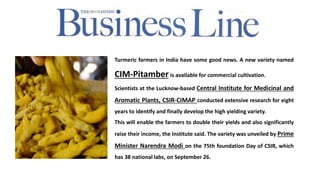
Turmeric farmers in India have some good news. A new variety named
CIM-Pitamber is available for commercial cultivation.
Scientists at the Lucknow-based Central Institute for Medicinal and
Aromatic Plants, CSIR-CIMAP conducted extensive research for eight
years to identify and finally develop the high yielding variety.
This will enable the farmers to double their yields and also significantly
raise their income, the Institute said. The variety was unveiled by Prime
Minister Narendra Modi on the 75th foundation Day of CSIR, which
has 38 national labs, on September 26.
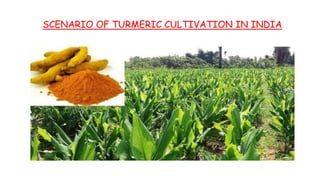
SCENARIO OF TURMERIC CULTIVATION IN INDIA
INTRODUCTION
Turmeric (Curcuma longa L), the ancient and sacred spice of India known as
‘Indian saffron’ is an important commercial spice crop grown in India. It is used
in diversified forms as :
A condiment, flavoring and coloring agent and as a principal ingredient in
Indian culinary as curry powder.
It has anti cancer and anti viral activities and hence finds use in the drug
industry and cosmetic industry.
'Kum-kum', popular with every house wife, is also a by-product of turmeric.
It finds a place in offerings on religious and ceremonial occasions.
The increasing demand for natural products as food additives makes turmeric
as ideal produce as a food colourant.
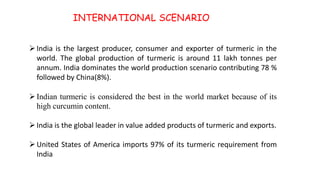
INTERNATIONAL SCENARIO
India is the largest producer, consumer and exporter of turmeric in the
world. The global production of turmeric is around 11 lakh tonnes per
annum. India dominates the world production scenario contributing 78 %
followed by China(8%).
Indian turmeric is considered the best in the world market because of its
high curcumin content.
India is the global leader in value added products of turmeric and exports.
United States of America imports 97% of its turmeric requirement from
India
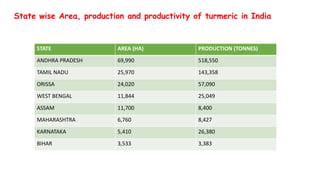
State wise Area, production and productivity of turmeric in India
STATE AREA (HA) PRODUCTION (TONNES)
ANDHRA PRADESH 69,990 518,550
TAMIL NADU 25,970 143,358
ORISSA 24,020 57,090
WEST BENGAL 11,844 25,049
ASSAM 11,700 8,400
MAHARASHTRA 6,760 8,427
KARNATAKA 5,410 26,380
BIHAR 3,533 3,383
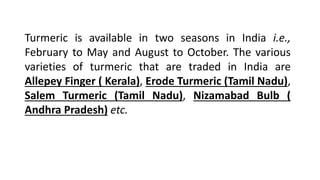
Turmeric is available in two seasons in India i.e.,
February to May and August to October. The various
varieties of turmeric that are traded in India are
Allepey Finger ( Kerala), Erode Turmeric (Tamil Nadu),
Salem Turmeric (Tamil Nadu), Nizamabad Bulb (
Andhra Pradesh) etc.
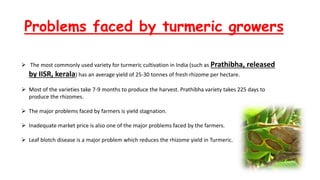
Problems faced by turmeric growers
 The most commonly used variety for turmeric cultivation in India (such as Prathibha, released
by IISR, kerala) has an average yield of 25-30 tonnes of fresh rhizome per hectare.
 Most of the varieties take 7-9 months to produce the harvest. Prathibha variety takes 225 days to
produce the rhizomes.
 The major problems faced by farmers is yield stagnation.
 Inadequate market price is also one of the major problems faced by the farmers.
 Leaf blotch disease is a major problem which reduces the rhizome yield in Turmeric.
HERE IS A SOLUTION
 Scientists at the Lucknow-based Central Institute for Medicinal and Aromatic Plants, CSIR-
CIMAP conducted extensive research for eight years to identify and finally develop the high
yielding variety.
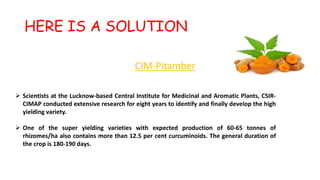
 One of the super yielding varieties with expected production of 60-65 tonnes of
rhizomes/ha also contains more than 12.5 per cent curcuminoids. The general duration of
the crop is 180-190 days.
CIM-Pitamber
The scientists used genetic techniques on 130 germplasms collected from
different places to select, cultivate, differentiate characteristics and finally develop
super clones. The CIM-Pitamber is tolerant to the common leaf blotch disease,
affecting the turmeric crop.
The variety will be able to produce rhizomes, with 90 per cent more curcuminoids
and yields, more than double the existing varieties, IISR Pratibha, now
grown in North Indian plains.
This will enable the farmers to double their yields and also significantly raise their
income. The variety was unveiled by Prime Minister Narendra Modi on the 75th
foundation Day of CSIR, which has 38 national labs, on September 26.
FEATURES :
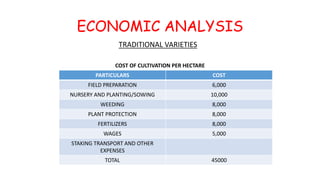
ECONOMIC ANALYSIS
TRADITIONAL VARIETIES
PARTICULARS COST
FIELD PREPARATION 6,000
NURSERY AND PLANTING/SOWING 10,000
WEEDING 8,000
PLANT PROTECTION 8,000
FERTILIZERS 8,000
WAGES 5,000
STAKING TRANSPORT AND OTHER
EXPENSES
TOTAL 45000
COST OF CULTIVATION PER HECTARE
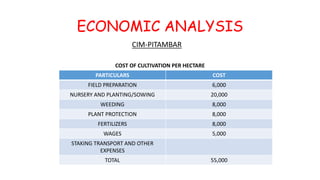
ECONOMIC ANALYSIS
CIM-PITAMBAR
PARTICULARS COST
FIELD PREPARATION 6,000
NURSERY AND PLANTING/SOWING 20,000
WEEDING 8,000
PLANT PROTECTION 8,000
FERTILIZERS 8,000
WAGES 5,000
STAKING TRANSPORT AND OTHER
EXPENSES
TOTAL 55,000
COST OF CULTIVATION PER HECTARE
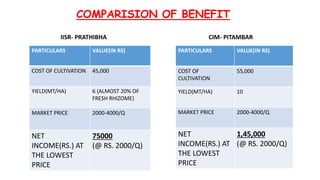
COMPARISION OF BENEFIT
PARTICULARS VALUE(IN RS)
COST OF CULTIVATION 45,000
YIELD(MT/HA) 6 (ALMOST 20% OF
FRESH RHIZOME)
MARKET PRICE 2000-4000/Q
NET
INCOME(RS.) AT
THE LOWEST
PRICE
75000
(@ RS. 2000/Q)
PARTICULARS VALUE(IN RS)
COST OF
CULTIVATION
55,000
YIELD(MT/HA) 10
MARKET PRICE 2000-4000/Q
NET
INCOME(RS.) AT
THE LOWEST
PRICE
1,45,000
(@ RS. 2000/Q)
IISR- PRATHIBHA CIM- PITAMBAR
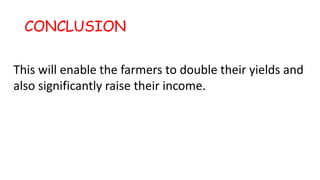
CONCLUSION
This will enable the farmers to double their yields and
also significantly raise their income.
WAIT…
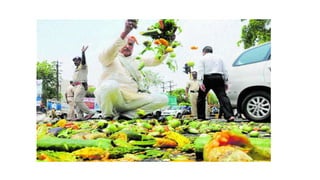
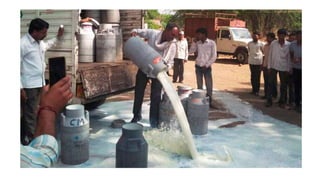
It was believed that “The more you
sow, the more you produce and hence
more you earn”.
DOUBLE THE
INCOME
OR
DOUBLE THE
TROUBLE
SO WHAT SHOULD BE DONE ??????
There aren’t any means or rather I would say “single innovative ways”
which could double the income of the farmer only by amending one of the
many aspects.
But I couldn’t say anything about the Rajnikanth type of ideas……
THE NEED OF THE HOUR
Policy amendments :
There are ample of innovative ways to increase the
yield of the farmers but these are not effective since
the things are not meant to be like that.
There is a huge lack in the framing of policies for the
farmers which has caused this huge downfall in the
income of farmers.
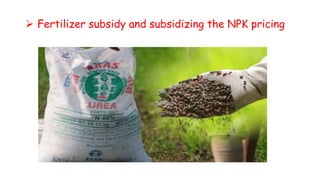
 Fertilizer subsidy and subsidizing the NPK pricing
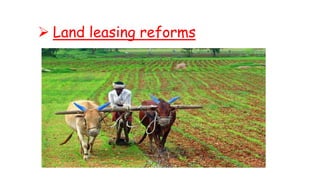
 Land leasing reforms
 Review of Farm credit and Subsidy
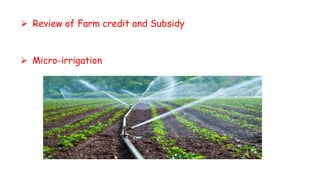
 Micro-irrigation
Strengthening Crop Insurance Scheme
AND MANY MORE………
WHAT I WANT TO SAY?????
Agricultural income could surely be increased but not only
by the means of innovative ways. Policy amendments are
required at the same time along with the innovative ideas
then only we could be sure that it will double the income of
farmer.
REFERENCES
 http://www.spices.res.in/
 http://www.thehindubusinessline.com/economy/agri
-business/farmready-a-profit-potent-turmeric-
variety/article9267822.ece
 http://agritech.tnau.ac.in/horticulture/horti_cost
%20of%20cultivation.html
 http://www.cimap.res.in/
Turmeric cultivation

Turmeric cultivation

  • 1.
    INSTITUTE OF AGRICULTURALSCIENCES, BHU “Farmready, a profit & potent turmeric variety” TO DOUBLE THE INCOME OF FARMER EXT – 411 RAWE SUBMITTED TO- PROF. O.P. MISHRA DR. B. JIRLI PRESENTED BY- SUNNY KUMAR ID 14158 BSC AG PART IV
  • 2.
    Turmeric farmers inIndia have some good news. A new variety named CIM-Pitamber is available for commercial cultivation. Scientists at the Lucknow-based Central Institute for Medicinal and Aromatic Plants, CSIR-CIMAP conducted extensive research for eight years to identify and finally develop the high yielding variety. This will enable the farmers to double their yields and also significantly raise their income, the Institute said. The variety was unveiled by Prime Minister Narendra Modi on the 75th foundation Day of CSIR, which has 38 national labs, on September 26.
  • 3.
    SCENARIO OF TURMERICCULTIVATION IN INDIA
  • 4.
    INTRODUCTION Turmeric (Curcuma longaL), the ancient and sacred spice of India known as ‘Indian saffron’ is an important commercial spice crop grown in India. It is used in diversified forms as : A condiment, flavoring and coloring agent and as a principal ingredient in Indian culinary as curry powder. It has anti cancer and anti viral activities and hence finds use in the drug industry and cosmetic industry. 'Kum-kum', popular with every house wife, is also a by-product of turmeric. It finds a place in offerings on religious and ceremonial occasions. The increasing demand for natural products as food additives makes turmeric as ideal produce as a food colourant.
  • 5.
    INTERNATIONAL SCENARIO India isthe largest producer, consumer and exporter of turmeric in the world. The global production of turmeric is around 11 lakh tonnes per annum. India dominates the world production scenario contributing 78 % followed by China(8%). Indian turmeric is considered the best in the world market because of its high curcumin content. India is the global leader in value added products of turmeric and exports. United States of America imports 97% of its turmeric requirement from India
  • 6.
    State wise Area,production and productivity of turmeric in India STATE AREA (HA) PRODUCTION (TONNES) ANDHRA PRADESH 69,990 518,550 TAMIL NADU 25,970 143,358 ORISSA 24,020 57,090 WEST BENGAL 11,844 25,049 ASSAM 11,700 8,400 MAHARASHTRA 6,760 8,427 KARNATAKA 5,410 26,380 BIHAR 3,533 3,383
  • 7.
    Turmeric is availablein two seasons in India i.e., February to May and August to October. The various varieties of turmeric that are traded in India are Allepey Finger ( Kerala), Erode Turmeric (Tamil Nadu), Salem Turmeric (Tamil Nadu), Nizamabad Bulb ( Andhra Pradesh) etc.
  • 8.
    Problems faced byturmeric growers  The most commonly used variety for turmeric cultivation in India (such as Prathibha, released by IISR, kerala) has an average yield of 25-30 tonnes of fresh rhizome per hectare.  Most of the varieties take 7-9 months to produce the harvest. Prathibha variety takes 225 days to produce the rhizomes.  The major problems faced by farmers is yield stagnation.  Inadequate market price is also one of the major problems faced by the farmers.  Leaf blotch disease is a major problem which reduces the rhizome yield in Turmeric.
  • 9.
    HERE IS ASOLUTION  Scientists at the Lucknow-based Central Institute for Medicinal and Aromatic Plants, CSIR- CIMAP conducted extensive research for eight years to identify and finally develop the high yielding variety.  One of the super yielding varieties with expected production of 60-65 tonnes of rhizomes/ha also contains more than 12.5 per cent curcuminoids. The general duration of the crop is 180-190 days. CIM-Pitamber
  • 10.
    The scientists usedgenetic techniques on 130 germplasms collected from different places to select, cultivate, differentiate characteristics and finally develop super clones. The CIM-Pitamber is tolerant to the common leaf blotch disease, affecting the turmeric crop. The variety will be able to produce rhizomes, with 90 per cent more curcuminoids and yields, more than double the existing varieties, IISR Pratibha, now grown in North Indian plains. This will enable the farmers to double their yields and also significantly raise their income. The variety was unveiled by Prime Minister Narendra Modi on the 75th foundation Day of CSIR, which has 38 national labs, on September 26. FEATURES :
  • 11.
    ECONOMIC ANALYSIS TRADITIONAL VARIETIES PARTICULARSCOST FIELD PREPARATION 6,000 NURSERY AND PLANTING/SOWING 10,000 WEEDING 8,000 PLANT PROTECTION 8,000 FERTILIZERS 8,000 WAGES 5,000 STAKING TRANSPORT AND OTHER EXPENSES TOTAL 45000 COST OF CULTIVATION PER HECTARE
  • 12.
    ECONOMIC ANALYSIS CIM-PITAMBAR PARTICULARS COST FIELDPREPARATION 6,000 NURSERY AND PLANTING/SOWING 20,000 WEEDING 8,000 PLANT PROTECTION 8,000 FERTILIZERS 8,000 WAGES 5,000 STAKING TRANSPORT AND OTHER EXPENSES TOTAL 55,000 COST OF CULTIVATION PER HECTARE
  • 13.
    COMPARISION OF BENEFIT PARTICULARSVALUE(IN RS) COST OF CULTIVATION 45,000 YIELD(MT/HA) 6 (ALMOST 20% OF FRESH RHIZOME) MARKET PRICE 2000-4000/Q NET INCOME(RS.) AT THE LOWEST PRICE 75000 (@ RS. 2000/Q) PARTICULARS VALUE(IN RS) COST OF CULTIVATION 55,000 YIELD(MT/HA) 10 MARKET PRICE 2000-4000/Q NET INCOME(RS.) AT THE LOWEST PRICE 1,45,000 (@ RS. 2000/Q) IISR- PRATHIBHA CIM- PITAMBAR
  • 14.
    CONCLUSION This will enablethe farmers to double their yields and also significantly raise their income.
  • 15.
    WAIT… It was believedthat “The more you sow, the more you produce and hence more you earn”.
  • 16.
  • 20.
    SO WHAT SHOULDBE DONE ??????
  • 21.
    There aren’t anymeans or rather I would say “single innovative ways” which could double the income of the farmer only by amending one of the many aspects. But I couldn’t say anything about the Rajnikanth type of ideas……
  • 22.
    THE NEED OFTHE HOUR Policy amendments : There are ample of innovative ways to increase the yield of the farmers but these are not effective since the things are not meant to be like that. There is a huge lack in the framing of policies for the farmers which has caused this huge downfall in the income of farmers.
  • 23.
     Fertilizer subsidyand subsidizing the NPK pricing
  • 24.
  • 25.
     Review ofFarm credit and Subsidy  Micro-irrigation
  • 26.
    Strengthening Crop InsuranceScheme AND MANY MORE………
  • 27.
    WHAT I WANTTO SAY????? Agricultural income could surely be increased but not only by the means of innovative ways. Policy amendments are required at the same time along with the innovative ideas then only we could be sure that it will double the income of farmer.
  • 28.