



Presentation 2
On
“Contamination of food associated
with their packaging material?”
Presented by
Sakshi Saxena
IBT VIIth sem
ASU2013010200124
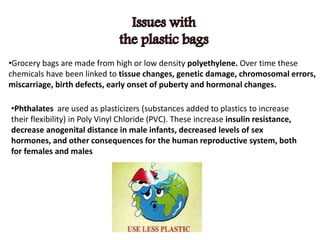
•Grocery bags are made from high or low density polyethylene. Over time these
chemicals have been linked to tissue changes, genetic damage, chromosomal errors,
miscarriage, birth defects, early onset of puberty and hormonal changes.
•Phthalates are used as plasticizers (substances added to plastics to increase
their flexibility) in Poly Vinyl Chloride (PVC). These increase insulin resistance,
decrease anogenital distance in male infants, decreased levels of sex
hormones, and other consequences for the human reproductive system, both
for females and males
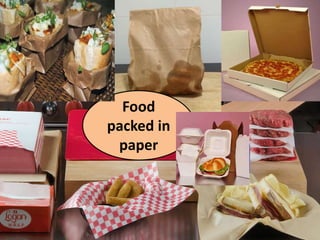
Food
packed in
paper
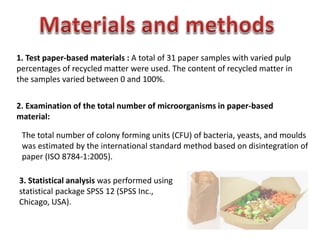
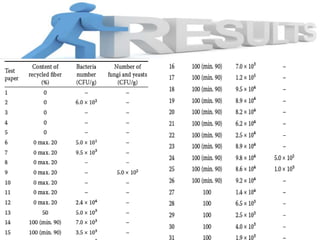
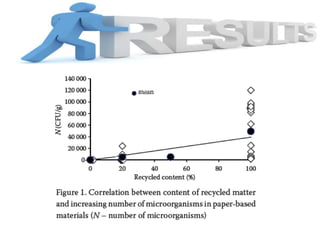
The total number of colony forming units (CFU) of bacteria, yeasts, and moulds
was estimated by the international standard method based on disintegration of
paper (ISO 8784-1:2005).
1. Test paper-based materials : A total of 31 paper samples with varied pulp
percentages of recycled matter were used. The content of recycled matter in
the samples varied between 0 and 100%.
2. Examination of the total number of microorganisms in paper-based
material:
3. Statistical analysis was performed using
statistical package SPSS 12 (SPSS Inc.,
Chicago, USA).
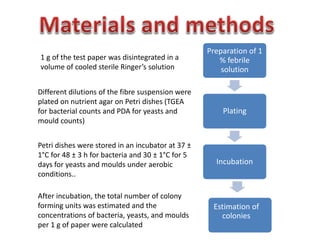
1 g of the test paper was disintegrated in a
volume of cooled sterile Ringer’s solution
Preparation of 1
% febrile
solution
Plating
Incubation
Different dilutions of the fibre suspension were
plated on nutrient agar on Petri dishes (TGEA
for bacterial counts and PDA for yeasts and
mould counts)
After incubation, the total number of colony
forming units was estimated and the
concentrations of bacteria, yeasts, and moulds
per 1 g of paper were calculated
Estimation of
colonies
Petri dishes were stored in an incubator at 37 ±
1°C for 48 ± 3 h for bacteria and 30 ± 1°C for 5
days for yeasts and moulds under aerobic
conditions..
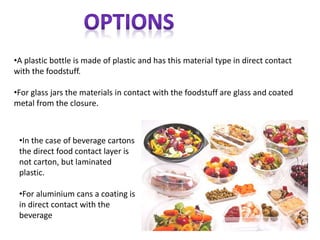
•A plastic bottle is made of plastic and has this material type in direct contact
with the foodstuff.
•For glass jars the materials in contact with the foodstuff are glass and coated
metal from the closure.
•In the case of beverage cartons
the direct food contact layer is
not carton, but laminated
plastic.
•For aluminium cans a coating is
in direct contact with the
beverage
The primary purpose of food packaging must continue to be maintaining
the safety, wholesomeness, and quality of food.
In general, any food contact material should not release chemicals into the
food at quantities that can harm human health.
In order to assess the health impacts related to food packaging it is therefore
essential to
(1) understand the chemical composition of the packaging material and
(2) the levels at which these compounds can partition into foodstuffs, a
process that is known as migration.
1. Public health impact of plastics: An overview.
Neeti Rustagi, S. K. Pradhan,1 and Ritesh Singh.
Indian J Occup Environ Med.
2011 Sep-Dec; 15(3): 100–103.
2. Microbial Contamination of Paper-based Food
Contact Materials with Different Contents of
Recycled Fiber. Zuzana HLADÍKOVÁ,
Kristina KEJLOVÁJitka SOSNOVCOVÁ,
Dagmar JÍROVÁ, Adam VAVROUŠ ,
Stanislav JANOUŠEK , Milada SYČOVÁ and
Vladimír ŠPELINA. Czech J. Food Sci., 33,
2015 (4): 308–312
3. Food Packaging Materials | Food Packaging Forum. (n.d.).
Retrieved October 14, 2016,
from http://www.foodpackagingforum.org/food-packaging-
health/food-packaging-materials
4. Food Packaging -- Roles, Materials, and
Environmental Issues. Retrieved October 14, 2016,
from http://www.ift.org/knowledge-center/read-ift-
publications/science-reports/scientific-status-summaries
/food-packaging.aspx
www.pinterest.com

Health issues with food packaging

  • 1.
    Presentation 2 On “Contamination offood associated with their packaging material?” Presented by Sakshi Saxena IBT VIIth sem ASU2013010200124
  • 2.
    •Grocery bags aremade from high or low density polyethylene. Over time these chemicals have been linked to tissue changes, genetic damage, chromosomal errors, miscarriage, birth defects, early onset of puberty and hormonal changes. •Phthalates are used as plasticizers (substances added to plastics to increase their flexibility) in Poly Vinyl Chloride (PVC). These increase insulin resistance, decrease anogenital distance in male infants, decreased levels of sex hormones, and other consequences for the human reproductive system, both for females and males
  • 6.
  • 8.
    The total numberof colony forming units (CFU) of bacteria, yeasts, and moulds was estimated by the international standard method based on disintegration of paper (ISO 8784-1:2005). 1. Test paper-based materials : A total of 31 paper samples with varied pulp percentages of recycled matter were used. The content of recycled matter in the samples varied between 0 and 100%. 2. Examination of the total number of microorganisms in paper-based material: 3. Statistical analysis was performed using statistical package SPSS 12 (SPSS Inc., Chicago, USA).
  • 9.
    1 g ofthe test paper was disintegrated in a volume of cooled sterile Ringer’s solution Preparation of 1 % febrile solution Plating Incubation Different dilutions of the fibre suspension were plated on nutrient agar on Petri dishes (TGEA for bacterial counts and PDA for yeasts and mould counts) After incubation, the total number of colony forming units was estimated and the concentrations of bacteria, yeasts, and moulds per 1 g of paper were calculated Estimation of colonies Petri dishes were stored in an incubator at 37 ± 1°C for 48 ± 3 h for bacteria and 30 ± 1°C for 5 days for yeasts and moulds under aerobic conditions..
  • 14.
    •A plastic bottleis made of plastic and has this material type in direct contact with the foodstuff. •For glass jars the materials in contact with the foodstuff are glass and coated metal from the closure. •In the case of beverage cartons the direct food contact layer is not carton, but laminated plastic. •For aluminium cans a coating is in direct contact with the beverage
  • 15.
    The primary purposeof food packaging must continue to be maintaining the safety, wholesomeness, and quality of food. In general, any food contact material should not release chemicals into the food at quantities that can harm human health. In order to assess the health impacts related to food packaging it is therefore essential to (1) understand the chemical composition of the packaging material and (2) the levels at which these compounds can partition into foodstuffs, a process that is known as migration.
  • 16.
    1. Public healthimpact of plastics: An overview. Neeti Rustagi, S. K. Pradhan,1 and Ritesh Singh. Indian J Occup Environ Med. 2011 Sep-Dec; 15(3): 100–103. 2. Microbial Contamination of Paper-based Food Contact Materials with Different Contents of Recycled Fiber. Zuzana HLADÍKOVÁ, Kristina KEJLOVÁJitka SOSNOVCOVÁ, Dagmar JÍROVÁ, Adam VAVROUŠ , Stanislav JANOUŠEK , Milada SYČOVÁ and Vladimír ŠPELINA. Czech J. Food Sci., 33, 2015 (4): 308–312
  • 17.
    3. Food PackagingMaterials | Food Packaging Forum. (n.d.). Retrieved October 14, 2016, from http://www.foodpackagingforum.org/food-packaging- health/food-packaging-materials 4. Food Packaging -- Roles, Materials, and Environmental Issues. Retrieved October 14, 2016, from http://www.ift.org/knowledge-center/read-ift- publications/science-reports/scientific-status-summaries /food-packaging.aspx
  • 18.