biochemaholic.wordpress.com
*The majority of biotechnology processes for producing pharmaceutical or 
diagnostic product involve the purification of proteins and peptides . 
*The sources includes bacteria, yeast and mammalian cell culture fluids, or 
extracts from naturally occurring tissue. 
**The initial purification of the target molecule necessitates clarification of the crude 
sample before application to the chromatography. 
www.publicdomaintreasurehunter.com
The standard techniques used for removal of cells and/or cell debris have been 
centrifugation and microfiltration.
The standard techniques used for removal of cells and/or cell debris have been 
centrifugation and microfiltration. 
Problem?
The standard techniques used for removal of cells and/or cell debris have been 
centrifugation and microfiltration. 
Problem? 
*small particle size and high 
viscosity reduce the efficiency 
*Difficult to obtain a completely 
particle-free liquid. 
ivanemmoy.wordpress.com
The standard techniques used for removal of cells and/or cell debris have been 
centrifugation and microfiltration. 
Problem? 
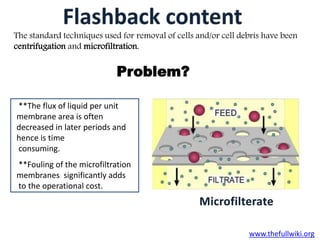
**The flux of liquid per unit 
membrane area is often 
decreased in later periods and 
hence is time 
consuming. 
**Fouling of the microfiltration 
membranes significantly adds 
to the operational cost. 
www.thefullwiki.org
The standard techniques used for removal of cells and/or cell debris have been 
centrifugation and microfiltration. 
Solution? 
Combined use of centrifugation and filtration
The standard techniques used for removal of cells and/or cell debris have been 
centrifugation and microfiltration. 
Solution? 
Combined use of centrifugation and filtration 
www.featurepics.com
The standard techniques used for removal of cells and/or cell debris have been 
centrifugation and microfiltration. 
Solution? 
Combined use of centrifugation and filtration 
*Long process times 
www.featurepics.com
The standard techniques used for removal of cells and/or cell debris have been 
centrifugation and microfiltration. 
Solution? 
Combined use of centrifugation and filtration 
*Long process times 
*Large units causing significant 
capital expenditure 
www.featurepics.com
The standard techniques used for removal of cells and/or cell debris have been 
centrifugation and microfiltration. 
Solution? 
Combined use of centrifugation and filtration 
*Long process times 
*Large units causing significant 
capital expenditure 
*Results in significant product loss 
due to product degradation. 
www.featurepics.com
www.leominster.cartridgeworld.co.uk
www.leominster.cartridgeworld.co.uk pubs.acs.org
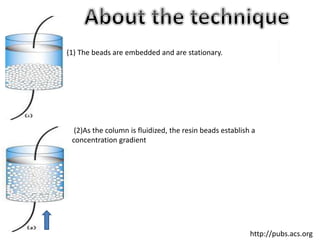
(1) The beads are embedded and are stationary. 
http://pubs.acs.org
(1) The beads are embedded and are stationary. 
(2)As the column is fluidized, the resin beads establish a 
concentration gradient 
http://pubs.acs.org
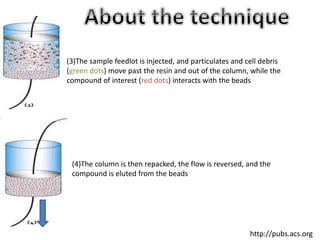
(3)The sample feedlot is injected, and particulates and cell debris 
(green dots) move past the resin and out of the column, while the 
compound of interest (red dots) interacts with the beads 
http://pubs.acs.org
(3)The sample feedlot is injected, and particulates and cell debris 
(green dots) move past the resin and out of the column, while the 
compound of interest (red dots) interacts with the beads 
(4)The column is then repacked, the flow is reversed, and the 
compound is eluted from the beads 
http://pubs.acs.org
* Allows the protein removal directly from the fermentation broth without 
going for prior removal of particulates like cell debris and other unwanted 
products. 
Allows the protein removal directly from the fermentation 
broth without going for prior removal of particulates like 
cell debris and other unwanted products. 
It reduces the time and cost for further separation 
procedures in the down stream processing.
* Allows the protein removal directly from the fermentation broth without 
going for prior removal of particulates like cell debris and other unwanted 
products. 
Allows the protein removal directly from the fermentation 
broth without going for prior removal of particulates like 
cell debris and other unwanted products. 
*It reduces the time and cost for further separation procedures in the 
down stream processing. 
It reduces the time and cost for further separation 
procedures in the down stream processing.
* Allows the protein removal directly from the fermentation broth without 
going for prior removal of particulates like cell debris and other unwanted 
products. 
Allows the protein removal directly from the fermentation 
broth without going for prior removal of particulates like 
cell debris and other unwanted products. 
*It reduces the time and cost for further separation procedures in the 
down stream processing. 
It reduces the time and cost for further separation 
procedures in the down stream processing. 
www.livechat-software.org
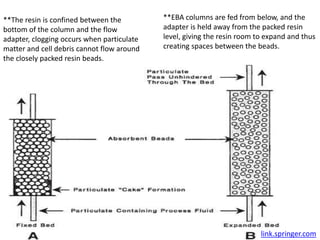
**The resin is confined between the 
bottom of the column and the flow 
adapter, clogging occurs when particulate 
matter and cell debris cannot flow around 
the closely packed resin beads. 
**EBA columns are fed from below, and the 
adapter is held away from the packed resin 
level, giving the resin room to expand and thus 
creating spaces between the beads. 
link.springer.com
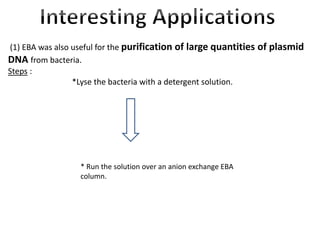
(1) EBA was also useful for the purification of large quantities of plasmid 
DNA from bacteria. 
Steps : 
*Lyse the bacteria with a detergent solution.
(1) EBA was also useful for the purification of large quantities of plasmid 
DNA from bacteria. 
Steps : 
*Lyse the bacteria with a detergent solution.
(1) EBA was also useful for the purification of large quantities of plasmid 
DNA from bacteria. 
Steps : 
*Lyse the bacteria with a detergent solution. 
* Run the solution over an anion exchange EBA 
column.
(1) EBA was also useful for the purification of large quantities of plasmid 
DNA from bacteria. 
Steps : 
*Lyse the bacteria with a detergent solution. 
* Run the solution over an anion exchange EBA 
column. 
Result : This yielded a plasmid DNA solution that was one step away from being suitable for 
human clinical trials without the use of typical toxic reagents such as phenol, ethidium bromide 
and cesium chloride.
(2) Application in diagnostics and epidemiology 
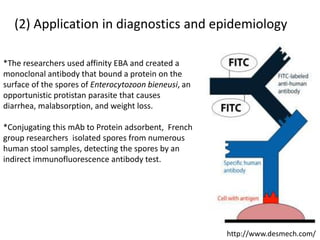
*The researchers used affinity EBA and created a 
monoclonal antibody that bound a protein on the 
surface of the spores of Enterocytozoon bieneusi, an 
opportunistic protistan parasite that causes 
diarrhea, malabsorption, and weight loss. 
*Conjugating this mAb to Protein adsorbent, French 
group researchers isolated spores from numerous 
human stool samples, detecting the spores by an 
indirect immunofluorescence antibody test. 
http://www.desmech.com/
*Several companies are looking forward to create variations on the ion-exchange 
resins that will allow more specific binding of products and limit 
the effects of salt concentration. 
*Increasing the volumes that can be run through the system is another 
issue to be worked upon. 
*Making EBA more suitable for the loading of samples directly from 
fermenters can also aid expanding the applications. 
“Beyond this, the future seems to lie in 
an expanded line of affinity chromatography matrices’.
** “Expanded-bed chromatography in primary protein purification” 
By F.Birger Anspach, , David Curbelo, Ralf Hartmann, Gunnar Garke, Wolf-Dieter 
Deckwer 
**“Physicochemical Basis of Expanded-Bed Adsorption for Protein 
Purification” Handbook of Bioseparations, Vol. 2: Separation Science and 
Technology; S. Ahuja, Ed.; Academic Press: San Diego, 2000. 
**“Expanded-Bed Adsorption Process for Protein Capture” Handbook of 
Bioseparations, Vol. 2: Separation Science and Technology; S. Ahuja, Ed.; 
Academic Press: San Diego, 2000. 
**“Expanded-bed adsorption” article by Randall Willis 
**http://www.desmech.com/ 
libguides.library.curtin.edu.au
affordable-templates.com

Expanded bed chromatography

  • 1.
  • 2.
    *The majority ofbiotechnology processes for producing pharmaceutical or diagnostic product involve the purification of proteins and peptides . *The sources includes bacteria, yeast and mammalian cell culture fluids, or extracts from naturally occurring tissue. **The initial purification of the target molecule necessitates clarification of the crude sample before application to the chromatography. www.publicdomaintreasurehunter.com
  • 3.
    The standard techniquesused for removal of cells and/or cell debris have been centrifugation and microfiltration.
  • 4.
    The standard techniquesused for removal of cells and/or cell debris have been centrifugation and microfiltration. Problem?
  • 5.
    The standard techniquesused for removal of cells and/or cell debris have been centrifugation and microfiltration. Problem? *small particle size and high viscosity reduce the efficiency *Difficult to obtain a completely particle-free liquid. ivanemmoy.wordpress.com
  • 6.
    The standard techniquesused for removal of cells and/or cell debris have been centrifugation and microfiltration. Problem? **The flux of liquid per unit membrane area is often decreased in later periods and hence is time consuming. **Fouling of the microfiltration membranes significantly adds to the operational cost. www.thefullwiki.org
  • 7.
    The standard techniquesused for removal of cells and/or cell debris have been centrifugation and microfiltration. Solution? Combined use of centrifugation and filtration
  • 8.
    The standard techniquesused for removal of cells and/or cell debris have been centrifugation and microfiltration. Solution? Combined use of centrifugation and filtration www.featurepics.com
  • 9.
    The standard techniquesused for removal of cells and/or cell debris have been centrifugation and microfiltration. Solution? Combined use of centrifugation and filtration *Long process times www.featurepics.com
  • 10.
    The standard techniquesused for removal of cells and/or cell debris have been centrifugation and microfiltration. Solution? Combined use of centrifugation and filtration *Long process times *Large units causing significant capital expenditure www.featurepics.com
  • 11.
    The standard techniquesused for removal of cells and/or cell debris have been centrifugation and microfiltration. Solution? Combined use of centrifugation and filtration *Long process times *Large units causing significant capital expenditure *Results in significant product loss due to product degradation. www.featurepics.com
  • 12.
  • 13.
  • 14.
  • 15.
    (1) The beadsare embedded and are stationary. http://pubs.acs.org
  • 16.
    (1) The beadsare embedded and are stationary. (2)As the column is fluidized, the resin beads establish a concentration gradient http://pubs.acs.org
  • 17.
    (3)The sample feedlotis injected, and particulates and cell debris (green dots) move past the resin and out of the column, while the compound of interest (red dots) interacts with the beads http://pubs.acs.org
  • 18.
    (3)The sample feedlotis injected, and particulates and cell debris (green dots) move past the resin and out of the column, while the compound of interest (red dots) interacts with the beads (4)The column is then repacked, the flow is reversed, and the compound is eluted from the beads http://pubs.acs.org
  • 19.
    * Allows theprotein removal directly from the fermentation broth without going for prior removal of particulates like cell debris and other unwanted products. Allows the protein removal directly from the fermentation broth without going for prior removal of particulates like cell debris and other unwanted products. It reduces the time and cost for further separation procedures in the down stream processing.
  • 20.
    * Allows theprotein removal directly from the fermentation broth without going for prior removal of particulates like cell debris and other unwanted products. Allows the protein removal directly from the fermentation broth without going for prior removal of particulates like cell debris and other unwanted products. *It reduces the time and cost for further separation procedures in the down stream processing. It reduces the time and cost for further separation procedures in the down stream processing.
  • 21.
    * Allows theprotein removal directly from the fermentation broth without going for prior removal of particulates like cell debris and other unwanted products. Allows the protein removal directly from the fermentation broth without going for prior removal of particulates like cell debris and other unwanted products. *It reduces the time and cost for further separation procedures in the down stream processing. It reduces the time and cost for further separation procedures in the down stream processing. www.livechat-software.org
  • 22.
    **The resin isconfined between the bottom of the column and the flow adapter, clogging occurs when particulate matter and cell debris cannot flow around the closely packed resin beads. **EBA columns are fed from below, and the adapter is held away from the packed resin level, giving the resin room to expand and thus creating spaces between the beads. link.springer.com
  • 23.
    (1) EBA wasalso useful for the purification of large quantities of plasmid DNA from bacteria. Steps : *Lyse the bacteria with a detergent solution.
  • 24.
    (1) EBA wasalso useful for the purification of large quantities of plasmid DNA from bacteria. Steps : *Lyse the bacteria with a detergent solution.
  • 25.
    (1) EBA wasalso useful for the purification of large quantities of plasmid DNA from bacteria. Steps : *Lyse the bacteria with a detergent solution. * Run the solution over an anion exchange EBA column.
  • 26.
    (1) EBA wasalso useful for the purification of large quantities of plasmid DNA from bacteria. Steps : *Lyse the bacteria with a detergent solution. * Run the solution over an anion exchange EBA column. Result : This yielded a plasmid DNA solution that was one step away from being suitable for human clinical trials without the use of typical toxic reagents such as phenol, ethidium bromide and cesium chloride.
  • 27.
    (2) Application indiagnostics and epidemiology *The researchers used affinity EBA and created a monoclonal antibody that bound a protein on the surface of the spores of Enterocytozoon bieneusi, an opportunistic protistan parasite that causes diarrhea, malabsorption, and weight loss. *Conjugating this mAb to Protein adsorbent, French group researchers isolated spores from numerous human stool samples, detecting the spores by an indirect immunofluorescence antibody test. http://www.desmech.com/
  • 28.
    *Several companies arelooking forward to create variations on the ion-exchange resins that will allow more specific binding of products and limit the effects of salt concentration. *Increasing the volumes that can be run through the system is another issue to be worked upon. *Making EBA more suitable for the loading of samples directly from fermenters can also aid expanding the applications. “Beyond this, the future seems to lie in an expanded line of affinity chromatography matrices’.
  • 29.
    ** “Expanded-bed chromatographyin primary protein purification” By F.Birger Anspach, , David Curbelo, Ralf Hartmann, Gunnar Garke, Wolf-Dieter Deckwer **“Physicochemical Basis of Expanded-Bed Adsorption for Protein Purification” Handbook of Bioseparations, Vol. 2: Separation Science and Technology; S. Ahuja, Ed.; Academic Press: San Diego, 2000. **“Expanded-Bed Adsorption Process for Protein Capture” Handbook of Bioseparations, Vol. 2: Separation Science and Technology; S. Ahuja, Ed.; Academic Press: San Diego, 2000. **“Expanded-bed adsorption” article by Randall Willis **http://www.desmech.com/ libguides.library.curtin.edu.au
  • 30.

Editor's Notes

  • #28 Monoclonal antibody : made from immune cells that are clones of a parent cell. Secondary, or indirect, immunofluorescence uses two antibodies; the unlabeled first (primary) antibody specifically binds the target molecule, and the secondary antibody, which carries the fluorophore, recognises the primary antibody and binds to it. Multiple secondary antibodies can bind a single primary antibody. This provides signal amplification by increasing the number of fluorophore molecules per antigen.[4] This protocol is more complex and time consuming than the primary (or direct) protocol above, but it allows more flexibility because a variety of different secondary antibodies and detection techniques can be used for a given primary antibody.