Prepared by; Vipin Kumar Shukla
Assistant Professor
SUBSTRATES FOR ANIMAL
CELLCULTURE
Substrates for Animal Cell Culture:
 Substrates are the surfaces which provide the surface
for attachment for culturing of animal cells or cultured
cells.
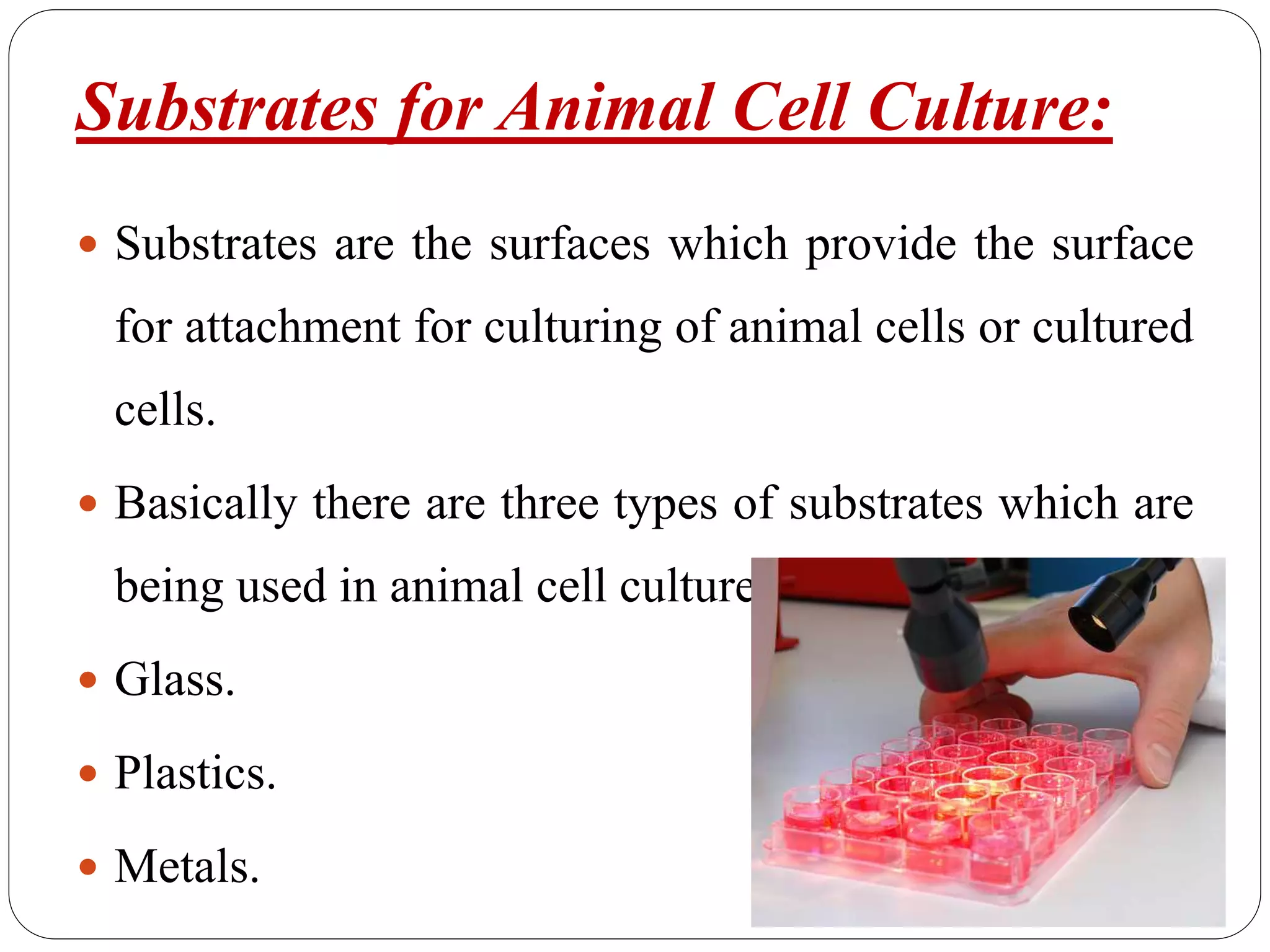
 Basically there are three types of substrates which are
being used in animal cell culture which are as follows:
 Glass.
 Plastics.
 Metals.
Glass as a Substrate:
 Most commonly used substrate for any culture.
 Reason: It can be easily washed or washable.
 It can be easily sterilized.
 It is optically clear, which helps in examine
microscopically.
 Animal cells are examined clearly which makes easier
to us.
Continued……
 Example of glass substrate:
 Soda Lime glass, & Alum Borosilicate.
 Alum Borosilicate: Most commonly used or preferably as
compared to soda lime glass.
 Soda Lime glass: It should be detoxified by boiling it in
weak acid.
 Repeated use lead to reduced the attachment. But it should
be regained by treating with magnesium acetate (1mm) so
that its conc. reduced.
Plastics as a Substrate:
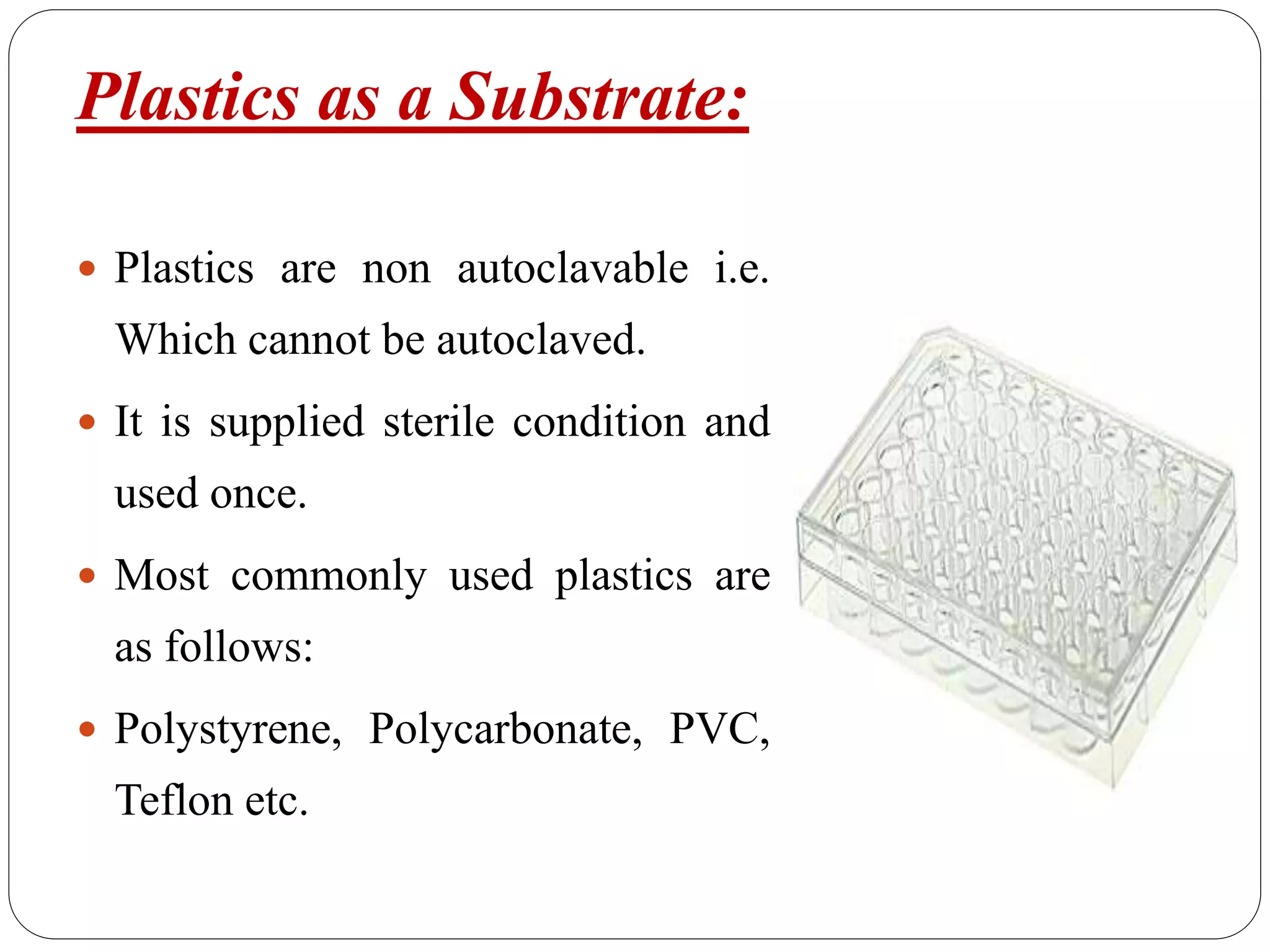
 Plastics are non autoclavable i.e.
Which cannot be autoclaved.
 It is supplied sterile condition and
used once.
 Most commonly used plastics are
as follows:
 Polystyrene, Polycarbonate, PVC,
Teflon etc.
Metals as a Substrate:
 Stainless Steel and Titanium are used in case
of metal to provide a surface attachment for
the cultured of animal cells.
 Proper grade stainless steel plate should be
used to avoid the release of toxic substances
such as Ions.
 It should be acid washed to remove the
surface impurities.
Cell suspension culture:
 The basic principle of cell suspension culture is
isolation of large number of cell and culturing them
on a nutrient medium for growth and development.
 Main aim of suspension culture is that it helps in
production of secondary metabolites.
Continued……
 Suspension culture is a type of culture in which single cells or
small aggregates of cell multiply while suspended in agitated
liquid medium.
 It is also referred to as cell culture or cell suspension culture.
 Cell suspension culture is the primary route for studying plant
cell secondary metabolism.
 The cell suspension culture requires optimization of the cell
line the cultivation media and the bioreactor system.
TYPE OF CELL SUSPENSION CULTURES:
 There are two type of cell suspension cultures
 Batch Culture
 Continuous culture
BATCH CULTURE:
 A batch culture is a cell suspension culture grown in a
fixed volume of nutrient culture medium.
 Cell suspension increases in biomass by cell division
and cell growth until a factor in the culture
environment (nutrient or oxygen availability) becomes
limiting and the growth ceases.
Continued……
 The cells in culture exhibit the following five phases
of a growth cycle
 Lag phase : where cells prepare to divide.
 Exponential phase : where the rate of cell division is
highest.
 Linear phase :where cell division slows but the rate of
cells expansion increases.
 Deceleration phase : where the rates of cell division
and elongation decreases.
 Stationary phase : where the number and size of cells
remain constant.
Model Curve of Cell Suspension Culture:
CONTINUOUS CULTURE:
 A culture is continuously supplied with nutrients by
the inflow of fresh medium but the culture volume is
normally constant.
 Continuous culture is further divided into two types :
 Close continuous culture
 Open continuous culture
CLOSE CONTINUOUS CULTURE:
 In close continuous culture the used medium is replaced
with the fresh medium, hence, the cells from used medium
are mechanically retrieved and added back to the culture
and thus, the cell biomass keeps increasing.
 Open continuous culture
 In open continuous culture both the cells and used
medium are replaced with fresh medium thus maintaining
culture at constant and sub maximal growth rate.
 Open continuous cell suspension culture is of two types
 Chemostat
 Turbidostats
CHEMOSTAT:
 In this system , culture vessels are usually cylindrical
or circular in shape and possess inlet and outlet pores
for aeration and the introduction and removal of cells
and medium.
 Thus in a steady state condition the density, growth
rate chemical composition and metabolic activity of
the cells all remain constant.
TURBIDOSTATS:
 A Turbidostats is a continuous culturing method
where the turbidity of the culture is held constant by
manipulating the rate at which medium is fed.
 In this system , the cells are allowed to grow up to a
certain turbidity, when the predetermined volume of
culture is replaced by fresh culture.
 The turbidity is measured by the changes of optical
density of medium.
IMPORTANCE OF CELL
SUSPENSION CULTURE:
 Such systems are capable of contributing significant
information about cell physiology biochemistry,
metabolic events, etc
 It is important to build up an understanding of an
organ/ embryoid formation starting from a single cell.
 Mutagenesis studies maybe facilitated by cell
suspension culture to produce mutant cell clone from
which mutant plants can be raised.
ADVANTAGES:
 The nutrients can be continually adjusted.
 This system can be scaled for large scale production
of the cells .
 A whole plant can be regenerated from a single plant
cell.
 Disadvantages:
 The productivity of suspension cultures decreases
over extended subculture periods.
 Slow growth and low productivity of plant cells.
 Cells may get damaged by shear conditions
Substrates for animal cellculture

Substrates for animal cellculture

  • 1.
    Prepared by; VipinKumar Shukla Assistant Professor SUBSTRATES FOR ANIMAL CELLCULTURE
  • 2.
    Substrates for AnimalCell Culture:  Substrates are the surfaces which provide the surface for attachment for culturing of animal cells or cultured cells.  Basically there are three types of substrates which are being used in animal cell culture which are as follows:  Glass.  Plastics.  Metals.
  • 3.
    Glass as aSubstrate:  Most commonly used substrate for any culture.  Reason: It can be easily washed or washable.  It can be easily sterilized.  It is optically clear, which helps in examine microscopically.  Animal cells are examined clearly which makes easier to us.
  • 4.
    Continued……  Example ofglass substrate:  Soda Lime glass, & Alum Borosilicate.  Alum Borosilicate: Most commonly used or preferably as compared to soda lime glass.  Soda Lime glass: It should be detoxified by boiling it in weak acid.  Repeated use lead to reduced the attachment. But it should be regained by treating with magnesium acetate (1mm) so that its conc. reduced.
  • 5.
    Plastics as aSubstrate:  Plastics are non autoclavable i.e. Which cannot be autoclaved.  It is supplied sterile condition and used once.  Most commonly used plastics are as follows:  Polystyrene, Polycarbonate, PVC, Teflon etc.
  • 6.
    Metals as aSubstrate:  Stainless Steel and Titanium are used in case of metal to provide a surface attachment for the cultured of animal cells.  Proper grade stainless steel plate should be used to avoid the release of toxic substances such as Ions.  It should be acid washed to remove the surface impurities.
  • 7.
    Cell suspension culture: The basic principle of cell suspension culture is isolation of large number of cell and culturing them on a nutrient medium for growth and development.  Main aim of suspension culture is that it helps in production of secondary metabolites.
  • 9.
    Continued……  Suspension cultureis a type of culture in which single cells or small aggregates of cell multiply while suspended in agitated liquid medium.  It is also referred to as cell culture or cell suspension culture.  Cell suspension culture is the primary route for studying plant cell secondary metabolism.  The cell suspension culture requires optimization of the cell line the cultivation media and the bioreactor system.
  • 10.
    TYPE OF CELLSUSPENSION CULTURES:  There are two type of cell suspension cultures  Batch Culture  Continuous culture
  • 11.
    BATCH CULTURE:  Abatch culture is a cell suspension culture grown in a fixed volume of nutrient culture medium.  Cell suspension increases in biomass by cell division and cell growth until a factor in the culture environment (nutrient or oxygen availability) becomes limiting and the growth ceases.
  • 12.
    Continued……  The cellsin culture exhibit the following five phases of a growth cycle  Lag phase : where cells prepare to divide.  Exponential phase : where the rate of cell division is highest.  Linear phase :where cell division slows but the rate of cells expansion increases.  Deceleration phase : where the rates of cell division and elongation decreases.  Stationary phase : where the number and size of cells remain constant.
  • 13.
    Model Curve ofCell Suspension Culture:
  • 14.
    CONTINUOUS CULTURE:  Aculture is continuously supplied with nutrients by the inflow of fresh medium but the culture volume is normally constant.  Continuous culture is further divided into two types :  Close continuous culture  Open continuous culture
  • 15.
    CLOSE CONTINUOUS CULTURE: In close continuous culture the used medium is replaced with the fresh medium, hence, the cells from used medium are mechanically retrieved and added back to the culture and thus, the cell biomass keeps increasing.  Open continuous culture  In open continuous culture both the cells and used medium are replaced with fresh medium thus maintaining culture at constant and sub maximal growth rate.  Open continuous cell suspension culture is of two types  Chemostat  Turbidostats
  • 16.
    CHEMOSTAT:  In thissystem , culture vessels are usually cylindrical or circular in shape and possess inlet and outlet pores for aeration and the introduction and removal of cells and medium.  Thus in a steady state condition the density, growth rate chemical composition and metabolic activity of the cells all remain constant.
  • 17.
    TURBIDOSTATS:  A Turbidostatsis a continuous culturing method where the turbidity of the culture is held constant by manipulating the rate at which medium is fed.  In this system , the cells are allowed to grow up to a certain turbidity, when the predetermined volume of culture is replaced by fresh culture.  The turbidity is measured by the changes of optical density of medium.
  • 18.
    IMPORTANCE OF CELL SUSPENSIONCULTURE:  Such systems are capable of contributing significant information about cell physiology biochemistry, metabolic events, etc  It is important to build up an understanding of an organ/ embryoid formation starting from a single cell.  Mutagenesis studies maybe facilitated by cell suspension culture to produce mutant cell clone from which mutant plants can be raised.
  • 19.
    ADVANTAGES:  The nutrientscan be continually adjusted.  This system can be scaled for large scale production of the cells .  A whole plant can be regenerated from a single plant cell.  Disadvantages:  The productivity of suspension cultures decreases over extended subculture periods.  Slow growth and low productivity of plant cells.  Cells may get damaged by shear conditions