SCHIZOPHRENIA
D R . S . K . K A R
A S S O C I AT E P R O F E S S O R O F P S Y C H I AT R Y
K G M U , L U C K N O W, U . P
• Schizo: Split
• Phrenia: Mind
SCHIZOPHRENIA
• A severe mental disorder
• A psychotic disorder
HISTORY
• The term “Schizophrenia” is coined by Eugene Bleuler
• Earlier to it, it was known as “Dementia Precox” & “Demence Precoce”
• Hecker coined the term “Hebephrenia”
• Kahlbaum coined the term “Catatonia”
EPIDEMIOLOGY
• Prevalence
– Current 0.6% (India)
– Life-time ~1% (India)
– Effects all age groups, genders, races
– Common age of onset: 2nd to 3rd decade of life
– Onset can be : Early onset / Late onset
– Follows waxing and waning course
SYMPTOMS
• Bleuler’s 4A
– Autism
– Ambivalence
– Association disturbances
– Affective disturbances
SYMPTOMS
• 1st rank symptoms (described by Kunt Sneider)
• 2nd rank symptoms
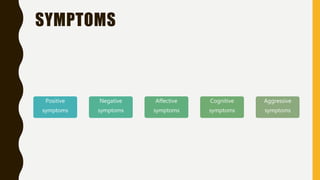
SYMPTOMS
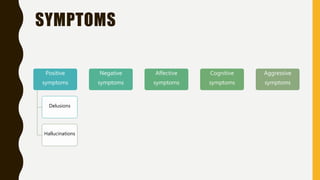
Positive
symptoms
Negative
symptoms
Affective
symptoms
Cognitive
symptoms
Aggressive
symptoms
SYMPTOMS
Positive
symptoms
Delusions
Hallucinations
Negative
symptoms
Affective
symptoms
Cognitive
symptoms
Aggressive
symptoms
SYMPTOMS
Positive
symptoms
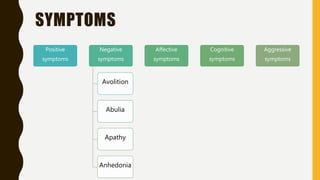
Negative
symptoms
Avolition
Abulia
Apathy
Anhedonia
Affective
symptoms
Cognitive
symptoms
Aggressive
symptoms
SYMPTOMS
Positive
symptoms
Negative
symptoms
Affective
symptoms
Inappropriate
affect
Incongruent
affect
Constricted
affect
Blunted/Flat
affect
Cognitive
symptoms
Aggressive
symptoms
SYMPTOMS
Positive
symptoms
Negative
symptoms
Affective
symptoms
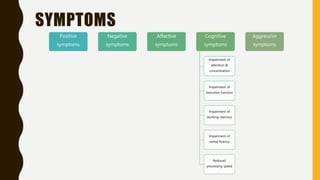
Cognitive
symptoms
Impairment of
attention &
concentration
Impairment of
executive function
Impairment of
working memory
Impairment of
verbal fluency
Reduced
processing speed
Aggressive
symptoms
SYMPTOMS
Positive
symptoms
Negative
symptoms
Affective
symptoms
Cognitive
symptoms
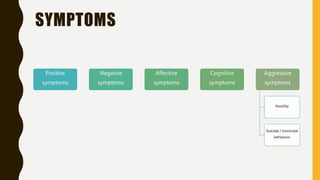
Aggressive
symptoms
Hostility
Suicidal / homicidal
behaviour
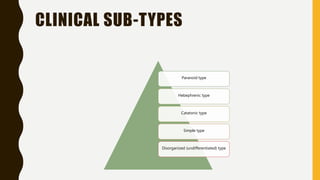
CLINICAL SUB-TYPES
Paranoid type
Hebephrenic type
Catatonic type
Simple type
Disorganized (undifferentiated) type
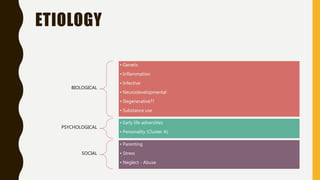
ETIOLOGY
BIOLOGICAL
• Genetic
• Inflammation
• Infective
• Neurodevelopmental
• Degenerative??
• Substance use
PSYCHOLOGICAL
• Early life adversities
• Personality (Cluster A)
SOCIAL
• Parenting
• Stress
• Neglect - Abuse
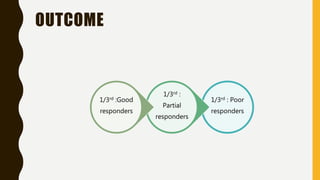
OUTCOME
1/3rd : Poor
responders
1/3rd :
Partial
responders
1/3rd :Good
responders
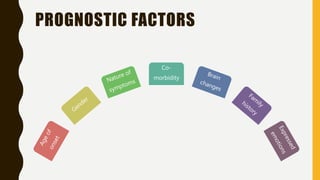
PROGNOSTIC FACTORS
Co-
morbidity
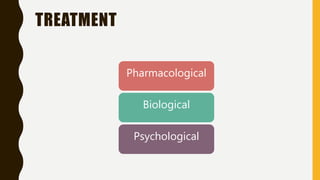
TREATMENT
Pharmacological
Biological
Psychological
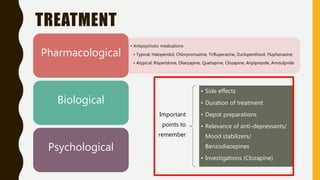
TREATMENT
• Antipsychotic medications
• Typical: Haloperidol, Chlorpromazine, Trifluperazine, Zuclopenthixol, Fluphenazine
• Atypical: Risperidone, Olanzapine, Quetiapine, Clozapine, Aripiprazole, Amisulpride
Pharmacological
Biological
Psychological
Important
points to
remember
• Side effects
• Duration of treatment
• Depot preparations
• Relevance of anti-depressants/
Mood stabilizers/
Benzodiazepines
• Investigations (Clozapine)
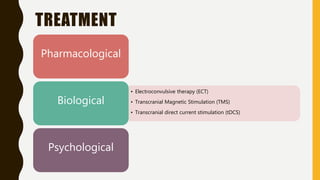
TREATMENT
Pharmacological
• Electroconvulsive therapy (ECT)
• Transcranial Magnetic Stimulation (TMS)
• Transcranial direct current stimulation (tDCS)
Biological
Psychological
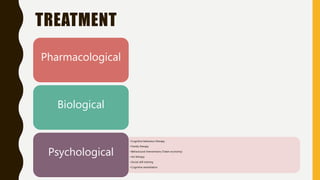
TREATMENT
Pharmacological
Biological
• Cognitive behaviour therapy
• Family therapy
• Behavioural interventions (Token economy)
• Art therapy
• Social skill training
• Cognitive remediation
Psychological
SUMMARY
QUERIES
Schizophrenia

Schizophrenia