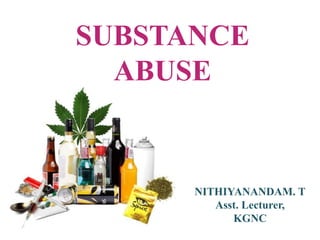
SUBSTANCE
ABUSE
NITHIYANANDAM. T
Asst. Lecturer,
KGNC
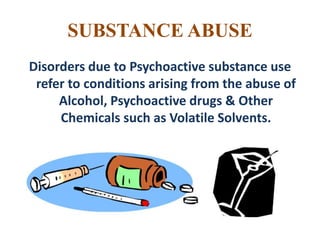
SUBSTANCE ABUSE
Disorders due to Psychoactive substance use
refer to conditions arising from the abuse of
Alcohol, Psychoactive drugs & Other
Chemicals such as Volatile Solvents.
TERMINOLOGIES
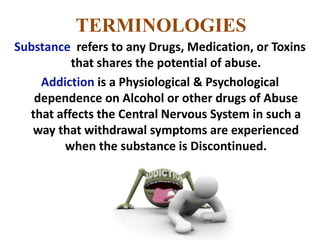
Substance refers to any Drugs, Medication, or Toxins
that shares the potential of abuse.
Addiction is a Physiological & Psychological
dependence on Alcohol or other drugs of Abuse
that affects the Central Nervous System in such a
way that withdrawal symptoms are experienced
when the substance is Discontinued.
Abuse refers to Maladaptive pattern of Substance
use that impairs health in a board sense.
Dependence refers to certain Physiological &
Psychological phenomena induced by the
repeated taking of a Substance.
Tolerance is a state in which after repeated
administration, a drug produced a decreased
effect, or increasing doses are required to
produce the same effect.
Withdrawal State is a group of signs & symptoms
recurring when a drug is reduced in amount or
withdrawn, which last for a limited time.
ICD – 10 CLASSIFICATION
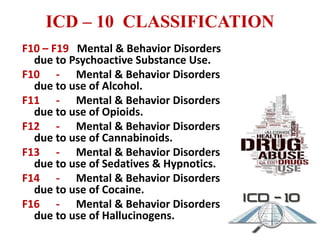
F10 – F19 Mental & Behavior Disorders
due to Psychoactive Substance Use.
F10 - Mental & Behavior Disorders
due to use of Alcohol.
F11 - Mental & Behavior Disorders
due to use of Opioids.
F12 - Mental & Behavior Disorders
due to use of Cannabinoids.
F13 - Mental & Behavior Disorders
due to use of Sedatives & Hypnotics.
F14 - Mental & Behavior Disorders
due to use of Cocaine.
F16 - Mental & Behavior Disorders
due to use of Hallucinogens.
COMMONLY USED
PSYCHOTROPIC SUBSTANCE
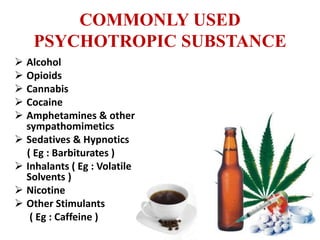
 Alcohol
 Opioids
 Cannabis
 Cocaine
 Amphetamines & other
sympathomimetics
 Sedatives & Hypnotics
( Eg : Barbiturates )
 Inhalants ( Eg : Volatile
Solvents )
 Nicotine
 Other Stimulants
( Eg : Caffeine )
ETIOLOGY
BIOLOGICAL FACTORS
Genetic Vulnerability :
Family History Of Substance use Disorders
Biochemical Factors :
Role of Dopamine & Nor-epinephrine have
been implicated in Cocaine, Ethanol, & Opioid
Dependence.
Abnormalities in Alcohol dehydrogenase or in
the Neurotransmitter mechanisms are thought
to play a role in Alcohol Dependence.
Neurobiological theories :
Drug addict may have an inborn deficiency of
Endomorphins.
Enzymes produced by a given gene might
influence hormones & Neurotransmitters,
contributing to the development of a
personality that is more sensitive to the peer
pressure.
Withdrawal & Reinforcing effects of drugs.
Co-morbid medical Disorder (Eg: To Control
Chronic Pain)
BEHAVIORAL THEORIES
Drug abuse as the result of Conditioning /
Cumulative reinforcement from drug use.
Drug use causes euphoric experience perceived
as rewarding, thereby motivating user to keep
taking the drug.
Stimuli & Setting associated with drug use may
themselves become reinforcing or may trigger
drug craving that can lead to relapse.
PSYCHOLOGICAL FACTORS
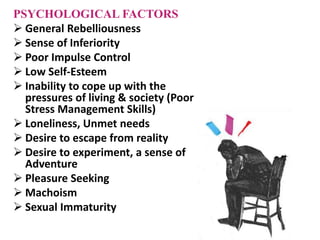
 General Rebelliousness
 Sense of Inferiority
 Poor Impulse Control
 Low Self-Esteem
 Inability to cope up with the
pressures of living & society (Poor
Stress Management Skills)
 Loneliness, Unmet needs
 Desire to escape from reality
 Desire to experiment, a sense of
Adventure
 Pleasure Seeking
 Machoism
 Sexual Immaturity
SOCIAL FACTORS
 Religious Reasons, Peer Pressure
 Urbanization, Extended Period of Education
 Unemployment, Overcrowding
 Poor Social Support
 Effects of Television & Other Mass Media
 Occupation: Substance use is more common in chefs,
Barmen, Executives, Salesman, Actors, Entertainers,
Army, Personnel, Journalists, Medical personnel, etc.,
EASY AVAILABILITY OF
DRUGS
Taking Drugs Prescribed by
the Doctors (Eg:
Benzodiazepine
Dependence)
Taking drugs that can be
bought legally without
Prescription (Eg: Nicotine,
Opioids)
Taking Drugs that can be
Obtained from illicit
Sources (Eg: Street Drugs)
PSYCHIATRIC DISORDERS
Substance Use Disorders are more Common in
Depression, Anxiety Disorders (Social Phobia),
Personality Disorders (Especially Anti-Social
Personality), & Occasionally in Organic Brain
Disorders & Schizophrenia.
CONSEQUENCES OF
SUBSTANCE ABUSE
This Commonly Leads to Physical Dependence,
Psychological Dependence, Or Both.
It may cause Unhealthy Lifestyles & Behaviors
Such as poor diet.
Chronic Substance abuse impairs Social &
Occupational Functioning, Creating Personal,
Professional, Financial, & Legal Problems (Drug
Seeking is commonly associated with Illegal
Activities, Such as Robbery or Assault).
Drug Use Beginning in early Adolescence may
lead to emotional & behavioral Problems,
Including Depression, Family Problems with
Relations, problems with or Failure to Complete
School, & Chronic Substance abuse Problems.
In Pregnant women, substance Abuse
Jeopardizes (Danger of Loss) fetal Well-being.
Psychoactive substances Produce negative
Outcomes In Many Patients, Including
Maladaptive Behavior, “Bad Trips” – Drug
Induced Psychosis, & even Long Term Psychosis.
• IV Drug Abuse May lead
to Life Threatening
Complications.
• Illicit Street Drugs pose
added Dangers; Materials
used to dilute them can
cause toxic Or allergic
Reactions.
ALCOHOL DEPENDENCE
SYNDROME
Alcohol Means Essence, anciently it called as
Magnus Hass which is derived from Arabic
Word.
Alcoholism refers to the uses of alcoholic
Beverages to the Point of Causing Damage
to the Individual, Society, Or Both.
(Or)
Chronic Dependence of Alcohol Characterized
by Excessive & Compulsive Drinking that
produce Disturbances in mental Or
Cognitive level of functioning which
interferes with social & Economic Levels.
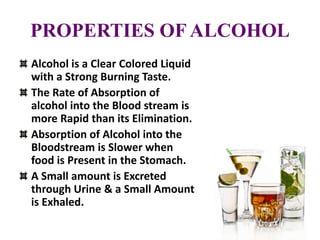
PROPERTIES OF ALCOHOL
Alcohol is a Clear Colored Liquid
with a Strong Burning Taste.
The Rate of Absorption of
alcohol into the Blood stream is
more Rapid than its Elimination.
Absorption of Alcohol into the
Bloodstream is Slower when
food is Present in the Stomach.
A Small amount is Excreted
through Urine & a Small Amount
is Exhaled.
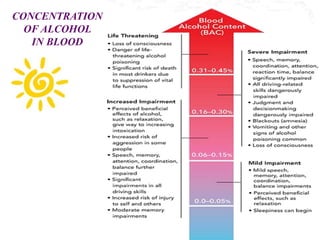
CONCENTRATION
OF ALCOHOL
IN BLOOD
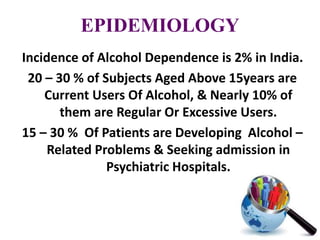
EPIDEMIOLOGY
Incidence of Alcohol Dependence is 2% in India.
20 – 30 % of Subjects Aged Above 15years are
Current Users Of Alcohol, & Nearly 10% of
them are Regular Or Excessive Users.
15 – 30 % Of Patients are Developing Alcohol –
Related Problems & Seeking admission in
Psychiatric Hospitals.
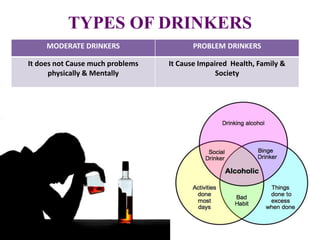
TYPES OF DRINKERS
MODERATE DRINKERS PROBLEM DRINKERS
It does not Cause much problems
physically & Mentally
It Cause Impaired Health, Family &
Society
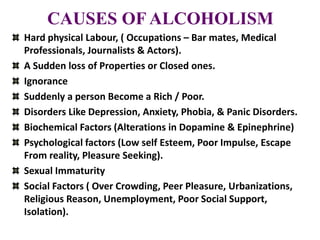
CAUSES OF ALCOHOLISM
Hard physical Labour, ( Occupations – Bar mates, Medical
Professionals, Journalists & Actors).
A Sudden loss of Properties or Closed ones.
Ignorance
Suddenly a person Become a Rich / Poor.
Disorders Like Depression, Anxiety, Phobia, & Panic Disorders.
Biochemical Factors (Alterations in Dopamine & Epinephrine)
Psychological factors (Low self Esteem, Poor Impulse, Escape
From reality, Pleasure Seeking).
Sexual Immaturity
Social Factors ( Over Crowding, Peer Pleasure, Urbanizations,
Religious Reason, Unemployment, Poor Social Support,
Isolation).
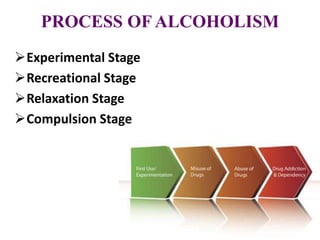
PROCESS OF ALCOHOLISM
Experimental Stage
Recreational Stage
Relaxation Stage
Compulsion Stage
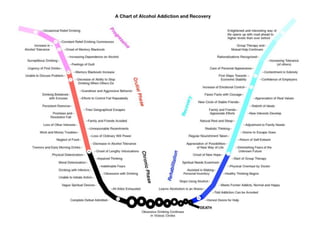
STAGES OF ALCOHOLISM
Progressive Phase
Crucial Phase
Chronic Phase
Rehabilitative Phase
Road For Recovery
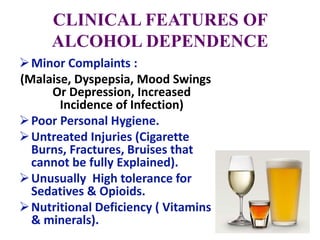
CLINICAL FEATURES OF
ALCOHOL DEPENDENCE
Minor Complaints :
(Malaise, Dyspepsia, Mood Swings
Or Depression, Increased
Incidence of Infection)
Poor Personal Hygiene.
Untreated Injuries (Cigarette
Burns, Fractures, Bruises that
cannot be fully Explained).
Unusually High tolerance for
Sedatives & Opioids.
Nutritional Deficiency ( Vitamins
& minerals).
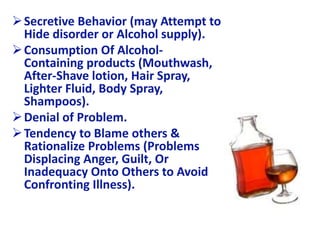
Secretive Behavior (may Attempt to
Hide disorder or Alcohol supply).
Consumption Of Alcohol-
Containing products (Mouthwash,
After-Shave lotion, Hair Spray,
Lighter Fluid, Body Spray,
Shampoos).
Denial of Problem.
Tendency to Blame others &
Rationalize Problems (Problems
Displacing Anger, Guilt, Or
Inadequacy Onto Others to Avoid
Confronting Illness).
ICD-10 CRITERIA FOR ALCOHOL
DEPENDENCE
A Strong Desire to take the Substance
Difficulty in Controlling Substance Taking
Behavior
A Physiological Withdrawal State.
Progressive neglect of Alternative pleasures
or Interests.
Persisting with Substance Use Despite Clear
Evidence of Harmful Consequences
PSYCHIATRIC DISORDERS DUE TO
ALCOHOL DEPENDENCE
Acute Intoxication
Withdrawal Syndrome
Alcohol-Induced
Amnestic Disorders
Alcohol-Induced
psychiatric Disorders
ACUTE INTOXICATION
It Develops During Or Shortly After
Alcohol Ingestion.
It is Characterized by,
 Clinically Significant Maladaptive
Behavior or Psychological Changes
(Eg’s: Inappropriate Sexual or
Aggressive Behavior).
 Mood Lability
 Impaired Judgment
 Slurred Speech
 Inco-ordination
 Unsteady gait
 Nystagmus
 Impaired Attention & Memory
 Finally Resulting in Stupor or Coma.
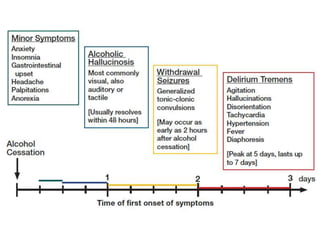
WITHDRAWAL SYNDROME
Person Who Have been Drinking Heavily
Over a Prolonged period of time, Any Rapid
Decrease in the amount of Alcohol in the
Body is likely to Produce Withdrawal
Symptoms.
These are:
Simple Withdrawal Symptoms
Delirium Tremens
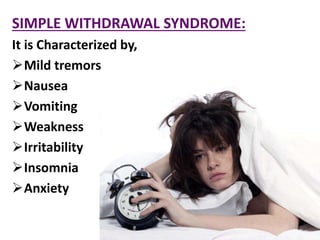
SIMPLE WITHDRAWAL SYNDROME:
It is Characterized by,
Mild tremors
Nausea
Vomiting
Weakness
Irritability
Insomnia
Anxiety
DELIRIUM TREMENS
It Occurs Usually within 2-
4days of Complete or
Significant Abstinence
From Heavy drinking.
The course is Very Short,
with Recovery Occurring
within 3-7days.
It is Characterized by,
 A Dramatic & Rapidly
Changing Picture of
Disordered Mental Activity,
with Clouding Of
Consciousness &
Disorientation in Time &
Place.
 Poor Attention Span.
 Vivid Hallucinations which
are Usually Visual, Tactile
Hallucinations Can also
Occur.
 Severe Psychomotor
Agitation
 Shouting & Evident Fear
 Grossly Tremulous Hands
which Sometimes Pick-Up
Imaginary Objects; Truncal
ataxia.
 Autonomic Disturbances
Such as Sweating, Fever,
Tachycardia, Raised Blood
pressure, Pupillary dilation.
 Dehydration with Electrolyte
Imbalances.
 Reversal of Sleep-Wake
Pattern or Insomnia
 Blood tests to Reveal
Leucocytosis & LFT
 Death may Occur due to
Cardiovascular Collapse,
Infection, Hyperthermia, Or
self Inflicted Injury.
ALCOHOL-INDUCED AMNESTIC
DISORDERS
Chronic Alcohol Abuse
associated with Thiamine
Deficiency (Vitamin B) is
the most frequent Cause
of Amnestic Disorders.
This Condition is Divided
into :
Wernicke’s Syndrome
Korsakoff’s Syndrome
WERNICKE’S SYNDROME is Characterized by,
Prominent Cerebellar Ataxia
Palsy of the 6th Cranial Nerve
Peripheral Neuropathy
Mental Confusion
KORSAKOFF’S SYNDROME
The Prominent Symptoms in this Syndrome is Gross
Memory disturbance.
Other Symptoms Include:
Disorientation
Confusion
Confabulation
Poor Attention Span & Distractibility
Impairment of Insight
ALCOHOL-INDUCED
PSYCHIATRIC DISORDERS
Alcohol Induced Dementia:
It is a long term Complication of
Alcohol Abuse, Characterized by
Global decrease in cognitive
Functioning (Decreased
Intellectual Functioning &
Memory).
This Disorder tends to Improve
With Abstinence, But Most of The
Patients may have Permanent
disabilities.
Alcohol-Induced Mood
Disorders:
Persistent Depression &
Anxiety
Suicidal Behavior
Alcohol-Induced Anxiety
Disorders:
Panic Attacks
Impaired Psychosexual
Dysfunction:
Erectile Dysfunction &
Delayed Ejaculation
Pathological Jealousy:
Delusion of Infidelity
Alcoholic Seizures:
 Generalized Tonic -
Clonic Seizures Occur
Within 12-48 Hours
After a Heavy Bout of
Drinking.
 Status Epilepticus
Alcoholic Hallucinosis:
 Presence of Auditory
Hallucination during
Abstinence
 Regular Alcohol Intake
RELAPSE
Relapse refers to the process of returning to the use
of alcohol or drugs after a period of Abstinence.
Relapse Dangers:
The presence of drugs or Alcohol, Drug users,
Places where you used Drugs.
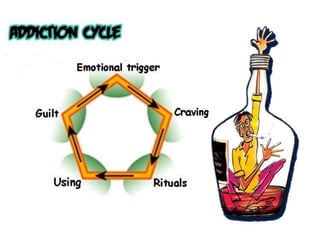
Negative Feelings, Anger, Sadness, Loneliness,
Guilt, Fear, & Anxiety.
Positive Feelings which make you celebrate.
Boredom – A State of Feeling Bored.
Increase the Intake of drug.
Physical pain
Lot of Cash
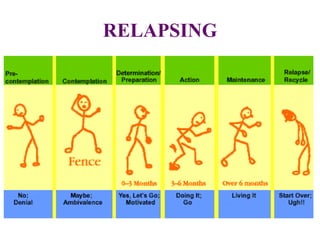
RELAPSING
Warning Signs Of Relapse:
 Stopping medications on one’s
own or against the advise of
medical professionals.
 Hanging around old drinking
haunts & drug using Friends.
 Isolating themselves.
 Keeping Alcohol, drugs around
the houses for some reason.
 Obsessive thinking about using
drugs / Drinking.
 Fail to follow their treatment
plan, Quitting therapies, Skipping
doctor’s appointments.
 Feeling Over – Confident
 Difficulties in Maintaining
Relationships.
 Setting Unrealistic Goals.
 Changes in Diet, Sleep, Energy
levels, & Personal Hygiene.
 Feeling Overwhelmed.
 Constant Boredom.
 Sudden Changes in Psychiatric
Symptoms.
 Unresolved Conflicts.
 Avoidance.
 Major life Changes – loss, Grief,
Trauma, Painful Emotions,
Winning the Lotteries.
 Ignoring Relapse warning Signs &
Symptoms
Signs & Symptoms of Relapse:
Experiencing Post acute Withdrawal
Return to denial
Avoidance & defensive Behavior
Starting to Build Crisis
Feeling Immobilized (Stuck)
Become depressed
Loss of control
Urges & Cravings
Chemical Loss of Control
COMPLICATIONS OF ALCOHOL
ABUSE
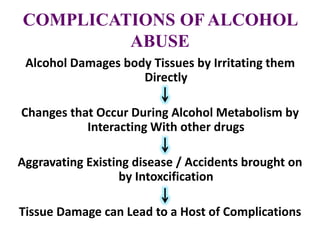
Alcohol Damages body Tissues by Irritating them
Directly
Changes that Occur During Alcohol Metabolism by
Interacting With other drugs
Aggravating Existing disease / Accidents brought on
by Intoxcification
Tissue Damage can Lead to a Host of Complications
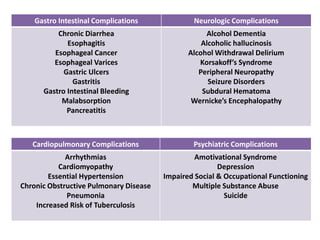
Gastro Intestinal Complications Neurologic Complications
Chronic Diarrhea
Esophagitis
Esophageal Cancer
Esophageal Varices
Gastric Ulcers
Gastritis
Gastro Intestinal Bleeding
Malabsorption
Pancreatitis
Alcohol Dementia
Alcoholic hallucinosis
Alcohol Withdrawal Delirium
Korsakoff’s Syndrome
Peripheral Neuropathy
Seizure Disorders
Subdural Hematoma
Wernicke’s Encephalopathy
Cardiopulmonary Complications Psychiatric Complications
Arrhythmias
Cardiomyopathy
Essential Hypertension
Chronic Obstructive Pulmonary Disease
Pneumonia
Increased Risk of Tuberculosis
Amotivational Syndrome
Depression
Impaired Social & Occupational Functioning
Multiple Substance Abuse
Suicide
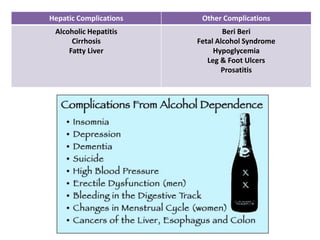
Hepatic Complications Other Complications
Alcoholic Hepatitis
Cirrhosis
Fatty Liver
Beri Beri
Fetal Alcohol Syndrome
Hypoglycemia
Leg & Foot Ulcers
Prosatitis
DIAGNOSTIC EVALUATION
 History collection.
 Mental Status Examination.
 Physical Examination.
 Neurologic Examination.
 CAGE Questionnaires.
 Michigan Alcohol Screening
Tests (MAST).
 Alcohol Use Disorders
Identification Tests (AUDIT).
 Paddington Alcohol Test (PAT).
 Blood Alcohol Level to indicate
Intoxication (200mg/dl).
 Urine Toxicology to reveal use
of Other Drugs.
 Serum Electrolytes Analysis
Revealing Electrolyte
Abnormalities associated with
Alcohol Use.
 Liver function Studies
demonstrating alcohol related
Liver Damage.
 Hematologic Workup Possibly
revealing Anemia,
Thrombocytopenia.
 Echocardiography &
Electrocardiography
demonstrating Cardiac
Problems.
 Based on ICD10 Criteria.
TREATMENT MODALITIES
Symptomatic Treatment.
Fluid Replacement
Therapy.
IV Glucose to Prevent
Hypoglycemia.
Correction of
Hypothermia / Acidosis.
Emergency Measures for
Trauma, Infection or GI
Bleeding.
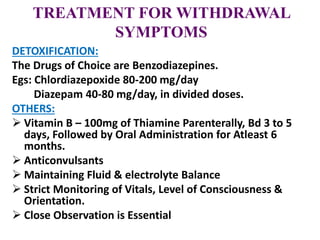
TREATMENT FOR WITHDRAWAL
SYMPTOMS
DETOXIFICATION:
The Drugs of Choice are Benzodiazepines.
Egs: Chlordiazepoxide 80-200 mg/day
Diazepam 40-80 mg/day, in divided doses.
OTHERS:
 Vitamin B – 100mg of Thiamine Parenterally, Bd 3 to 5
days, Followed by Oral Administration for Atleast 6
months.
 Anticonvulsants
 Maintaining Fluid & electrolyte Balance
 Strict Monitoring of Vitals, Level of Consciousness &
Orientation.
 Close Observation is Essential
ALCOHOL DETERRENT
THERAPY
Deterrent agents are given to desensitize the
individual to the effects of alcohol &
Abstinence.
The Most commonly Used Drug is Disulfiram or
Tetraethyl thiuram disulfide or Antabuse.
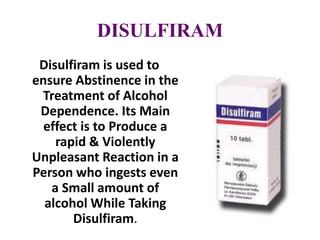
DISULFIRAM
Disulfiram is used to
ensure Abstinence in the
Treatment of Alcohol
Dependence. Its Main
effect is to Produce a
rapid & Violently
Unpleasant Reaction in a
Person who ingests even
a Small amount of
alcohol While Taking
Disulfiram.
DOSAGE:
Initial Dose is 500mg/day orally for the 1st 2weeks,
followed by a maintenance dosage of 250mg/day.
The Dosage should not exceed 500mg/day.
INDICATIONS:
Disulfiram use is as an Aversive Conditioning
Treatment for Alcohol Dependence.
CONTRAINDICATIONS:
Pulmonary & Cardiovascular Disease
Disulfiram Should be used with caution in patients
with Nephritis, Brain Damage, Hypothyroidism,
Diabetes, Hepatic Disease, Seizures, Poly-drug
Dependence or an Abnormal EEG.
High Risk for Alcohol Ingestion.
ACTION:
It is an Aldehyde Dehydrogenase inhibitor that
interferes with the metabolism of alcohol &
Produces a marked increase in blood acetaldehyde
levels.
Accumulation of acetaldehyde( more than 10 times
which occurs in the normal metabolism of alcohol)
produces a wide array of Unpleasant reactions
Called DISULFIRAM-ETHANOL REACTION (DER).
Characterized by Nausea, Throbbing headache,
Hypotension, Sweating, thirst, Chest Pain,
tachycardia, Vertigo, blurred Vision associated with
Severe Anxiety.
ADVERSE EFFECTS:
Fatigue, Dermatitis, Impotence, Optic Neuritis,
Mental Changes, Acute Polyneuropathy,
Hepatic Damage, Convulsions, Respiratory
Depression, cardiovascular Collapse,
Myocardial Infarction, Death.
NURSING RESPONSIBILITY:
 An informed Consent should be taken before Starting treatment.
 Ensure that at least 12hours have elapsed since the last ingestion
of Alcohol before Administering the Drug.
 Patient should be warned against Ingestion of any alcohol-
containing preparations such as Cough Syrups, Sauces,
Aftershave Lotions, Etc.,
 Caution patient against taking CNS Depressants & Over-the-
Counter(OTC) Medications during disulfiram therapy.
 Instruct The Patient to avoid driving or other activities requiring
alertness.
 Patients should be warned that the Disulfiram-alcohol Reaction
may continue for as long as 1or 2 weeks after the last dose of
disulfiram.
 Patients should carry identification cards describing Disulfiram-
alcohol reaction & listing the name & phone number of the
physician to be called.
 Emphasize the Importance of Follow-Up visits to the physician to
monitor progress in long-term therapy.
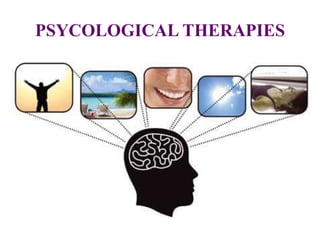
PSYCOLOGICAL THERAPIES
PSYCHOLOGICAL THERAPY:
 Motivational Interviewing
 Group Therapy
 Aversive Conditioning / Therapy
 Cognitive Therapy
 Relapse Prevention Technique: This technique helps the
patient to identify high-risk relapse factors & develop
strategies to deal with them.
 Cue Exposure Technique: The technique aims through
repeated exposure to desensitize drug abusers to drug
effects, & thus improve their ability to Remain Abstinent.
 Assertive Training
 Behavior Counseling
 Supportive Psychotherapy
 Individual Psychotherapy
AGENCIES CONCERNED WITH
ALCOHOL-RELATED PROBLEMS
This is a self Help organization
founded in the USA by 2 Alcoholic
men Dr. Bob Smith & Dr. Bill Wilson
On 10th june,1985.
Alcoholic Anonymous considers
Alcoholism as a Physical, Mental,
Spiritual disease, a Progressive one,
which can be Arrested but not Cured.
Members attend Group meetings
usually twice a week on a long –
term basis.
Each member is assigned a support
person from whom he may seek help
when the temptation to drink occurs.
In Crisis he can obtain immediate help by
telephone.
Once Sobriety is achieved he is Expected
to help others.
The Organization works on the firm belief
that Abstinence must be Complete.
The only Requirement for membership is a
Desire to stop drinking.
There is no authority, but only a fellowship
of imperfect alcoholics whose strength is
formed out of weakness.
Their primary purpose is to help each
other stay sober and help each other
alcoholics to achieve sobriety.
Al-Anon
This is a Group Started by Mrs. Annie, Wife of
Dr. Bob to support the Spouses of Alcoholics.
Al-Teen
Provides Support to their Teenage Children.
Hostels
These are intended mainly for those rendered
homeless due to alcohol-related problems. They
Provide Rehabilitation & Counseling. Usually
abstinence is a Condition of Residence.
NURSING MANAGEMENT
Nursing Assessment:
Recognition of Alcohol Abuse using CAGE
Questionnaire
C – Have you ever felt you ought to CUT down on
your drinking ?
A – Have People ANNOYED you by criticizing your
drinking ?
G – have you ever felt GUILTY about your drinking ?
E – Have you ever had a drink first thing in the
morning (An EYE – OPENER) to steady your nerves
or get rid of a Hangover ?
Be suspicious about ‘At Risk’ Factors:
 Problems in the Marriage & Family , At Work , With
Finances or with the Law
 At risk occupations
 Withdrawal Symptoms after Admission
 Alcohol – related physical Disorders
 Repeated Accidents
 Deliberate Self Harm
If at – risk Factors raise Suspicion, the next step is to ask
Tactful but Persistent Questions to confirm the Diagnosis.
Certain clinical Signs lead to the suspicion that drugs are
being injected: Needle Tracks & Thrombosed Veins,
wearing Garments with long Sleeves, etc., IV use should
be suspected in any patient who presents with
Subcutaneous Abscesses or Hepatitis.
Behavioral Changes:
Absence from School or work, Negligence of
Appearance, Minor Criminal Offences, Isolation
from Former Friends& Adoption of new Friends in a
Drug Culture.
Laboratory Tests:
Raised Gamma – Glutamyl Transpeptidase (GGT),
Raised Mean Corpuscular Volume (MCV), Blood
Alcohol Concentration, Most drugs can be detected
in urine except Lysergic Acid Diethylamide (LSD).
Gastrointestinal:
Nausea/Vomiting , Changes in Weight/Appetite, Signs
of Malnutrition, Color & Consistency of Stool.
 Nervous System:
Orientation, Level of Consciousness, Co-ordination, Gait, Long term
& Short term Memory, Signs of Depression & Anxiety, Tremors
Or Increased Reflexes, Pupils (Constricted/Dilated)
 Cardiovascular & Respiratory:
Vital Signs, Peripheral Pulses, Dyspnea on Exertion, Abnormal
Breath Sounds, Arrhythmias, Fatigue, Peripheral Edema.
 Integumentary:
Skin lesions, Needle tracks on Scaring on arms, legs, fingers, toes,
under the tongue, or between gums & lips.
 Emotional Behavior:
 Affect, Rate of Speech, Suspiciousness, anger, agitation,
Hallucinations, Blackouts, Violent Episodes, Support Systems
 Denial & Rationalization are the feelings of fear, Insecurity, Low
Self Esteem.
Identify the type of Substance the
person has been using , the amount,
frequency, method of administration
& the length of time the substance has
been abused.
Note of any Suicidal ideation or
interest, with drained Symptoms.
Assess for level of motivation for
treatment.
Identify reason for Admission.
A Baseline Physical & Emotional
Nursing assessment is done to
determine Admission status & Provide
baseline from which to determine
progress towards an expected
Outcome.
NURSING DIAGNOSIS
 Risk for injury related to Hallucinosis, acute Intoxication
evidenced by Confusion, Disorientation, inability to
identify potentially Harmful Situations.
 Altered Health Maintenance related to inability to
identify, manage or seek out help to maintain health,
evidenced by various physical symptoms, Exhaustion,
Sleep Disturbances, etc.,
 Ineffective Denial Related to weak, under-developed ego,
evidenced by Lack of Insight, Rationalization of problems,
Blaming Others, Failure to Accept responsibility for his
Behavior.
 Ineffective individual coping related to impairment of
adaptive behavior & Problem – Solving abilities,
evidenced by use of substances as Coping Mechanisms.
OTHER SUUBSTANCE USE
DISORDERS
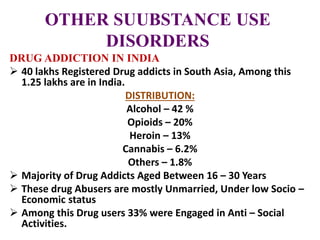
DRUG ADDICTION IN INDIA
 40 lakhs Registered Drug addicts in South Asia, Among this
1.25 lakhs are in India.
DISTRIBUTION:
Alcohol – 42 %
Opioids – 20%
Heroin – 13%
Cannabis – 6.2%
Others – 1.8%
 Majority of Drug Addicts Aged Between 16 – 30 Years
 These drug Abusers are mostly Unmarried, Under low Socio –
Economic status
 Among this Drug users 33% were Engaged in Anti – Social
Activities.
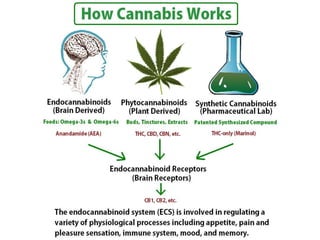
CANNABIS USE DISORDER
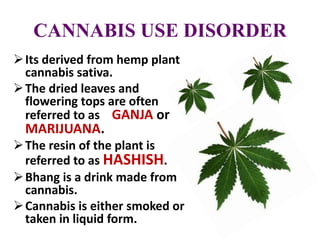
Its derived from hemp plant
cannabis sativa.
The dried leaves and
flowering tops are often
referred to as GANJA or
MARIJUANA.
The resin of the plant is
referred to as HASHISH.
Bhang is a drink made from
cannabis.
Cannabis is either smoked or
taken in liquid form.
ACUTE INTOXICATION
MILD INTOXICATION
It is characterized by
 Mild impairment of consciousness and
orientation.
 Tachycardia
 A sense of floating in the air
 Euphoria
 Dream Like States
 Tremors
 Photophobia
 Dry Mouth
 Lacrimation
 Increased Appetite
 Alteration In The Psychomotor Activity
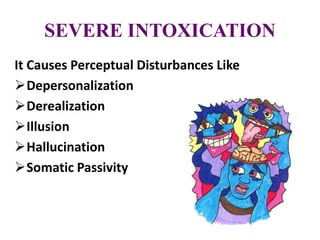
SEVERE INTOXICATION
It Causes Perceptual Disturbances Like
Depersonalization
Derealization
Illusion
Hallucination
Somatic Passivity
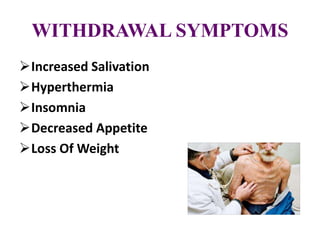
WITHDRAWAL SYMPTOMS
Increased Salivation
Hyperthermia
Insomnia
Decreased Appetite
Loss Of Weight
COMPLICATIONS
Memory Impairment
Amotivational Syndrome
Transient Or Short Lasting
Psychiatric Disorders Such as Acute
Anxiety, Paranoid Psychosis,
Hysterical Fugue Like States,
Hypomania, Schizophrenia.
TREATMENT
Supportive And Symptomatic
Treatment
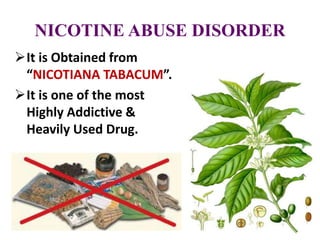
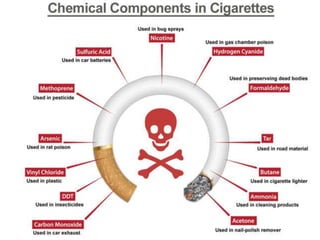
NICOTINE ABUSE DISORDER
It is Obtained from
“NICOTIANA TABACUM”.
It is one of the most
Highly Addictive &
Heavily Used Drug.
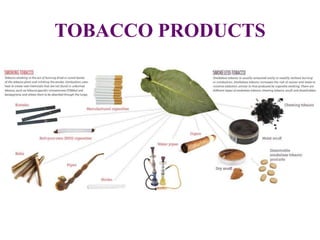
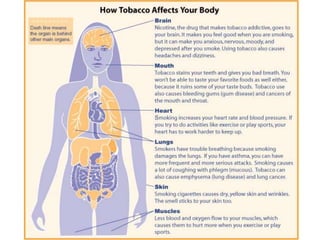
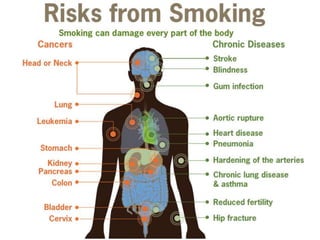
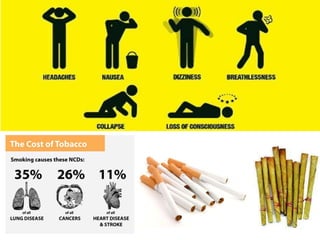
TOBACCO PRODUCTS
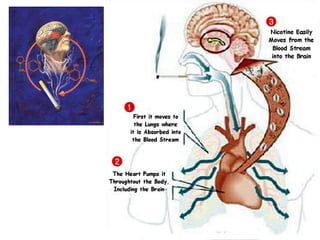
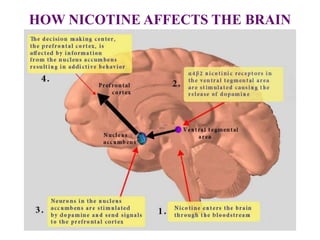
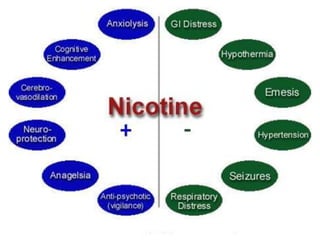
HOW NICOTINE AFFECTS THE BRAIN
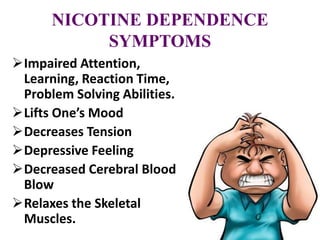
NICOTINE DEPENDENCE
SYMPTOMS
Impaired Attention,
Learning, Reaction Time,
Problem Solving Abilities.
Lifts One’s Mood
Decreases Tension
Depressive Feeling
Decreased Cerebral Blood
Blow
Relaxes the Skeletal
Muscles.
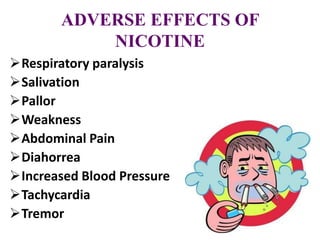
ADVERSE EFFECTS OF
NICOTINE
Respiratory paralysis
Salivation
Pallor
Weakness
Abdominal Pain
Diahorrea
Increased Blood Pressure
Tachycardia
Tremor
NICOTINE TOXICITY
Inability to Concentrate
Confusion
Sensory Disturbances
Decreases the Rapid Eye
Movement while Sleep
During Pregnancy,
Increased Incidence of Low
Birth Weight Babies
Increased Incidence of
Newborns with Persistent
Pulmonary Hypertension.
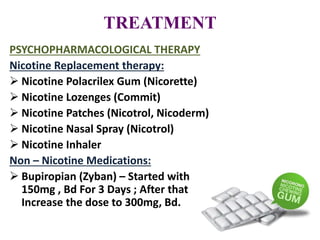
TREATMENT
PSYCHOPHARMACOLOGICAL THERAPY
Nicotine Replacement therapy:
 Nicotine Polacrilex Gum (Nicorette)
 Nicotine Lozenges (Commit)
 Nicotine Patches (Nicotrol, Nicoderm)
 Nicotine Nasal Spray (Nicotrol)
 Nicotine Inhaler
Non – Nicotine Medications:
 Bupiropian (Zyban) – Started with
150mg , Bd For 3 Days ; After that
Increase the dose to 300mg, Bd.
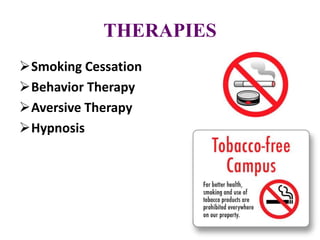
THERAPIES
Smoking Cessation
Behavior Therapy
Aversive Therapy
Hypnosis
OPIOID USE DISORDERS
The most Important Dependence Producing
Derivatives are Morphine & Heroin.
The commonly Abused Opioids (Narcotics) in
our Country are Heroin (Brown Sugar, Smack)
And the Synthetic Preparations Like Pethidine,
Fortwin & Tidigesic.
More Opiate Users had begun with Chasing
Heroin (Inhaling the Smoke / Chasing the
Dragon), they Gradually Shifted to Needle use.
Injecting Drug users have become a high Risk
Group for HIV Infection.
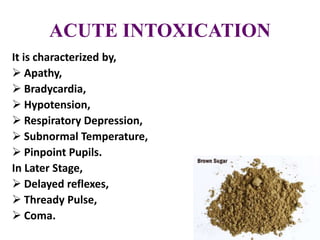
ACUTE INTOXICATION
It is characterized by,
 Apathy,
 Bradycardia,
 Hypotension,
 Respiratory Depression,
 Subnormal Temperature,
 Pinpoint Pupils.
In Later Stage,
 Delayed reflexes,
 Thready Pulse,
 Coma.
WITHDRAWAL SYNDROME
It Rarely Produce a Life – Threatening Situation.
Common Symptoms Includes,
Withdrawal Symptoms Begin Within 12 Hours of
the Last Dose, Peak in 24 -36 hours, Disappear in
5 – 6 Days.
Watery Eyes,
Running Nose,
Yawning,
Loss of Appetite,
Irritability,
Tremors,
Anxiety.
Sweating,
Cramps,
Nausea,
Diahorrea,
Insomnia,
Raised Body Temperature,
Piloerection
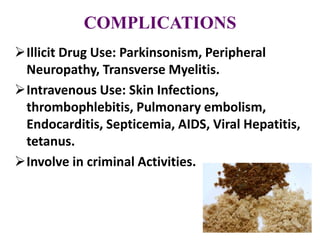
COMPLICATIONS
Illicit Drug Use: Parkinsonism, Peripheral
Neuropathy, Transverse Myelitis.
Intravenous Use: Skin Infections,
thrombophlebitis, Pulmonary embolism,
Endocarditis, Septicemia, AIDS, Viral Hepatitis,
tetanus.
Involve in criminal Activities.
TREATMENT
Opioid Overdose: Treated with Narcotic Antagonists
[Egs: Naloxone, Naltrexone]
Detoxification: Withdrawal symptoms can be
managed By Methadone, Clonidine, Naltrexone,
Buprenorphine, etc.
Maintenance Therapy: After the Detoxification
Phase, the patient is maintained on one of the
following Regimens:
- Methadone Maintenance
- Opioids Antagonists
- Psychological methods like Individual
Psychotherapy, Behavior Therapy, Group Therapy,
Family Therapy.
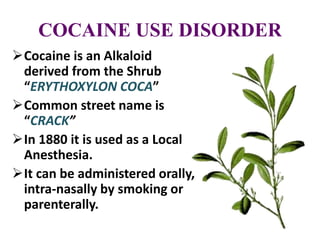
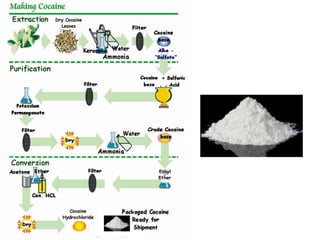
COCAINE USE DISORDER
Cocaine is an Alkaloid
derived from the Shrub
“ERYTHOXYLON COCA”
Common street name is
“CRACK”
In 1880 it is used as a Local
Anesthesia.
It can be administered orally,
intra-nasally by smoking or
parenterally.
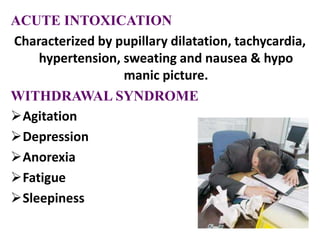
ACUTE INTOXICATION
Characterized by pupillary dilatation, tachycardia,
hypertension, sweating and nausea & hypo
manic picture.
WITHDRAWAL SYNDROME
Agitation
Depression
Anorexia
Fatigue
Sleepiness
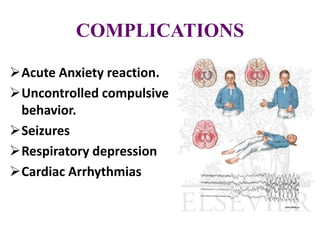
COMPLICATIONS
Acute Anxiety reaction.
Uncontrolled compulsive
behavior.
Seizures
Respiratory depression
Cardiac Arrhythmias
TREATMENT
MANAGEMENT OF INTOXICATION:
Amyl Nitrite is an antidote.
Diazepam / Propanolol
(withdrawal syndrome)
Anti - Depressants (Imipramine
or Amitriptyline).
Psychotherapy.
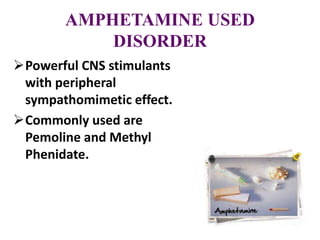
AMPHETAMINE USED
DISORDER
Powerful CNS stimulants
with peripheral
sympathomimetic effect.
Commonly used are
Pemoline and Methyl
Phenidate.
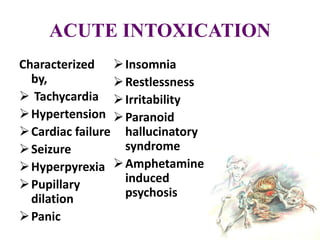
ACUTE INTOXICATION
Characterized
by,
 Tachycardia
Hypertension
Cardiac failure
Seizure
Hyperpyrexia
Pupillary
dilation
Panic
Insomnia
Restlessness
Irritability
Paranoid
hallucinatory
syndrome
Amphetamine
induced
psychosis
WITHDRAWAL SYNDROME
Characterized by
Depression
Apathy
Fatigue
Hypersomnia / Insomnia
Agitation
Hyperphagia
COMPLICATIONS
Seizure
Delirium
Arrhythmias
Aggressive behavior
Coma
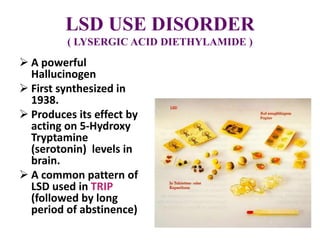
LSD USE DISORDER
( LYSERGIC ACID DIETHYLAMIDE )
 A powerful
Hallucinogen
 First synthesized in
1938.
 Produces its effect by
acting on 5-Hydroxy
Tryptamine
(serotonin) levels in
brain.
 A common pattern of
LSD used in TRIP
(followed by long
period of abstinence)
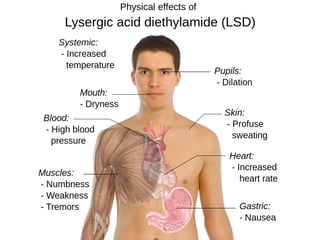
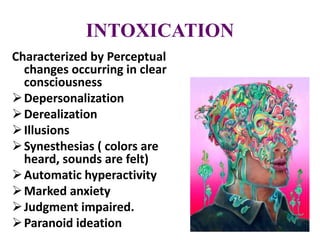
INTOXICATION
Characterized by Perceptual
changes occurring in clear
consciousness
Depersonalization
Derealization
Illusions
Synesthesias ( colors are
heard, sounds are felt)
Automatic hyperactivity
Marked anxiety
Judgment impaired.
Paranoid ideation
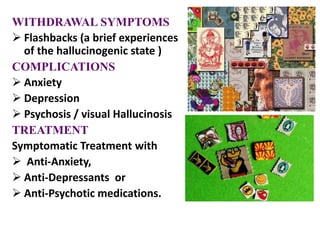
WITHDRAWAL SYMPTOMS
 Flashbacks (a brief experiences
of the hallucinogenic state )
COMPLICATIONS
 Anxiety
 Depression
 Psychosis / visual Hallucinosis
TREATMENT
Symptomatic Treatment with
 Anti-Anxiety,
 Anti-Depressants or
 Anti-Psychotic medications.
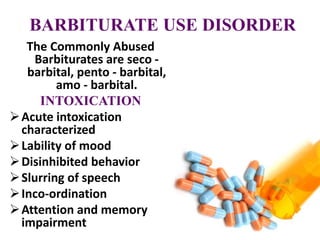
BARBITURATE USE DISORDER
The Commonly Abused
Barbiturates are seco -
barbital, pento - barbital,
amo - barbital.
INTOXICATION
Acute intoxication
characterized
Lability of mood
Disinhibited behavior
Slurring of speech
Inco-ordination
Attention and memory
impairment
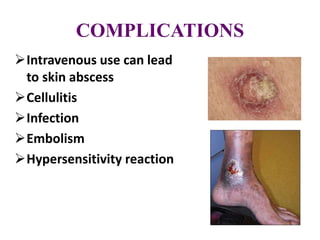
COMPLICATIONS
Intravenous use can lead
to skin abscess
Cellulitis
Infection
Embolism
Hypersensitivity reaction
WITHDRAWAL SYNDROME
Restlessness
Tremors
Seizure in severe cases
resembling delirium tremens
TREATMENT
If the patient is conscious,
induction of vomiting and use of
Activated Charcoal can reduce
the absorption.
Treatment is symptomatic.
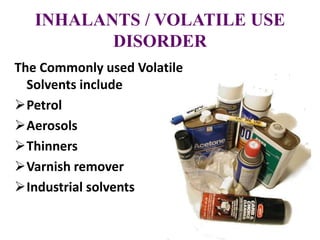
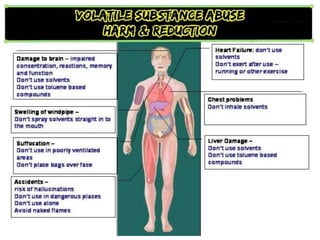
INHALANTS / VOLATILE USE
DISORDER
The Commonly used Volatile
Solvents include
Petrol
Aerosols
Thinners
Varnish remover
Industrial solvents
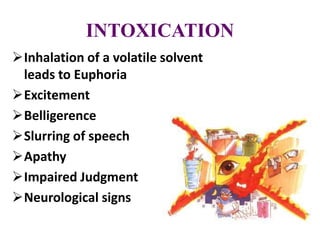
INTOXICATION
Inhalation of a volatile solvent
leads to Euphoria
Excitement
Belligerence
Slurring of speech
Apathy
Impaired Judgment
Neurological signs
WITHDRAWAL SYMPTOMS
Anxiety
Depression
COMPLICATIONS
Irreversible damage to the liver
and kidneys
Peripheral neuropathy
Perceptual disturbances
Brain damage
TREATMENT
Reassurance
Diazepam for intoxication.
NURSING INTERVENTIONS
Acute Intoxication
 Care for a Substance Abuse patient starts with an
Assessment - To determine which substance he is
abusing, Assess the Signs and symptoms vary with
the substance and dosage.
 During the Acute phase of drug Intoxication and
Detoxification - Maintaining the patient’s vital
functions, ensuring his safety, and easing
discomfort.
 During Rehabilitation, caregiver help the patient
acknowledge his substance abuse problem and
find alternative ways to cope with stress & help
the patient to achieve recovery and stay drug-free.
Acute Episodes
 Continuously monitor the Patient's Vital Signs and Urine
Output.
 Watch for Complications of Overdose & Withdrawal.
 Maintain a safe and quiet environment.
 Take appropriate measures to prevent suicide attempts
and assaults.
 Remove harmful objects from the room, and use restrains
only if you suspect the patient might harm himself or
others.
 Approach the patient in a non - threatening way; limit
sustained eye contact, which he may perceive as
threatening.
 Institute seizure precautions.
 Administer IV fluids to Increase Circulatory Volume.
 Give medications as Ordered.
 Monitor & Record the Patients effectiveness.
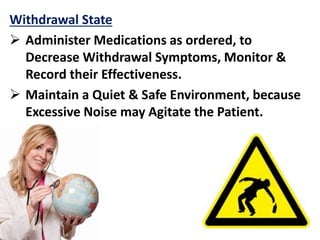
Withdrawal State
 Administer Medications as ordered, to
Decrease Withdrawal Symptoms, Monitor &
Record their Effectiveness.
 Maintain a Quiet & Safe Environment, because
Excessive Noise may Agitate the Patient.
WHEN THE ACUTE EPISODE HAS
RESOLVED
 Carefully Monitor & Promote Adequate Nutrition.
 Administer drugs carefully to prevent Hoarding.
 Check the patient’s mouth to ensure that he has
swallowed Oral Medication.
 Closely Monitor Visitors who might Supply him
with Drugs.
 Refer the Patient for Rehabilitation as appropriate;
Give him a list of available Resources.
 Encourage Family Members to seek Help
Regardless of whether the Abuser Seeks it.
 Suggest Private Therapy or Community Mental
Health Clinics.
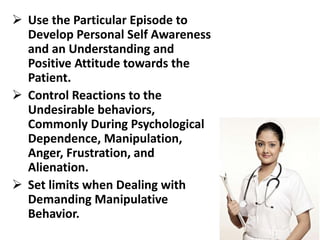
 Use the Particular Episode to
Develop Personal Self Awareness
and an Understanding and
Positive Attitude towards the
Patient.
 Control Reactions to the
Undesirable behaviors,
Commonly During Psychological
Dependence, Manipulation,
Anger, Frustration, and
Alienation.
 Set limits when Dealing with
Demanding Manipulative
Behavior.
PREVENTION
PRIMARY PREVENTION
 Reduction of Prescribing by Doctors ( Anxiolytics
Especially Benzodiazepines)
 Identification & Treatment of Family Members who may
be Contributing to the Drug Abuse.
 Introduction of social changes by
- Putting Up the Price of Alcohol & Its Beverages.
- Controlling / Abolishing the Advertising of Alcoholic
drinks.
- Controls On sales by Limiting Hours Or Banning
sales in Super-Markets.
- Restricting Availability & Lessening Social
Deprivation ( Governmental Measures).
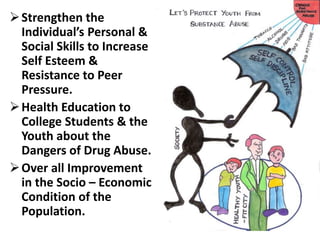
Strengthen the
Individual’s Personal &
Social Skills to Increase
Self Esteem &
Resistance to Peer
Pressure.
Health Education to
College Students & the
Youth about the
Dangers of Drug Abuse.
Over all Improvement
in the Socio – Economic
Condition of the
Population.
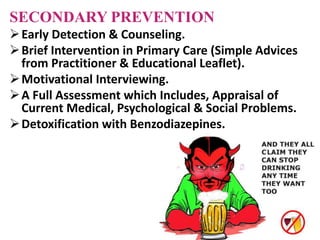
SECONDARY PREVENTION
Early Detection & Counseling.
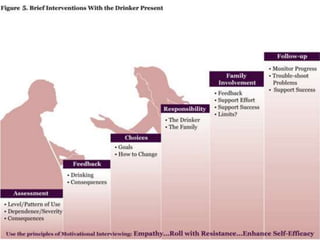
Brief Intervention in Primary Care (Simple Advices
from Practitioner & Educational Leaflet).
Motivational Interviewing.
A Full Assessment which Includes, Appraisal of
Current Medical, Psychological & Social Problems.
Detoxification with Benzodiazepines.
TERITARY PREVENTION
Alcohol Deterrent Therapy
Other Therapies include Assertive Training, Teaching
Coping Skills, Behavior Counseling, Supportive &
Individual Psychotherapy.
Agencies concerned with Alcohol – Related
Problems (Alcoholic Anonymous, Al – Anon, Al –
Teen, etc).
Motivation Enhancement including Education about
Health consequences of Alcohol use.
Identifying High Risk Situations & Developing
Strategies to Deal with them (Eg: Craving
Management).
Drink Refusal Skills ( Assertiveness Training )
Dealing with Faulty Cognitions.
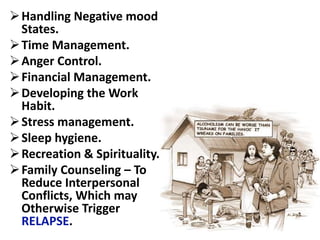
Handling Negative mood
States.
Time Management.
Anger Control.
Financial Management.
Developing the Work
Habit.
Stress management.
Sleep hygiene.
Recreation & Spirituality.
Family Counseling – To
Reduce Interpersonal
Conflicts, Which may
Otherwise Trigger
RELAPSE.
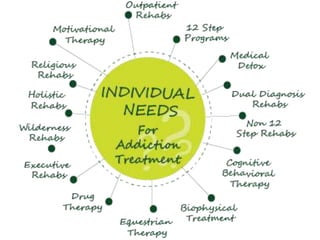
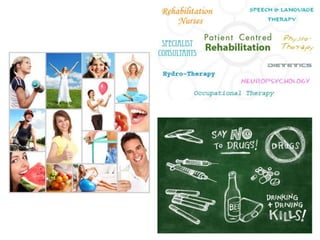
REHABILITATION
The Aim of Rehabilitation of an Individual
De -addicted from the Effects of
Alcohol/Drugs.
 To Enable him to Leave the Drug Sub –
Culture.
 To Develop New Social Contacts, In this
Patients First Engage in Work & Social
Activities in Sheltered Surroundings &
then take Greater Responsibilities for
Themselves in Conditions Increasingly
like those of Everyday Life.
 Continuing Social Support is Usually
Required when the Person makes the
Transition to Normal Work & Living .
PSYCHOEDUCATION
(FOR PATIENTS & FAMILY)
 Teach about the Physical, Psychological & Social
Complication of Drug & Alcohol Use.
 Inform the Concern that Psychoactive Substance may
alter a person’s Mood, Perceptions, Consciousness or
Behavior.
 Explain to the Family that the Patient may Use Lies,
Denial or Manipulation to continue Drug of Alcohol Use
and to avoid Treatment.
 Teach the Patient/Family that Drug Overdose or
Withdrawal can result in a Medical Emergency & even
Death, Give the Family Emergency resources for Help.
 Caution the Patient that Sharing Dirty or Used Needle can
Result in a Life-Threatening Disease such as AIDS,
Hepatitis – B.
 Teach the Family to Establish Trust with the Patient and
to Use Firm limit Setting, when necessary to help the
Patient Confront Drug Abuse Issues.
 Provide the Patient with a Full Range of Treatment during
Hospitalization such as Medication, Individual Therapy,
Group therapy, 12 step program(AA) & Behavior
Modification to Strengthen the Recovery Process.
 Teach how to Recognize Psychosocial Stressors that may
Exacerbate Substance Abuse Problem & how to Avoid or
Prevent them.
 Emphasize the Importance of Changing Lifestyle,
Friendships & Habits that Promote Drug Use to Remain
Sober.
 Teach about the Availability of Local Self – Help Programs
(AA, Al – Anon, Al - Teen) to Strengthen the Patient’s
Recovery & Support the Family’s Assistance.
Substance Abuse, Psychiatric Nursing, B. Sc (N) PPT

Substance Abuse, Psychiatric Nursing, B. Sc (N) PPT

  • 1.
  • 3.
    SUBSTANCE ABUSE Disorders dueto Psychoactive substance use refer to conditions arising from the abuse of Alcohol, Psychoactive drugs & Other Chemicals such as Volatile Solvents.
  • 4.
    TERMINOLOGIES Substance refers toany Drugs, Medication, or Toxins that shares the potential of abuse. Addiction is a Physiological & Psychological dependence on Alcohol or other drugs of Abuse that affects the Central Nervous System in such a way that withdrawal symptoms are experienced when the substance is Discontinued.
  • 5.
    Abuse refers toMaladaptive pattern of Substance use that impairs health in a board sense. Dependence refers to certain Physiological & Psychological phenomena induced by the repeated taking of a Substance. Tolerance is a state in which after repeated administration, a drug produced a decreased effect, or increasing doses are required to produce the same effect. Withdrawal State is a group of signs & symptoms recurring when a drug is reduced in amount or withdrawn, which last for a limited time.
  • 6.
    ICD – 10CLASSIFICATION F10 – F19 Mental & Behavior Disorders due to Psychoactive Substance Use. F10 - Mental & Behavior Disorders due to use of Alcohol. F11 - Mental & Behavior Disorders due to use of Opioids. F12 - Mental & Behavior Disorders due to use of Cannabinoids. F13 - Mental & Behavior Disorders due to use of Sedatives & Hypnotics. F14 - Mental & Behavior Disorders due to use of Cocaine. F16 - Mental & Behavior Disorders due to use of Hallucinogens.
  • 7.
    COMMONLY USED PSYCHOTROPIC SUBSTANCE Alcohol  Opioids  Cannabis  Cocaine  Amphetamines & other sympathomimetics  Sedatives & Hypnotics ( Eg : Barbiturates )  Inhalants ( Eg : Volatile Solvents )  Nicotine  Other Stimulants ( Eg : Caffeine )
  • 8.
    ETIOLOGY BIOLOGICAL FACTORS Genetic Vulnerability: Family History Of Substance use Disorders Biochemical Factors : Role of Dopamine & Nor-epinephrine have been implicated in Cocaine, Ethanol, & Opioid Dependence. Abnormalities in Alcohol dehydrogenase or in the Neurotransmitter mechanisms are thought to play a role in Alcohol Dependence.
  • 9.
    Neurobiological theories : Drugaddict may have an inborn deficiency of Endomorphins. Enzymes produced by a given gene might influence hormones & Neurotransmitters, contributing to the development of a personality that is more sensitive to the peer pressure. Withdrawal & Reinforcing effects of drugs. Co-morbid medical Disorder (Eg: To Control Chronic Pain)
  • 10.
    BEHAVIORAL THEORIES Drug abuseas the result of Conditioning / Cumulative reinforcement from drug use. Drug use causes euphoric experience perceived as rewarding, thereby motivating user to keep taking the drug. Stimuli & Setting associated with drug use may themselves become reinforcing or may trigger drug craving that can lead to relapse.
  • 11.
    PSYCHOLOGICAL FACTORS  GeneralRebelliousness  Sense of Inferiority  Poor Impulse Control  Low Self-Esteem  Inability to cope up with the pressures of living & society (Poor Stress Management Skills)  Loneliness, Unmet needs  Desire to escape from reality  Desire to experiment, a sense of Adventure  Pleasure Seeking  Machoism  Sexual Immaturity
  • 12.
    SOCIAL FACTORS  ReligiousReasons, Peer Pressure  Urbanization, Extended Period of Education  Unemployment, Overcrowding  Poor Social Support  Effects of Television & Other Mass Media  Occupation: Substance use is more common in chefs, Barmen, Executives, Salesman, Actors, Entertainers, Army, Personnel, Journalists, Medical personnel, etc.,
  • 13.
    EASY AVAILABILITY OF DRUGS TakingDrugs Prescribed by the Doctors (Eg: Benzodiazepine Dependence) Taking drugs that can be bought legally without Prescription (Eg: Nicotine, Opioids) Taking Drugs that can be Obtained from illicit Sources (Eg: Street Drugs)
  • 14.
    PSYCHIATRIC DISORDERS Substance UseDisorders are more Common in Depression, Anxiety Disorders (Social Phobia), Personality Disorders (Especially Anti-Social Personality), & Occasionally in Organic Brain Disorders & Schizophrenia.
  • 15.
    CONSEQUENCES OF SUBSTANCE ABUSE ThisCommonly Leads to Physical Dependence, Psychological Dependence, Or Both. It may cause Unhealthy Lifestyles & Behaviors Such as poor diet. Chronic Substance abuse impairs Social & Occupational Functioning, Creating Personal, Professional, Financial, & Legal Problems (Drug Seeking is commonly associated with Illegal Activities, Such as Robbery or Assault).
  • 16.
    Drug Use Beginningin early Adolescence may lead to emotional & behavioral Problems, Including Depression, Family Problems with Relations, problems with or Failure to Complete School, & Chronic Substance abuse Problems. In Pregnant women, substance Abuse Jeopardizes (Danger of Loss) fetal Well-being. Psychoactive substances Produce negative Outcomes In Many Patients, Including Maladaptive Behavior, “Bad Trips” – Drug Induced Psychosis, & even Long Term Psychosis.
  • 17.
    • IV DrugAbuse May lead to Life Threatening Complications. • Illicit Street Drugs pose added Dangers; Materials used to dilute them can cause toxic Or allergic Reactions.
  • 18.
    ALCOHOL DEPENDENCE SYNDROME Alcohol MeansEssence, anciently it called as Magnus Hass which is derived from Arabic Word. Alcoholism refers to the uses of alcoholic Beverages to the Point of Causing Damage to the Individual, Society, Or Both. (Or) Chronic Dependence of Alcohol Characterized by Excessive & Compulsive Drinking that produce Disturbances in mental Or Cognitive level of functioning which interferes with social & Economic Levels.
  • 19.
    PROPERTIES OF ALCOHOL Alcoholis a Clear Colored Liquid with a Strong Burning Taste. The Rate of Absorption of alcohol into the Blood stream is more Rapid than its Elimination. Absorption of Alcohol into the Bloodstream is Slower when food is Present in the Stomach. A Small amount is Excreted through Urine & a Small Amount is Exhaled.
  • 20.
  • 21.
    EPIDEMIOLOGY Incidence of AlcoholDependence is 2% in India. 20 – 30 % of Subjects Aged Above 15years are Current Users Of Alcohol, & Nearly 10% of them are Regular Or Excessive Users. 15 – 30 % Of Patients are Developing Alcohol – Related Problems & Seeking admission in Psychiatric Hospitals.
  • 22.
    TYPES OF DRINKERS MODERATEDRINKERS PROBLEM DRINKERS It does not Cause much problems physically & Mentally It Cause Impaired Health, Family & Society
  • 25.
    CAUSES OF ALCOHOLISM Hardphysical Labour, ( Occupations – Bar mates, Medical Professionals, Journalists & Actors). A Sudden loss of Properties or Closed ones. Ignorance Suddenly a person Become a Rich / Poor. Disorders Like Depression, Anxiety, Phobia, & Panic Disorders. Biochemical Factors (Alterations in Dopamine & Epinephrine) Psychological factors (Low self Esteem, Poor Impulse, Escape From reality, Pleasure Seeking). Sexual Immaturity Social Factors ( Over Crowding, Peer Pleasure, Urbanizations, Religious Reason, Unemployment, Poor Social Support, Isolation).
  • 26.
    PROCESS OF ALCOHOLISM ExperimentalStage Recreational Stage Relaxation Stage Compulsion Stage
  • 27.
    STAGES OF ALCOHOLISM ProgressivePhase Crucial Phase Chronic Phase Rehabilitative Phase Road For Recovery
  • 31.
    CLINICAL FEATURES OF ALCOHOLDEPENDENCE Minor Complaints : (Malaise, Dyspepsia, Mood Swings Or Depression, Increased Incidence of Infection) Poor Personal Hygiene. Untreated Injuries (Cigarette Burns, Fractures, Bruises that cannot be fully Explained). Unusually High tolerance for Sedatives & Opioids. Nutritional Deficiency ( Vitamins & minerals).
  • 32.
    Secretive Behavior (mayAttempt to Hide disorder or Alcohol supply). Consumption Of Alcohol- Containing products (Mouthwash, After-Shave lotion, Hair Spray, Lighter Fluid, Body Spray, Shampoos). Denial of Problem. Tendency to Blame others & Rationalize Problems (Problems Displacing Anger, Guilt, Or Inadequacy Onto Others to Avoid Confronting Illness).
  • 33.
    ICD-10 CRITERIA FORALCOHOL DEPENDENCE A Strong Desire to take the Substance Difficulty in Controlling Substance Taking Behavior A Physiological Withdrawal State. Progressive neglect of Alternative pleasures or Interests. Persisting with Substance Use Despite Clear Evidence of Harmful Consequences
  • 34.
    PSYCHIATRIC DISORDERS DUETO ALCOHOL DEPENDENCE Acute Intoxication Withdrawal Syndrome Alcohol-Induced Amnestic Disorders Alcohol-Induced psychiatric Disorders
  • 35.
    ACUTE INTOXICATION It DevelopsDuring Or Shortly After Alcohol Ingestion. It is Characterized by,  Clinically Significant Maladaptive Behavior or Psychological Changes (Eg’s: Inappropriate Sexual or Aggressive Behavior).  Mood Lability  Impaired Judgment  Slurred Speech  Inco-ordination  Unsteady gait  Nystagmus  Impaired Attention & Memory  Finally Resulting in Stupor or Coma.
  • 37.
    WITHDRAWAL SYNDROME Person WhoHave been Drinking Heavily Over a Prolonged period of time, Any Rapid Decrease in the amount of Alcohol in the Body is likely to Produce Withdrawal Symptoms. These are: Simple Withdrawal Symptoms Delirium Tremens
  • 38.
    SIMPLE WITHDRAWAL SYNDROME: Itis Characterized by, Mild tremors Nausea Vomiting Weakness Irritability Insomnia Anxiety
  • 39.
    DELIRIUM TREMENS It OccursUsually within 2- 4days of Complete or Significant Abstinence From Heavy drinking. The course is Very Short, with Recovery Occurring within 3-7days.
  • 40.
    It is Characterizedby,  A Dramatic & Rapidly Changing Picture of Disordered Mental Activity, with Clouding Of Consciousness & Disorientation in Time & Place.  Poor Attention Span.  Vivid Hallucinations which are Usually Visual, Tactile Hallucinations Can also Occur.  Severe Psychomotor Agitation  Shouting & Evident Fear  Grossly Tremulous Hands which Sometimes Pick-Up Imaginary Objects; Truncal ataxia.  Autonomic Disturbances Such as Sweating, Fever, Tachycardia, Raised Blood pressure, Pupillary dilation.  Dehydration with Electrolyte Imbalances.  Reversal of Sleep-Wake Pattern or Insomnia  Blood tests to Reveal Leucocytosis & LFT  Death may Occur due to Cardiovascular Collapse, Infection, Hyperthermia, Or self Inflicted Injury.
  • 41.
    ALCOHOL-INDUCED AMNESTIC DISORDERS Chronic AlcoholAbuse associated with Thiamine Deficiency (Vitamin B) is the most frequent Cause of Amnestic Disorders. This Condition is Divided into : Wernicke’s Syndrome Korsakoff’s Syndrome
  • 42.
    WERNICKE’S SYNDROME isCharacterized by, Prominent Cerebellar Ataxia Palsy of the 6th Cranial Nerve Peripheral Neuropathy Mental Confusion KORSAKOFF’S SYNDROME The Prominent Symptoms in this Syndrome is Gross Memory disturbance. Other Symptoms Include: Disorientation Confusion Confabulation Poor Attention Span & Distractibility Impairment of Insight
  • 43.
    ALCOHOL-INDUCED PSYCHIATRIC DISORDERS Alcohol InducedDementia: It is a long term Complication of Alcohol Abuse, Characterized by Global decrease in cognitive Functioning (Decreased Intellectual Functioning & Memory). This Disorder tends to Improve With Abstinence, But Most of The Patients may have Permanent disabilities.
  • 44.
    Alcohol-Induced Mood Disorders: Persistent Depression& Anxiety Suicidal Behavior Alcohol-Induced Anxiety Disorders: Panic Attacks Impaired Psychosexual Dysfunction: Erectile Dysfunction & Delayed Ejaculation Pathological Jealousy: Delusion of Infidelity Alcoholic Seizures:  Generalized Tonic - Clonic Seizures Occur Within 12-48 Hours After a Heavy Bout of Drinking.  Status Epilepticus Alcoholic Hallucinosis:  Presence of Auditory Hallucination during Abstinence  Regular Alcohol Intake
  • 46.
    RELAPSE Relapse refers tothe process of returning to the use of alcohol or drugs after a period of Abstinence. Relapse Dangers: The presence of drugs or Alcohol, Drug users, Places where you used Drugs. Negative Feelings, Anger, Sadness, Loneliness, Guilt, Fear, & Anxiety. Positive Feelings which make you celebrate. Boredom – A State of Feeling Bored. Increase the Intake of drug. Physical pain Lot of Cash
  • 47.
  • 48.
    Warning Signs OfRelapse:  Stopping medications on one’s own or against the advise of medical professionals.  Hanging around old drinking haunts & drug using Friends.  Isolating themselves.  Keeping Alcohol, drugs around the houses for some reason.  Obsessive thinking about using drugs / Drinking.  Fail to follow their treatment plan, Quitting therapies, Skipping doctor’s appointments.  Feeling Over – Confident  Difficulties in Maintaining Relationships.  Setting Unrealistic Goals.  Changes in Diet, Sleep, Energy levels, & Personal Hygiene.  Feeling Overwhelmed.  Constant Boredom.  Sudden Changes in Psychiatric Symptoms.  Unresolved Conflicts.  Avoidance.  Major life Changes – loss, Grief, Trauma, Painful Emotions, Winning the Lotteries.  Ignoring Relapse warning Signs & Symptoms
  • 49.
    Signs & Symptomsof Relapse: Experiencing Post acute Withdrawal Return to denial Avoidance & defensive Behavior Starting to Build Crisis Feeling Immobilized (Stuck) Become depressed Loss of control Urges & Cravings Chemical Loss of Control
  • 50.
    COMPLICATIONS OF ALCOHOL ABUSE AlcoholDamages body Tissues by Irritating them Directly Changes that Occur During Alcohol Metabolism by Interacting With other drugs Aggravating Existing disease / Accidents brought on by Intoxcification Tissue Damage can Lead to a Host of Complications
  • 51.
    Gastro Intestinal ComplicationsNeurologic Complications Chronic Diarrhea Esophagitis Esophageal Cancer Esophageal Varices Gastric Ulcers Gastritis Gastro Intestinal Bleeding Malabsorption Pancreatitis Alcohol Dementia Alcoholic hallucinosis Alcohol Withdrawal Delirium Korsakoff’s Syndrome Peripheral Neuropathy Seizure Disorders Subdural Hematoma Wernicke’s Encephalopathy Cardiopulmonary Complications Psychiatric Complications Arrhythmias Cardiomyopathy Essential Hypertension Chronic Obstructive Pulmonary Disease Pneumonia Increased Risk of Tuberculosis Amotivational Syndrome Depression Impaired Social & Occupational Functioning Multiple Substance Abuse Suicide
  • 52.
    Hepatic Complications OtherComplications Alcoholic Hepatitis Cirrhosis Fatty Liver Beri Beri Fetal Alcohol Syndrome Hypoglycemia Leg & Foot Ulcers Prosatitis
  • 53.
    DIAGNOSTIC EVALUATION  Historycollection.  Mental Status Examination.  Physical Examination.  Neurologic Examination.  CAGE Questionnaires.  Michigan Alcohol Screening Tests (MAST).  Alcohol Use Disorders Identification Tests (AUDIT).  Paddington Alcohol Test (PAT).  Blood Alcohol Level to indicate Intoxication (200mg/dl).  Urine Toxicology to reveal use of Other Drugs.  Serum Electrolytes Analysis Revealing Electrolyte Abnormalities associated with Alcohol Use.  Liver function Studies demonstrating alcohol related Liver Damage.  Hematologic Workup Possibly revealing Anemia, Thrombocytopenia.  Echocardiography & Electrocardiography demonstrating Cardiac Problems.  Based on ICD10 Criteria.
  • 54.
    TREATMENT MODALITIES Symptomatic Treatment. FluidReplacement Therapy. IV Glucose to Prevent Hypoglycemia. Correction of Hypothermia / Acidosis. Emergency Measures for Trauma, Infection or GI Bleeding.
  • 55.
    TREATMENT FOR WITHDRAWAL SYMPTOMS DETOXIFICATION: TheDrugs of Choice are Benzodiazepines. Egs: Chlordiazepoxide 80-200 mg/day Diazepam 40-80 mg/day, in divided doses. OTHERS:  Vitamin B – 100mg of Thiamine Parenterally, Bd 3 to 5 days, Followed by Oral Administration for Atleast 6 months.  Anticonvulsants  Maintaining Fluid & electrolyte Balance  Strict Monitoring of Vitals, Level of Consciousness & Orientation.  Close Observation is Essential
  • 57.
    ALCOHOL DETERRENT THERAPY Deterrent agentsare given to desensitize the individual to the effects of alcohol & Abstinence. The Most commonly Used Drug is Disulfiram or Tetraethyl thiuram disulfide or Antabuse.
  • 58.
    DISULFIRAM Disulfiram is usedto ensure Abstinence in the Treatment of Alcohol Dependence. Its Main effect is to Produce a rapid & Violently Unpleasant Reaction in a Person who ingests even a Small amount of alcohol While Taking Disulfiram.
  • 59.
    DOSAGE: Initial Dose is500mg/day orally for the 1st 2weeks, followed by a maintenance dosage of 250mg/day. The Dosage should not exceed 500mg/day. INDICATIONS: Disulfiram use is as an Aversive Conditioning Treatment for Alcohol Dependence. CONTRAINDICATIONS: Pulmonary & Cardiovascular Disease Disulfiram Should be used with caution in patients with Nephritis, Brain Damage, Hypothyroidism, Diabetes, Hepatic Disease, Seizures, Poly-drug Dependence or an Abnormal EEG. High Risk for Alcohol Ingestion.
  • 60.
    ACTION: It is anAldehyde Dehydrogenase inhibitor that interferes with the metabolism of alcohol & Produces a marked increase in blood acetaldehyde levels. Accumulation of acetaldehyde( more than 10 times which occurs in the normal metabolism of alcohol) produces a wide array of Unpleasant reactions Called DISULFIRAM-ETHANOL REACTION (DER). Characterized by Nausea, Throbbing headache, Hypotension, Sweating, thirst, Chest Pain, tachycardia, Vertigo, blurred Vision associated with Severe Anxiety.
  • 61.
    ADVERSE EFFECTS: Fatigue, Dermatitis,Impotence, Optic Neuritis, Mental Changes, Acute Polyneuropathy, Hepatic Damage, Convulsions, Respiratory Depression, cardiovascular Collapse, Myocardial Infarction, Death.
  • 62.
    NURSING RESPONSIBILITY:  Aninformed Consent should be taken before Starting treatment.  Ensure that at least 12hours have elapsed since the last ingestion of Alcohol before Administering the Drug.  Patient should be warned against Ingestion of any alcohol- containing preparations such as Cough Syrups, Sauces, Aftershave Lotions, Etc.,  Caution patient against taking CNS Depressants & Over-the- Counter(OTC) Medications during disulfiram therapy.  Instruct The Patient to avoid driving or other activities requiring alertness.  Patients should be warned that the Disulfiram-alcohol Reaction may continue for as long as 1or 2 weeks after the last dose of disulfiram.  Patients should carry identification cards describing Disulfiram- alcohol reaction & listing the name & phone number of the physician to be called.  Emphasize the Importance of Follow-Up visits to the physician to monitor progress in long-term therapy.
  • 63.
  • 64.
    PSYCHOLOGICAL THERAPY:  MotivationalInterviewing  Group Therapy  Aversive Conditioning / Therapy  Cognitive Therapy  Relapse Prevention Technique: This technique helps the patient to identify high-risk relapse factors & develop strategies to deal with them.  Cue Exposure Technique: The technique aims through repeated exposure to desensitize drug abusers to drug effects, & thus improve their ability to Remain Abstinent.  Assertive Training  Behavior Counseling  Supportive Psychotherapy  Individual Psychotherapy
  • 65.
    AGENCIES CONCERNED WITH ALCOHOL-RELATEDPROBLEMS This is a self Help organization founded in the USA by 2 Alcoholic men Dr. Bob Smith & Dr. Bill Wilson On 10th june,1985. Alcoholic Anonymous considers Alcoholism as a Physical, Mental, Spiritual disease, a Progressive one, which can be Arrested but not Cured. Members attend Group meetings usually twice a week on a long – term basis. Each member is assigned a support person from whom he may seek help when the temptation to drink occurs.
  • 66.
    In Crisis hecan obtain immediate help by telephone. Once Sobriety is achieved he is Expected to help others. The Organization works on the firm belief that Abstinence must be Complete. The only Requirement for membership is a Desire to stop drinking. There is no authority, but only a fellowship of imperfect alcoholics whose strength is formed out of weakness. Their primary purpose is to help each other stay sober and help each other alcoholics to achieve sobriety.
  • 68.
    Al-Anon This is aGroup Started by Mrs. Annie, Wife of Dr. Bob to support the Spouses of Alcoholics. Al-Teen Provides Support to their Teenage Children. Hostels These are intended mainly for those rendered homeless due to alcohol-related problems. They Provide Rehabilitation & Counseling. Usually abstinence is a Condition of Residence.
  • 69.
    NURSING MANAGEMENT Nursing Assessment: Recognitionof Alcohol Abuse using CAGE Questionnaire C – Have you ever felt you ought to CUT down on your drinking ? A – Have People ANNOYED you by criticizing your drinking ? G – have you ever felt GUILTY about your drinking ? E – Have you ever had a drink first thing in the morning (An EYE – OPENER) to steady your nerves or get rid of a Hangover ?
  • 70.
    Be suspicious about‘At Risk’ Factors:  Problems in the Marriage & Family , At Work , With Finances or with the Law  At risk occupations  Withdrawal Symptoms after Admission  Alcohol – related physical Disorders  Repeated Accidents  Deliberate Self Harm If at – risk Factors raise Suspicion, the next step is to ask Tactful but Persistent Questions to confirm the Diagnosis. Certain clinical Signs lead to the suspicion that drugs are being injected: Needle Tracks & Thrombosed Veins, wearing Garments with long Sleeves, etc., IV use should be suspected in any patient who presents with Subcutaneous Abscesses or Hepatitis.
  • 71.
    Behavioral Changes: Absence fromSchool or work, Negligence of Appearance, Minor Criminal Offences, Isolation from Former Friends& Adoption of new Friends in a Drug Culture. Laboratory Tests: Raised Gamma – Glutamyl Transpeptidase (GGT), Raised Mean Corpuscular Volume (MCV), Blood Alcohol Concentration, Most drugs can be detected in urine except Lysergic Acid Diethylamide (LSD). Gastrointestinal: Nausea/Vomiting , Changes in Weight/Appetite, Signs of Malnutrition, Color & Consistency of Stool.
  • 72.
     Nervous System: Orientation,Level of Consciousness, Co-ordination, Gait, Long term & Short term Memory, Signs of Depression & Anxiety, Tremors Or Increased Reflexes, Pupils (Constricted/Dilated)  Cardiovascular & Respiratory: Vital Signs, Peripheral Pulses, Dyspnea on Exertion, Abnormal Breath Sounds, Arrhythmias, Fatigue, Peripheral Edema.  Integumentary: Skin lesions, Needle tracks on Scaring on arms, legs, fingers, toes, under the tongue, or between gums & lips.  Emotional Behavior:  Affect, Rate of Speech, Suspiciousness, anger, agitation, Hallucinations, Blackouts, Violent Episodes, Support Systems  Denial & Rationalization are the feelings of fear, Insecurity, Low Self Esteem.
  • 73.
    Identify the typeof Substance the person has been using , the amount, frequency, method of administration & the length of time the substance has been abused. Note of any Suicidal ideation or interest, with drained Symptoms. Assess for level of motivation for treatment. Identify reason for Admission. A Baseline Physical & Emotional Nursing assessment is done to determine Admission status & Provide baseline from which to determine progress towards an expected Outcome.
  • 74.
    NURSING DIAGNOSIS  Riskfor injury related to Hallucinosis, acute Intoxication evidenced by Confusion, Disorientation, inability to identify potentially Harmful Situations.  Altered Health Maintenance related to inability to identify, manage or seek out help to maintain health, evidenced by various physical symptoms, Exhaustion, Sleep Disturbances, etc.,  Ineffective Denial Related to weak, under-developed ego, evidenced by Lack of Insight, Rationalization of problems, Blaming Others, Failure to Accept responsibility for his Behavior.  Ineffective individual coping related to impairment of adaptive behavior & Problem – Solving abilities, evidenced by use of substances as Coping Mechanisms.
  • 75.
    OTHER SUUBSTANCE USE DISORDERS DRUGADDICTION IN INDIA  40 lakhs Registered Drug addicts in South Asia, Among this 1.25 lakhs are in India. DISTRIBUTION: Alcohol – 42 % Opioids – 20% Heroin – 13% Cannabis – 6.2% Others – 1.8%  Majority of Drug Addicts Aged Between 16 – 30 Years  These drug Abusers are mostly Unmarried, Under low Socio – Economic status  Among this Drug users 33% were Engaged in Anti – Social Activities.
  • 76.
    CANNABIS USE DISORDER Itsderived from hemp plant cannabis sativa. The dried leaves and flowering tops are often referred to as GANJA or MARIJUANA. The resin of the plant is referred to as HASHISH. Bhang is a drink made from cannabis. Cannabis is either smoked or taken in liquid form.
  • 78.
    ACUTE INTOXICATION MILD INTOXICATION Itis characterized by  Mild impairment of consciousness and orientation.  Tachycardia  A sense of floating in the air  Euphoria  Dream Like States  Tremors  Photophobia  Dry Mouth  Lacrimation  Increased Appetite  Alteration In The Psychomotor Activity
  • 79.
    SEVERE INTOXICATION It CausesPerceptual Disturbances Like Depersonalization Derealization Illusion Hallucination Somatic Passivity
  • 80.
  • 81.
    COMPLICATIONS Memory Impairment Amotivational Syndrome TransientOr Short Lasting Psychiatric Disorders Such as Acute Anxiety, Paranoid Psychosis, Hysterical Fugue Like States, Hypomania, Schizophrenia. TREATMENT Supportive And Symptomatic Treatment
  • 82.
    NICOTINE ABUSE DISORDER Itis Obtained from “NICOTIANA TABACUM”. It is one of the most Highly Addictive & Heavily Used Drug.
  • 83.
  • 87.
  • 90.
    NICOTINE DEPENDENCE SYMPTOMS Impaired Attention, Learning,Reaction Time, Problem Solving Abilities. Lifts One’s Mood Decreases Tension Depressive Feeling Decreased Cerebral Blood Blow Relaxes the Skeletal Muscles.
  • 92.
    ADVERSE EFFECTS OF NICOTINE Respiratoryparalysis Salivation Pallor Weakness Abdominal Pain Diahorrea Increased Blood Pressure Tachycardia Tremor
  • 94.
    NICOTINE TOXICITY Inability toConcentrate Confusion Sensory Disturbances Decreases the Rapid Eye Movement while Sleep During Pregnancy, Increased Incidence of Low Birth Weight Babies Increased Incidence of Newborns with Persistent Pulmonary Hypertension.
  • 95.
    TREATMENT PSYCHOPHARMACOLOGICAL THERAPY Nicotine Replacementtherapy:  Nicotine Polacrilex Gum (Nicorette)  Nicotine Lozenges (Commit)  Nicotine Patches (Nicotrol, Nicoderm)  Nicotine Nasal Spray (Nicotrol)  Nicotine Inhaler Non – Nicotine Medications:  Bupiropian (Zyban) – Started with 150mg , Bd For 3 Days ; After that Increase the dose to 300mg, Bd.
  • 96.
  • 97.
    OPIOID USE DISORDERS Themost Important Dependence Producing Derivatives are Morphine & Heroin. The commonly Abused Opioids (Narcotics) in our Country are Heroin (Brown Sugar, Smack) And the Synthetic Preparations Like Pethidine, Fortwin & Tidigesic. More Opiate Users had begun with Chasing Heroin (Inhaling the Smoke / Chasing the Dragon), they Gradually Shifted to Needle use. Injecting Drug users have become a high Risk Group for HIV Infection.
  • 98.
    ACUTE INTOXICATION It ischaracterized by,  Apathy,  Bradycardia,  Hypotension,  Respiratory Depression,  Subnormal Temperature,  Pinpoint Pupils. In Later Stage,  Delayed reflexes,  Thready Pulse,  Coma.
  • 99.
    WITHDRAWAL SYNDROME It RarelyProduce a Life – Threatening Situation. Common Symptoms Includes, Withdrawal Symptoms Begin Within 12 Hours of the Last Dose, Peak in 24 -36 hours, Disappear in 5 – 6 Days. Watery Eyes, Running Nose, Yawning, Loss of Appetite, Irritability, Tremors, Anxiety. Sweating, Cramps, Nausea, Diahorrea, Insomnia, Raised Body Temperature, Piloerection
  • 100.
    COMPLICATIONS Illicit Drug Use:Parkinsonism, Peripheral Neuropathy, Transverse Myelitis. Intravenous Use: Skin Infections, thrombophlebitis, Pulmonary embolism, Endocarditis, Septicemia, AIDS, Viral Hepatitis, tetanus. Involve in criminal Activities.
  • 101.
    TREATMENT Opioid Overdose: Treatedwith Narcotic Antagonists [Egs: Naloxone, Naltrexone] Detoxification: Withdrawal symptoms can be managed By Methadone, Clonidine, Naltrexone, Buprenorphine, etc. Maintenance Therapy: After the Detoxification Phase, the patient is maintained on one of the following Regimens: - Methadone Maintenance - Opioids Antagonists - Psychological methods like Individual Psychotherapy, Behavior Therapy, Group Therapy, Family Therapy.
  • 102.
    COCAINE USE DISORDER Cocaineis an Alkaloid derived from the Shrub “ERYTHOXYLON COCA” Common street name is “CRACK” In 1880 it is used as a Local Anesthesia. It can be administered orally, intra-nasally by smoking or parenterally.
  • 104.
    ACUTE INTOXICATION Characterized bypupillary dilatation, tachycardia, hypertension, sweating and nausea & hypo manic picture. WITHDRAWAL SYNDROME Agitation Depression Anorexia Fatigue Sleepiness
  • 105.
    COMPLICATIONS Acute Anxiety reaction. Uncontrolledcompulsive behavior. Seizures Respiratory depression Cardiac Arrhythmias
  • 106.
    TREATMENT MANAGEMENT OF INTOXICATION: AmylNitrite is an antidote. Diazepam / Propanolol (withdrawal syndrome) Anti - Depressants (Imipramine or Amitriptyline). Psychotherapy.
  • 107.
    AMPHETAMINE USED DISORDER Powerful CNSstimulants with peripheral sympathomimetic effect. Commonly used are Pemoline and Methyl Phenidate.
  • 108.
    ACUTE INTOXICATION Characterized by,  Tachycardia Hypertension Cardiacfailure Seizure Hyperpyrexia Pupillary dilation Panic Insomnia Restlessness Irritability Paranoid hallucinatory syndrome Amphetamine induced psychosis
  • 109.
  • 110.
  • 111.
    LSD USE DISORDER (LYSERGIC ACID DIETHYLAMIDE )  A powerful Hallucinogen  First synthesized in 1938.  Produces its effect by acting on 5-Hydroxy Tryptamine (serotonin) levels in brain.  A common pattern of LSD used in TRIP (followed by long period of abstinence)
  • 113.
    INTOXICATION Characterized by Perceptual changesoccurring in clear consciousness Depersonalization Derealization Illusions Synesthesias ( colors are heard, sounds are felt) Automatic hyperactivity Marked anxiety Judgment impaired. Paranoid ideation
  • 114.
    WITHDRAWAL SYMPTOMS  Flashbacks(a brief experiences of the hallucinogenic state ) COMPLICATIONS  Anxiety  Depression  Psychosis / visual Hallucinosis TREATMENT Symptomatic Treatment with  Anti-Anxiety,  Anti-Depressants or  Anti-Psychotic medications.
  • 115.
    BARBITURATE USE DISORDER TheCommonly Abused Barbiturates are seco - barbital, pento - barbital, amo - barbital. INTOXICATION Acute intoxication characterized Lability of mood Disinhibited behavior Slurring of speech Inco-ordination Attention and memory impairment
  • 116.
    COMPLICATIONS Intravenous use canlead to skin abscess Cellulitis Infection Embolism Hypersensitivity reaction
  • 117.
    WITHDRAWAL SYNDROME Restlessness Tremors Seizure insevere cases resembling delirium tremens TREATMENT If the patient is conscious, induction of vomiting and use of Activated Charcoal can reduce the absorption. Treatment is symptomatic.
  • 118.
    INHALANTS / VOLATILEUSE DISORDER The Commonly used Volatile Solvents include Petrol Aerosols Thinners Varnish remover Industrial solvents
  • 119.
    INTOXICATION Inhalation of avolatile solvent leads to Euphoria Excitement Belligerence Slurring of speech Apathy Impaired Judgment Neurological signs
  • 121.
    WITHDRAWAL SYMPTOMS Anxiety Depression COMPLICATIONS Irreversible damageto the liver and kidneys Peripheral neuropathy Perceptual disturbances Brain damage TREATMENT Reassurance Diazepam for intoxication.
  • 123.
    NURSING INTERVENTIONS Acute Intoxication Care for a Substance Abuse patient starts with an Assessment - To determine which substance he is abusing, Assess the Signs and symptoms vary with the substance and dosage.  During the Acute phase of drug Intoxication and Detoxification - Maintaining the patient’s vital functions, ensuring his safety, and easing discomfort.  During Rehabilitation, caregiver help the patient acknowledge his substance abuse problem and find alternative ways to cope with stress & help the patient to achieve recovery and stay drug-free.
  • 124.
    Acute Episodes  Continuouslymonitor the Patient's Vital Signs and Urine Output.  Watch for Complications of Overdose & Withdrawal.  Maintain a safe and quiet environment.  Take appropriate measures to prevent suicide attempts and assaults.  Remove harmful objects from the room, and use restrains only if you suspect the patient might harm himself or others.  Approach the patient in a non - threatening way; limit sustained eye contact, which he may perceive as threatening.  Institute seizure precautions.  Administer IV fluids to Increase Circulatory Volume.  Give medications as Ordered.  Monitor & Record the Patients effectiveness.
  • 125.
    Withdrawal State  AdministerMedications as ordered, to Decrease Withdrawal Symptoms, Monitor & Record their Effectiveness.  Maintain a Quiet & Safe Environment, because Excessive Noise may Agitate the Patient.
  • 126.
    WHEN THE ACUTEEPISODE HAS RESOLVED  Carefully Monitor & Promote Adequate Nutrition.  Administer drugs carefully to prevent Hoarding.  Check the patient’s mouth to ensure that he has swallowed Oral Medication.  Closely Monitor Visitors who might Supply him with Drugs.  Refer the Patient for Rehabilitation as appropriate; Give him a list of available Resources.  Encourage Family Members to seek Help Regardless of whether the Abuser Seeks it.  Suggest Private Therapy or Community Mental Health Clinics.
  • 127.
     Use theParticular Episode to Develop Personal Self Awareness and an Understanding and Positive Attitude towards the Patient.  Control Reactions to the Undesirable behaviors, Commonly During Psychological Dependence, Manipulation, Anger, Frustration, and Alienation.  Set limits when Dealing with Demanding Manipulative Behavior.
  • 128.
    PREVENTION PRIMARY PREVENTION  Reductionof Prescribing by Doctors ( Anxiolytics Especially Benzodiazepines)  Identification & Treatment of Family Members who may be Contributing to the Drug Abuse.  Introduction of social changes by - Putting Up the Price of Alcohol & Its Beverages. - Controlling / Abolishing the Advertising of Alcoholic drinks. - Controls On sales by Limiting Hours Or Banning sales in Super-Markets. - Restricting Availability & Lessening Social Deprivation ( Governmental Measures).
  • 129.
    Strengthen the Individual’s Personal& Social Skills to Increase Self Esteem & Resistance to Peer Pressure. Health Education to College Students & the Youth about the Dangers of Drug Abuse. Over all Improvement in the Socio – Economic Condition of the Population.
  • 131.
    SECONDARY PREVENTION Early Detection& Counseling. Brief Intervention in Primary Care (Simple Advices from Practitioner & Educational Leaflet). Motivational Interviewing. A Full Assessment which Includes, Appraisal of Current Medical, Psychological & Social Problems. Detoxification with Benzodiazepines.
  • 133.
    TERITARY PREVENTION Alcohol DeterrentTherapy Other Therapies include Assertive Training, Teaching Coping Skills, Behavior Counseling, Supportive & Individual Psychotherapy. Agencies concerned with Alcohol – Related Problems (Alcoholic Anonymous, Al – Anon, Al – Teen, etc). Motivation Enhancement including Education about Health consequences of Alcohol use. Identifying High Risk Situations & Developing Strategies to Deal with them (Eg: Craving Management). Drink Refusal Skills ( Assertiveness Training ) Dealing with Faulty Cognitions.
  • 134.
    Handling Negative mood States. TimeManagement. Anger Control. Financial Management. Developing the Work Habit. Stress management. Sleep hygiene. Recreation & Spirituality. Family Counseling – To Reduce Interpersonal Conflicts, Which may Otherwise Trigger RELAPSE.
  • 135.
    REHABILITATION The Aim ofRehabilitation of an Individual De -addicted from the Effects of Alcohol/Drugs.  To Enable him to Leave the Drug Sub – Culture.  To Develop New Social Contacts, In this Patients First Engage in Work & Social Activities in Sheltered Surroundings & then take Greater Responsibilities for Themselves in Conditions Increasingly like those of Everyday Life.  Continuing Social Support is Usually Required when the Person makes the Transition to Normal Work & Living .
  • 137.
    PSYCHOEDUCATION (FOR PATIENTS &FAMILY)  Teach about the Physical, Psychological & Social Complication of Drug & Alcohol Use.  Inform the Concern that Psychoactive Substance may alter a person’s Mood, Perceptions, Consciousness or Behavior.  Explain to the Family that the Patient may Use Lies, Denial or Manipulation to continue Drug of Alcohol Use and to avoid Treatment.  Teach the Patient/Family that Drug Overdose or Withdrawal can result in a Medical Emergency & even Death, Give the Family Emergency resources for Help.  Caution the Patient that Sharing Dirty or Used Needle can Result in a Life-Threatening Disease such as AIDS, Hepatitis – B.
  • 139.
     Teach theFamily to Establish Trust with the Patient and to Use Firm limit Setting, when necessary to help the Patient Confront Drug Abuse Issues.  Provide the Patient with a Full Range of Treatment during Hospitalization such as Medication, Individual Therapy, Group therapy, 12 step program(AA) & Behavior Modification to Strengthen the Recovery Process.  Teach how to Recognize Psychosocial Stressors that may Exacerbate Substance Abuse Problem & how to Avoid or Prevent them.  Emphasize the Importance of Changing Lifestyle, Friendships & Habits that Promote Drug Use to Remain Sober.  Teach about the Availability of Local Self – Help Programs (AA, Al – Anon, Al - Teen) to Strengthen the Patient’s Recovery & Support the Family’s Assistance.