Verb
“to be”
MIS
AMIGOS Y
YO
M. Jose Suarez Febrero 2015
In this lesson you will learn to:
Describe yourself and others.
Identify people and things.
Using:
Ser to describe what someone is like.
Definite and indefinite articles.
Noun-adjective agreement.
MIS AMIGOS Y YO
(MY FRIENDS AND I)
Objetivos2
 I will now pass out your vocabulary for this section of the
unit.
 We will be studying description words and reviewing the verb
ser.
 There are a lot of words in this unit- please
be sure to study every night!
 Please take a few minutes to go over
your words and jot down any notes.
VOCABULARIO
Vocabulario.3
 Artístico(a) artistic
 Atlético(a) athletic
 Trabajador(a)
hard-working
 Perezoso(a) lazy
 Organizado(a) organized
 Desorganizado(a)
disorganized
 Alto(a) tall
 Bajo(a) short
 Grande big
 Pequeño(a) small
 Viejo(a) old
 Joven young
 Bonito(a) pretty
 Guapo(a) handsome
 Malo(a) bad
 Pelirrojo(a) red-
haired
 Pelo castaño brown
hair
 Pelo rubio blond
hair
 El hombre the man
 La mujer the
woman
 El chico the boy
 La chica the girl
 Cómico(a) comic
 Serio(a) serious
PRESENTACIÓN DE
VOCABULARIO
Vocabulario.4
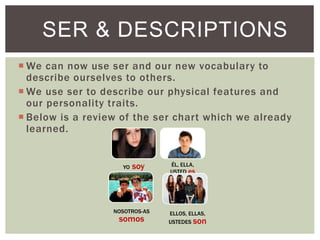
 We can now use ser and our new vocabulary to
describe ourselves to others.
 We use ser to describe our physical features and
our personality traits.
 Below is a review of the ser chart which we already
learned.
SER & DESCRIPTIONS
YO soy ÉL, ELLA,
USTED es
NOSOTROS-AS
somos
ELLOS, ELLAS,
USTEDES son
 Now, we can put ser and our vocabulary together to form a
complete sentence which describes ourselves or other
people.
 To ask somebody what they are like
 we say:
“¿Cómo eres tú?”( informal) or
“¿Cómo es usted?” (formal)
 The formula to answer the previous
question would be:
Subject pronoun + ser + description word(s)
Ex: Yo soy baja y simpatica.Ser & descriptions6
SER & DESCRIPTIONS
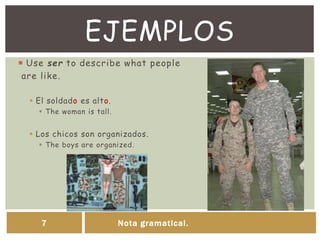
 Use ser to describe what people
are like.
 El soldado es alto.
 The woman is tall.
 Los chicos son organizados.
 The boys are organized.
EJEMPLOS
Nota gramatical.7
Más ejemplos:
 Yo soy baja y cómica- I am short and funny.
 Él es antipático e inteligente -
he is mean and smart.
 Nosotros somos amigos- We are friends.
 Usted es tonta pero estudiosa –
 you are silly but intellectual.
 Ellos son altos, feos y gordos.
EJEMPLOS
Nota gramatical.8
1. Marco es pequeño.
2. Luisa es
trabajadora.
3. Pablo es
organizado.
4. Joaquín es malo.
5. Anabel es joven.
6. Francisco es
cómico.
a. No, es bueno.
b. No, es alto.
c. No, es
desorganizado.
d. No, es perezosa.
e. No, es serio.
f. No, es vieja.
ACTIVIDAD 1
LOS OPUETOS  OPPOSITES
Los opuestos. Match the columns.9
Definite articles (in English, the) are used with
nouns to indicate specific persons, places, or
things. Indefinite articles (a, an) are used with
nouns to indicate nonspecific persons, places, or
things.
Examples:
 The boy is a friend. The (El) definite article
 El chico es un amigo. a (un) indefinite article
ENGLISH GRAMMAR CONNECTION
Refreshing your memory.10
Complete the following Actividades:
  ¿Cómo son las personas de la clase?
  ¿Son estudiosos?
  ¿Cómo son después de la clase de español?
TIME TO PRACTICE!
Actividades.11
 English Grammar Connection. Adjectives are words that
describe nouns. In English, the adjective almost always
comes before the noun. In Spanish, the adjective usually
comes after the noun.
 Examples:
 The serious students.
 Los estudiantes serios.
Noun+adjective.12
ENGLISH GRAMMAR CONNECTION
Noun – Adjective Agreement
In Spanish, adjectives match the gender and
number of the nouns they describe.
Masculine
 Singular el chico alto the tall boy
 Plural los chicos altos the tall boys
Feminine
 Singular la chica alta the tall girl
 Plural las chicas altas the tall girls
ADJECTIVE AGREEMENT
Noun+adjective.13
To make a negative statement about
yourself, all you have to do is place the word
“no” before the verb ser in the sentence.
For example, if you want to say “I am not tall”
you would say: Yo no soy alta.
You may also see sentences where the
subject pronoun is dropped. This is okay to
do once you feel more comfortable with
using the verb.
Ex: Soy alto- I am tall (the yo is dropped)
NEGATIVO
 We will now practice using our
vocabulary and Ser.
1.Please give me 3 words that
describe you physically.
2. Please give me 3 words to describe
your personality.
3. Please describe your best friend to
me in 4 words.
4. Describe one of your siblings to me
in 3 words.
5. Describe 1 other person in this
room in 3 words.
VAMOS A PRACTICAR
Vamos a practicar.15
To practice further, we will now create wanted
posters.
Using the worksheet with faces, pick 1 face
to be the criminal.
Write a description of the criminal in the 3rd
person.
Ex: Ella es muy baja. (Be sure to watch your
feminine and masculine description words!)
Then describe the criminal’s personality.
Remember that they are a criminal….
Vamos a practicar.17
Evaluación
¡Excelente trabajo!
 ¿Alcanzamos (did we reach)
nuestro objetivo?
 Sum up this lesson in 2 sentences.
18 Evaluación.18

7 descripciones-ser

  • 1.
    Verb “to be” MIS AMIGOS Y YO M.Jose Suarez Febrero 2015
  • 2.
    In this lessonyou will learn to: Describe yourself and others. Identify people and things. Using: Ser to describe what someone is like. Definite and indefinite articles. Noun-adjective agreement. MIS AMIGOS Y YO (MY FRIENDS AND I) Objetivos2
  • 3.
     I willnow pass out your vocabulary for this section of the unit.  We will be studying description words and reviewing the verb ser.  There are a lot of words in this unit- please be sure to study every night!  Please take a few minutes to go over your words and jot down any notes. VOCABULARIO Vocabulario.3
  • 4.
     Artístico(a) artistic Atlético(a) athletic  Trabajador(a) hard-working  Perezoso(a) lazy  Organizado(a) organized  Desorganizado(a) disorganized  Alto(a) tall  Bajo(a) short  Grande big  Pequeño(a) small  Viejo(a) old  Joven young  Bonito(a) pretty  Guapo(a) handsome  Malo(a) bad  Pelirrojo(a) red- haired  Pelo castaño brown hair  Pelo rubio blond hair  El hombre the man  La mujer the woman  El chico the boy  La chica the girl  Cómico(a) comic  Serio(a) serious PRESENTACIÓN DE VOCABULARIO Vocabulario.4
  • 5.
     We cannow use ser and our new vocabulary to describe ourselves to others.  We use ser to describe our physical features and our personality traits.  Below is a review of the ser chart which we already learned. SER & DESCRIPTIONS YO soy ÉL, ELLA, USTED es NOSOTROS-AS somos ELLOS, ELLAS, USTEDES son
  • 6.
     Now, wecan put ser and our vocabulary together to form a complete sentence which describes ourselves or other people.  To ask somebody what they are like  we say: “¿Cómo eres tú?”( informal) or “¿Cómo es usted?” (formal)  The formula to answer the previous question would be: Subject pronoun + ser + description word(s) Ex: Yo soy baja y simpatica.Ser & descriptions6 SER & DESCRIPTIONS
  • 7.
     Use serto describe what people are like.  El soldado es alto.  The woman is tall.  Los chicos son organizados.  The boys are organized. EJEMPLOS Nota gramatical.7
  • 8.
    Más ejemplos:  Yosoy baja y cómica- I am short and funny.  Él es antipático e inteligente - he is mean and smart.  Nosotros somos amigos- We are friends.  Usted es tonta pero estudiosa –  you are silly but intellectual.  Ellos son altos, feos y gordos. EJEMPLOS Nota gramatical.8
  • 9.
    1. Marco espequeño. 2. Luisa es trabajadora. 3. Pablo es organizado. 4. Joaquín es malo. 5. Anabel es joven. 6. Francisco es cómico. a. No, es bueno. b. No, es alto. c. No, es desorganizado. d. No, es perezosa. e. No, es serio. f. No, es vieja. ACTIVIDAD 1 LOS OPUETOS  OPPOSITES Los opuestos. Match the columns.9
  • 10.
    Definite articles (inEnglish, the) are used with nouns to indicate specific persons, places, or things. Indefinite articles (a, an) are used with nouns to indicate nonspecific persons, places, or things. Examples:  The boy is a friend. The (El) definite article  El chico es un amigo. a (un) indefinite article ENGLISH GRAMMAR CONNECTION Refreshing your memory.10
  • 11.
    Complete the followingActividades:   ¿Cómo son las personas de la clase?   ¿Son estudiosos?   ¿Cómo son después de la clase de español? TIME TO PRACTICE! Actividades.11
  • 12.
     English GrammarConnection. Adjectives are words that describe nouns. In English, the adjective almost always comes before the noun. In Spanish, the adjective usually comes after the noun.  Examples:  The serious students.  Los estudiantes serios. Noun+adjective.12 ENGLISH GRAMMAR CONNECTION
  • 13.
    Noun – AdjectiveAgreement In Spanish, adjectives match the gender and number of the nouns they describe. Masculine  Singular el chico alto the tall boy  Plural los chicos altos the tall boys Feminine  Singular la chica alta the tall girl  Plural las chicas altas the tall girls ADJECTIVE AGREEMENT Noun+adjective.13
  • 14.
    To make anegative statement about yourself, all you have to do is place the word “no” before the verb ser in the sentence. For example, if you want to say “I am not tall” you would say: Yo no soy alta. You may also see sentences where the subject pronoun is dropped. This is okay to do once you feel more comfortable with using the verb. Ex: Soy alto- I am tall (the yo is dropped) NEGATIVO
  • 15.
     We willnow practice using our vocabulary and Ser. 1.Please give me 3 words that describe you physically. 2. Please give me 3 words to describe your personality. 3. Please describe your best friend to me in 4 words. 4. Describe one of your siblings to me in 3 words. 5. Describe 1 other person in this room in 3 words. VAMOS A PRACTICAR Vamos a practicar.15
  • 16.
    To practice further,we will now create wanted posters. Using the worksheet with faces, pick 1 face to be the criminal. Write a description of the criminal in the 3rd person. Ex: Ella es muy baja. (Be sure to watch your feminine and masculine description words!) Then describe the criminal’s personality. Remember that they are a criminal….
  • 17.
  • 18.
    Evaluación ¡Excelente trabajo!  ¿Alcanzamos(did we reach) nuestro objetivo?  Sum up this lesson in 2 sentences. 18 Evaluación.18