Subject Pronouns P. 82 Realidades 1
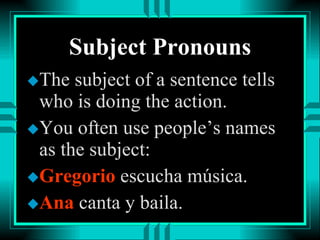
Subject Pronouns The subject of a sentence tells who is doing the action. You often use people’s names as the subject: Gregorio  escucha música. Ana  canta y baila.
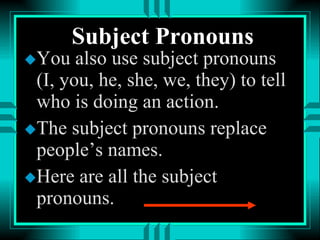
Subject Pronouns You also use subject pronouns (I, you, he, she, we, they) to tell who is doing an action. The subject pronouns replace people’s names. Here are all the subject pronouns.
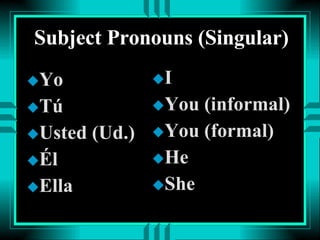
Subject Pronouns (Singular) Yo Tú Usted (Ud.) Él Ella I You (informal) You (formal) He She
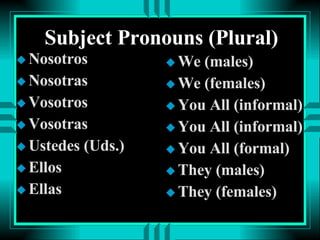
Subject Pronouns (Plural) Nosotros Nosotras Vosotros Vosotras Ustedes (Uds.) Ellos Ellas We (males) We (females) You All (informal) You All (informal) You All (formal) They (males) They (females)
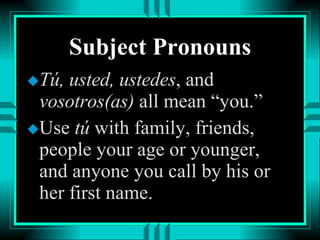
Subject Pronouns Tú, usted, ustedes , and  vosotros(as)  all mean “you.” Use  tú  with family, friends, people your age or younger, and anyone you call by his or her first name.
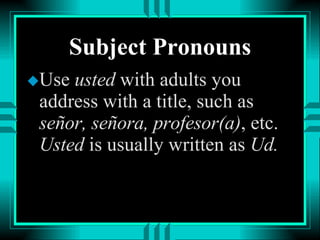
Subject Pronouns Use  usted  with adults you address with a title, such as  señor, señora, profesor(a) , etc.  Usted  is usually written as  Ud.
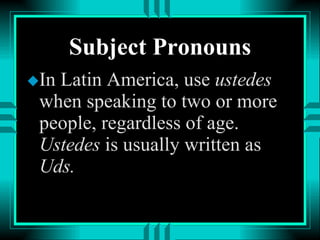
Subject Pronouns In Latin America, use  ustedes  when speaking to two or more people, regardless of age.  Ustedes  is usually written as  Uds.
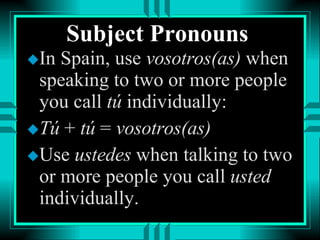
Subject Pronouns In Spain, use  vosotros(as)  when speaking to two or more people you call  tú  individually:  Tú  +  tú  =  vosotros(as) Use  ustedes  when talking to two or more people you call  usted  individually.
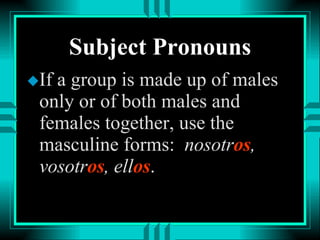
Subject Pronouns If a group is made up of males only or of both males and females together, use the masculine forms:  nosotr os , vosotr os , ell os .
Subject Pronouns You can combine a subject pronoun and a name to form a subject.
Subject Pronouns Alejandro y yo =  nosotros Carlos y ella =  ellos Pepe y tú =  ustedes Lola y ella =  ellas

Subject Pronouns

  • 1.
    Subject Pronouns P.82 Realidades 1
  • 2.
    Subject Pronouns Thesubject of a sentence tells who is doing the action. You often use people’s names as the subject: Gregorio escucha música. Ana canta y baila.
  • 3.
    Subject Pronouns Youalso use subject pronouns (I, you, he, she, we, they) to tell who is doing an action. The subject pronouns replace people’s names. Here are all the subject pronouns.
  • 4.
    Subject Pronouns (Singular)Yo Tú Usted (Ud.) Él Ella I You (informal) You (formal) He She
  • 5.
    Subject Pronouns (Plural)Nosotros Nosotras Vosotros Vosotras Ustedes (Uds.) Ellos Ellas We (males) We (females) You All (informal) You All (informal) You All (formal) They (males) They (females)
  • 6.
    Subject Pronouns Tú,usted, ustedes , and vosotros(as) all mean “you.” Use tú with family, friends, people your age or younger, and anyone you call by his or her first name.
  • 7.
    Subject Pronouns Use usted with adults you address with a title, such as señor, señora, profesor(a) , etc. Usted is usually written as Ud.
  • 8.
    Subject Pronouns InLatin America, use ustedes when speaking to two or more people, regardless of age. Ustedes is usually written as Uds.
  • 9.
    Subject Pronouns InSpain, use vosotros(as) when speaking to two or more people you call tú individually: Tú + tú = vosotros(as) Use ustedes when talking to two or more people you call usted individually.
  • 10.
    Subject Pronouns Ifa group is made up of males only or of both males and females together, use the masculine forms: nosotr os , vosotr os , ell os .
  • 11.
    Subject Pronouns Youcan combine a subject pronoun and a name to form a subject.
  • 12.
    Subject Pronouns Alejandroy yo = nosotros Carlos y ella = ellos Pepe y tú = ustedes Lola y ella = ellas