Making questions with Question words
          (Interrogativos)
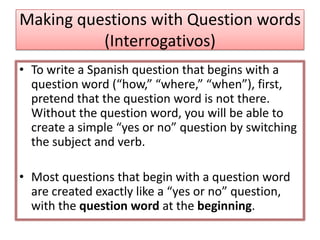
• To write a Spanish question that begins with a
  question word (“how,” “where,” “when”), first,
  pretend that the question word is not there.
  Without the question word, you will be able to
  create a simple “yes or no” question by switching
  the subject and verb.

• Most questions that begin with a question word
  are created exactly like a “yes or no” question,
  with the question word at the beginning.
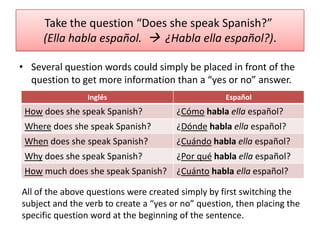
Take the question “Does she speak Spanish?”
     (Ella habla español.  ¿Habla ella español?).

• Several question words could simply be placed in front of the
  question to get more information than a “yes or no” answer.
                Inglés                              Español
 How does she speak Spanish?           ¿Cómo habla ella español?
 Where does she speak Spanish?         ¿Dónde habla ella español?
 When does she speak Spanish?          ¿Cuándo habla ella español?
 Why does she speak Spanish?           ¿Por qué habla ella español?
 How much does she speak Spanish? ¿Cuánto habla ella español?

All of the above questions were created simply by first switching the
subject and the verb to create a “yes or no” question, then placing the
specific question word at the beginning of the sentence.
Using ¿Quién? and ¿Quiénes?

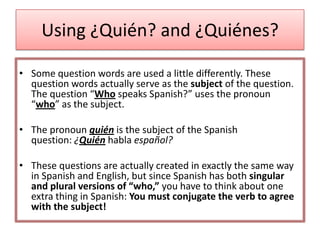
• Some question words are used a little differently. These
  question words actually serve as the subject of the question.
  The question “Who speaks Spanish?” uses the pronoun
  “who” as the subject.

• The pronoun quién is the subject of the Spanish
  question: ¿Quién habla español?

• These questions are actually created in exactly the same way
  in Spanish and English, but since Spanish has both singular
  and plural versions of “who,” you have to think about one
  extra thing in Spanish: You must conjugate the verb to agree
  with the subject!
• Quién represents one person, so use the él form of the verb, which is
  the form you would use if one person were the subject of the
  sentence.
• Quiénes, represents several people, so use the ellos form of the verb
  with it.

• Note: When the question words quién and quiénes are preceded by
  a preposition such as a [a quién] or de [de quién], they will NOT be
  the subject of the sentence.

• Who all is playing volleyball? (more than one person)
• ¿ Quiénes juegan al vólibol?

• Who is dancing with Shakita? (only one person)
• ¿ Quién baila con Shakita?

• Notice that when the question word serves as the subject, there is
  no need to switch the subject and verb.
Using ¿Cuánto? and ¿Cuántos?
             Español                Inglés (modifies/replaces)
             cuánto            how much (singular, masculine noun)
             cuánta             how much (singular, feminine noun)
             cuántos            how many (plural, masculine noun)
             cuántas            How many (plural, feminine noun)


• When creating a question with cuánto or cuántos, the question
  word has to agree with the item you are asking about. Question
  formation:
            ¿Cuánto(a,os,as) + item + verb + subject?
• ¿Cuánta tarea tiene Marta? = How much homework does Marta
  have? (tarea is feminine & singular)
• ¿Cuántos libros compraste tú? = How many books did you buy?
        (libros is masculine & plural)
Using ¿Cuál? and ¿Cuáles?
            Español              Inglés (modifies/replaces)
             cuál                  Which (one) (singular)
            cuáles                  Which ones (plural)


• When creating a question with cuál or cuáles, the question
  word has to be singular if you are asking which one and plural
  if asking which ones.

• Question formation:
               ¿Cuál (cuáles) + verb + subject?

• ¿Cuál es tu computadora? = Which one is your computer?
• ¿Cuáles tienen un cargador? = Which ones have a charger?

Question formation with interrogatives

  • 1.
    Making questions withQuestion words (Interrogativos) • To write a Spanish question that begins with a question word (“how,” “where,” “when”), first, pretend that the question word is not there. Without the question word, you will be able to create a simple “yes or no” question by switching the subject and verb. • Most questions that begin with a question word are created exactly like a “yes or no” question, with the question word at the beginning.
  • 2.
    Take the question“Does she speak Spanish?” (Ella habla español.  ¿Habla ella español?). • Several question words could simply be placed in front of the question to get more information than a “yes or no” answer. Inglés Español How does she speak Spanish? ¿Cómo habla ella español? Where does she speak Spanish? ¿Dónde habla ella español? When does she speak Spanish? ¿Cuándo habla ella español? Why does she speak Spanish? ¿Por qué habla ella español? How much does she speak Spanish? ¿Cuánto habla ella español? All of the above questions were created simply by first switching the subject and the verb to create a “yes or no” question, then placing the specific question word at the beginning of the sentence.
  • 3.
    Using ¿Quién? and¿Quiénes? • Some question words are used a little differently. These question words actually serve as the subject of the question. The question “Who speaks Spanish?” uses the pronoun “who” as the subject. • The pronoun quién is the subject of the Spanish question: ¿Quién habla español? • These questions are actually created in exactly the same way in Spanish and English, but since Spanish has both singular and plural versions of “who,” you have to think about one extra thing in Spanish: You must conjugate the verb to agree with the subject!
  • 4.
    • Quién representsone person, so use the él form of the verb, which is the form you would use if one person were the subject of the sentence. • Quiénes, represents several people, so use the ellos form of the verb with it. • Note: When the question words quién and quiénes are preceded by a preposition such as a [a quién] or de [de quién], they will NOT be the subject of the sentence. • Who all is playing volleyball? (more than one person) • ¿ Quiénes juegan al vólibol? • Who is dancing with Shakita? (only one person) • ¿ Quién baila con Shakita? • Notice that when the question word serves as the subject, there is no need to switch the subject and verb.
  • 5.
    Using ¿Cuánto? and¿Cuántos? Español Inglés (modifies/replaces) cuánto how much (singular, masculine noun) cuánta how much (singular, feminine noun) cuántos how many (plural, masculine noun) cuántas How many (plural, feminine noun) • When creating a question with cuánto or cuántos, the question word has to agree with the item you are asking about. Question formation: ¿Cuánto(a,os,as) + item + verb + subject? • ¿Cuánta tarea tiene Marta? = How much homework does Marta have? (tarea is feminine & singular) • ¿Cuántos libros compraste tú? = How many books did you buy? (libros is masculine & plural)
  • 6.
    Using ¿Cuál? and¿Cuáles? Español Inglés (modifies/replaces) cuál Which (one) (singular) cuáles Which ones (plural) • When creating a question with cuál or cuáles, the question word has to be singular if you are asking which one and plural if asking which ones. • Question formation: ¿Cuál (cuáles) + verb + subject? • ¿Cuál es tu computadora? = Which one is your computer? • ¿Cuáles tienen un cargador? = Which ones have a charger?