SUBJECT PRONOUNS
A pronoun is a word that takes the place of a
noun.
WHAT IS A PRONOUN?
 It’s a word used instead of a noun (or a phrase
containing a noun)
Example: `He', `it', `who', and `anything' are
pronouns.
 When the pronoun is the subject (the person
doing the action) of the sentence, it is called a
Subject Pronoun.
Example: Bob is swimming. He is swimming.
WHAT ARE THE ENGLISH SUBJECT
PRONOUNS?
Singular Plural
1st
person I We
2nd
person You
3rd
person He, She, It They
ENGLISH SUBJECT PRONOUNS AND
THEIR SPANISH EQUIVALENTS
 Spanish subject pronouns are similar to English,
but there are some differences.
Singular Plural
1st
person
I = Yo
We = nosotros (m)
Nosotras (f)
2nd
person
You (familiar) = tú
You (plural, familiar) =
vosotros
vosotras
3rd
person
He = él
She = ella
You (formal) = Usted (Ud.)
They (m) = Ellos
They (f) = Ellas
You (plural) = Ustedes (Uds.)
THE FIRST PERSON SINGULAR
PRONOUN “YO”
 “Yo” means “I” and is used
in the same way as in
English.
 Yo soy americano.
 Yo soy estudiante.
 Note that it is not
capitalized unless it starts
a sentence:
 Mi amigo y yo…
SECOND PERSON SINGULAR
PRONOUN
TÚ
 Tú means you (familiar/
informal)
 Used when talking to
someone familiar
 We’ll learn more about
this in a moment.
3RD
PERSON SINGULAR MASCULINE
ÉL
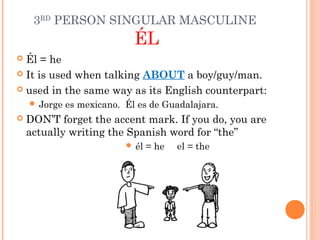
 Él = he
 It is used when talking ABOUT a boy/guy/man.
 used in the same way as its English counterpart:
 Jorge es mexicano. Él es de Guadalajara.
 DON’T forget the accent mark. If you do, you are
actually writing the Spanish word for “the”
 él = he el = the
3RD
PERSON SINGULAR FEMININE
ELLA
 Ella = she
 It is used when talking ABOUT a girl/woman.
 used in the same way as its English counterpart:
 Rosa es mexicana. Ella es de Acapulco.
 Please pronounce it correctly.
 It sounds like (eh-yah) not (el-lah)
 Remember ll= y sound.
FORMAL YOU
USTED (UD.)
 Usted means you (formal)
 Used when talking to someone you should respect.
 Abbriviated Capital U lower case d period. (Ud.)
 Considered a 3rd
person singular pronoun.
 We’ll learn more about this pronoun in a moment.
 Use nosotros/ nosotras to talk about
a group of people that includes you.
 in English we have one word to talk
about “we,” but in Spanish, we
distinguish between “we” masculine
and feminine:
 Juan: “Mi hermano y yo somos de
Argentina. Nosotros vivimos en Buenos
Aires.”
 Juana: “Mi hermana y yo somos de
Bolivia. Nosotras vivimos en La Paz.”
 use the masculine pronoun if it refers
to a mixed group:
 Juan: “Mi hermano, mi novia, y yo somos
de Argentina. Nosotros vivimos en
Buenos Aires.”
 Juana: “Mi hermana, mis padres, y yo
somos de Bolivia. Nosotros vivimos en La
Paz.
THE FIRST PERSON PLURAL
PRONOUN “NOSOTROS / NOSOTRAS”
3RD
PERSON PLURAL MASCULINE
ELLOS
 Ellos = They (masculine)
 It is used when talking ABOUT a
group of boys/guys/men or a
mixed group.
 used in the same way as its
English counterpart:
 Jorge y Pepe son mexicanos. Ellos
son de Guadalajara.
 Jorge y Ana son alumnos. Ellos son
amigos también.
 Please pronounce it correctly.
 It sounds like (eh-yohs) not (el-lohs)
 Remember ll= y sound.
3RD
PERSON PLURAL FEMININE
ELLAS
 Ellas = They (feminine)
 It is used when talking ABOUT a group of only females.
 used in the same way as its English counterpart:
 Sofía y Ana son alumnas. Ellas son amigas también.
 Please pronounce it correctly.
 It sounds like (eh-yahs) not (el-lahs)
 Remember ll= y sound.
FORMAL YOU PLURAL
USTEDES (UDS.)
 Abbriviated Capital “U”, lower case “d”, lower
case “s” period. (Uds.)
 Considered a 3rd
person plural pronoun.
 We’ll learn more about this pronoun in a
moment.
YOU, YOU, AND YOU
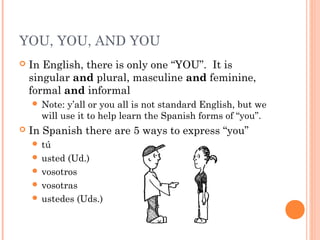
 In English, there is only one “YOU”. It is
singular and plural, masculine and feminine,
formal and informal
 Note: y’all or you all is not standard English, but we
will use it to help learn the Spanish forms of “you”.
 In Spanish there are 5 ways to express “you”
 tú
 usted (Ud.)
 vosotros
 vosotras
 ustedes (Uds.)
 Let’s look at the singular forms first. Each one
has a specific time when it used. If you use the
wrong one, it can be offensive to the person with
whom you are speaking.
DIFFERENCES – YOU: TÚ VS. USTED
Tú = you (informal/familiar)
Use “tú” when talking to people
with whom you are on a first
name basis.
friends
family
small children
people younger than you
pets
Usted (Ud.) = you (formal)
Use “Usted” when talking with people
to whom you should show respect.
People in authority
(police, teachers, bosses, etc.)
Strangers
Acquaintances
Adults
 In Spanish there are three ways to say “all of you”
 Vosotros
 Vosotras
 Ustedes (Uds.)
 Vosotros/vosotras are the plural forms of tú. Ustedes
is the plural form of usted.
 Vosotros is used when talking to a familiar group of
males or a mixed group.
 Vosotras is the feminine form of vosotros and is used
when the entire group is female
 These two familiar forms are used primarily in Spain.
 We will not use vosotros/as in class, but you need to
be aware of it.
DIFFERENCES – Y’ALL
 The plural you form “ustedes (Uds.)” Is used
differently in Spain and Latin America.
 In Spain, vosotros/as is used when talking to an
informal group. Uds. is used to address a formal
group.
 In Latin America, Uds. is generally used in both
formal and informal situations. (They don’t use
vosotros/as)
 Since we use Latin American Spanish in class,
we will only use Uds. to indicate all forms of
y’all.
DIFFERENCES – Y’ALL
REVIEW
Yo = I
First person singular
Not capitalized unless the first
word of the sentence
Used to talk ABOUT yourself
Nosotros/as = we
First person plural
distinguish between “we” masculine
and feminine
Used to talk ABOUT yourself and
friends
Tú = You (singular, informal/familiar)
Second person Singular
Use it to talk TO a person that is a
friend or family member
Vosotros/as = You (singular, familiar)
Second person Plural
Use it to talk TO a group of friends or
family members.
Third person singular
Él = he
Don’t forget the accent
Use it to talk ABOUT a guy.
Ella = she
Use it to talk ABOUT a girl.
Watch the pronunciation.
Ud. = You (singular, formal)
Use it to talk TO a person that is due
respect.
Third person plural
Ellos = They (masculine)
It is used when talking ABOUT a group
of boys/guys/men or a mixed group.
Ellas = They (feminine)
It is used when talking ABOUT a group
of only females.
Uds. = You (plural)
Use it to talk TO a group of people

Subjectpronouns

  • 1.
    SUBJECT PRONOUNS A pronounis a word that takes the place of a noun.
  • 2.
    WHAT IS APRONOUN?  It’s a word used instead of a noun (or a phrase containing a noun) Example: `He', `it', `who', and `anything' are pronouns.  When the pronoun is the subject (the person doing the action) of the sentence, it is called a Subject Pronoun. Example: Bob is swimming. He is swimming.
  • 3.
    WHAT ARE THEENGLISH SUBJECT PRONOUNS? Singular Plural 1st person I We 2nd person You 3rd person He, She, It They
  • 4.
    ENGLISH SUBJECT PRONOUNSAND THEIR SPANISH EQUIVALENTS  Spanish subject pronouns are similar to English, but there are some differences. Singular Plural 1st person I = Yo We = nosotros (m) Nosotras (f) 2nd person You (familiar) = tú You (plural, familiar) = vosotros vosotras 3rd person He = él She = ella You (formal) = Usted (Ud.) They (m) = Ellos They (f) = Ellas You (plural) = Ustedes (Uds.)
  • 5.
    THE FIRST PERSONSINGULAR PRONOUN “YO”  “Yo” means “I” and is used in the same way as in English.  Yo soy americano.  Yo soy estudiante.  Note that it is not capitalized unless it starts a sentence:  Mi amigo y yo…
  • 6.
    SECOND PERSON SINGULAR PRONOUN TÚ Tú means you (familiar/ informal)  Used when talking to someone familiar  We’ll learn more about this in a moment.
  • 7.
    3RD PERSON SINGULAR MASCULINE ÉL Él = he  It is used when talking ABOUT a boy/guy/man.  used in the same way as its English counterpart:  Jorge es mexicano. Él es de Guadalajara.  DON’T forget the accent mark. If you do, you are actually writing the Spanish word for “the”  él = he el = the
  • 8.
    3RD PERSON SINGULAR FEMININE ELLA Ella = she  It is used when talking ABOUT a girl/woman.  used in the same way as its English counterpart:  Rosa es mexicana. Ella es de Acapulco.  Please pronounce it correctly.  It sounds like (eh-yah) not (el-lah)  Remember ll= y sound.
  • 9.
    FORMAL YOU USTED (UD.) Usted means you (formal)  Used when talking to someone you should respect.  Abbriviated Capital U lower case d period. (Ud.)  Considered a 3rd person singular pronoun.  We’ll learn more about this pronoun in a moment.
  • 10.
     Use nosotros/nosotras to talk about a group of people that includes you.  in English we have one word to talk about “we,” but in Spanish, we distinguish between “we” masculine and feminine:  Juan: “Mi hermano y yo somos de Argentina. Nosotros vivimos en Buenos Aires.”  Juana: “Mi hermana y yo somos de Bolivia. Nosotras vivimos en La Paz.”  use the masculine pronoun if it refers to a mixed group:  Juan: “Mi hermano, mi novia, y yo somos de Argentina. Nosotros vivimos en Buenos Aires.”  Juana: “Mi hermana, mis padres, y yo somos de Bolivia. Nosotros vivimos en La Paz. THE FIRST PERSON PLURAL PRONOUN “NOSOTROS / NOSOTRAS”
  • 11.
    3RD PERSON PLURAL MASCULINE ELLOS Ellos = They (masculine)  It is used when talking ABOUT a group of boys/guys/men or a mixed group.  used in the same way as its English counterpart:  Jorge y Pepe son mexicanos. Ellos son de Guadalajara.  Jorge y Ana son alumnos. Ellos son amigos también.  Please pronounce it correctly.  It sounds like (eh-yohs) not (el-lohs)  Remember ll= y sound.
  • 12.
    3RD PERSON PLURAL FEMININE ELLAS Ellas = They (feminine)  It is used when talking ABOUT a group of only females.  used in the same way as its English counterpart:  Sofía y Ana son alumnas. Ellas son amigas también.  Please pronounce it correctly.  It sounds like (eh-yahs) not (el-lahs)  Remember ll= y sound.
  • 13.
    FORMAL YOU PLURAL USTEDES(UDS.)  Abbriviated Capital “U”, lower case “d”, lower case “s” period. (Uds.)  Considered a 3rd person plural pronoun.  We’ll learn more about this pronoun in a moment.
  • 14.
    YOU, YOU, ANDYOU  In English, there is only one “YOU”. It is singular and plural, masculine and feminine, formal and informal  Note: y’all or you all is not standard English, but we will use it to help learn the Spanish forms of “you”.  In Spanish there are 5 ways to express “you”  tú  usted (Ud.)  vosotros  vosotras  ustedes (Uds.)
  • 15.
     Let’s lookat the singular forms first. Each one has a specific time when it used. If you use the wrong one, it can be offensive to the person with whom you are speaking. DIFFERENCES – YOU: TÚ VS. USTED Tú = you (informal/familiar) Use “tú” when talking to people with whom you are on a first name basis. friends family small children people younger than you pets Usted (Ud.) = you (formal) Use “Usted” when talking with people to whom you should show respect. People in authority (police, teachers, bosses, etc.) Strangers Acquaintances Adults
  • 16.
     In Spanishthere are three ways to say “all of you”  Vosotros  Vosotras  Ustedes (Uds.)  Vosotros/vosotras are the plural forms of tú. Ustedes is the plural form of usted.  Vosotros is used when talking to a familiar group of males or a mixed group.  Vosotras is the feminine form of vosotros and is used when the entire group is female  These two familiar forms are used primarily in Spain.  We will not use vosotros/as in class, but you need to be aware of it. DIFFERENCES – Y’ALL
  • 17.
     The pluralyou form “ustedes (Uds.)” Is used differently in Spain and Latin America.  In Spain, vosotros/as is used when talking to an informal group. Uds. is used to address a formal group.  In Latin America, Uds. is generally used in both formal and informal situations. (They don’t use vosotros/as)  Since we use Latin American Spanish in class, we will only use Uds. to indicate all forms of y’all. DIFFERENCES – Y’ALL
  • 18.
    REVIEW Yo = I Firstperson singular Not capitalized unless the first word of the sentence Used to talk ABOUT yourself Nosotros/as = we First person plural distinguish between “we” masculine and feminine Used to talk ABOUT yourself and friends Tú = You (singular, informal/familiar) Second person Singular Use it to talk TO a person that is a friend or family member Vosotros/as = You (singular, familiar) Second person Plural Use it to talk TO a group of friends or family members. Third person singular Él = he Don’t forget the accent Use it to talk ABOUT a guy. Ella = she Use it to talk ABOUT a girl. Watch the pronunciation. Ud. = You (singular, formal) Use it to talk TO a person that is due respect. Third person plural Ellos = They (masculine) It is used when talking ABOUT a group of boys/guys/men or a mixed group. Ellas = They (feminine) It is used when talking ABOUT a group of only females. Uds. = You (plural) Use it to talk TO a group of people