LONERS
M. Jose Suarez Febrero 2015
OR
DIONZA
Masculin
o
O
Femenino
In order to achieve these objectives, we’re going to:
 In this lesson you will target all of your literacy skills
to learn about gender and number agreement
between the Subject/Object or Nouns with the
adjective.
 Learn strategies that will help us to remember the
gender of the words in Spanish.
NUESTRO (OUR) OBJETIVO ES APRENDER
“MASCULINO Y FEMENINO”
Objetivos2
Personas, animales, lugares y cosas.3
UN SUSTANTIVO (NOUN) ES UNA PALABRA QUE
IDENTIFICA:
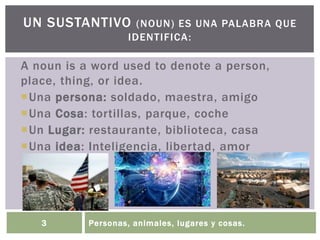
A noun is a word used to denote a person,
place, thing, or idea.
Una persona: soldado, maestra, amigo
Una Cosa: tortillas, parque, coche
Un Lugar: restaurante, biblioteca, casa
Una idea: Inteligencia, libertad, amor
Masculino y femenino.4
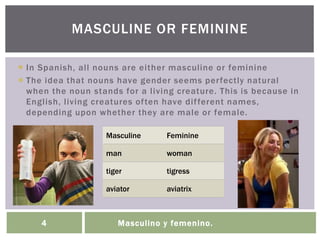
 In Spanish, all nouns are either masculine or feminine
 The idea that nouns have gender seems perfectly natural
when the noun stands for a living creature. This is because in
English, living creatures often have different names,
depending upon whether they are male or female.
MASCULINE OR FEMININE
Masculine Feminine
man woman
tiger tigress
aviator aviatrix
Masculino y femenino.5
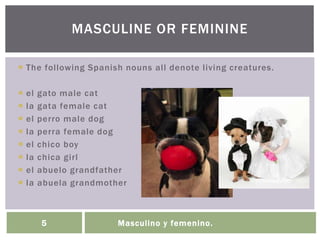
 The following Spanish nouns all denote living creatures.
 el gato male cat
 la gata female cat
 el perro male dog
 la perra female dog
 el chico boy
 la chica girl
 el abuelo grandfather
 la abuela grandmother
MASCULINE OR FEMININE
Masculine.6
 How are all of these masculine nouns alike?
Hint: look at both the beginning and the ending of each line.
Come up with the rule.
MASCULINE OR FEMININE
el gato
el perro
el chico
el abuelo
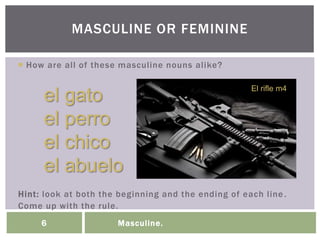
El rifle m4
Feminine.7
 How are all of these feminine nouns alike?
Hint: look at both the beginning and the ending of each line.
Come up with the rule.
MASCULINE OR FEMININE
la gata
la perra
la chica
la abuela
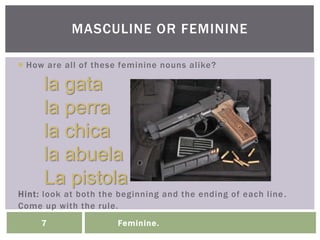
La pistola
Masculine and Feminine.8
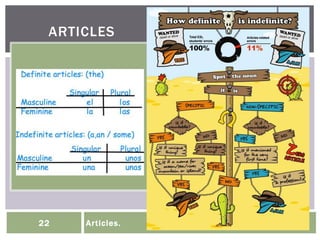
"El" and "la" both mean "the.“
 el chico (the boy)
la chica (the girl)
 el perro (the male dog)
la gata (the female cat)
 Note: These two words (el, la) are called "definite articles."
You will learn more about them in a later lesson.
EXPRESSING “THE”
Masculine and Feminine.9
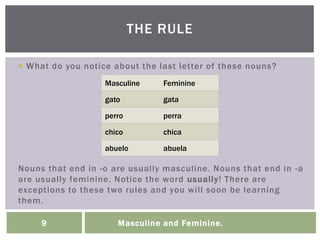
 What do you notice about the last letter of these nouns?
Nouns that end in -o are usually masculine. Nouns that end in -a
are usually feminine. Notice the word usually! There are
exceptions to these two rules and you will soon be learning
them.
THE RULE
Masculine Feminine
gato gata
perro perra
chico chica
abuelo abuela
Masculine or Feminine?10
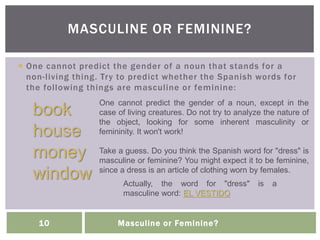
 One cannot predict the gender of a noun that stands for a
non-living thing. Try to predict whether the Spanish words for
the following things are masculine or feminine:
MASCULINE OR FEMININE?
book
house
money
window
One cannot predict the gender of a noun, except in the
case of living creatures. Do not try to analyze the nature of
the object, looking for some inherent masculinity or
femininity. It won't work!
Take a guess. Do you think the Spanish word for "dress" is
masculine or feminine? You might expect it to be feminine,
since a dress is an article of clothing worn by females.
Actually, the word for "dress" is a
masculine word: EL VESTIDO
Masculine or Feminine?11
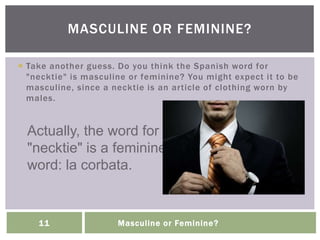
 Take another guess. Do you think the Spanish word for
"necktie" is masculine or feminine? You might expect it to be
masculine, since a necktie is an article of clothing worn by
males.
MASCULINE OR FEMININE?
Actually, the word for
"necktie" is a feminine
word: la corbata.
Masculine and feminine.12

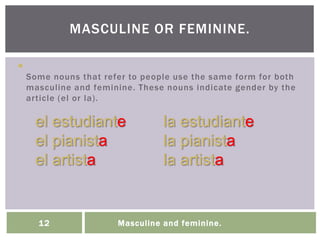
Some nouns that refer to people use the same form for both
masculine and feminine. These nouns indicate gender by the
article (el or la).
MASCULINE OR FEMININE.
el estudiante la estudiante
el pianista la pianista
el artista la artista
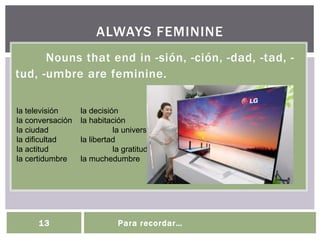
Nouns that end in -sión, -ción, -dad, -tad, -
tud, -umbre are feminine.
ALWAYS FEMININE
13 Para recordar…
la televisión la decisión
la conversación la habitación
la ciudad la universidad
la dificultad la libertad
la actitud la gratitud
la certidumbre la muchedumbre
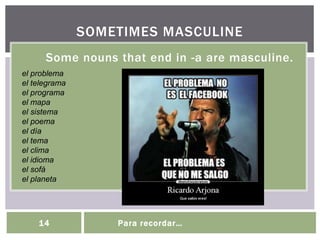
Some nouns that end in -a are masculine.
SOMETIMES MASCULINE
14 Para recordar…
el problema
el telegrama
el programa
el mapa
el sistema
el poema
el día
el tema
el clima
el idioma
el sofá
el planeta
Many nouns that end in -ma are masculine.
Notice that eight of the twelve nouns listed above
end in -ma.
Note: A few nouns that end in -ma are feminine, such as la
cama and la pluma.
ALWAYS MASCULINE
15 Para recordar…
el telegrama
el programa
el problema
el sistema
el poema
el idioma
el clima
el tema
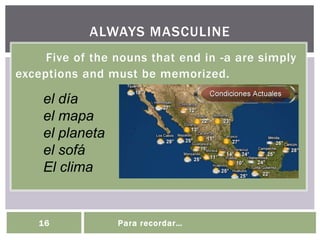
Five of the nouns that end in -a are simply
exceptions and must be memorized.
ALWAYS MASCULINE
16 Para recordar…
el día
el mapa
el planeta
el sofá
El clima
 Five of the nouns that end in -a are simply
exceptions Las palabras terminadas en –
ista pueden ser femeninas y masculinas:
El/la periodista
el/la protagonista
and must be memorized.
ANOTHER CASE
17 Para recordar…
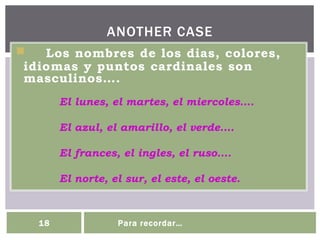
 Los nombres de los dias, colores,
idiomas y puntos cardinales son
masculinos….
ANOTHER CASE
18 Para recordar…
El lunes, el martes, el miercoles….
El azul, el amarillo, el verde….
El frances, el ingles, el ruso….
El norte, el sur, el este, el oeste.
Loners or Dionza.19
Remember the ends of these two words:
IF ALL OF THE ABOVE FAILS….
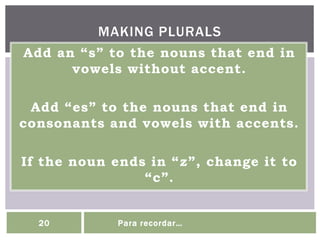
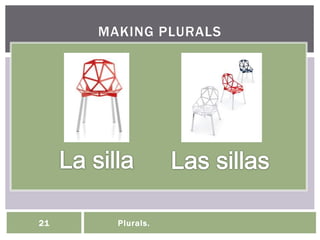
Add an “s” to the nouns that end in
vowels without accent.
Add “es” to the nouns that end in
consonants and vowels with accents.
If the noun ends in “z”, change it to
“c”.
MAKING PLURALS
20 Para recordar…
MAKING PLURALS
21 Plurals.
ARTICLES
22 Articles.
Evaluación
¡Excelente trabajo!
 ¿Alcanzamos (did we reach) nuestro
objetivo?
 Sum up this hour’s lesson in two
sentences.
23 Estudia y prepárate siempre.

3 masculino-femenino

  • 1.
    LONERS M. Jose SuarezFebrero 2015 OR DIONZA Masculin o O Femenino
  • 2.
    In order toachieve these objectives, we’re going to:  In this lesson you will target all of your literacy skills to learn about gender and number agreement between the Subject/Object or Nouns with the adjective.  Learn strategies that will help us to remember the gender of the words in Spanish. NUESTRO (OUR) OBJETIVO ES APRENDER “MASCULINO Y FEMENINO” Objetivos2
  • 3.
    Personas, animales, lugaresy cosas.3 UN SUSTANTIVO (NOUN) ES UNA PALABRA QUE IDENTIFICA: A noun is a word used to denote a person, place, thing, or idea. Una persona: soldado, maestra, amigo Una Cosa: tortillas, parque, coche Un Lugar: restaurante, biblioteca, casa Una idea: Inteligencia, libertad, amor
  • 4.
    Masculino y femenino.4 In Spanish, all nouns are either masculine or feminine  The idea that nouns have gender seems perfectly natural when the noun stands for a living creature. This is because in English, living creatures often have different names, depending upon whether they are male or female. MASCULINE OR FEMININE Masculine Feminine man woman tiger tigress aviator aviatrix
  • 5.
    Masculino y femenino.5 The following Spanish nouns all denote living creatures.  el gato male cat  la gata female cat  el perro male dog  la perra female dog  el chico boy  la chica girl  el abuelo grandfather  la abuela grandmother MASCULINE OR FEMININE
  • 6.
    Masculine.6  How areall of these masculine nouns alike? Hint: look at both the beginning and the ending of each line. Come up with the rule. MASCULINE OR FEMININE el gato el perro el chico el abuelo El rifle m4
  • 7.
    Feminine.7  How areall of these feminine nouns alike? Hint: look at both the beginning and the ending of each line. Come up with the rule. MASCULINE OR FEMININE la gata la perra la chica la abuela La pistola
  • 8.
    Masculine and Feminine.8 "El"and "la" both mean "the.“  el chico (the boy) la chica (the girl)  el perro (the male dog) la gata (the female cat)  Note: These two words (el, la) are called "definite articles." You will learn more about them in a later lesson. EXPRESSING “THE”
  • 9.
    Masculine and Feminine.9 What do you notice about the last letter of these nouns? Nouns that end in -o are usually masculine. Nouns that end in -a are usually feminine. Notice the word usually! There are exceptions to these two rules and you will soon be learning them. THE RULE Masculine Feminine gato gata perro perra chico chica abuelo abuela
  • 10.
    Masculine or Feminine?10 One cannot predict the gender of a noun that stands for a non-living thing. Try to predict whether the Spanish words for the following things are masculine or feminine: MASCULINE OR FEMININE? book house money window One cannot predict the gender of a noun, except in the case of living creatures. Do not try to analyze the nature of the object, looking for some inherent masculinity or femininity. It won't work! Take a guess. Do you think the Spanish word for "dress" is masculine or feminine? You might expect it to be feminine, since a dress is an article of clothing worn by females. Actually, the word for "dress" is a masculine word: EL VESTIDO
  • 11.
    Masculine or Feminine?11 Take another guess. Do you think the Spanish word for "necktie" is masculine or feminine? You might expect it to be masculine, since a necktie is an article of clothing worn by males. MASCULINE OR FEMININE? Actually, the word for "necktie" is a feminine word: la corbata.
  • 12.
    Masculine and feminine.12  Somenouns that refer to people use the same form for both masculine and feminine. These nouns indicate gender by the article (el or la). MASCULINE OR FEMININE. el estudiante la estudiante el pianista la pianista el artista la artista
  • 13.
    Nouns that endin -sión, -ción, -dad, -tad, - tud, -umbre are feminine. ALWAYS FEMININE 13 Para recordar… la televisión la decisión la conversación la habitación la ciudad la universidad la dificultad la libertad la actitud la gratitud la certidumbre la muchedumbre
  • 14.
    Some nouns thatend in -a are masculine. SOMETIMES MASCULINE 14 Para recordar… el problema el telegrama el programa el mapa el sistema el poema el día el tema el clima el idioma el sofá el planeta
  • 15.
    Many nouns thatend in -ma are masculine. Notice that eight of the twelve nouns listed above end in -ma. Note: A few nouns that end in -ma are feminine, such as la cama and la pluma. ALWAYS MASCULINE 15 Para recordar… el telegrama el programa el problema el sistema el poema el idioma el clima el tema
  • 16.
    Five of thenouns that end in -a are simply exceptions and must be memorized. ALWAYS MASCULINE 16 Para recordar… el día el mapa el planeta el sofá El clima
  • 17.
     Five ofthe nouns that end in -a are simply exceptions Las palabras terminadas en – ista pueden ser femeninas y masculinas: El/la periodista el/la protagonista and must be memorized. ANOTHER CASE 17 Para recordar…
  • 18.
     Los nombresde los dias, colores, idiomas y puntos cardinales son masculinos…. ANOTHER CASE 18 Para recordar… El lunes, el martes, el miercoles…. El azul, el amarillo, el verde…. El frances, el ingles, el ruso…. El norte, el sur, el este, el oeste.
  • 19.
    Loners or Dionza.19 Rememberthe ends of these two words: IF ALL OF THE ABOVE FAILS….
  • 20.
    Add an “s”to the nouns that end in vowels without accent. Add “es” to the nouns that end in consonants and vowels with accents. If the noun ends in “z”, change it to “c”. MAKING PLURALS 20 Para recordar…
  • 21.
  • 22.
  • 23.
    Evaluación ¡Excelente trabajo!  ¿Alcanzamos(did we reach) nuestro objetivo?  Sum up this hour’s lesson in two sentences. 23 Estudia y prepárate siempre.