Spanish Pronouns How they compare with English
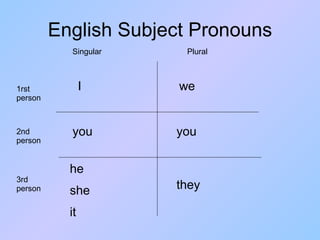
Pronouns in General English and Spanish both make use of subject pronouns.  They can be organized as first, 2 nd , and 3 rd  person.  In English “I” and “we” are first person.  “I” is first person, singular and “we” is first person plural.  Let’s take a look at how pronouns are organized in English.
English Subject Pronouns I you you he she it we they 1rst person 3rd person 2nd person Singular Plural
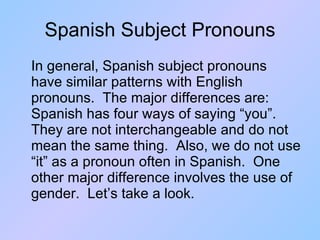
Spanish Subject Pronouns In general, Spanish subject pronouns have similar patterns with English pronouns.  The major differences are:  Spanish has four ways of saying “you”.  They are not interchangeable and do not mean the same thing.  Also, we do not use “it” as a pronoun often in Spanish.  One other major difference involves the use of gender.  Let’s take a look.
Spanish Subject Pronouns yo tú él ella Ud. nosotros nosotras (vosotros) (vosotras) ellos ellas Uds. 1rst person 2nd person 3rd person Singular Plural
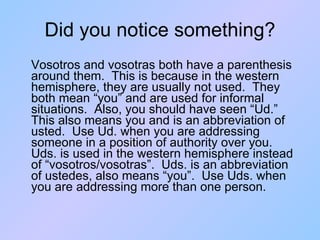
Did you notice something? Vosotros and vosotras both have a parenthesis around them.  This is because in the western hemisphere, they are usually not used.  They both mean “you” and are used for informal situations.  Also, you should have seen “Ud.”  This also means you and is an abbreviation of usted.  Use Ud. when you are addressing someone in a position of authority over you.  Uds. is used in the western hemisphere instead of “vosotros/vosotras”.  Uds. is an abbreviation of ustedes, also means “you”.  Use Uds. when you are addressing more than one person.
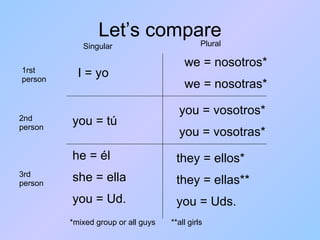
Let’s compare I = yo you = tú he = él she = ella you = Ud. they = ellos* they = ellas** you = Uds. *mixed group or all guys **all girls you = vosotros* you = vosotras* we = nosotros* we = nosotras* 1rst person 2nd person 3rd person Plural Singular
Now it is time to learn. This is meant to be a review.  If you have not studied it already, you may have difficulty. If you want to learn Spanish, you  will  need to learn the subject pronouns. You can often tell what the subject is by the verb.  Therefore in Spanish, it is not always necessary to include the subject. Memorize these subject pronouns.

Spanish Pronouns

  • 1.
    Spanish Pronouns Howthey compare with English
  • 2.
    Pronouns in GeneralEnglish and Spanish both make use of subject pronouns. They can be organized as first, 2 nd , and 3 rd person. In English “I” and “we” are first person. “I” is first person, singular and “we” is first person plural. Let’s take a look at how pronouns are organized in English.
  • 3.
    English Subject PronounsI you you he she it we they 1rst person 3rd person 2nd person Singular Plural
  • 4.
    Spanish Subject PronounsIn general, Spanish subject pronouns have similar patterns with English pronouns. The major differences are: Spanish has four ways of saying “you”. They are not interchangeable and do not mean the same thing. Also, we do not use “it” as a pronoun often in Spanish. One other major difference involves the use of gender. Let’s take a look.
  • 5.
    Spanish Subject Pronounsyo tú él ella Ud. nosotros nosotras (vosotros) (vosotras) ellos ellas Uds. 1rst person 2nd person 3rd person Singular Plural
  • 6.
    Did you noticesomething? Vosotros and vosotras both have a parenthesis around them. This is because in the western hemisphere, they are usually not used. They both mean “you” and are used for informal situations. Also, you should have seen “Ud.” This also means you and is an abbreviation of usted. Use Ud. when you are addressing someone in a position of authority over you. Uds. is used in the western hemisphere instead of “vosotros/vosotras”. Uds. is an abbreviation of ustedes, also means “you”. Use Uds. when you are addressing more than one person.
  • 7.
    Let’s compare I= yo you = tú he = él she = ella you = Ud. they = ellos* they = ellas** you = Uds. *mixed group or all guys **all girls you = vosotros* you = vosotras* we = nosotros* we = nosotras* 1rst person 2nd person 3rd person Plural Singular
  • 8.
    Now it istime to learn. This is meant to be a review. If you have not studied it already, you may have difficulty. If you want to learn Spanish, you will need to learn the subject pronouns. You can often tell what the subject is by the verb. Therefore in Spanish, it is not always necessary to include the subject. Memorize these subject pronouns.