Los Pronombres pronouns
Subject Pronouns In this presentation we’re going to look at the form and use of subject pronouns in Spanish. Do you remember  subject pronouns??
Lets Get Started! Compare these two sentences Jorge  es mexicano. Él  es mexicano. In the first sentence, we name the person who is Mexican. In the second sentence, we replace the person’s name with the word ‘él’.
And your point is…?! A pronoun is a word that replaces a noun:  e.g.  Jorge =  é l. Examples of pronouns in English are :  We, You, He, She, It, I & They. These particular examples are all  subject  pronouns or pronouns used only when replacing  subjects  of verbs.
Here are your subject pronouns in Spanish!!
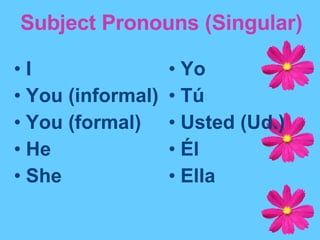
Subject Pronouns (Singular) Yo Tú Usted (Ud.) Él Ella I You (informal) You (formal) He She
Subject Pronouns (Plural) Nosotros Nosotras Ustedes (Uds.) Ellos Ellas We (males) We (females) You All ( informal & formal ) They (males) They (females)
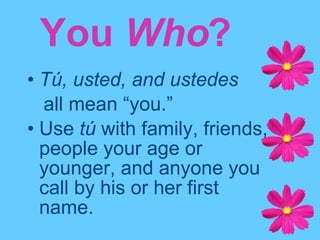
You  Who ? Tú, usted, and ustedes   all mean “you.” Use  tú  with family, friends, people your age or younger, and anyone you call by his or her first name.
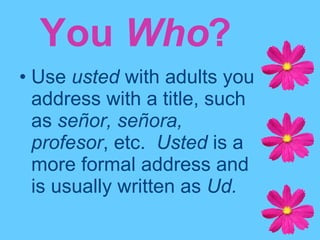
You  Who ? Use  usted  with adults you address with a title, such as  señor, señora, profesor , etc.  Usted  is a more formal address and is usually written as  Ud.
In most countries, use  ustedes  when speaking to  two or more  people, regardless of age or formality.  Ustedes  is usually written as  Uds. Hey, you!
Not really, here’s a summary! Singular informal -> tú formal-> Usted (Ud.) Plural formal & informal-> Ustedes (Uds.) That’s confusing!
Subject Pronouns For the purposes of instructions, I will use the following abbreviations  all year long  to distinguish the different forms of ‘You’. Be Prepared to Memorize!!!
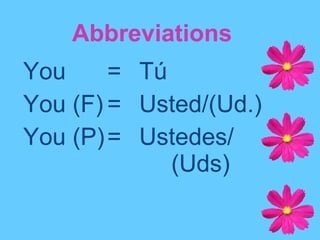
Abbreviations You = T ú You (F) = Usted/(Ud.) You (P) = Ustedes/  (Uds)
If a group is made up of males  only  or of  both  males and females together, use the masculine forms:  nosotr os  or ell os . Masculine or Feminine?
Only when a group is made up of ALL females do you use the feminine forms:  nosotr as  or ell as . Masculine or Feminine?
You can combine a subject pronoun and a name to form a subject. Subject Pronouns
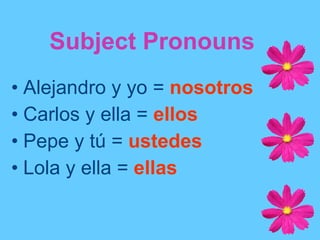
Subject Pronouns Alejandro y yo =  nosotros Carlos y ella =  ellos Pepe y tú =  ustedes Lola y ella =  ellas
Don’t forget the accent marks!! Él ( w/ accent ) means  ‘He’ . El ( w/o accent ) means ‘ The’ . Other Helpful Tips
Unlike ‘I’ in English, ‘yo’ is only capitalized when it begins a sentence: Mi amigo y yo jugamos.  More Helpful Tips
In English we always have to use a subject pronoun.  Look at these sentences: Went to the store. Speaks German. Without the pronouns these sentences make no sense! One More Point!
Spanish sentences frequently drop the subject pronoun when they are NOT needed to clarify who we are talking about: Bailas muy bien. Estudio con ellos. Spanish is Different!
Did you notice ‘it’ is a subject pronoun in English? In Spanish, there is NO word for ‘it’ as a subject.  You simply conjugate the verb in the  él/ella/Ud. form!!! And finally…

Subject Pronouns

  • 1.
  • 2.
    Subject Pronouns Inthis presentation we’re going to look at the form and use of subject pronouns in Spanish. Do you remember subject pronouns??
  • 3.
    Lets Get Started!Compare these two sentences Jorge es mexicano. Él es mexicano. In the first sentence, we name the person who is Mexican. In the second sentence, we replace the person’s name with the word ‘él’.
  • 4.
    And your pointis…?! A pronoun is a word that replaces a noun: e.g. Jorge = é l. Examples of pronouns in English are : We, You, He, She, It, I & They. These particular examples are all subject pronouns or pronouns used only when replacing subjects of verbs.
  • 5.
    Here are yoursubject pronouns in Spanish!!
  • 6.
    Subject Pronouns (Singular)Yo Tú Usted (Ud.) Él Ella I You (informal) You (formal) He She
  • 7.
    Subject Pronouns (Plural)Nosotros Nosotras Ustedes (Uds.) Ellos Ellas We (males) We (females) You All ( informal & formal ) They (males) They (females)
  • 8.
    You Who? Tú, usted, and ustedes all mean “you.” Use tú with family, friends, people your age or younger, and anyone you call by his or her first name.
  • 9.
    You Who? Use usted with adults you address with a title, such as señor, señora, profesor , etc. Usted is a more formal address and is usually written as Ud.
  • 10.
    In most countries,use ustedes when speaking to two or more people, regardless of age or formality. Ustedes is usually written as Uds. Hey, you!
  • 11.
    Not really, here’sa summary! Singular informal -> tú formal-> Usted (Ud.) Plural formal & informal-> Ustedes (Uds.) That’s confusing!
  • 12.
    Subject Pronouns Forthe purposes of instructions, I will use the following abbreviations all year long to distinguish the different forms of ‘You’. Be Prepared to Memorize!!!
  • 13.
    Abbreviations You =T ú You (F) = Usted/(Ud.) You (P) = Ustedes/ (Uds)
  • 14.
    If a groupis made up of males only or of both males and females together, use the masculine forms: nosotr os or ell os . Masculine or Feminine?
  • 15.
    Only when agroup is made up of ALL females do you use the feminine forms: nosotr as or ell as . Masculine or Feminine?
  • 16.
    You can combinea subject pronoun and a name to form a subject. Subject Pronouns
  • 17.
    Subject Pronouns Alejandroy yo = nosotros Carlos y ella = ellos Pepe y tú = ustedes Lola y ella = ellas
  • 18.
    Don’t forget theaccent marks!! Él ( w/ accent ) means ‘He’ . El ( w/o accent ) means ‘ The’ . Other Helpful Tips
  • 19.
    Unlike ‘I’ inEnglish, ‘yo’ is only capitalized when it begins a sentence: Mi amigo y yo jugamos. More Helpful Tips
  • 20.
    In English wealways have to use a subject pronoun. Look at these sentences: Went to the store. Speaks German. Without the pronouns these sentences make no sense! One More Point!
  • 21.
    Spanish sentences frequentlydrop the subject pronoun when they are NOT needed to clarify who we are talking about: Bailas muy bien. Estudio con ellos. Spanish is Different!
  • 22.
    Did you notice‘it’ is a subject pronoun in English? In Spanish, there is NO word for ‘it’ as a subject. You simply conjugate the verb in the él/ella/Ud. form!!! And finally…