Subject Pronouns

      P. 82
   Realidades 1
Subject Pronouns
x The  subject of a sentence tells
  who is doing the action.
x You often use people’s names
  as the subject:
x Gregorio escucha música.
x Ana canta y baila.
Subject Pronouns
x You   also use subject pronouns
  (I, you, he, she, we, they) to tell
  who is doing an action.
x The subject pronouns replace
  people’s names.
x Here are all the subject
  pronouns.
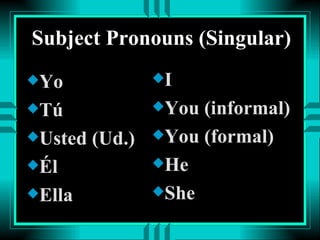
Subject Pronouns (Singular)
x Yo          xI

x Tú          x You (informal)
x Usted (Ud.) x You (formal)
x Él          x He

x Ella        x She
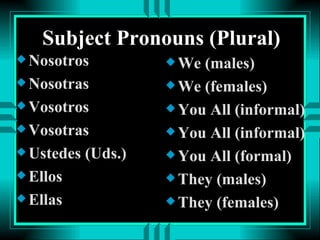
Subject Pronouns (Plural)
x Nosotros           x We (males)
x Nosotras           x We (females)
x Vosotros           x You All (informal)
x Vosotras           x You All (informal)
x Ustedes   (Uds.)   x You All (formal)
x Ellos              x They (males)
x Ellas              x They (females)
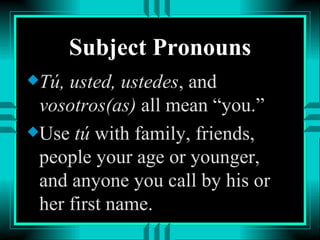
Subject Pronouns
x Tú, usted, ustedes, and
  vosotros(as) all mean “you.”
x Use tú with family, friends,
  people your age or younger,
  and anyone you call by his or
  her first name.
Subject Pronouns
x Useusted with adults you
 address with a title, such as
 señor, señora, profesor(a), etc.
 Usted is usually written as Ud.
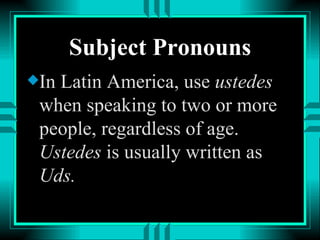
Subject Pronouns
x In
   Latin America, use ustedes
 when speaking to two or more
 people, regardless of age.
 Ustedes is usually written as
 Uds.
Subject Pronouns
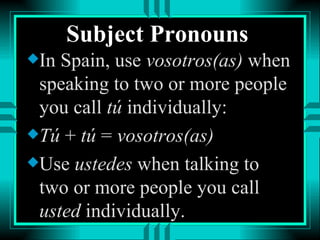
x In Spain, use vosotros(as) when
  speaking to two or more people
  you call tú individually:
x Tú + tú = vosotros(as)
x Use ustedes when talking to
  two or more people you call
  usted individually.
Subject Pronouns
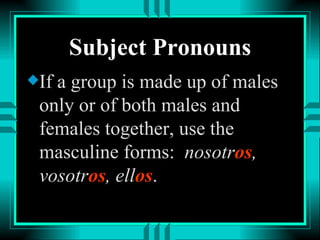
x If
   a group is made up of males
 only or of both males and
 females together, use the
 masculine forms: nosotros,
 vosotros, ellos.
Subject Pronouns
x You can combine a subject
 pronoun and a name to form a
 subject.
Subject Pronouns
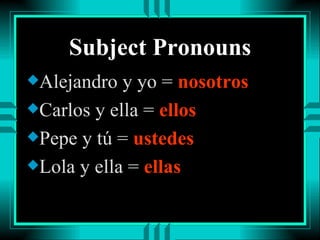
x Alejandro  y yo = nosotros
x Carlos y ella = ellos
x Pepe y tú = ustedes
x Lola y ella = ellas

TEMA 2A GRAMMAR SUBJECT PRONOUNS

  • 1.
    Subject Pronouns P. 82 Realidades 1
  • 2.
    Subject Pronouns x The subject of a sentence tells who is doing the action. x You often use people’s names as the subject: x Gregorio escucha música. x Ana canta y baila.
  • 3.
    Subject Pronouns x You also use subject pronouns (I, you, he, she, we, they) to tell who is doing an action. x The subject pronouns replace people’s names. x Here are all the subject pronouns.
  • 4.
    Subject Pronouns (Singular) xYo xI x Tú x You (informal) x Usted (Ud.) x You (formal) x Él x He x Ella x She
  • 5.
    Subject Pronouns (Plural) xNosotros x We (males) x Nosotras x We (females) x Vosotros x You All (informal) x Vosotras x You All (informal) x Ustedes (Uds.) x You All (formal) x Ellos x They (males) x Ellas x They (females)
  • 6.
    Subject Pronouns x Tú,usted, ustedes, and vosotros(as) all mean “you.” x Use tú with family, friends, people your age or younger, and anyone you call by his or her first name.
  • 7.
    Subject Pronouns x Useustedwith adults you address with a title, such as señor, señora, profesor(a), etc. Usted is usually written as Ud.
  • 8.
    Subject Pronouns x In Latin America, use ustedes when speaking to two or more people, regardless of age. Ustedes is usually written as Uds.
  • 9.
    Subject Pronouns x InSpain, use vosotros(as) when speaking to two or more people you call tú individually: x Tú + tú = vosotros(as) x Use ustedes when talking to two or more people you call usted individually.
  • 10.
    Subject Pronouns x If a group is made up of males only or of both males and females together, use the masculine forms: nosotros, vosotros, ellos.
  • 11.
    Subject Pronouns x Youcan combine a subject pronoun and a name to form a subject.
  • 12.
    Subject Pronouns x Alejandro y yo = nosotros x Carlos y ella = ellos x Pepe y tú = ustedes x Lola y ella = ellas