1

Sieve
Analysis
Test Procedure
12/17/2013
2

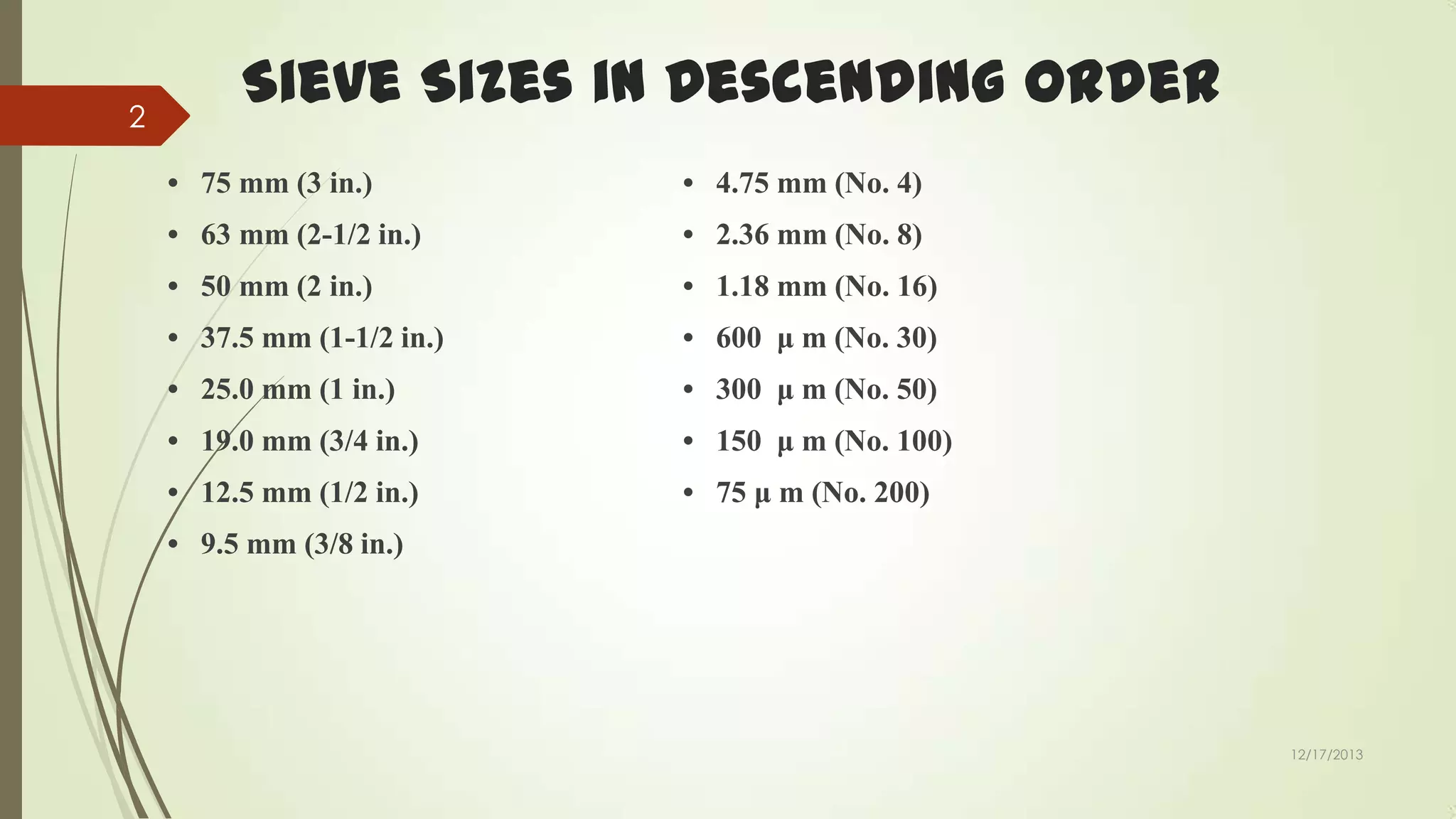
Sieve Sizes in Descending Order
• 75 mm (3 in.)

• 4.75 mm (No. 4)

• 63 mm (2-1/2 in.)

• 2.36 mm (No. 8)

• 50 mm (2 in.)

• 1.18 mm (No. 16)

• 37.5 mm (1-1/2 in.)

• 600 μ m (No. 30)

• 25.0 mm (1 in.)

• 300 μ m (No. 50)

• 19.0 mm (3/4 in.)

• 150 μ m (No. 100)

• 12.5 mm (1/2 in.)

• 75 μ m (No. 200)

• 9.5 mm (3/8 in.)

12/17/2013
3

Sieve Analysis Test Procedure
 Prepare the sample
 Fine Aggregate
 Select a representative sample of approximately 500 g from material that has been thoroughly dried at a temperature of 110
C (230
9 F).
 Weigh the sample and record its mass to the nearest 0.1 g.

 Coarse Aggregate
 Dry the sample in an oven to a constant mass, and then allow cooling to room temperature.
 Record the total dry mass of the sample to the nearest gram.
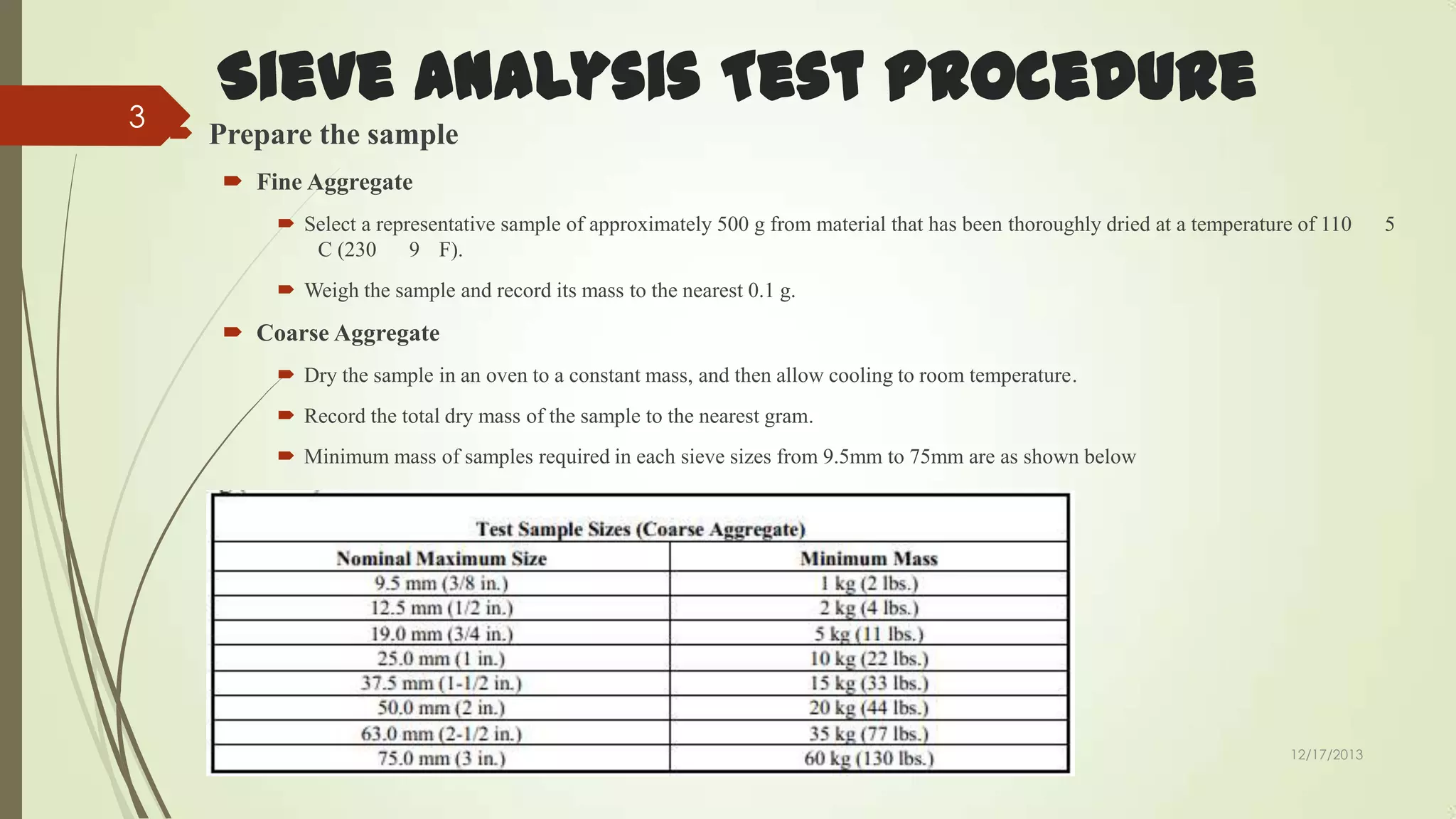
 Minimum mass of samples required in each sieve sizes from 9.5mm to 75mm are as shown below

12/17/2013

5
4

Sieve Analysis Test Procedure
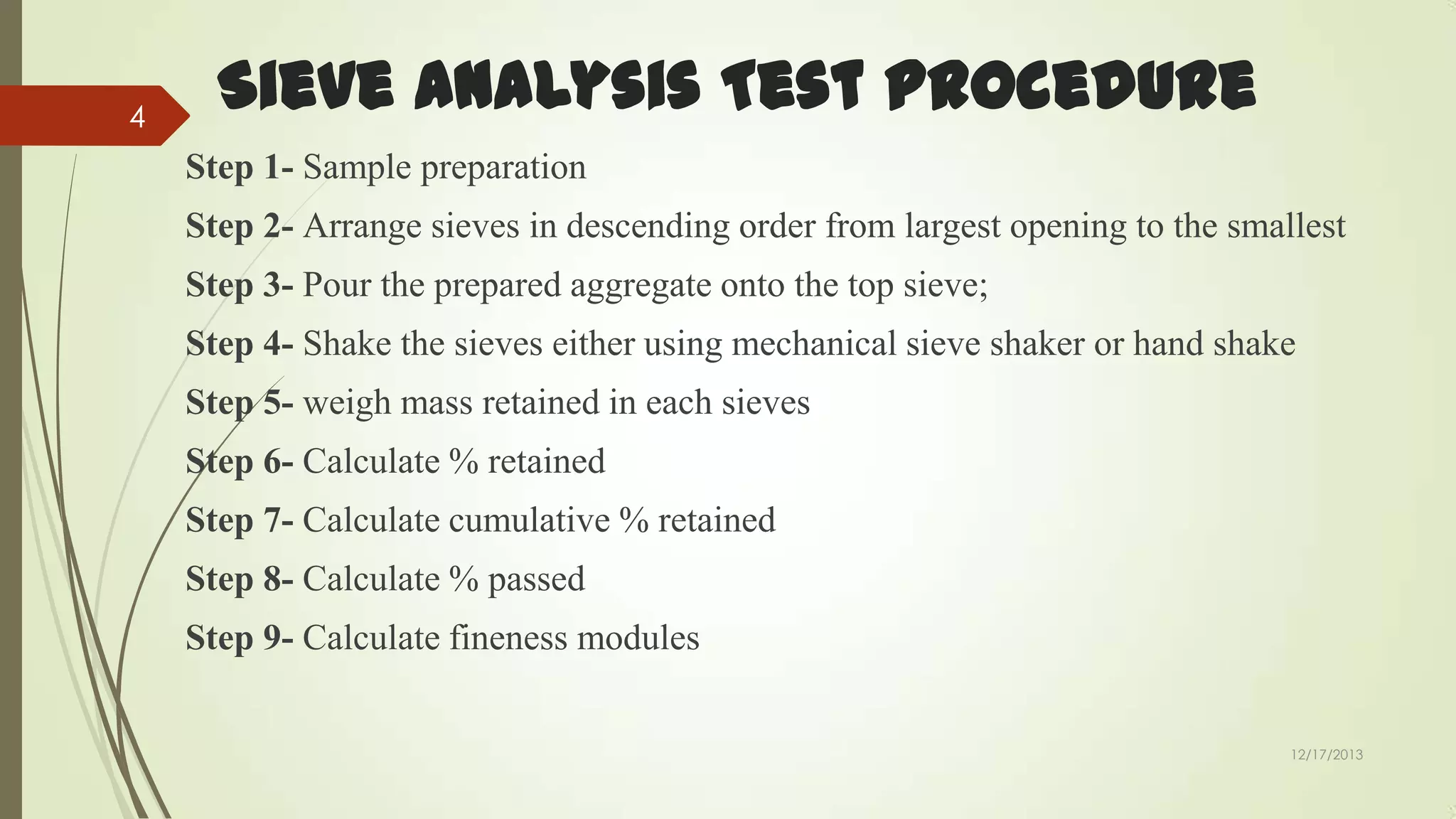
Step 1- Sample preparation
Step 2- Arrange sieves in descending order from largest opening to the smallest
Step 3- Pour the prepared aggregate onto the top sieve;
Step 4- Shake the sieves either using mechanical sieve shaker or hand shake

Step 5- weigh mass retained in each sieves
Step 6- Calculate % retained
Step 7- Calculate cumulative % retained

Step 8- Calculate % passed
Step 9- Calculate fineness modules
12/17/2013
5

Atterberg
Limit Tests
Test Procedure for Liquid limit
(Casagrande)
12/17/2013
6

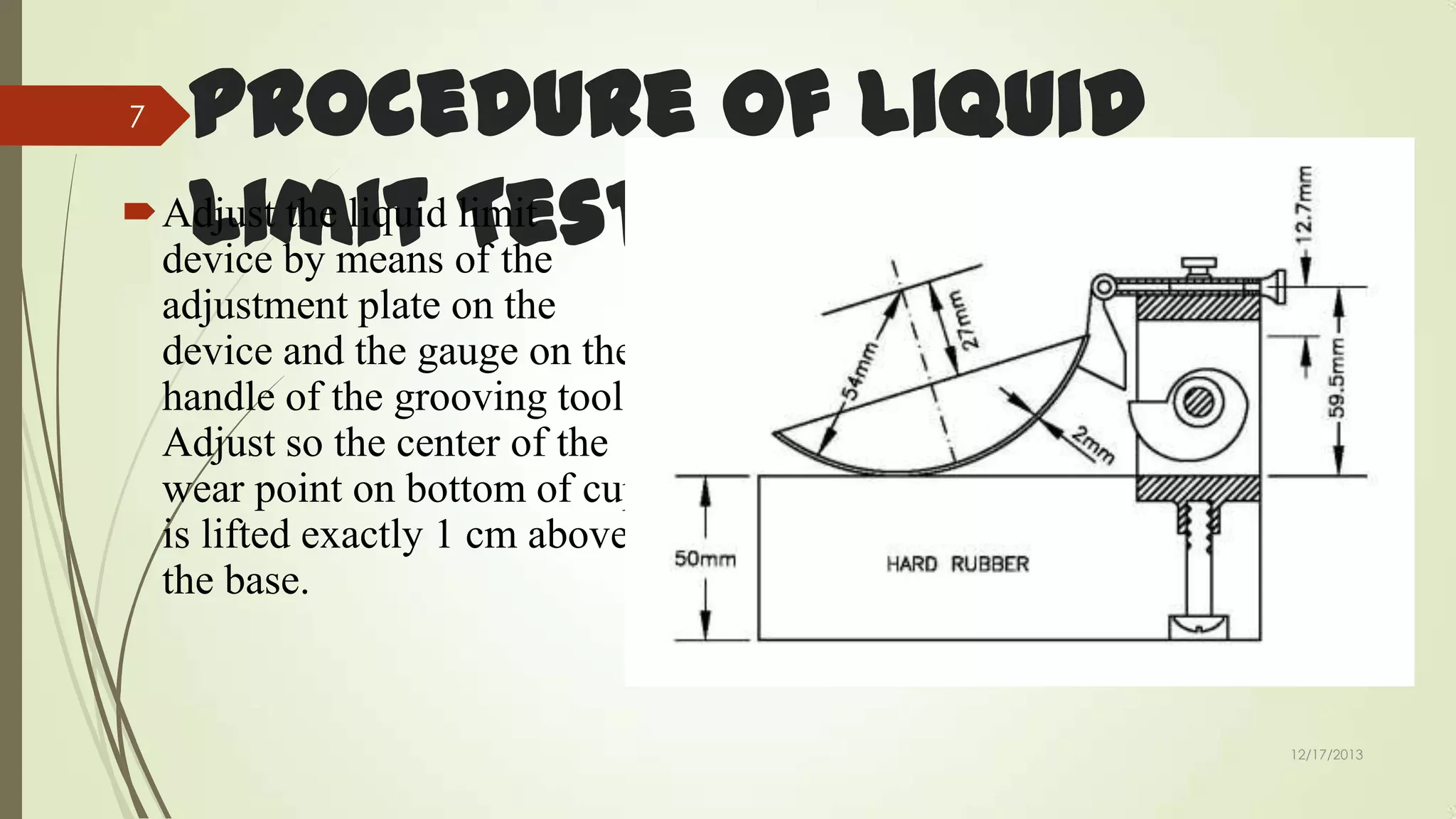
Introduction
 This method describes the procedure for determining the plasticity index of finegrained soils. This includes all soils having more than 50% of its particles
passing a No. 400 mm.
 The plasticity index of a soil is the numerical difference between its liquid and
plastic limits.
 The lowest water content determined by the following procedure at which the
soil remains plastic is the plastic limit.
 The water content determined by the following procedure at which the soil
passes from a plastic state to a liquid state is the liquid limit.

12/17/2013
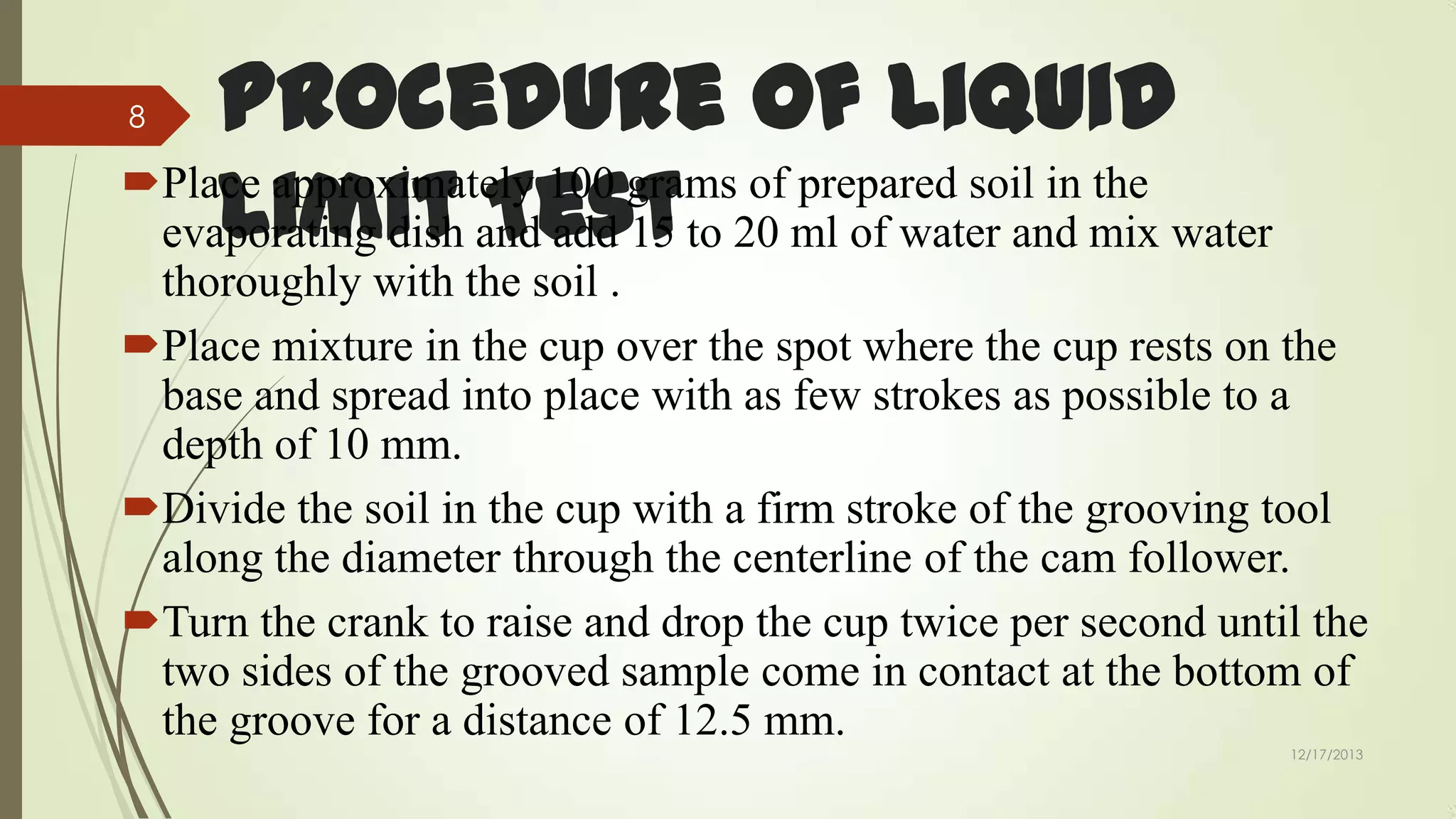
Procedure of Liquid
Adjust the liquid Test
limit
Limit of the
device by means
7

adjustment plate on the
device and the gauge on the
handle of the grooving tool.
Adjust so the center of the
wear point on bottom of cup
is lifted exactly 1 cm above
the base.

12/17/2013
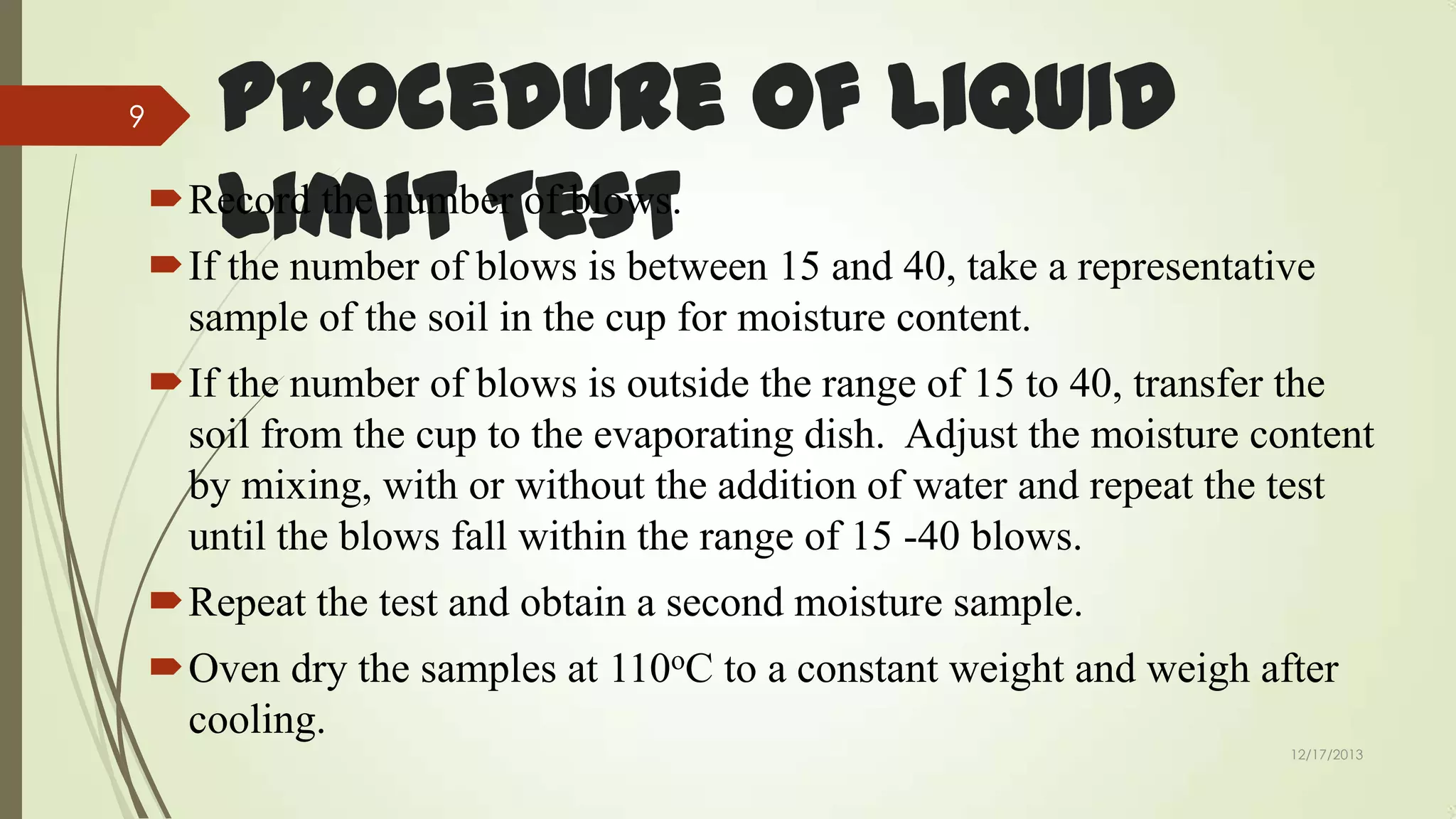
Procedure of Liquid
Place approximately 100 grams of prepared soil in the
Limit Test
evaporating dish and add 15 to 20 ml of water and mix water
8

thoroughly with the soil .
Place mixture in the cup over the spot where the cup rests on the
base and spread into place with as few strokes as possible to a
depth of 10 mm.
Divide the soil in the cup with a firm stroke of the grooving tool
along the diameter through the centerline of the cam follower.
Turn the crank to raise and drop the cup twice per second until the
two sides of the grooved sample come in contact at the bottom of
the groove for a distance of 12.5 mm.
12/17/2013
9

Procedure of Liquid
Record the number of blows.
Limit blows is between 15 and 40, take a representative
Test
If the number of
sample of the soil in the cup for moisture content.
If the number of blows is outside the range of 15 to 40, transfer the
soil from the cup to the evaporating dish. Adjust the moisture content
by mixing, with or without the addition of water and repeat the test
until the blows fall within the range of 15 -40 blows.

Repeat the test and obtain a second moisture sample.
Oven dry the samples at 110oC to a constant weight and weigh after
cooling.
12/17/2013
10

Calculation
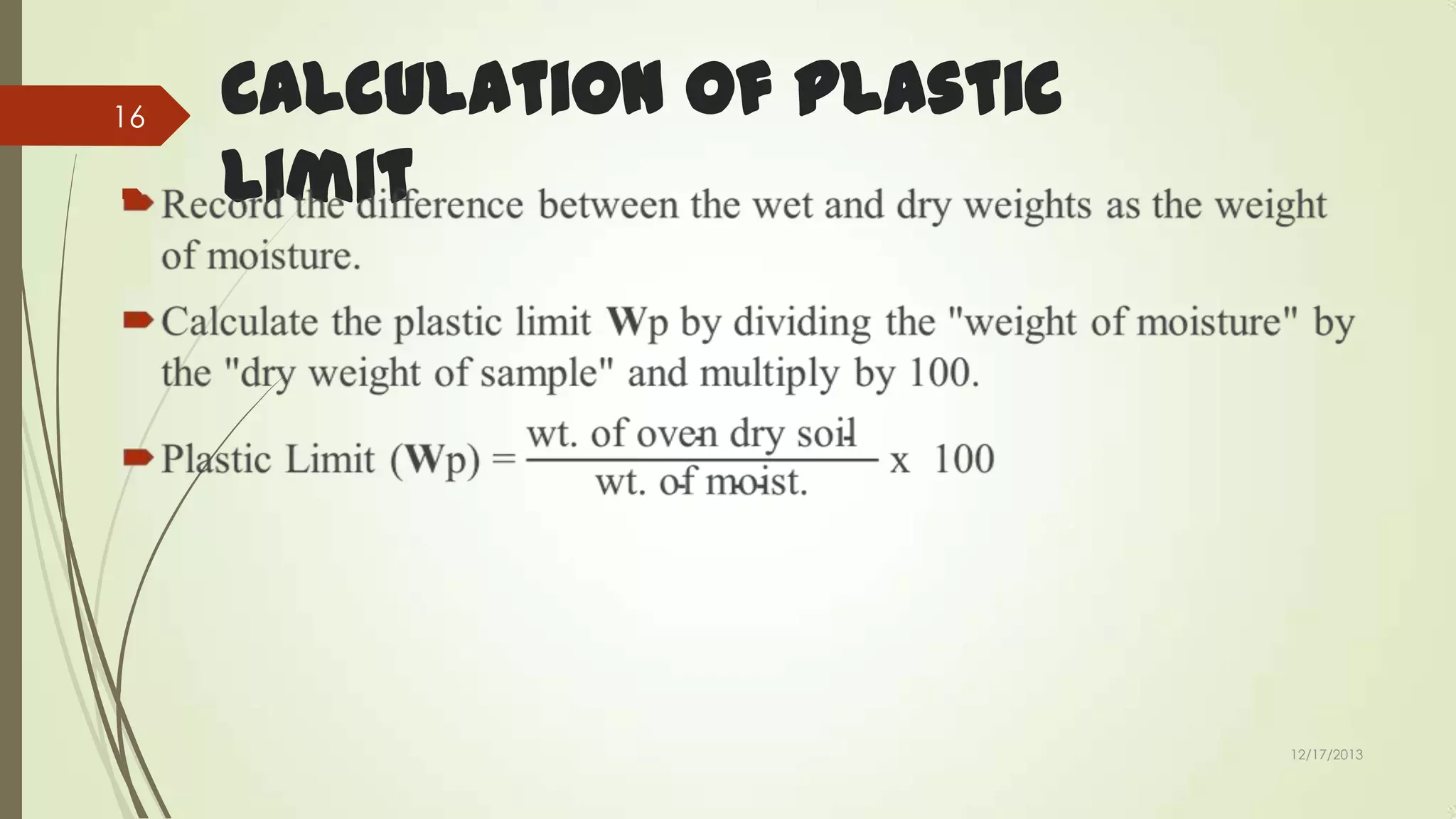
Record the numerical difference between the wet and dry weight as
weight of moisture.
The "weight of moisture" divided by the "dry weight of sample" and
multiplied by one hundred is the percent moisture.

12/17/2013
11

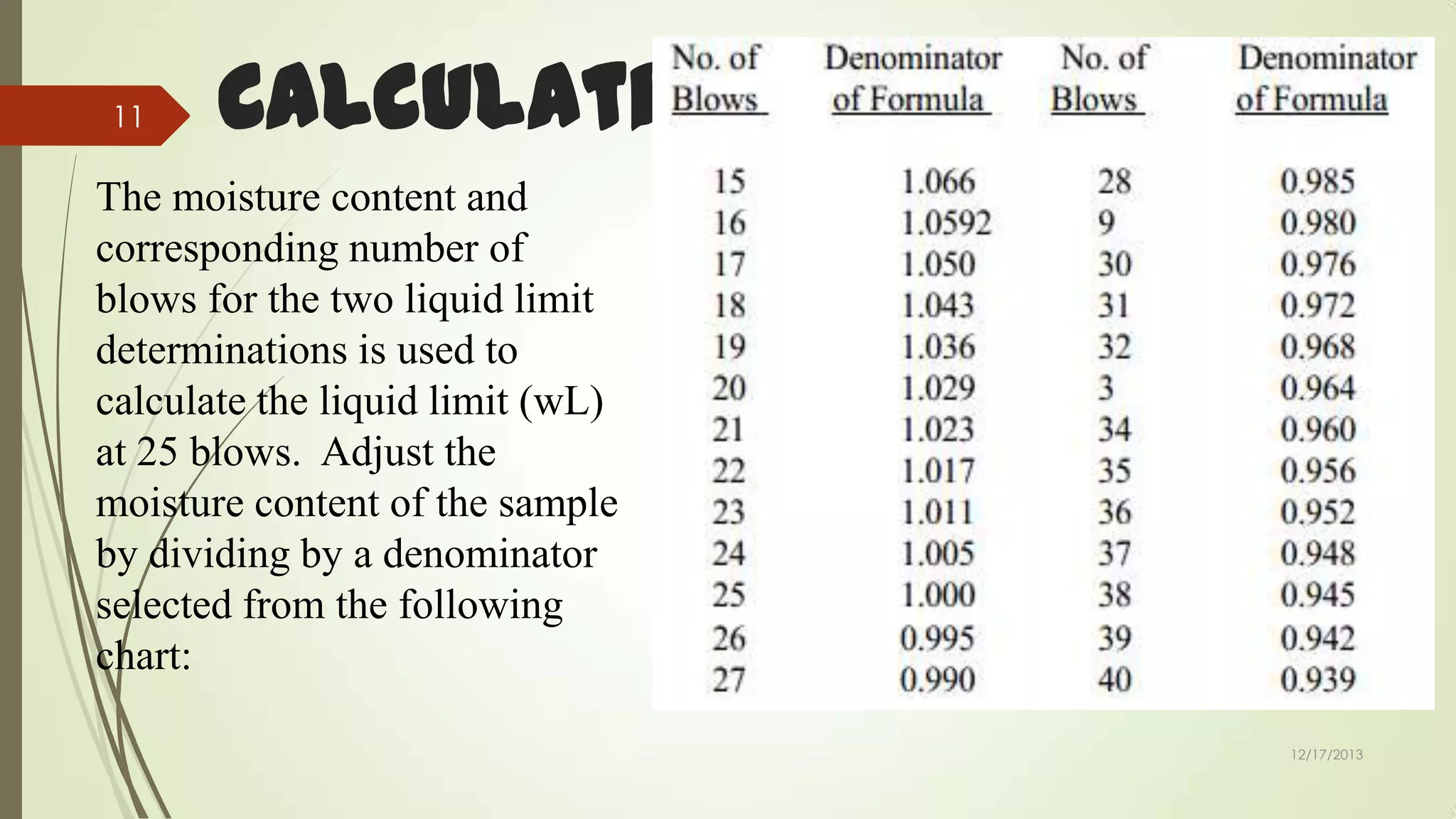
Calculation

The moisture content and
corresponding number of
blows for the two liquid limit
determinations is used to
calculate the liquid limit (wL)
at 25 blows. Adjust the
moisture content of the sample
by dividing by a denominator
selected from the following
chart:
12/17/2013
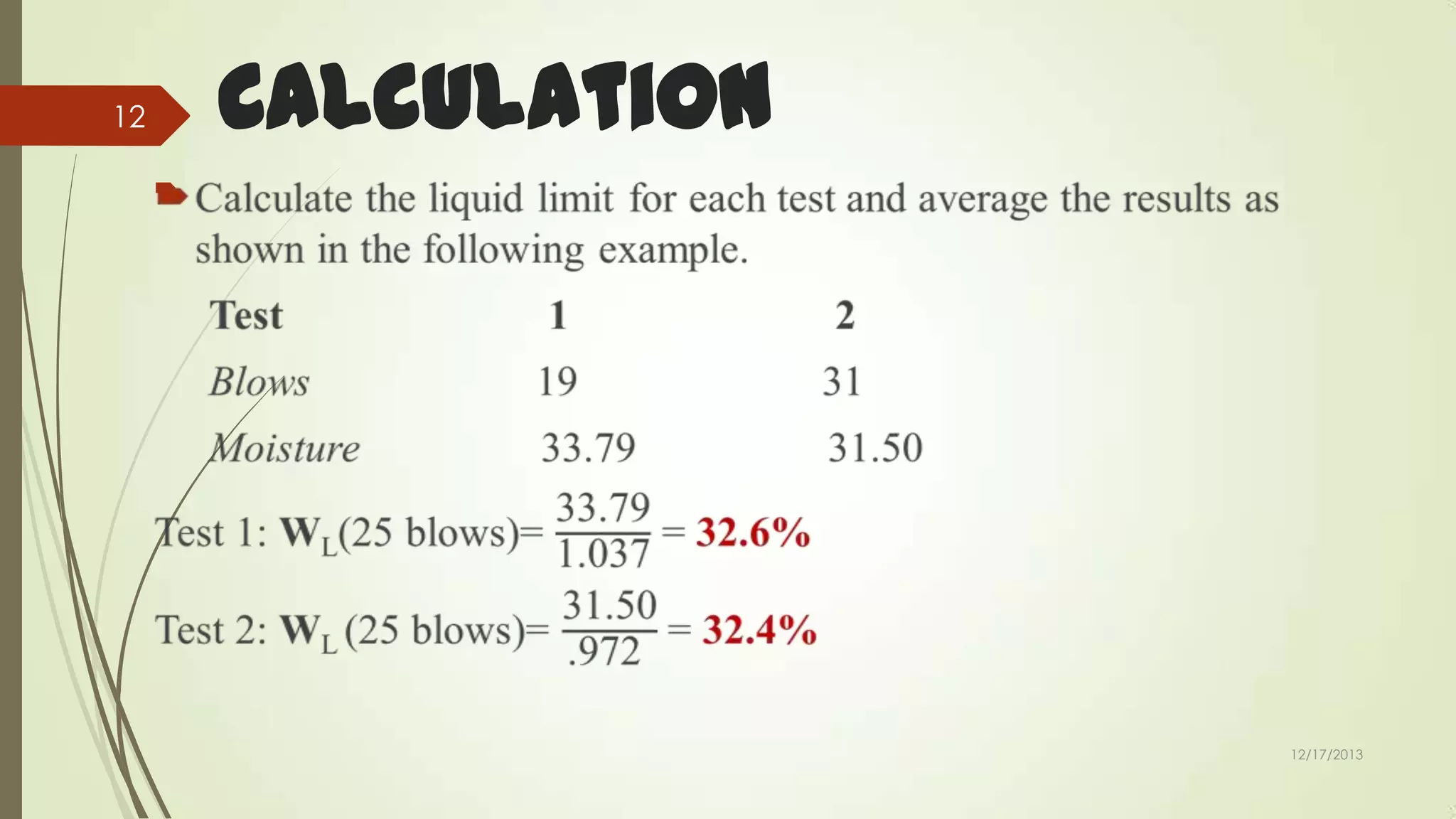
Calculation

12


12/17/2013
13

Atterberg
Limit Tests
Test Procedure for Plastic limit
12/17/2013
Procedure of Plastic Limit
Test
Place approximately 20 grams of the prepared soil in evaporating

14

dish and thoroughly mix with water until the mass becomes plastic
enough to be shaped into a ball.
Take approximately 8 to 12 grams of the moistened soil and form
into a uniform mass roughly elliptical in shape.
Roll the ball of soil by hand on the rolling surface with just
enough pressure to form an elongated thread as rolling proceeds.

12/17/2013
15

Procedure of Plastic Limit
Test
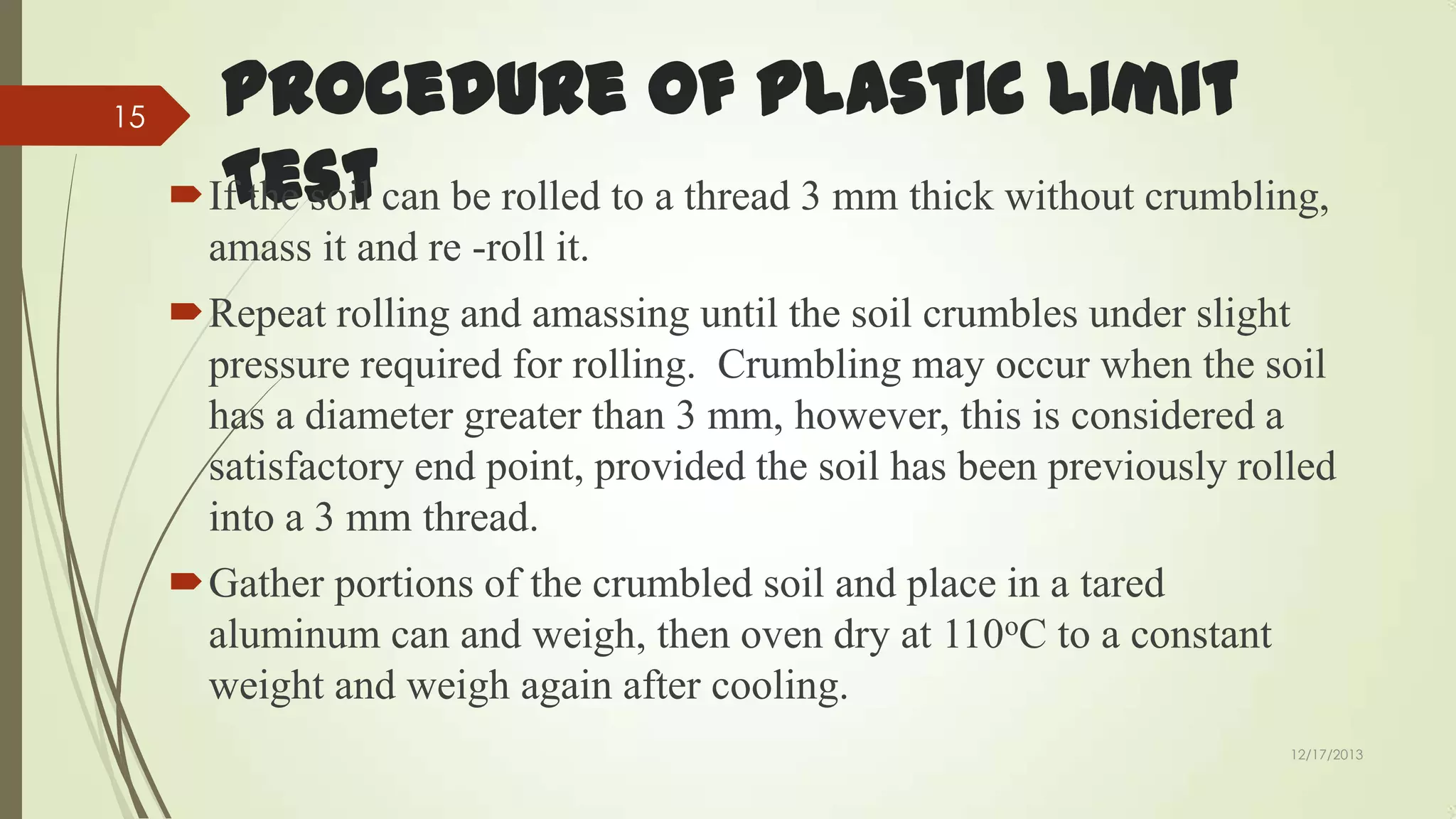
If the soil can be rolled to a thread 3 mm thick without crumbling,
amass it and re -roll it.
Repeat rolling and amassing until the soil crumbles under slight
pressure required for rolling. Crumbling may occur when the soil
has a diameter greater than 3 mm, however, this is considered a
satisfactory end point, provided the soil has been previously rolled
into a 3 mm thread.
Gather portions of the crumbled soil and place in a tared
aluminum can and weigh, then oven dry at 110oC to a constant
weight and weigh again after cooling.
12/17/2013
16


Calculation of Plastic
Limit

12/17/2013
17

Compactio
n Test
Standard and Modified
Proctor test
12/17/2013
18

Compaction Test
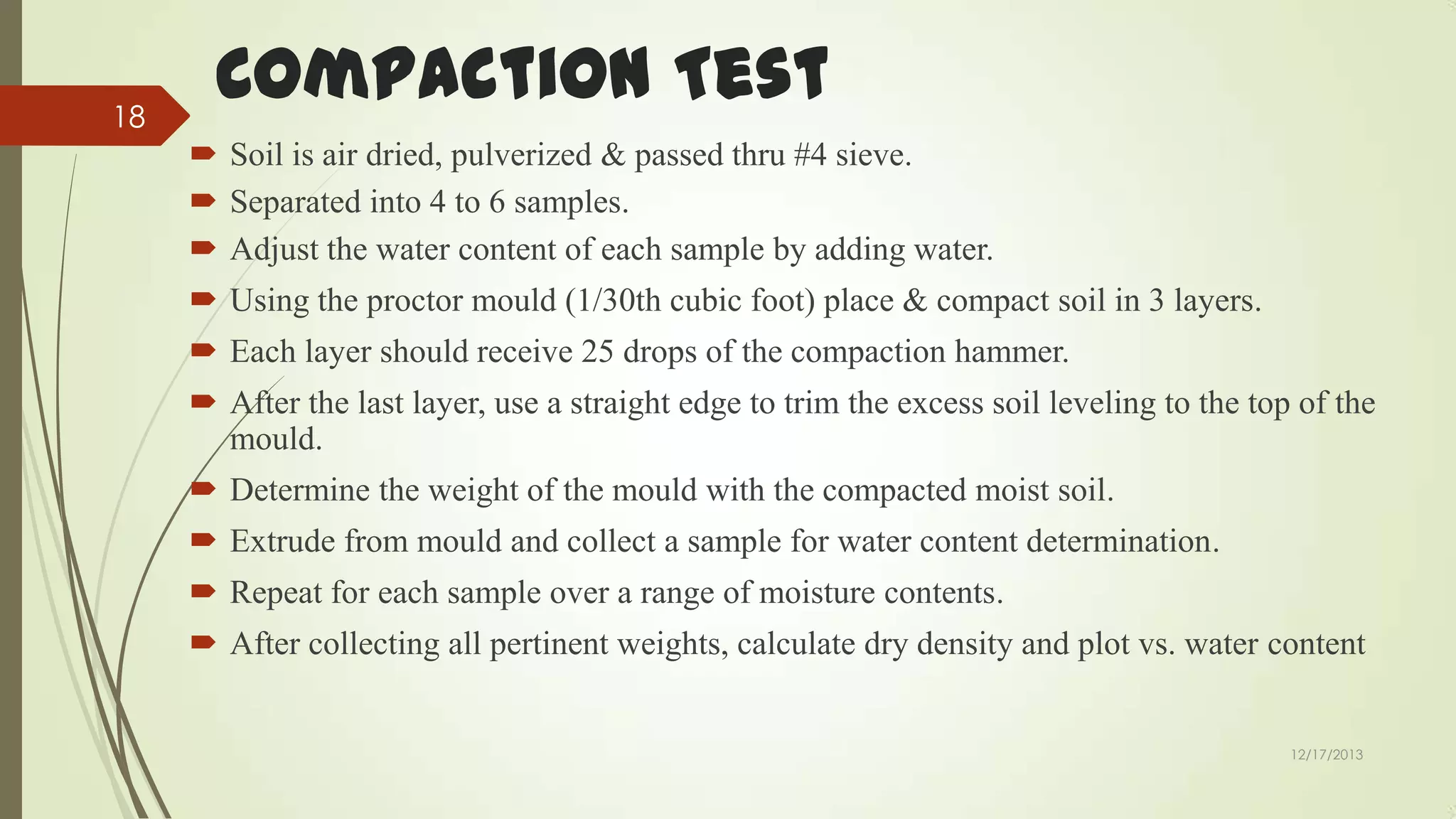
 Soil is air dried, pulverized & passed thru #4 sieve.
 Separated into 4 to 6 samples.
 Adjust the water content of each sample by adding water.

 Using the proctor mould (1/30th cubic foot) place & compact soil in 3 layers.
 Each layer should receive 25 drops of the compaction hammer.
 After the last layer, use a straight edge to trim the excess soil leveling to the top of the
mould.

 Determine the weight of the mould with the compacted moist soil.
 Extrude from mould and collect a sample for water content determination.
 Repeat for each sample over a range of moisture contents.
 After collecting all pertinent weights, calculate dry density and plot vs. water content

12/17/2013
19

CBR (California
Bearing Ratio)
Test
12/17/2013
20

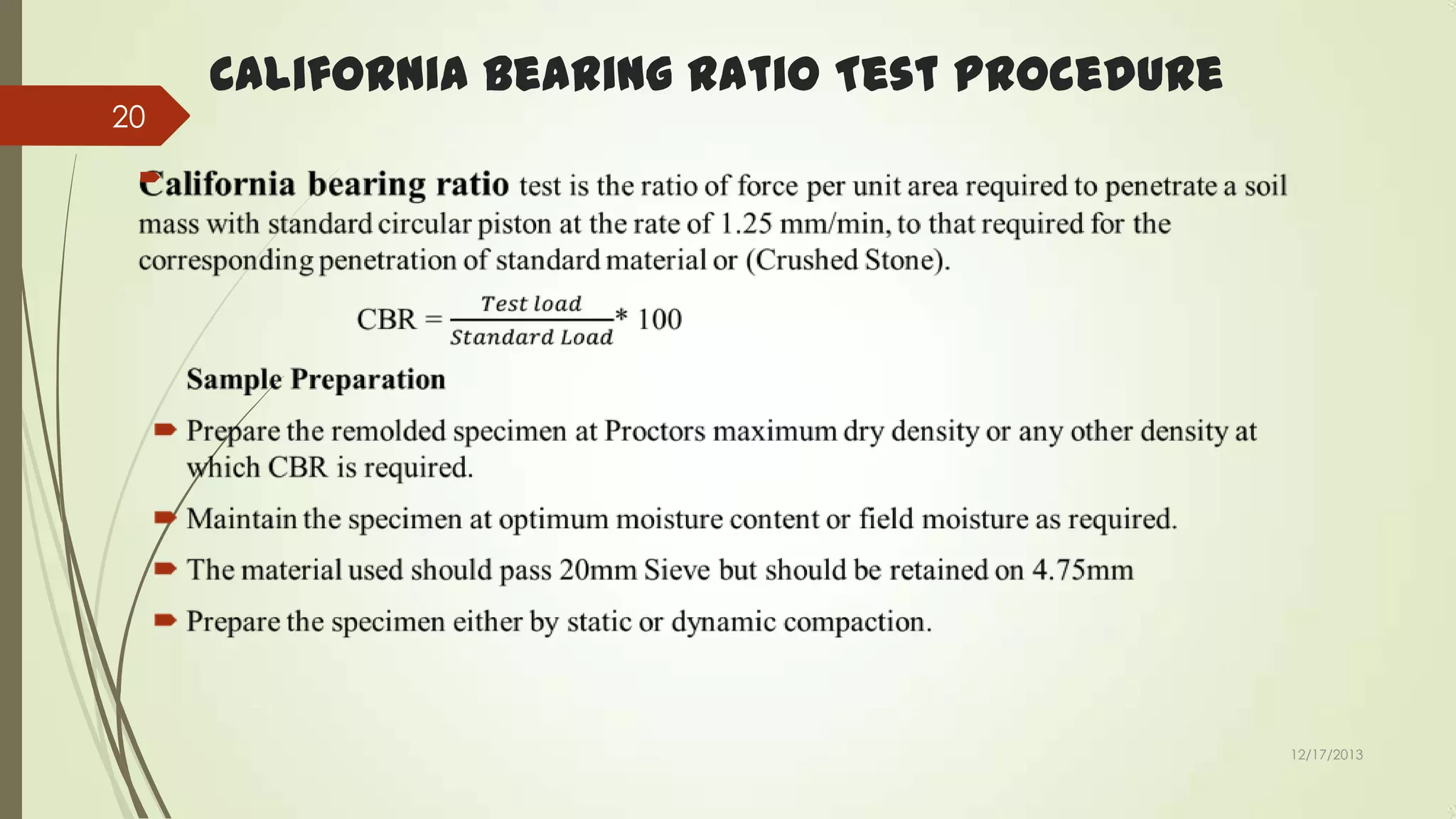
California Bearing Ratio Test Procedure



12/17/2013
21

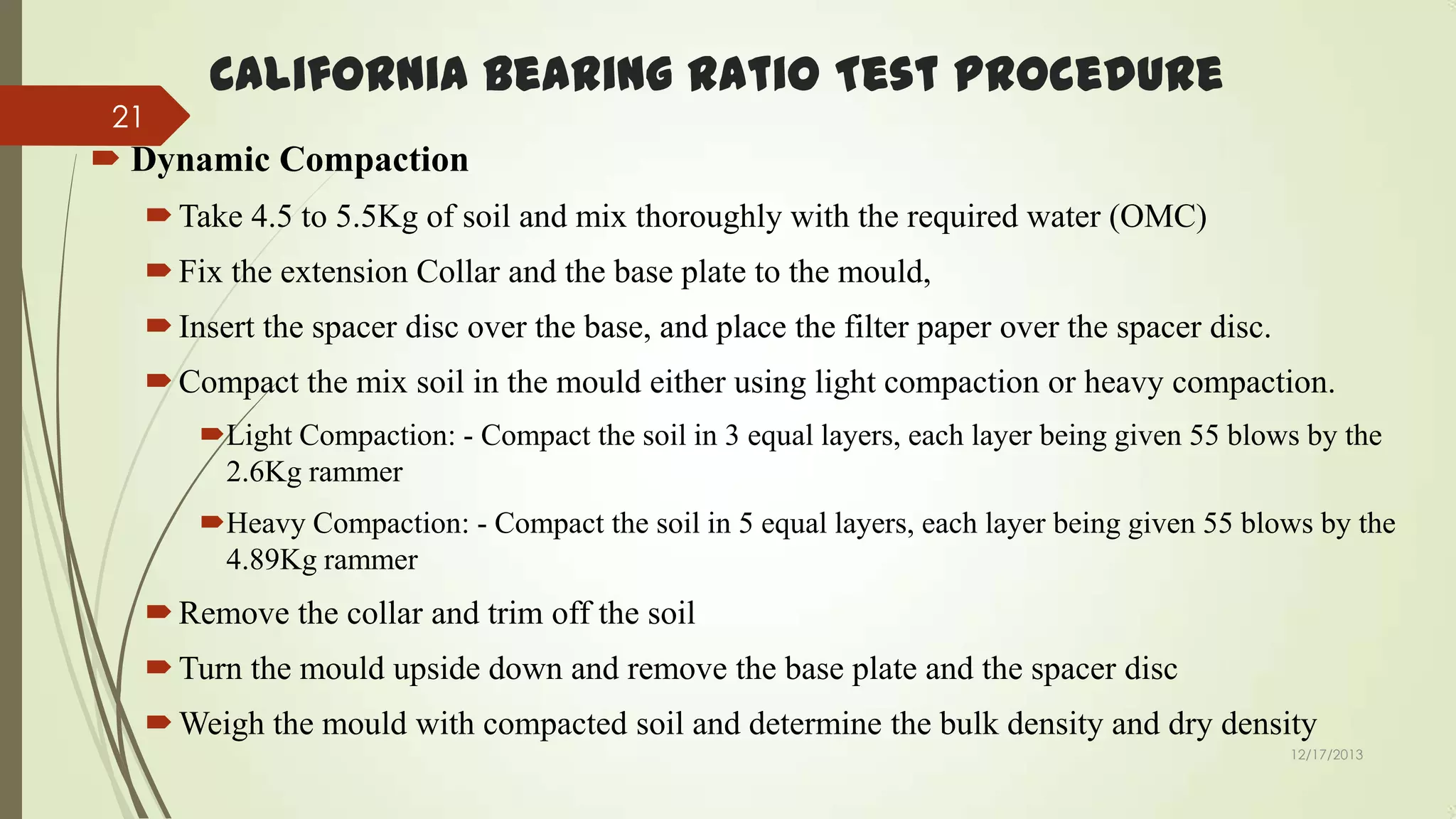
California Bearing Ratio Test Procedure

 Dynamic Compaction
 Take 4.5 to 5.5Kg of soil and mix thoroughly with the required water (OMC)

 Fix the extension Collar and the base plate to the mould,
 Insert the spacer disc over the base, and place the filter paper over the spacer disc.
 Compact the mix soil in the mould either using light compaction or heavy compaction.
Light Compaction: - Compact the soil in 3 equal layers, each layer being given 55 blows by the
2.6Kg rammer
Heavy Compaction: - Compact the soil in 5 equal layers, each layer being given 55 blows by the
4.89Kg rammer

 Remove the collar and trim off the soil
 Turn the mould upside down and remove the base plate and the spacer disc
 Weigh the mould with compacted soil and determine the bulk density and dry density
12/17/2013
22

California Bearing Ratio Test Procedure

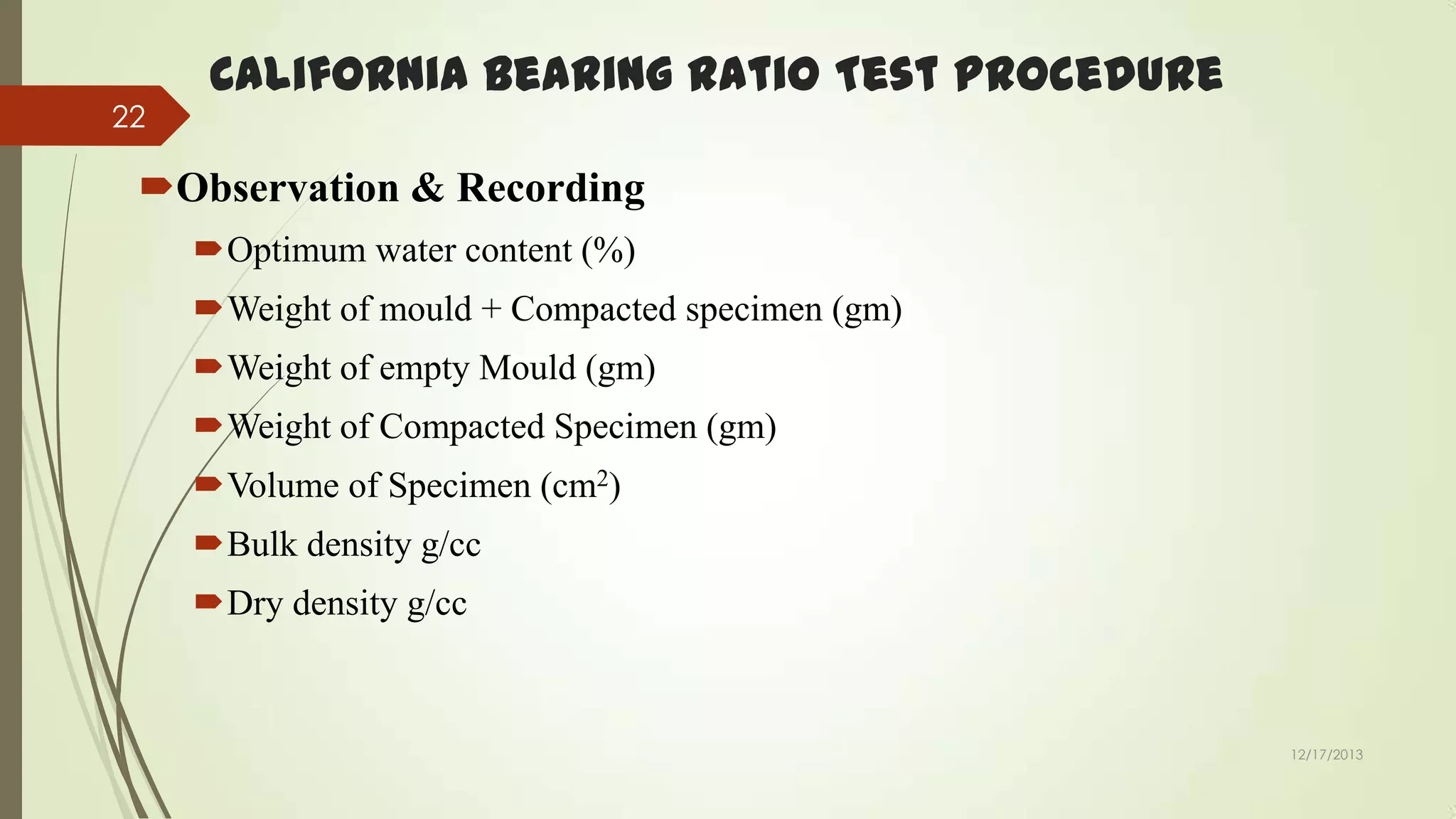
Observation & Recording
Optimum water content (%)

Weight of mould + Compacted specimen (gm)
Weight of empty Mould (gm)
Weight of Compacted Specimen (gm)

Volume of Specimen (cm2)
Bulk density g/cc
Dry density g/cc

12/17/2013
23

California Bearing Ratio Test Procedure

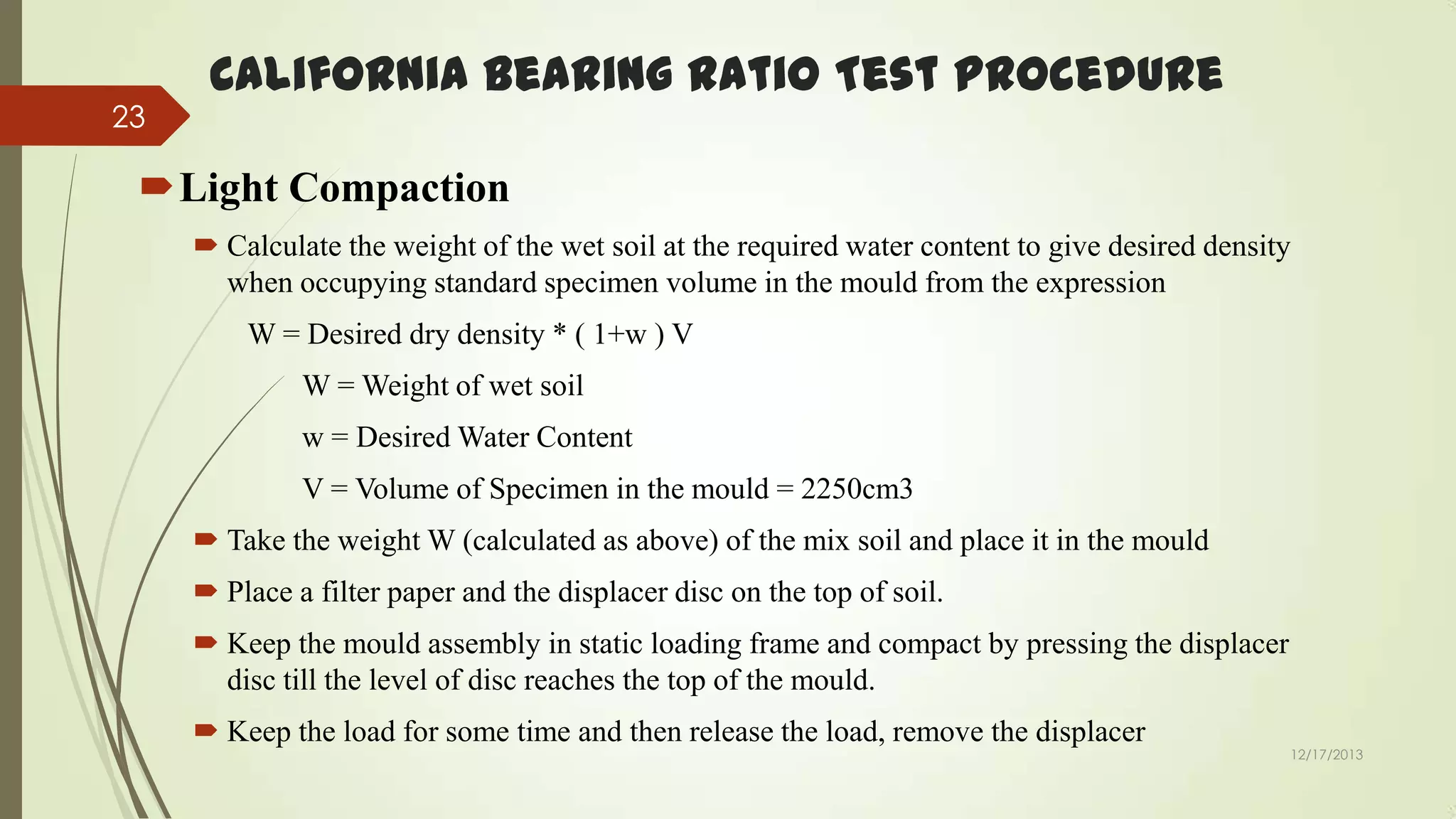
Light Compaction
 Calculate the weight of the wet soil at the required water content to give desired density
when occupying standard specimen volume in the mould from the expression
W = Desired dry density * ( 1+w ) V
W = Weight of wet soil
w = Desired Water Content

V = Volume of Specimen in the mould = 2250cm3
 Take the weight W (calculated as above) of the mix soil and place it in the mould
 Place a filter paper and the displacer disc on the top of soil.
 Keep the mould assembly in static loading frame and compact by pressing the displacer
disc till the level of disc reaches the top of the mould.
 Keep the load for some time and then release the load, remove the displacer

12/17/2013
24

California Bearing Ratio Test Procedure
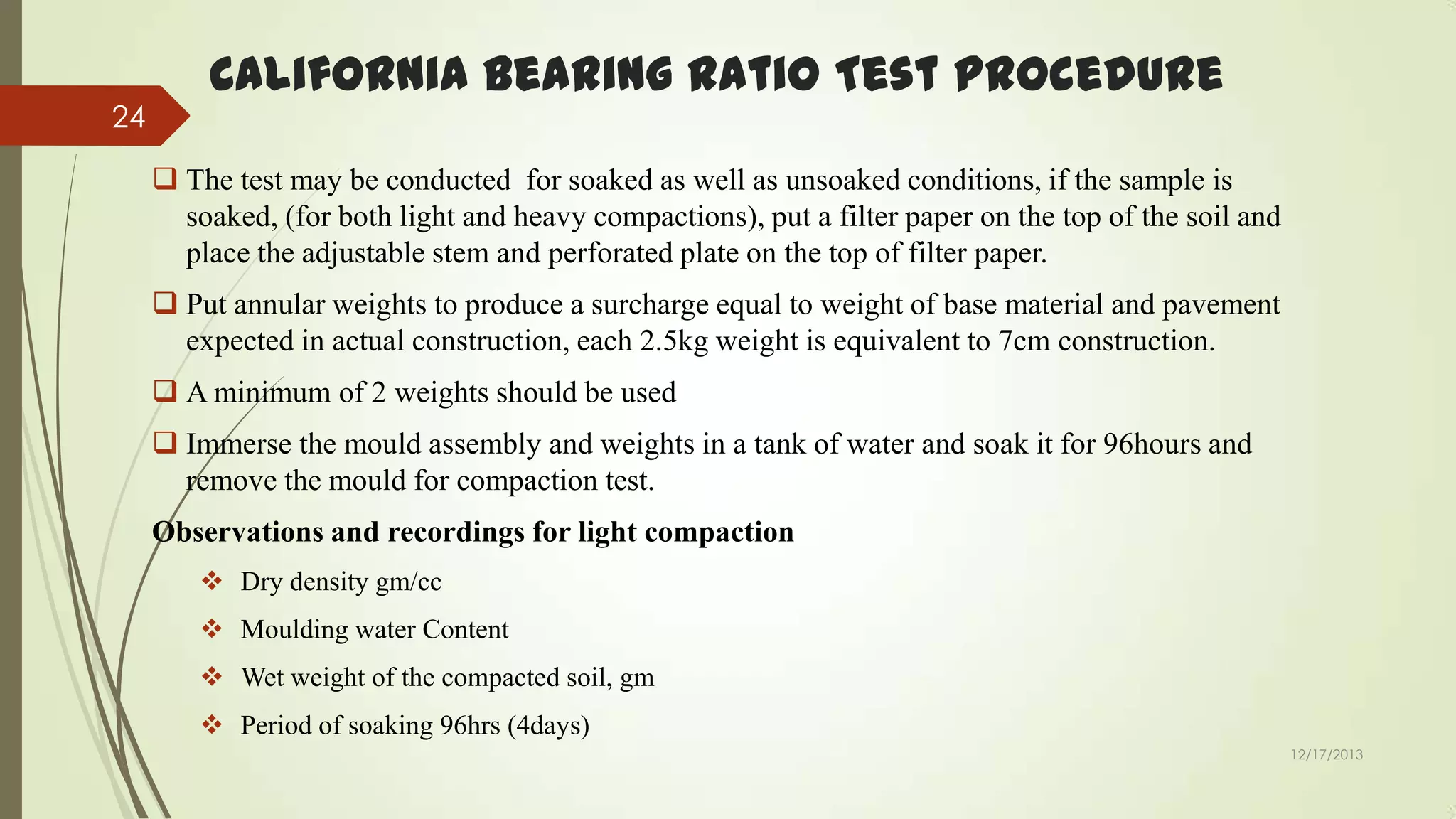
 The test may be conducted for soaked as well as unsoaked conditions, if the sample is
soaked, (for both light and heavy compactions), put a filter paper on the top of the soil and
place the adjustable stem and perforated plate on the top of filter paper.

 Put annular weights to produce a surcharge equal to weight of base material and pavement
expected in actual construction, each 2.5kg weight is equivalent to 7cm construction.
 A minimum of 2 weights should be used
 Immerse the mould assembly and weights in a tank of water and soak it for 96hours and
remove the mould for compaction test.
Observations and recordings for light compaction
 Dry density gm/cc
 Moulding water Content

 Wet weight of the compacted soil, gm
 Period of soaking 96hrs (4days)
12/17/2013
25

California Bearing Ratio Test Procedure
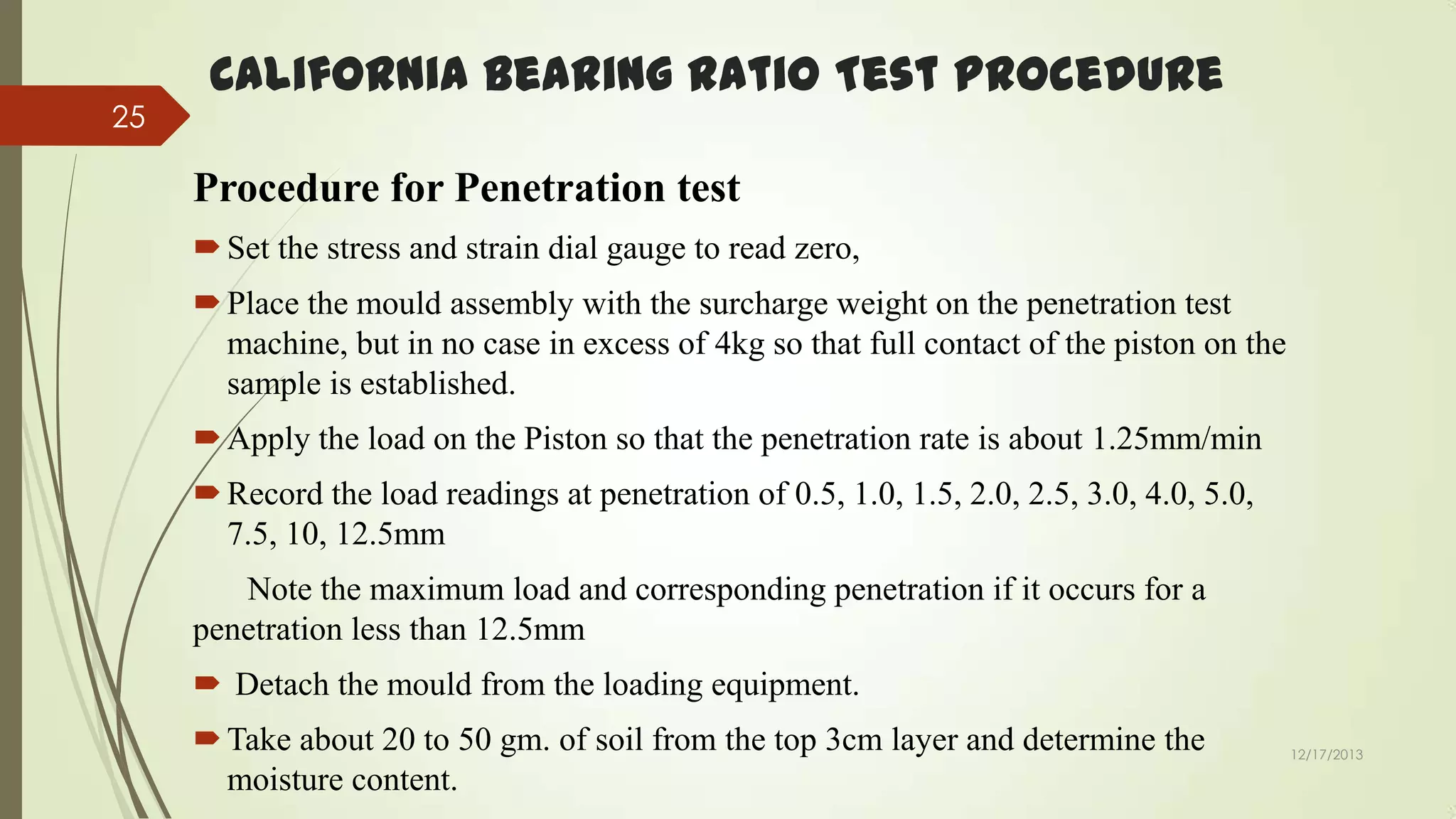
Procedure for Penetration test
 Set the stress and strain dial gauge to read zero,

 Place the mould assembly with the surcharge weight on the penetration test
machine, but in no case in excess of 4kg so that full contact of the piston on the
sample is established.
 Apply the load on the Piston so that the penetration rate is about 1.25mm/min

 Record the load readings at penetration of 0.5, 1.0, 1.5, 2.0, 2.5, 3.0, 4.0, 5.0,
7.5, 10, 12.5mm
Note the maximum load and corresponding penetration if it occurs for a
penetration less than 12.5mm
 Detach the mould from the loading equipment.
 Take about 20 to 50 gm. of soil from the top 3cm layer and determine the
moisture content.

12/17/2013
26

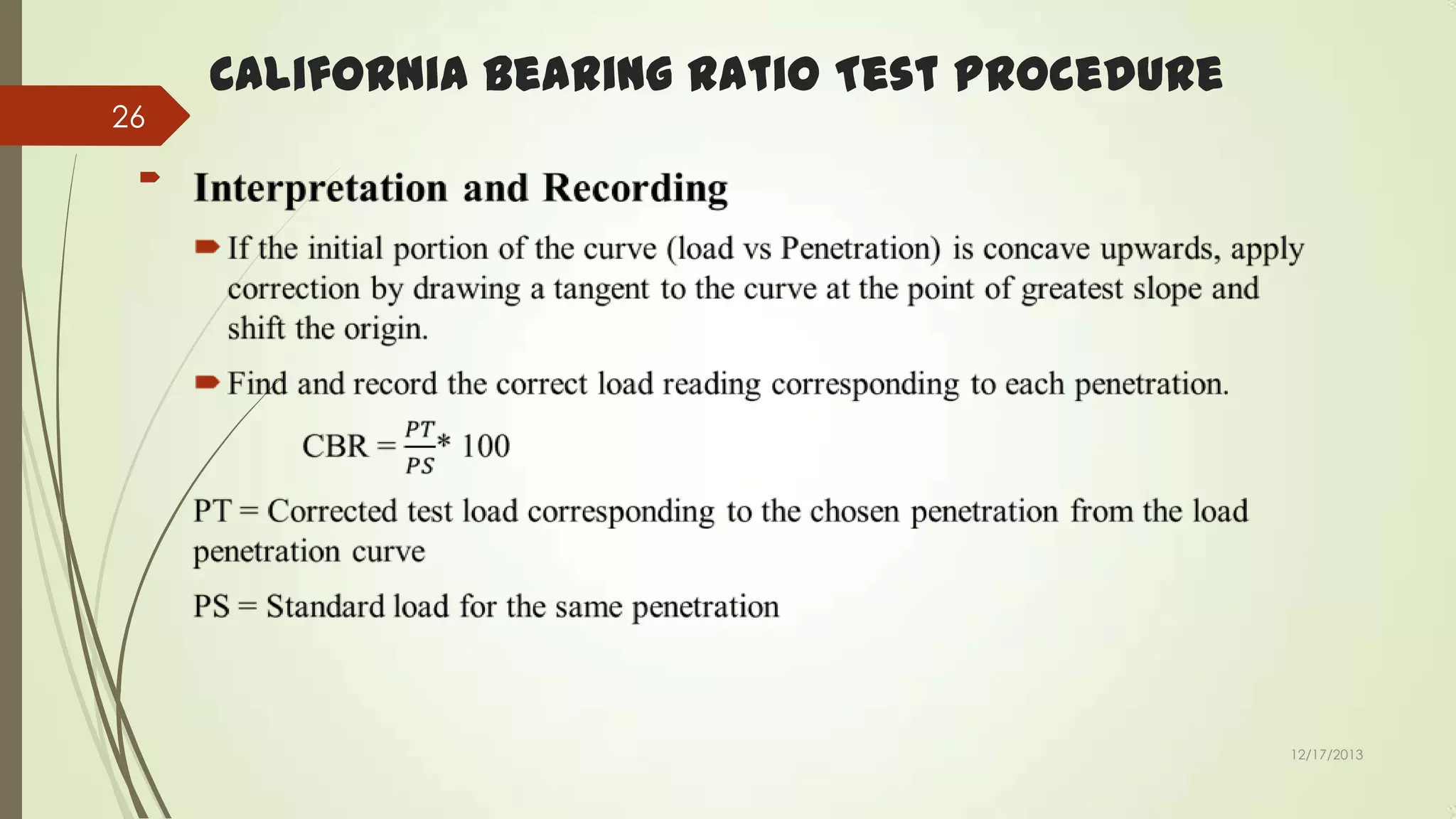
California Bearing Ratio Test Procedure



12/17/2013
27

California Bearing Ratio Test Procedure
Interpretation and Recording
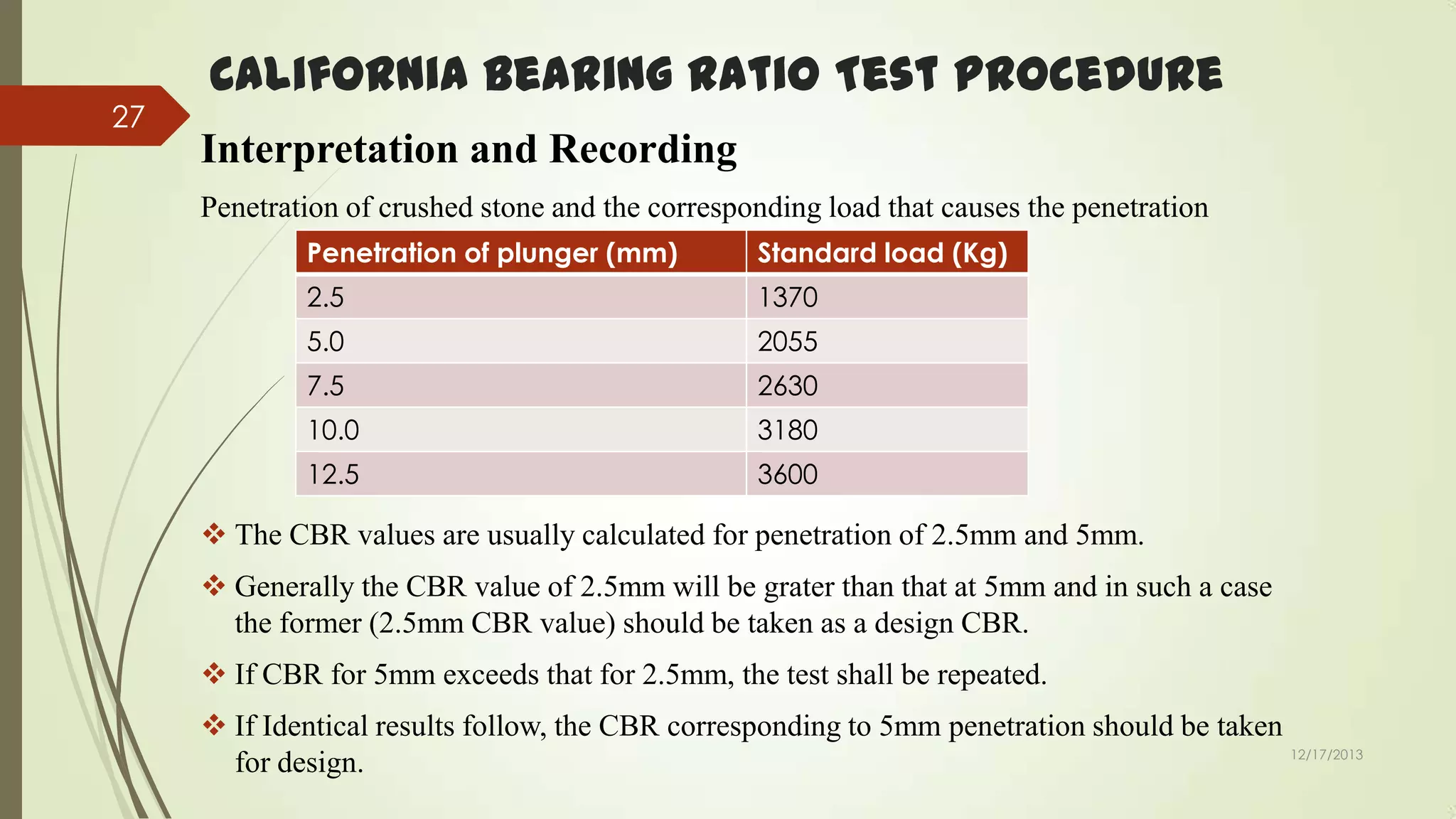
Penetration of crushed stone and the corresponding load that causes the penetration
Penetration of plunger (mm)

Standard load (Kg)

2.5

1370

5.0

2055

7.5

2630

10.0

3180

12.5

3600

 The CBR values are usually calculated for penetration of 2.5mm and 5mm.
 Generally the CBR value of 2.5mm will be grater than that at 5mm and in such a case
the former (2.5mm CBR value) should be taken as a design CBR.
 If CBR for 5mm exceeds that for 2.5mm, the test shall be repeated.
 If Identical results follow, the CBR corresponding to 5mm penetration should be taken
12/17/2013
for design.

Subgrade soil test, by Micotol

  • 1.
  • 2.
    2 Sieve Sizes inDescending Order • 75 mm (3 in.) • 4.75 mm (No. 4) • 63 mm (2-1/2 in.) • 2.36 mm (No. 8) • 50 mm (2 in.) • 1.18 mm (No. 16) • 37.5 mm (1-1/2 in.) • 600 μ m (No. 30) • 25.0 mm (1 in.) • 300 μ m (No. 50) • 19.0 mm (3/4 in.) • 150 μ m (No. 100) • 12.5 mm (1/2 in.) • 75 μ m (No. 200) • 9.5 mm (3/8 in.) 12/17/2013
  • 3.
    3 Sieve Analysis TestProcedure  Prepare the sample  Fine Aggregate  Select a representative sample of approximately 500 g from material that has been thoroughly dried at a temperature of 110 C (230 9 F).  Weigh the sample and record its mass to the nearest 0.1 g.  Coarse Aggregate  Dry the sample in an oven to a constant mass, and then allow cooling to room temperature.  Record the total dry mass of the sample to the nearest gram.  Minimum mass of samples required in each sieve sizes from 9.5mm to 75mm are as shown below 12/17/2013 5
  • 4.
    4 Sieve Analysis TestProcedure Step 1- Sample preparation Step 2- Arrange sieves in descending order from largest opening to the smallest Step 3- Pour the prepared aggregate onto the top sieve; Step 4- Shake the sieves either using mechanical sieve shaker or hand shake Step 5- weigh mass retained in each sieves Step 6- Calculate % retained Step 7- Calculate cumulative % retained Step 8- Calculate % passed Step 9- Calculate fineness modules 12/17/2013
  • 5.
    5 Atterberg Limit Tests Test Procedurefor Liquid limit (Casagrande) 12/17/2013
  • 6.
    6 Introduction  This methoddescribes the procedure for determining the plasticity index of finegrained soils. This includes all soils having more than 50% of its particles passing a No. 400 mm.  The plasticity index of a soil is the numerical difference between its liquid and plastic limits.  The lowest water content determined by the following procedure at which the soil remains plastic is the plastic limit.  The water content determined by the following procedure at which the soil passes from a plastic state to a liquid state is the liquid limit. 12/17/2013
  • 7.
    Procedure of Liquid Adjustthe liquid Test limit Limit of the device by means 7 adjustment plate on the device and the gauge on the handle of the grooving tool. Adjust so the center of the wear point on bottom of cup is lifted exactly 1 cm above the base. 12/17/2013
  • 8.
    Procedure of Liquid Placeapproximately 100 grams of prepared soil in the Limit Test evaporating dish and add 15 to 20 ml of water and mix water 8 thoroughly with the soil . Place mixture in the cup over the spot where the cup rests on the base and spread into place with as few strokes as possible to a depth of 10 mm. Divide the soil in the cup with a firm stroke of the grooving tool along the diameter through the centerline of the cam follower. Turn the crank to raise and drop the cup twice per second until the two sides of the grooved sample come in contact at the bottom of the groove for a distance of 12.5 mm. 12/17/2013
  • 9.
    9 Procedure of Liquid Recordthe number of blows. Limit blows is between 15 and 40, take a representative Test If the number of sample of the soil in the cup for moisture content. If the number of blows is outside the range of 15 to 40, transfer the soil from the cup to the evaporating dish. Adjust the moisture content by mixing, with or without the addition of water and repeat the test until the blows fall within the range of 15 -40 blows. Repeat the test and obtain a second moisture sample. Oven dry the samples at 110oC to a constant weight and weigh after cooling. 12/17/2013
  • 10.
    10 Calculation Record the numericaldifference between the wet and dry weight as weight of moisture. The "weight of moisture" divided by the "dry weight of sample" and multiplied by one hundred is the percent moisture. 12/17/2013
  • 11.
    11 Calculation The moisture contentand corresponding number of blows for the two liquid limit determinations is used to calculate the liquid limit (wL) at 25 blows. Adjust the moisture content of the sample by dividing by a denominator selected from the following chart: 12/17/2013
  • 12.
  • 13.
    13 Atterberg Limit Tests Test Procedurefor Plastic limit 12/17/2013
  • 14.
    Procedure of PlasticLimit Test Place approximately 20 grams of the prepared soil in evaporating 14 dish and thoroughly mix with water until the mass becomes plastic enough to be shaped into a ball. Take approximately 8 to 12 grams of the moistened soil and form into a uniform mass roughly elliptical in shape. Roll the ball of soil by hand on the rolling surface with just enough pressure to form an elongated thread as rolling proceeds. 12/17/2013
  • 15.
    15 Procedure of PlasticLimit Test If the soil can be rolled to a thread 3 mm thick without crumbling, amass it and re -roll it. Repeat rolling and amassing until the soil crumbles under slight pressure required for rolling. Crumbling may occur when the soil has a diameter greater than 3 mm, however, this is considered a satisfactory end point, provided the soil has been previously rolled into a 3 mm thread. Gather portions of the crumbled soil and place in a tared aluminum can and weigh, then oven dry at 110oC to a constant weight and weigh again after cooling. 12/17/2013
  • 16.
  • 17.
    17 Compactio n Test Standard andModified Proctor test 12/17/2013
  • 18.
    18 Compaction Test  Soilis air dried, pulverized & passed thru #4 sieve.  Separated into 4 to 6 samples.  Adjust the water content of each sample by adding water.  Using the proctor mould (1/30th cubic foot) place & compact soil in 3 layers.  Each layer should receive 25 drops of the compaction hammer.  After the last layer, use a straight edge to trim the excess soil leveling to the top of the mould.  Determine the weight of the mould with the compacted moist soil.  Extrude from mould and collect a sample for water content determination.  Repeat for each sample over a range of moisture contents.  After collecting all pertinent weights, calculate dry density and plot vs. water content 12/17/2013
  • 19.
  • 20.
    20 California Bearing RatioTest Procedure  12/17/2013
  • 21.
    21 California Bearing RatioTest Procedure  Dynamic Compaction  Take 4.5 to 5.5Kg of soil and mix thoroughly with the required water (OMC)  Fix the extension Collar and the base plate to the mould,  Insert the spacer disc over the base, and place the filter paper over the spacer disc.  Compact the mix soil in the mould either using light compaction or heavy compaction. Light Compaction: - Compact the soil in 3 equal layers, each layer being given 55 blows by the 2.6Kg rammer Heavy Compaction: - Compact the soil in 5 equal layers, each layer being given 55 blows by the 4.89Kg rammer  Remove the collar and trim off the soil  Turn the mould upside down and remove the base plate and the spacer disc  Weigh the mould with compacted soil and determine the bulk density and dry density 12/17/2013
  • 22.
    22 California Bearing RatioTest Procedure Observation & Recording Optimum water content (%) Weight of mould + Compacted specimen (gm) Weight of empty Mould (gm) Weight of Compacted Specimen (gm) Volume of Specimen (cm2) Bulk density g/cc Dry density g/cc 12/17/2013
  • 23.
    23 California Bearing RatioTest Procedure Light Compaction  Calculate the weight of the wet soil at the required water content to give desired density when occupying standard specimen volume in the mould from the expression W = Desired dry density * ( 1+w ) V W = Weight of wet soil w = Desired Water Content V = Volume of Specimen in the mould = 2250cm3  Take the weight W (calculated as above) of the mix soil and place it in the mould  Place a filter paper and the displacer disc on the top of soil.  Keep the mould assembly in static loading frame and compact by pressing the displacer disc till the level of disc reaches the top of the mould.  Keep the load for some time and then release the load, remove the displacer 12/17/2013
  • 24.
    24 California Bearing RatioTest Procedure  The test may be conducted for soaked as well as unsoaked conditions, if the sample is soaked, (for both light and heavy compactions), put a filter paper on the top of the soil and place the adjustable stem and perforated plate on the top of filter paper.  Put annular weights to produce a surcharge equal to weight of base material and pavement expected in actual construction, each 2.5kg weight is equivalent to 7cm construction.  A minimum of 2 weights should be used  Immerse the mould assembly and weights in a tank of water and soak it for 96hours and remove the mould for compaction test. Observations and recordings for light compaction  Dry density gm/cc  Moulding water Content  Wet weight of the compacted soil, gm  Period of soaking 96hrs (4days) 12/17/2013
  • 25.
    25 California Bearing RatioTest Procedure Procedure for Penetration test  Set the stress and strain dial gauge to read zero,  Place the mould assembly with the surcharge weight on the penetration test machine, but in no case in excess of 4kg so that full contact of the piston on the sample is established.  Apply the load on the Piston so that the penetration rate is about 1.25mm/min  Record the load readings at penetration of 0.5, 1.0, 1.5, 2.0, 2.5, 3.0, 4.0, 5.0, 7.5, 10, 12.5mm Note the maximum load and corresponding penetration if it occurs for a penetration less than 12.5mm  Detach the mould from the loading equipment.  Take about 20 to 50 gm. of soil from the top 3cm layer and determine the moisture content. 12/17/2013
  • 26.
    26 California Bearing RatioTest Procedure  12/17/2013
  • 27.
    27 California Bearing RatioTest Procedure Interpretation and Recording Penetration of crushed stone and the corresponding load that causes the penetration Penetration of plunger (mm) Standard load (Kg) 2.5 1370 5.0 2055 7.5 2630 10.0 3180 12.5 3600  The CBR values are usually calculated for penetration of 2.5mm and 5mm.  Generally the CBR value of 2.5mm will be grater than that at 5mm and in such a case the former (2.5mm CBR value) should be taken as a design CBR.  If CBR for 5mm exceeds that for 2.5mm, the test shall be repeated.  If Identical results follow, the CBR corresponding to 5mm penetration should be taken 12/17/2013 for design.