Compaction Tests and empirical
relations.
Presentation by
Jyoti Khatiwada
Roll no. 10
What is a Proctor test?
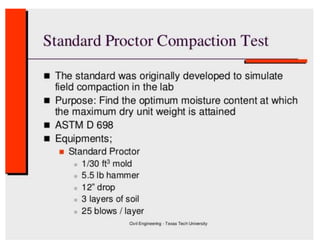
The Proctor compaction test is a laboratory
method of experimentally determining the
optimal moisture content at which a given
soil type will become most dense and
achieve its maximum dry density
Compaction (Soil Compaction) is the process
of applying energy to loose soil to consolidate
it and remove any voids, thereby increasing
the density and consequently its load-bearing
capacity.
What is the purpose of the Proctor
test?
• The Proctor compaction test is a laboratory
geotechnical testing method used to
determine the soil compaction properties,
specifically, to determine the optimal water
content at which soil can reach its maximum
dry density
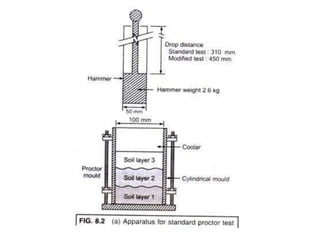
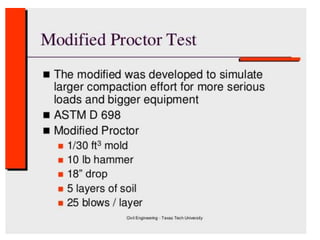
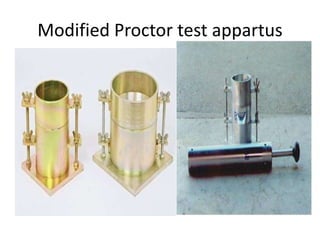
Modified Proctor test appartus
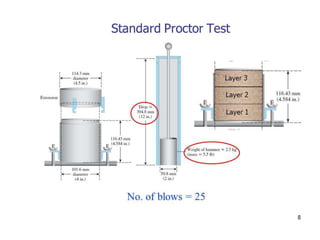
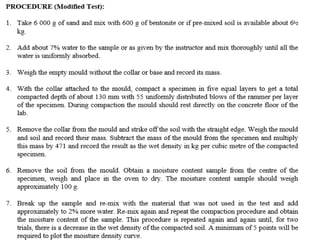
• These laboratory tests generally consist of compacting soil
at known moisture content into a cylindrical mold of
standard dimensions using a compactive effort of
controlled magnitude.
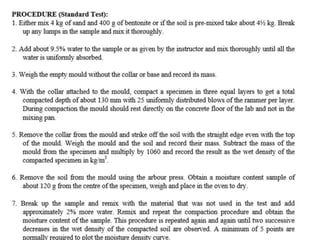
• The soil is usually compacted into the mold to a certain
amount of equal layers, each receiving a number of blows
from a standard weighted hammer at a specified height.
This process is then repeated for various moisture contents
and the dry densities are determined for each.
• The graphical relationship of the dry density to moisture
content is then plotted to establish the compaction curve.
• The maximum dry density is finally obtained from the peak
point of the compaction curve and its corresponding
moisture content, also known as the optimal moisture
content.
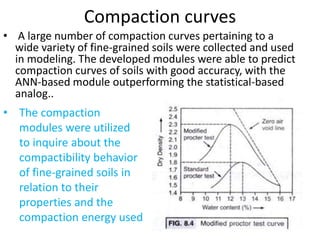
Compaction curves
• A large number of compaction curves pertaining to a
wide variety of fine-grained soils were collected and used
in modeling. The developed modules were able to predict
compaction curves of soils with good accuracy, with the
ANN-based module outperforming the statistical-based
analog..
• The compaction
modules were utilized
to inquire about the
compactibility behavior
of fine-grained soils in
relation to their
properties and the
compaction energy used
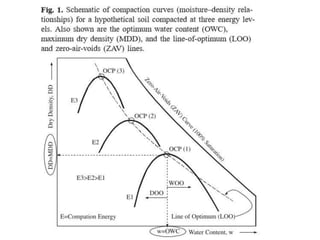
• The point at which this transition occurs is
called the optimum compaction point (OCP),
which relates two key compaction
characteristics: the maximum dry density
(MDD) and the corresponding optimum water
content (OWC). The portion of the curve to
the left of the OCP is named dry of optimum
(DOO) and that to its right wet of optimum
(WOO), as shown in Fig. 1. Because of the bell-
shaped nature of the compaction curve, soil
may be compacted to equal density at two
different water contents.
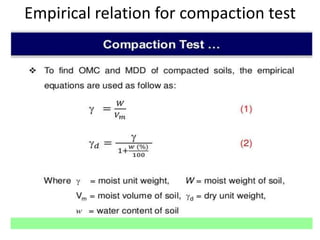
Empirical relation for compaction test
• Thank you

proctor test and compaction

  • 1.
    Compaction Tests andempirical relations. Presentation by Jyoti Khatiwada Roll no. 10
  • 2.
    What is aProctor test? The Proctor compaction test is a laboratory method of experimentally determining the optimal moisture content at which a given soil type will become most dense and achieve its maximum dry density Compaction (Soil Compaction) is the process of applying energy to loose soil to consolidate it and remove any voids, thereby increasing the density and consequently its load-bearing capacity.
  • 3.
    What is thepurpose of the Proctor test? • The Proctor compaction test is a laboratory geotechnical testing method used to determine the soil compaction properties, specifically, to determine the optimal water content at which soil can reach its maximum dry density
  • 10.
  • 12.
    • These laboratorytests generally consist of compacting soil at known moisture content into a cylindrical mold of standard dimensions using a compactive effort of controlled magnitude. • The soil is usually compacted into the mold to a certain amount of equal layers, each receiving a number of blows from a standard weighted hammer at a specified height. This process is then repeated for various moisture contents and the dry densities are determined for each. • The graphical relationship of the dry density to moisture content is then plotted to establish the compaction curve. • The maximum dry density is finally obtained from the peak point of the compaction curve and its corresponding moisture content, also known as the optimal moisture content.
  • 13.
    Compaction curves • Alarge number of compaction curves pertaining to a wide variety of fine-grained soils were collected and used in modeling. The developed modules were able to predict compaction curves of soils with good accuracy, with the ANN-based module outperforming the statistical-based analog.. • The compaction modules were utilized to inquire about the compactibility behavior of fine-grained soils in relation to their properties and the compaction energy used
  • 15.
    • The pointat which this transition occurs is called the optimum compaction point (OCP), which relates two key compaction characteristics: the maximum dry density (MDD) and the corresponding optimum water content (OWC). The portion of the curve to the left of the OCP is named dry of optimum (DOO) and that to its right wet of optimum (WOO), as shown in Fig. 1. Because of the bell- shaped nature of the compaction curve, soil may be compacted to equal density at two different water contents.
  • 17.
    Empirical relation forcompaction test
  • 18.