Social Mobility
Study Unit 8.2
By C. Settley
Learning Outcomes
• Give a detailed explanation of the
concept social mobility
• Discuss the differences between
vertical and horizontal mobility
• Discuss the consequences of social
mobility
The concept social mobility
• The movement of an individual from
one social status or class to another
Social mobility
Open Class System
• - A few obstacles in
moving from one status
to another
• - Equal opportunities
irrespective of birth,
gender, race, religion,
ethnicity, background
• - Equal opportunities to
alter social
position/social
stratification system
Closed Class System
• Characterized by
children inheriting their
social positions from
their parents
• Fixed/ascribed
• Positions are strongly
based on qualities such
as race, gender, social
background or ethnicity
• - No control over these
qualities
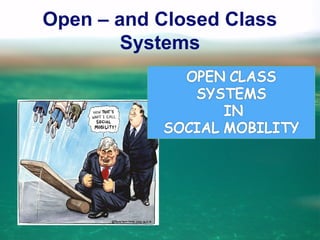
Open – and Closed Class
Systems
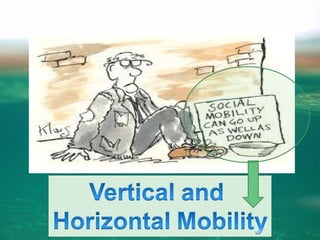
Vertical and Horizontal
Mobility
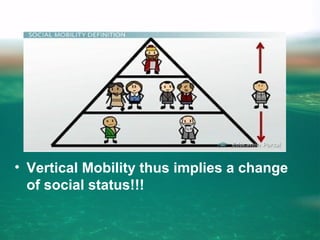
• Vertical Mobility
• Refers to the upward or downward
movement on the status ladder
• Example: being promoted, marrying a
wealthy person
• Two factors that give rise to upward
mobility:
• 1) a highly industrialized society
• 2) highly trained individuals
Vertical and Horizontal
Mobility
• Vertical Mobility
• Downward movement refers to the loss
of a job or when people do the same job
for less in salary wages, lack of
education, early marriage or large
families
• Vertical Mobility thus implies a change
of social status!!!
Consequences of social
mobility
• Although most people rate upward
mobility highly, it may have unpleasant
consequences.
• Adjustment to new status may cause
problems (uncertainty, responsibilities)
• Old friends may be exchanged due to
occupational statuses.
Consequences of social
mobility
• May cause family problems.
• Moving, travelling.
• May result in financial burdens.
• May also create false expectations.
• May lead to disappointments.
• Stress and psychological conditions.
• Higher incidences of suicide,
depression, psychosis.
Reference
• Du Toit, D. & le Roux, E. (2014). Nursing
sociology. 5th
ed. Pretoria: Van Schaik.

Social mobility

  • 1.
    Social Mobility Study Unit8.2 By C. Settley
  • 2.
    Learning Outcomes • Givea detailed explanation of the concept social mobility • Discuss the differences between vertical and horizontal mobility • Discuss the consequences of social mobility
  • 3.
    The concept socialmobility • The movement of an individual from one social status or class to another
  • 4.
    Social mobility Open ClassSystem • - A few obstacles in moving from one status to another • - Equal opportunities irrespective of birth, gender, race, religion, ethnicity, background • - Equal opportunities to alter social position/social stratification system Closed Class System • Characterized by children inheriting their social positions from their parents • Fixed/ascribed • Positions are strongly based on qualities such as race, gender, social background or ethnicity • - No control over these qualities
  • 5.
    Open – andClosed Class Systems
  • 7.
    Vertical and Horizontal Mobility •Vertical Mobility • Refers to the upward or downward movement on the status ladder • Example: being promoted, marrying a wealthy person • Two factors that give rise to upward mobility: • 1) a highly industrialized society • 2) highly trained individuals
  • 8.
    Vertical and Horizontal Mobility •Vertical Mobility • Downward movement refers to the loss of a job or when people do the same job for less in salary wages, lack of education, early marriage or large families
  • 9.
    • Vertical Mobilitythus implies a change of social status!!!
  • 10.
    Consequences of social mobility •Although most people rate upward mobility highly, it may have unpleasant consequences. • Adjustment to new status may cause problems (uncertainty, responsibilities) • Old friends may be exchanged due to occupational statuses.
  • 11.
    Consequences of social mobility •May cause family problems. • Moving, travelling. • May result in financial burdens. • May also create false expectations. • May lead to disappointments. • Stress and psychological conditions. • Higher incidences of suicide, depression, psychosis.
  • 12.
    Reference • Du Toit,D. & le Roux, E. (2014). Nursing sociology. 5th ed. Pretoria: Van Schaik.