Sociological theories

              Functionalist perspective
              Conflict perspective
              Interaction perspective
              Post modern perspective


1                                    TOK202
Founders of the functionalist
    perspective :

    August Comte (1798-1857)
    Herbert Spencer (1820-1903)
    Émile Durkheim (1858-1917)


2                             TOK202
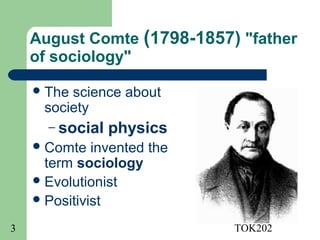
August Comte (1798-1857) "father
    of sociology"

     Thescience about
     society
      – social   physics
     Comte   invented the
      term sociology
     Evolutionist
     Positivist

3                            TOK202
Comtes positivism

    Comte's views of the three stages of the history of
       sciences. In order as follows, the stages are:

    1.   Theological - nature has a will of it's own. This stage is broken
         down into three stages of its own, including animism,
         polytheism, and monotheism.

    2.   Metaphysical state - though substituting ideas for a personal
         will.
    3.   Positive - a search for absolute knowledge.


4                                                        TOK202
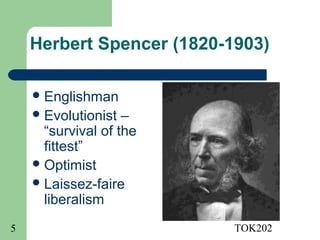
Herbert Spencer (1820-1903)

     Englishman
     Evolutionist  –
      “survival of the
      fittest”
     Optimist
     Laissez-faire
      liberalism
5                          TOK202
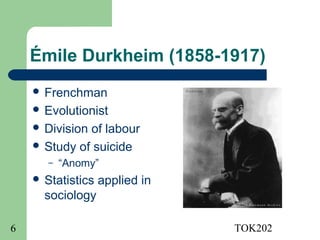
Émile Durkheim (1858-1917)
     Frenchman
     Evolutionist
     Divisionof labour
     Study of suicide
       –   “Anomy”
     Statistics   applied in
      sociology

6                               TOK202
Functionalism

     Society  is a combination of different
      parts/institutions such as:
      –   Family, religion, economy and educational system
     These institutions secure the evolution and
      growth of society


7                                            TOK202
The characteristics of society
     Well  planned uniformity
     Stability and equilibrium between different
      parts
     Consensus of the main values
     Every institution has a function which helps
      society to remain stable
     What is, is good – “natural selection” of good
      institutions/functions

8                                        TOK202
Functionalistic research questions?

     Mapping,    describing and analysing
      –   The positive functions
      –   The institutions
      –   (The dysfunctions)


9                                        TOK202
Assignment
      Mention     all main parts/institutions which you
       believe are the brick stones of society. How
       do these parts work together in creating
       societies equilibrium?
      What are the main weaknesses of the
       functionalist perspective in describing
       society?
      Is it politically biased? If, then how?


10                                           TOK202
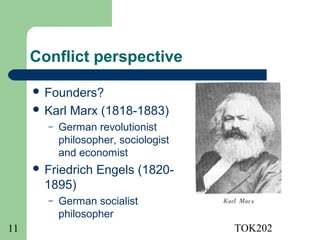
Conflict perspective

      Founders?
      Karl   Marx (1818-1883)
       –   German revolutionist
           philosopher, sociologist
           and economist
      Friedrich   Engels (1820-
       1895)
       –   German socialist
           philosopher
11                                    TOK202
Marxism
        Historical materialism
         –   “It is not the consciousness of men that determines their
             existence, but on the contrary, it is their social existence
             which determines their consciousness...”
        Dialectic
        Class struggle
        National economy
        Socialism
        Communism


12                                                          TOK202
Conflict perspective in modern sociology

      Not  only focusing on class struggle as Marx
       did, but on the overall power structure in
       society, such as conflicts between different
       groups of interests
        –   Producers and consumers, employers and
            employed, Muslims and Christians, teachers and
            students, parents and kids, personality and
            culture


13                                             TOK202
Conflict causes social change

      Inevery society there are conflicts; conflict is
       the driving force of social change

      Conflict does not necessary mean violence,
       rather tension, competition or disagreement
       about objectives and values, conflict of
       interests


14                                          TOK202
Research questions?

      Mapping  of power-relations
      Someone is making benefit of the situation at
       the expense of someone else
      How can we dissolve the conflict? Can there
       be a win-win solution?


15                                       TOK202
Conflict vs. functionalist
     perspective

      The conflict paradigm highlights parts of
       society where functionalists usually do not
       focus on
      The weakness of the conflict paradigm is that
       they miss the consensus- and balance in
       society


16                                       TOK202
Assignment

        The conflict paradigm presupposes that resources
         and power are limited, which in turn, creates tension
         and conflicts between different groups.
        Investigate some relationships within the school from
         the viewpoint of conflict theories, for example the
         relationship between teachers and students, or
         between school-board and students, or between
         pastime and studies.

17                                               TOK202
Assignment
        The functionalist paradigm presupposes that every
         part of society has a (positive) function.
        Investigate some relationships within the school from
         the viewpoint of functionalist perspective, for
         example the relationship between teachers and
         students, or between school-board and students, or
         between pastime and studies.


18                                               TOK202
Interaction perspective


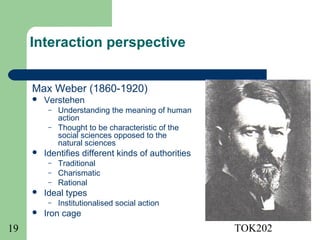
     Max Weber (1860-1920)
        Verstehen
          –   Understanding the meaning of human
              action
          –   Thought to be characteristic of the
              social sciences opposed to the
              natural sciences
        Identifies different kinds of authorities
          –   Traditional
          –   Charismatic
          –   Rational
        Ideal types
          –   Institutionalised social action
        Iron cage
19                                                   TOK202
Interaction perspective/founders
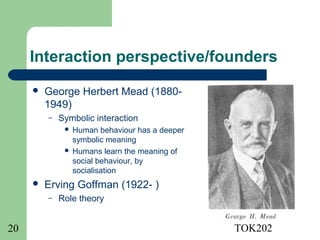
        George Herbert Mead (1880-
         1949)
         –   Symbolic interaction
               Human behaviour has a deeper
                symbolic meaning
               Humans learn the meaning of
                social behaviour, by
                socialisation
        Erving Goffman (1922- )
         –   Role theory


20                                             TOK202
Objectivity/impartiality

      Is objectivity possible in (social) sciences?
      Scientists have consciousness formed by
       their personal experience, they live in a
       certain culture, place and time, they have
       their personal interests
      Is objectivity desirable in science?


21                                         TOK202
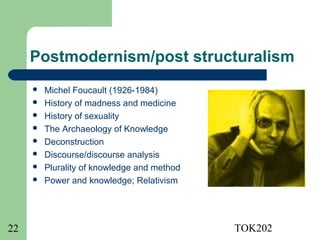
Postmodernism/post structuralism
        Michel Foucault (1926-1984)
        History of madness and medicine
        History of sexuality
        The Archaeology of Knowledge
        Deconstruction
        Discourse/discourse analysis
        Plurality of knowledge and method
        Power and knowledge; Relativism


22                                           TOK202

Sociological theories

  • 1.
    Sociological theories Functionalist perspective Conflict perspective Interaction perspective Post modern perspective 1 TOK202
  • 2.
    Founders of thefunctionalist perspective : August Comte (1798-1857) Herbert Spencer (1820-1903) Émile Durkheim (1858-1917) 2 TOK202
  • 3.
    August Comte (1798-1857)"father of sociology"  Thescience about society – social physics  Comte invented the term sociology  Evolutionist  Positivist 3 TOK202
  • 4.
    Comtes positivism Comte's views of the three stages of the history of sciences. In order as follows, the stages are: 1. Theological - nature has a will of it's own. This stage is broken down into three stages of its own, including animism, polytheism, and monotheism. 2. Metaphysical state - though substituting ideas for a personal will. 3. Positive - a search for absolute knowledge. 4 TOK202
  • 5.
    Herbert Spencer (1820-1903)  Englishman  Evolutionist – “survival of the fittest”  Optimist  Laissez-faire liberalism 5 TOK202
  • 6.
    Émile Durkheim (1858-1917)  Frenchman  Evolutionist  Divisionof labour  Study of suicide – “Anomy”  Statistics applied in sociology 6 TOK202
  • 7.
    Functionalism  Society is a combination of different parts/institutions such as: – Family, religion, economy and educational system  These institutions secure the evolution and growth of society 7 TOK202
  • 8.
    The characteristics ofsociety  Well planned uniformity  Stability and equilibrium between different parts  Consensus of the main values  Every institution has a function which helps society to remain stable  What is, is good – “natural selection” of good institutions/functions 8 TOK202
  • 9.
    Functionalistic research questions?  Mapping, describing and analysing – The positive functions – The institutions – (The dysfunctions) 9 TOK202
  • 10.
    Assignment  Mention all main parts/institutions which you believe are the brick stones of society. How do these parts work together in creating societies equilibrium?  What are the main weaknesses of the functionalist perspective in describing society?  Is it politically biased? If, then how? 10 TOK202
  • 11.
    Conflict perspective  Founders?  Karl Marx (1818-1883) – German revolutionist philosopher, sociologist and economist  Friedrich Engels (1820- 1895) – German socialist philosopher 11 TOK202
  • 12.
    Marxism  Historical materialism – “It is not the consciousness of men that determines their existence, but on the contrary, it is their social existence which determines their consciousness...”  Dialectic  Class struggle  National economy  Socialism  Communism 12 TOK202
  • 13.
    Conflict perspective inmodern sociology  Not only focusing on class struggle as Marx did, but on the overall power structure in society, such as conflicts between different groups of interests – Producers and consumers, employers and employed, Muslims and Christians, teachers and students, parents and kids, personality and culture 13 TOK202
  • 14.
    Conflict causes socialchange  Inevery society there are conflicts; conflict is the driving force of social change  Conflict does not necessary mean violence, rather tension, competition or disagreement about objectives and values, conflict of interests 14 TOK202
  • 15.
    Research questions?  Mapping of power-relations  Someone is making benefit of the situation at the expense of someone else  How can we dissolve the conflict? Can there be a win-win solution? 15 TOK202
  • 16.
    Conflict vs. functionalist perspective  The conflict paradigm highlights parts of society where functionalists usually do not focus on  The weakness of the conflict paradigm is that they miss the consensus- and balance in society 16 TOK202
  • 17.
    Assignment  The conflict paradigm presupposes that resources and power are limited, which in turn, creates tension and conflicts between different groups.  Investigate some relationships within the school from the viewpoint of conflict theories, for example the relationship between teachers and students, or between school-board and students, or between pastime and studies. 17 TOK202
  • 18.
    Assignment  The functionalist paradigm presupposes that every part of society has a (positive) function.  Investigate some relationships within the school from the viewpoint of functionalist perspective, for example the relationship between teachers and students, or between school-board and students, or between pastime and studies. 18 TOK202
  • 19.
    Interaction perspective Max Weber (1860-1920)  Verstehen – Understanding the meaning of human action – Thought to be characteristic of the social sciences opposed to the natural sciences  Identifies different kinds of authorities – Traditional – Charismatic – Rational  Ideal types – Institutionalised social action  Iron cage 19 TOK202
  • 20.
    Interaction perspective/founders  George Herbert Mead (1880- 1949) – Symbolic interaction  Human behaviour has a deeper symbolic meaning  Humans learn the meaning of social behaviour, by socialisation  Erving Goffman (1922- ) – Role theory 20 TOK202
  • 21.
    Objectivity/impartiality  Is objectivity possible in (social) sciences?  Scientists have consciousness formed by their personal experience, they live in a certain culture, place and time, they have their personal interests  Is objectivity desirable in science? 21 TOK202
  • 22.
    Postmodernism/post structuralism  Michel Foucault (1926-1984)  History of madness and medicine  History of sexuality  The Archaeology of Knowledge  Deconstruction  Discourse/discourse analysis  Plurality of knowledge and method  Power and knowledge; Relativism 22 TOK202