Social Stratification
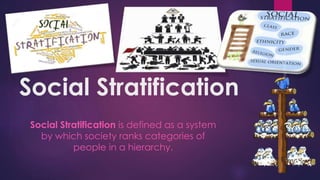
Social Stratification is defined as a system
by which society ranks categories of
people in a hierarchy.
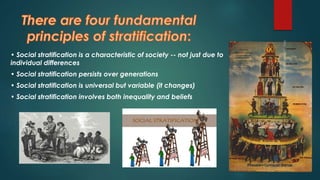
• Social stratification is a characteristic of society -- not just due to
individual differences
• Social stratification persists over generations
• Social stratification is universal but variable (it changes)
• Social stratification involves both inequality and beliefs
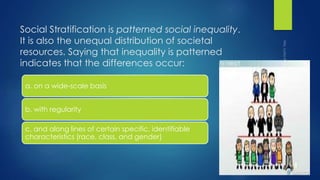
Social Stratification is patterned social inequality.
It is also the unequal distribution of societal
resources. Saying that inequality is patterned
indicates that the differences occur:
a. on a wide-scale basis
b. with regularity
c. and along lines of certain specific, identifiable
characteristics (race, class, and gender)
a. Power: the
ability to
impose one’s
will on others
b. Prestige:
the respect
given by
others
c. Property:
forms of
wealth
Patterned: if we know whether a person or group
possesses or does not possess certain traits, then we will
be able to predict with reasonable accuracy how this
person or group is likely to fare in the social hierarchy
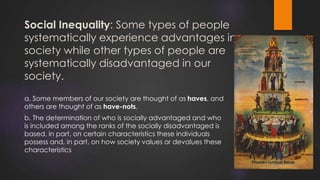
Social Inequality: Some types of people
systematically experience advantages in
society while other types of people are
systematically disadvantaged in our
society.
a. Some members of our society are thought of as haves, and
others are thought of as have-nots.
b. The determination of who is socially advantaged and who
is included among the ranks of the socially disadvantaged is
based, in part, on certain characteristics these individuals
possess and, in part, on how society values or devalues these
characteristics
Caste and Class Systems
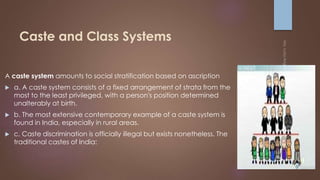
A caste system amounts to social stratification based on ascription
 a. A caste system consists of a fixed arrangement of strata from the
most to the least privileged, with a person's position determined
unalterably at birth.
 b. The most extensive contemporary example of a caste system is
found in India, especially in rural areas.
 c. Caste discrimination is officially illegal but exists nonetheless. The
traditional castes of India:
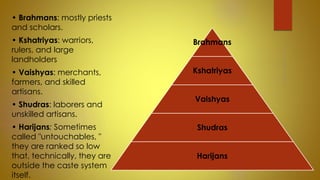
• Brahmans: mostly priests
and scholars.
• Kshatriyas: warriors,
rulers, and large
landholders
• Vaishyas: merchants,
farmers, and skilled
artisans.
• Shudras: laborers and
unskilled artisans.
• Harijans: Sometimes
called "untouchables, "
they are ranked so low
that, technically, they are
outside the caste system
itself.
Brahmans
Kshatriyas
Vaishyas
Shudras
Harijans
Caste systems shape people's lives in
four crucial ways:
• Caste system largely determines occupation
• Caste systems largely mandate endogamy
• Powerful cultural beliefs underlie caste systems
• Caste systems limit outgroup social contacts
In a class system, social stratification is
based on individual achievement
a. Class Systems. People who can be considered peers in society
because of their similar life chances, similar life circumstances, and
similar opportunities, constitute a social class.
In a class system social standing is determined by factors over
which people can exert some control, and some mobility does
take place.
b. In a class system, status inconsistency, the degree of
consistency of a person's social standing across various dimensions
of social inequality, is lower than in a caste system
c. Structural social mobility: a shift in social position of large
numbers of people due more to changes in society itself than
individual efforts (Ex. Computer Industry)
d. Stratification persists because it is backed up by an ideology:
cultural beliefs that directly or indirectly justify social stratification
e. Ideological support for inequality. An ideology or pattern of
beliefs justifies social inequality in the Unites States, which legitimizes
or justifies a particular societal arrangement.
A video about social stratification
in the Philippines:

Power point - social stratification

  • 1.
    Social Stratification Social Stratificationis defined as a system by which society ranks categories of people in a hierarchy.
  • 2.
    • Social stratificationis a characteristic of society -- not just due to individual differences • Social stratification persists over generations • Social stratification is universal but variable (it changes) • Social stratification involves both inequality and beliefs
  • 3.
    Social Stratification ispatterned social inequality. It is also the unequal distribution of societal resources. Saying that inequality is patterned indicates that the differences occur: a. on a wide-scale basis b. with regularity c. and along lines of certain specific, identifiable characteristics (race, class, and gender)
  • 4.
    a. Power: the abilityto impose one’s will on others b. Prestige: the respect given by others c. Property: forms of wealth
  • 5.
    Patterned: if weknow whether a person or group possesses or does not possess certain traits, then we will be able to predict with reasonable accuracy how this person or group is likely to fare in the social hierarchy
  • 6.
    Social Inequality: Sometypes of people systematically experience advantages in society while other types of people are systematically disadvantaged in our society. a. Some members of our society are thought of as haves, and others are thought of as have-nots. b. The determination of who is socially advantaged and who is included among the ranks of the socially disadvantaged is based, in part, on certain characteristics these individuals possess and, in part, on how society values or devalues these characteristics
  • 7.
    Caste and ClassSystems A caste system amounts to social stratification based on ascription  a. A caste system consists of a fixed arrangement of strata from the most to the least privileged, with a person's position determined unalterably at birth.  b. The most extensive contemporary example of a caste system is found in India, especially in rural areas.  c. Caste discrimination is officially illegal but exists nonetheless. The traditional castes of India:
  • 8.
    • Brahmans: mostlypriests and scholars. • Kshatriyas: warriors, rulers, and large landholders • Vaishyas: merchants, farmers, and skilled artisans. • Shudras: laborers and unskilled artisans. • Harijans: Sometimes called "untouchables, " they are ranked so low that, technically, they are outside the caste system itself. Brahmans Kshatriyas Vaishyas Shudras Harijans
  • 9.
    Caste systems shapepeople's lives in four crucial ways: • Caste system largely determines occupation • Caste systems largely mandate endogamy • Powerful cultural beliefs underlie caste systems • Caste systems limit outgroup social contacts
  • 10.
    In a classsystem, social stratification is based on individual achievement a. Class Systems. People who can be considered peers in society because of their similar life chances, similar life circumstances, and similar opportunities, constitute a social class. In a class system social standing is determined by factors over which people can exert some control, and some mobility does take place. b. In a class system, status inconsistency, the degree of consistency of a person's social standing across various dimensions of social inequality, is lower than in a caste system
  • 11.
    c. Structural socialmobility: a shift in social position of large numbers of people due more to changes in society itself than individual efforts (Ex. Computer Industry) d. Stratification persists because it is backed up by an ideology: cultural beliefs that directly or indirectly justify social stratification e. Ideological support for inequality. An ideology or pattern of beliefs justifies social inequality in the Unites States, which legitimizes or justifies a particular societal arrangement.
  • 12.
    A video aboutsocial stratification in the Philippines: