TOPIC 5 SOCIAL MOBILITY AND CHANGES IN EDUCATION (FULL).pptx
1.
TOPIC 5:
SOCIAL MOBILITYAND CHANGES IN
EDUCATION
AMIZA SUHAILA BINTI AMINUDDIN (D21290897)
NURSHAMIRA BINTI MOHAMAD SHAKRI (D21290915)
NURUL HARDEAH BINTI AHMAD SUKIMAN (D21290918)
2.
THE CONCEPT OFSOCIAL
MOBILITY
• A society is constituted by the people who are dynamic (over-changing) in
nature.
• Our society has evolved from the primitive uncivilized into modern civilized
and cultured society. Individual are normally recognized in society through
statuses they occupied and roles they enact.
• Social mobility is the movement of individuals, families, households or other
categories of people within or between social strata in a society.
• It is a change in social status relative to one’s current social position within a
given society.
• This movement occurs between layers or tiers in social stratification systems.
3.
• Wallace andWallace: “Social mobility refers the movement of a
person or person’s from one social status to another.”
• S. Bogardus: “Social mobility is any change in social position such as
occupational changes where a person move up or down the
occupational scale, or relation to office whereby a follower becomes
a leader, or a leap from a low economic class to a high one, or vice-
versa.
• Based on the definition above, the nature of Social Mobility can be
related to the occupation, income, education and the status.
• Sociologist described the changes in a status depends on two types:
a. Ascribed status: Status that an individual is born with or otherwise assigned
and has no control over it. (etc: religion, heritage, ethnicity and gender)
b. Achieved status: Status that an individual earns or choose and that reflects
their skills, abilities and efforts. (Qualified nurse)
4.
TYPES OF SOCIALMOBILITY
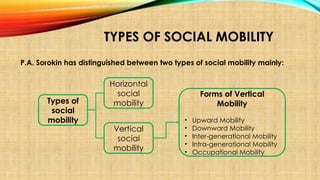
P.A. Sorokin has distinguished between two types of social mobility mainly:
Types of
social
mobility
Vertical
social
mobility
Horizontal
social
mobility
Forms of Vertical
Mobility
• Upward Mobility
• Downward Mobility
• Inter-generational Mobility
• Intra-generational Mobility
• Occupational Mobility
5.
HORIZONTAL SOCIAL MOBILITY
•Horizontal mobility is the transition of an individual or social object
from one social group to another situated on the same level
• “Horizontal Mobility refers to a territorial, religious, political party,
family, occupational and other horizontal shifting without any
noticeable change in vertical position.” Sorokin
• Characteristics:
1. A person changes his or her occupation but the overall social standing
remains the same.
2. Certain occupations like doctor, an engineer and a professor may enjoy the
same status but when an engineer changes his occupations form an
engineer to teaching engineering, he has moved from one occupational
category to another.
3. There has been no change taken place in the system of Social Stratification.
6.
VERTICAL SOCIAL MOBILITY
•Vertical social mobility refers to any change in the occupational, economic,
political status of an individual or a group which leads to a change in their
position.
• It involves change in status of the individual, education, occupations, or
power positions.
• Eg: When a teacher becomes a lecturer in a university, it is upward mobility.
• However, vertical social mobility can either lead to upward movement or
downward movement.
7.
UPWARD MOBILITY
• Whena person or a group of persons moves from a lower position to an
upper position, It is called ‘Upward Mobility’.
• For instance, when a person belonging to lower caste and occupying a
lower position after winning elections becomes a minister
• There are many social and psychic costs involved in upward mobility. In the
course of upward movement, the mobile man must leave behind many
people and places.
• He must leave the ways of thinking and behaving that characterized many
of his earlier associations, and he must learn, if he can, new ways of thinking
and behaving appropriate to his new status.
8.
DOWNWARD MOBILITY
• Itrefers to the movement of a person from higher class to lower ones.
Sometimes individuals fail to maintain their social, political or economic
positions and lose their status.
• This type of descending mobility occur due to lack of initiative and efforts
on the part of the people or unwanted events.
• Downward mobility is more stressful for persons who suffer a drastic decline
in status or position than upward mobility. Men who enjoy an orderly and
consistent career tend to make a stable personal, family and community
adjustment.
• Eg: business setbacks, unemployment, dropping out of school, illness or
getting divorce which may result in a loss of income or status.
9.
INTER-GENERATIONAL MOBILITY
• Thistype of mobility means that one generation changes its social status in
contrast to the preceding generation. However, this mobility may be upward
or downward.
• For e.g. people of a lower caste or class may provide facilities to their
children to get higher education, training and skills. With the help of these
skills, the younger generation may get employment entitling them to a
higher position. If the father is a shoemaker but his son, after acquiring
becomes a clerk or a doctor or an engineer, it would be called Upward
Intergenerational Mobility.
10.
CONDITIONS FOR INTER-GENERATIONAL
MOBILITY
1. Difference between Parents and their Offspring
• If a parent occupies an important position requiring high capacity, his children who are less
capable are likely to be downwardly mobile. Conversely, children who are more capable
than their parents are likely to be upwardly mobile, especially in open –class societies.
2. Population Change
• In developed and developing countries, greater population expansion at the
lower than at the higher levels contributes to upward mobility. Overall, population
growth creates new positions at the upper and middle levels, where growth is not
great enough to fill their vacancies.
3. Changes in Occupational Structure
• With the changing times, many occupations have been upgraded or downgraded
because their socially defined importance has changed. Some occupations have
moved up or down because of changes in the availability of worker s willing and
able to perform these tasks. Such changes in occupational structure also affect the
rate of mobility between generations.
According to Sorokin, following conditions affect the rate of
mobility between generations:
11.
INTRA-GENERATIONAL SOCIAL
MOBILITY
This typeof mobility takes place in a life span of one generation.
• A person may start his career as a clerk. He may acquire more education
and skills. Over a period of time, he may become IAS officer or a Professor.
In this way, he may move up and occupy a higher position than the one
with which he had started his career. This type of mobility takes place in a
life span of one generation. which he had started his career.
• Family member of the same person (his brother) may also have started his
career as clerk but may not have moved up to occupy a higher position in
his life span, therefore within the same generation, one brother changes
his position and other does not.
12.
OCCUPATIONAL MOBILITY
• Occupationalmobility means change from one position to another.
Different occupations are hierarchically arranged because the
incumbents of these occupations get different economic rewards and
enjoy different degrees of power, prestige and privileges based on their
economic returns, authority and prestige.
• Occupational mobility stands for a change from an occupation of a lower
prestige to an occupation of higher prestige and vice –versa.
13.
FACTORS AFFECTING SOCIAL
MOBILITY
1.Motivation
• Each individual has a desire not only to have a better way of living but also
to improve his social status. This desire motivates and without motivation
such social mobility is not possible.
2. Education
• Education not only helps an individual to acquire knowledge but is also an
opportunity for higher prestige occupational position. Education facilitates
upward mobility, whereas lack of education can lead downward mobility.
3. Achievements and Failures
• Remarkable achievement affect status. For instance, a poor man who has
acquired wealth or and unknown writer who has won a literary prize will
improve his status. On the contrary, failures and misdeeds have a similar
effect on the downward mobility.
14.
FACTORS AFFECTING SOCIAL
MOBILITY
4.Skill and Training
• Each society makes provision to impart skill and training to the
younger generation. Skill and training facilitate in the improvement of
social position, thus leading to social mobility
5. Migration
• People migrate from one place to another either due to push or pull
factors. Migration affects one’s position and result in social mobility. It
can be both ways –upward or downward.
6. Industrialization
• The industrial revolution ushered new social system in which people
were given status according to their ability and training. Therefore,
industrialization facilitates social mobility.
15.
FACTORS AFFECTING SOCIALMOBILITY
7. Urbanization
• Urban settlements offer lots of work and educational facilities to
people keeping aside their ascribed status. Therefore, urbanization
facilitates social mobility by removing those factors which hinder
social mobility.
8. Legislation
• Enactment of new laws also facilitate social mobility. Legislations like
right to education to all, property rights to women and
secularisation and so in help people to grab opportunities and
prosper, therefore resulting in social mobility.
16.
SOCIAL MOBILITY ANDCHANGES IN
EDUCATION
I.Positive effect of social
mobility
II.Negative effects of social
mobility
17.
POSITIVE EFFECTS
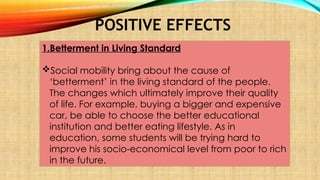
1.Betterment inLiving Standard
Social mobility bring about the cause of
‘betterment’ in the living standard of the people.
The changes which ultimately improve their quality
of life. For example, buying a bigger and expensive
car, be able to choose the better educational
institution and better eating lifestyle. As in
education, some students will be trying hard to
improve his socio-economical level from poor to rich
in the future.
18.
POSITIVE EFFECTS
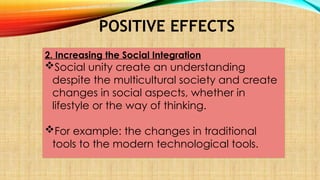
2. Increasingthe Social Integration
Social unity create an understanding
despite the multicultural society and create
changes in social aspects, whether in
lifestyle or the way of thinking.
For example: the changes in traditional
tools to the modern technological tools.
19.
NEGATIVE EFFECTS
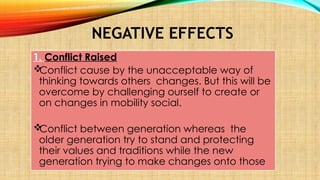
1. ConflictRaised
Conflict cause by the unacceptable way of
thinking towards others changes. But this will be
overcome by challenging ourself to create or
on changes in mobility social.
Conflict between generation whereas the
older generation try to stand and protecting
their values and traditions while the new
generation trying to make changes onto those
20.
NEGATIVE EFFECTS
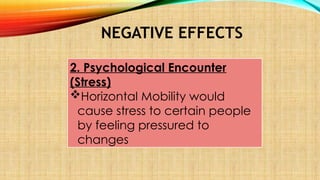
2. PsychologicalEncounter
(Stress)
Horizontal Mobility would
cause stress to certain people
by feeling pressured to
changes
21.
SOCIAL MOBILITY ANDCHANGES IN EDUCATION
(CURRENT CHANGES IN EDUCATION)
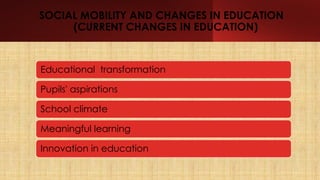
Educational transformation
Pupils' aspirations
School climate
Meaningful learning
Innovation in education
22.
EDUCATIONAL TRANSFORMATION
• 1.Technological trends in teaching and learning
• The growth of technological capabilities means that a variety of media and
learning-support tools now exist to help students receive a high-quality education
through the Internet.
• 2. Soft skills training: a major trend in higher education
• In an effort to prepare students for their future careers, schools must have the
training in place to help students nurture and grow in these skill areas.
• 3. Student trend: decreasing attention spans
• To keep the attention of Millennials, the content presented to them must have
excellent visuals and dialogue along with an interesting storyline that will hold their
attention. This younger group cares more about the narrative and the visual nature
of the content that interests them than other age groups.
23.
• 4. Facilitatinglearning versus teaching
• The best teachers will be those who can help students take
ownership of their learning.
• 5. Life-long learning trend
• This offers chances for schools to grow as they create new programs
and adult learning opportunities to help their alumni thrive within the
changing professional space.
24.
PUPILS' ASPIRATIONS
• Theconcept of pupils’ aspirations is often used as a predictor for study
outcome, as aspirations could motivate (or demotivate) pupils to continue
with their education.
• There is a range of definitions for aspirations varying from: ‘reflects pupils
hopes and dreams, likely to be disengaged from the school reality of
students’ (Khattab 2015)
• When there is a big gap between a high aspiration and a low level of
education, pupils need access to resources in order to achieve their goals.
• When there is a big gap between a high aspiration and a low level of
education, pupils need access to resources in order to achieve their goals.
25.
SCHOOL CLIMATE
• Schoolclimate is an essential element of successful schools to promote student
achievement, preparation for democratic life and preparation to be successful in
the 21st century workplace.
• Comprehensive school climate assessment provides data that should be used as a
springboard for community-wide understanding, school improvement planning and
implementation efforts as well as accountability. Currently, there are research-
based guidelines that recognize the unique nature of each school’s history,
strengths, needs and goals and provide benchmarks and a road map for school
improvement efforts.
• School climate is grounded in people’s experience of school life — socially,
emotionally, ethically and civically as well as academically. Hence, school climate
assessment and improvement efforts need to explicitly recognize and address the
social, emotional, ethical and civic as well as academic dimensions of school life.
• School climate needs to be an integral component of quality education systems,
practices and professional development, thus ensuring sustainability and
leadership.
26.
MEANINGFUL LEARNING
• ConnectContent With Meaning
• Discourage Rote Memorization
• Encourage Self-Testing
• Let Students Figure Out the Problem
• Give Frequent, Low-Stakes Assessments
27.
INNOVATION IN EDUCATION
•In the field of education technology, most products and services on the market work to
improve the educational experiences of students, instructors or managers. Far fewer are
intended to ensure the educational experience can continue for each student on their own, in
the event of choice
• Edmentum is responding to increasing demands to deploy their online learning and
assessment tools in districts across the country. Their adaptive curriculum and research-based
assessments can help students access quality instruction and resources for an extended
period out of the classroom.
• Artificial intelligence is demonstrating its power to serve as a teacher in cases where students
need to be isolated.
• There’s an APP for just about anything in education and a lot are deploying the best in AR, VR
and AI to put the learner in charge. We shouldn’t need a crisis to rethink education and how it
functions. But technology changes the role the teacher plays from directing to supporting and
guiding, and changes the reliance on certain times and places that we expect students,
particularly young students, to “do” school.
28.
• Self-Care
• Dueto the COVID-19 pandemic and other world events, teachers and families may
all be more overwhelmed than ever. This year, as schools moved to online learning
and teachers scrambled to adjust their curriculum, many teachers, students, and
parents gained new appreciation for the value of self-care.
• Blended Learning
• Blended learning is a school or classroom structure in which students learn partially
from direct teacher instruction and partially in more self-directed activities.[1] This
mixture might be perfect if students are learning from both school and home next
year. Although it’s still difficult to predict how and when students will return to school,
many voices in education—including Forbes contributor Enrique Dans—believe that
blended learning will be on the rise this school year.
• Gamification
• Looking for ways to make learning fun for your students? Gamification, a learning
strategy that involves using games and rewards to teach students, is a strategy with
plenty of both advocates and critics.


![• Self-Care
• Due to the COVID-19 pandemic and other world events, teachers and families may
all be more overwhelmed than ever. This year, as schools moved to online learning
and teachers scrambled to adjust their curriculum, many teachers, students, and
parents gained new appreciation for the value of self-care.
• Blended Learning
• Blended learning is a school or classroom structure in which students learn partially
from direct teacher instruction and partially in more self-directed activities.[1] This
mixture might be perfect if students are learning from both school and home next
year. Although it’s still difficult to predict how and when students will return to school,
many voices in education—including Forbes contributor Enrique Dans—believe that
blended learning will be on the rise this school year.
• Gamification
• Looking for ways to make learning fun for your students? Gamification, a learning
strategy that involves using games and rewards to teach students, is a strategy with
plenty of both advocates and critics.](https://image.slidesharecdn.com/topic5socialmobilityandchangesineducationfull-250713061121-b3637e46/85/TOPIC-5-SOCIAL-MOBILITY-AND-CHANGES-IN-EDUCATION-FULL-pptx-28-320.jpg)


