DESIGN OF DOUBLY REINFORCED BEAM BY   BY LIMIT STATE METHOD
TYPES OF BEAMS Doubly Reinforced beam Singly Reinforced beam
  Need of doubly reinforced beam
NEED OF DOUBLY REINFORCED BEAM In practice, very frequently, it is desirable or even mandatory to have a section of restricted depth in order to comply with some architectural or structural requirements wherein the section has to carry a moment more than it can resist a balanced section. If the section is made arbitrarily made shallower than the balanced design, it results in over reinforced section and the concrete is over stressed, while steel is stressed to its permissible value. As it is mentioned in IS:456 do not permit the use of over reinforced section. In such cases it is preferable to design it as doubly reinforced beam where the reinforcement is also provided in compression to give additional strength to concrete.
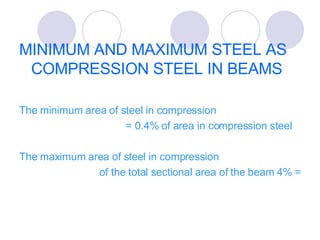
MINIMUM AND MAXIMUM STEEL AS COMPRESSION STEEL IN BEAMS The minimum area of steel in compression  = 0.4% of area in compression steel The maximum area of steel in compression  = 4% of the total sectional area of the beam
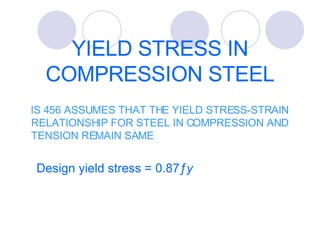
YIELD STRESS IN COMPRESSION STEEL IS 456 ASSUMES THAT THE YIELD STRESS-STRAIN RELATIONSHIP FOR STEEL IN COMPRESSION AND TENSION REMAIN SAME Design yield stress = 0.87 ƒy
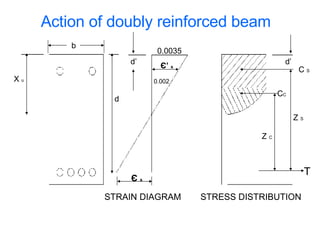
Z  S Z  C C C d’ C  S 0.0035 d’ 0.002 b X  u Є  s   d Є’  s Action of doubly reinforced beam T STRAIN DIAGRAM STRESS DISTRIBUTION
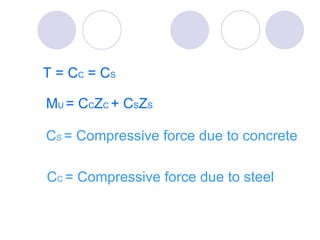
T = C C  = C S M U  = C C Z C  + C S Z S C S  = Compressive force due to concrete C C  = Compressive force due to steel
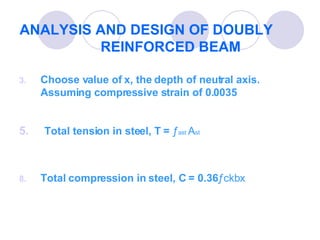
ANALYSIS AND DESIGN OF DOUBLY  REINFORCED BEAM Choose value of x, the depth of neutral axis. Assuming compressive strain of 0.0035  Total tension in steel, T =  ƒ ast  A st Total compression in steel, C = 0.36 ƒckbx
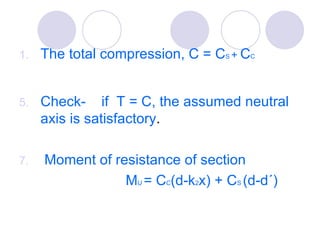
The total compression, C = C S  +  C C Check-  if  T = C, the assumed neutral axis is satisfactory . Moment of resistance of section M U  = C C (d-k 2 x) + C S  (d-d΄)
Thank you

RCCDR_Beam

  • 1.
    DESIGN OF DOUBLYREINFORCED BEAM BY BY LIMIT STATE METHOD
  • 2.
    TYPES OF BEAMSDoubly Reinforced beam Singly Reinforced beam
  • 3.
    Needof doubly reinforced beam
  • 4.
    NEED OF DOUBLYREINFORCED BEAM In practice, very frequently, it is desirable or even mandatory to have a section of restricted depth in order to comply with some architectural or structural requirements wherein the section has to carry a moment more than it can resist a balanced section. If the section is made arbitrarily made shallower than the balanced design, it results in over reinforced section and the concrete is over stressed, while steel is stressed to its permissible value. As it is mentioned in IS:456 do not permit the use of over reinforced section. In such cases it is preferable to design it as doubly reinforced beam where the reinforcement is also provided in compression to give additional strength to concrete.
  • 5.
    MINIMUM AND MAXIMUMSTEEL AS COMPRESSION STEEL IN BEAMS The minimum area of steel in compression = 0.4% of area in compression steel The maximum area of steel in compression = 4% of the total sectional area of the beam
  • 6.
    YIELD STRESS INCOMPRESSION STEEL IS 456 ASSUMES THAT THE YIELD STRESS-STRAIN RELATIONSHIP FOR STEEL IN COMPRESSION AND TENSION REMAIN SAME Design yield stress = 0.87 ƒy
  • 7.
    Z SZ C C C d’ C S 0.0035 d’ 0.002 b X u Є s d Є’ s Action of doubly reinforced beam T STRAIN DIAGRAM STRESS DISTRIBUTION
  • 8.
    T = CC = C S M U = C C Z C + C S Z S C S = Compressive force due to concrete C C = Compressive force due to steel
  • 9.
    ANALYSIS AND DESIGNOF DOUBLY REINFORCED BEAM Choose value of x, the depth of neutral axis. Assuming compressive strain of 0.0035 Total tension in steel, T = ƒ ast A st Total compression in steel, C = 0.36 ƒckbx
  • 10.
    The total compression,C = C S + C C Check- if T = C, the assumed neutral axis is satisfactory . Moment of resistance of section M U = C C (d-k 2 x) + C S (d-d΄)
  • 11.