STUDY DESIGNS
Joaniter Nankabirwa-Wandera
MMED /MSc
Learning Objectives
• Classify study designs
• Define the unique features of the study
designs
• Discuss weaknesses and strengths
associated with each study design
• Discuss the most appropriate study design
to answer certain research questions
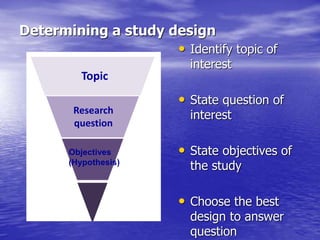
Determining a study design
• Identify topic of
interest
• State question of
interest
• State objectives of
the study
• Choose the best
design to answer
question
Topic
Research
question
Objectives
(Hypothesis)
Types of Study Designs
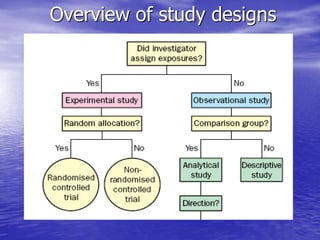
Observational
• -- Case report
• -- Case series
• -- Ecological Studies
• -- Cross-sectional
• -- Case-control
• -- Cohort
Experimental
• -- Randomized clinical trial
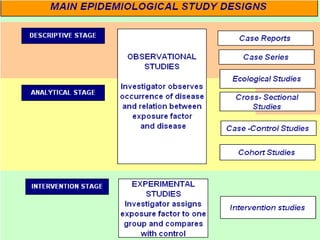
Overview of study designs
Observational studies
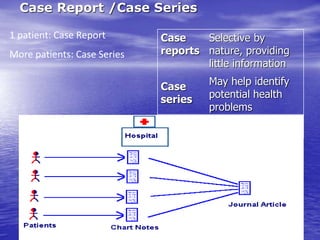
Case Report /Case Series
Case
reports
Case
series
Selective by
nature, providing
little information
May help identify
potential health
problems
Uses of case series
and reports
1 patient: Case Report
More patients: Case Series
Ecological Studies
Describe disease
occurrence on
population level
Evaluate an association
using the population -not
the individual -as the unit
of analysis.
The rates of disease are
examined in relation to
factors described on the
population level
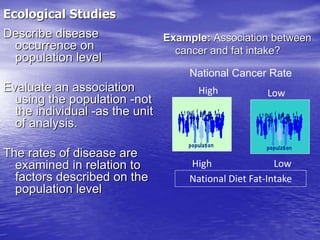
Example: Association between
cancer and fat intake?
National Cancer Rate
High Low
High Low
National Diet Fat-Intake
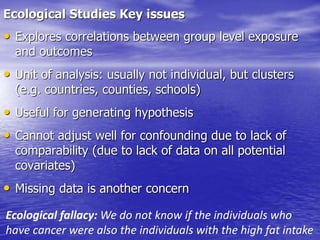
Ecological Studies Key issues
Ecological fallacy: We do not know if the individuals who
have cancer were also the individuals with the high fat intake
• Explores correlations between group level exposure
and outcomes
• Unit of analysis: usually not individual, but clusters
(e.g. countries, counties, schools)
• Useful for generating hypothesis
• Cannot adjust well for confounding due to lack of
comparability (due to lack of data on all potential
covariates)
• Missing data is another concern
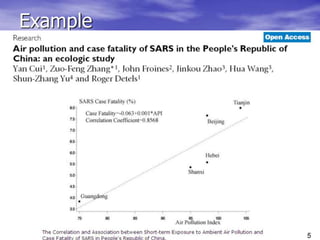
Example
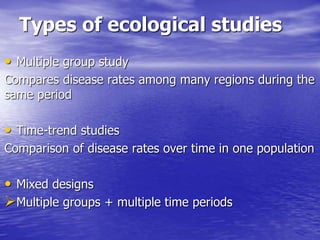
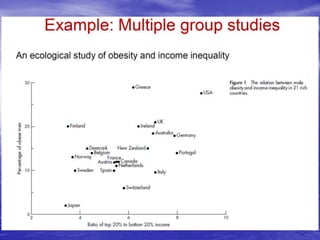
Types of ecological studies
• Multiple group study
Compares disease rates among many regions during the
same period
• Time-trend studies
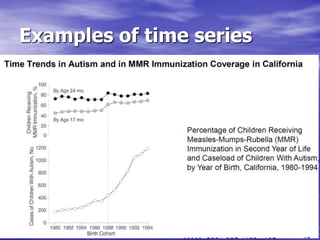
Comparison of disease rates over time in one population
• Mixed designs
Multiple groups + multiple time periods
Examples of time series
Uses of ecological studies
• Are appropriate designs when generating
• May be used for testing a new hypothesis
BUT have limited value due to in-built
design errors
• Only design possible when adequate
measurement of individual-level variables
is not possible/not ethical Example:
Holding off immunization
• When funds or time is limited to do
individual level studies
Advantages of ecological studies
• Are low cost and convenience
• Simple to analyze and present
• Often helpful for generating new hypotheses for
further research
• Aggregated data on exposure and health outcomes
often publicly available in state and national
databases
Disadvantages of ecological studies
• Cannot adjust well for confounding due to lack of
data on all potential covariates
• Measures of exposure are only a proxy based on the
average in the population
• Lack of available data on confounding factors.
• Missing data is another concern
• Prone to Ecological fallacy: We do not know if
grouped results apply on the individual level
Ecological fallacy
• Also called ecological inference fallacy or population
fallacy
• is an error where conclusions are inappropriately
inferred about individuals from the results of aggregate
data
• Example: If countries with more Protestants tend to
have higher suicide rates, then Protestants must be
more likely to commit suicide
• How can it be avoided: If individual data is not
available difficult to control for except through
modelling
Why ecological studies
• Low cost and convenience
• Some measurements cannot be made on individuals
• Ecologic effects are the main interest (at the
population level)
• Simplicity of analyses and presentation
• Often helpful for generating new hypotheses for
further research
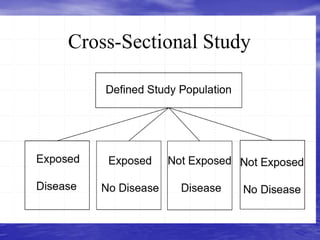
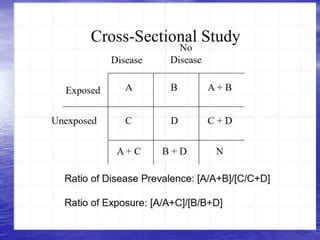
Cross-sectional studies
• Exposure and disease are determined
simultaneously for each person  a snapshot of
the population at one point in time
• No follow up in this design
• This can only indicate association, but cannot give
a time-sequence.
• Good for prevalence studies and testing
association
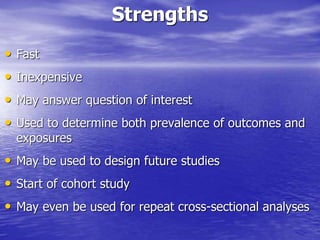
Strengths
• Fast
• Inexpensive
• May answer question of interest
• Used to determine both prevalence of outcomes and
exposures
• May be used to design future studies
• Start of cohort study
• May even be used for repeat cross-sectional analyses
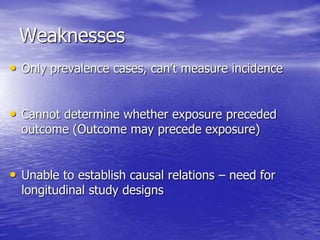
Weaknesses
• Only prevalence cases, can’t measure incidence
• Cannot determine whether exposure preceded
outcome (Outcome may precede exposure)
• Unable to establish causal relations – need for
longitudinal study designs
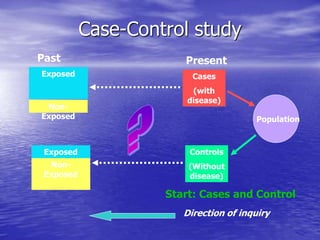
Case-Control study
Start: Cases and Control
Population
Cases
(with
disease)
Controls
(Without
disease)
Exposed
Non-
Exposed
Non-
Exposed
Exposed
Direction of inquiry
Present
Past
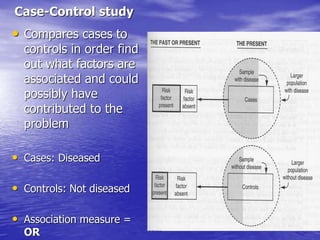
Case-Control study
• Compares cases to
controls in order find
out what factors are
associated and could
possibly have
contributed to the
problem
• Cases: Diseased
• Controls: Not diseased
• Association measure =
OR
Features of case control studies
• Less expensive than cohort studies and
experiments
• Small number of participants needed
• Bes t design for diseases with long latent period
• Very efficient for rare diseases
• Multiple etiologic factors can be studied at one time
• Cannot yield estimates of incidence or prevalence
• Riskier due to biases (especially recall bias)
Cohort studies
• A cohort is a group of subjects that are followed
over time starting at a specified point in time and
usually have something in common at the start
• Cohort study is where participants are selected
with respect to exposure
• Individuals exposed to a risk factor (study group)
are compared those not exposed (the control
group).
• Starts with measuring exposure, looks forward to
the outcome
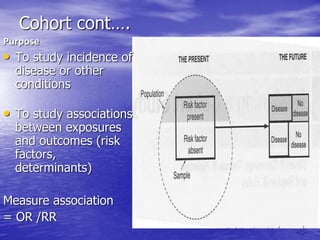
Cohort cont….
Purpose
• To study incidence of
disease or other
conditions
• To study associations
between exposures
and outcomes (risk
factors,
determinants)
Measure association
= OR /RR
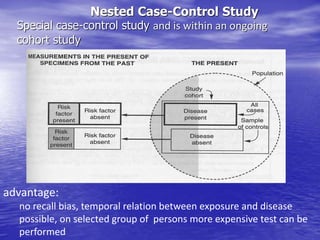
Nested Case-Control Study
Special case-control study and is within an ongoing
cohort study
advantage:
no recall bias, temporal relation between exposure and disease
possible, on selected group of persons more expensive test can be
performed
WHY OBSERVATIONAL STUDIES
• Usually the only option if the predictor is a
potentially harmful exposure or risk factor
• Even if the predictor is an intervention, an RCT may
not be feasible due to duration between exposure
and outcome
• Financial reasons: intervention studies can be
significantly more expensive than observational studie
• More intellectually interesting than RCTs?
.
END
OBSERVATIONAL STUDIES
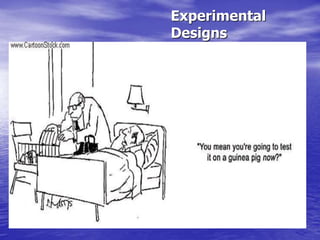
Experimental
Designs
Clinical Trial: Definition
A clinical trial is a prospective study comparing the
effect of intervention(s) against a control
A research activity that involves the administration of
a test regimen
Note: A proper clinical trial
 Always prospective
 Must have 1 or more interventions
 Must have a control group
Clinical Trial Objectives
• To asses the efficacy of a new intervention or drug
• To asses the effectiveness of a new intervention or
drug
• To asses the safety of a new intervention or drug
History of Clinical Trials
• Daniel 1:12-16. A diet experiment (Royal food and wine versus
vegetables and water) for 10 days
• 17th century: Lancaster (captain of a ship)
– experiment to examine the effect of lemon juice on scurvy for sailors.
– Ships with lemons were free of scurvy compared to ships without
lemons having scurvy.
• Lind (1753) – Study of 5 tx for scurvy in 10 pts (2/tx) plus 2 pts
without tx (control).
– First two pts given orange and lemons recovered quickly and was fit for
duty after 6 days, compared favorably with all other patients
• Smallpox experiment (1721) at the Newgate prison in Great
Britain. Voluntary inmates were inoculated and were free from
smallpox.
Key Elements of a Clinical Trial
• Selection of subjects
• Allocation of exposure
• Blinding
• Data collection
• Statistical issues
• Ethical considerations
Selection of Subjects
Population at risk/Target population
 ENTIRE group of individuals to generalize results
 The intervention is intended to benefit this population
Accessible population
 Population to which the researcher has reasonable access
 May be a subset of the target
Study population
 Group of participants actually studied
 Subset of population meeting eligibility criteria
 Inclusion criteria – identifies the target population
 Exclusion criteria – excludes people from the study, mainly for
safety reasons
Allocation of exposure
• Studies without controls –
 not a clinical trial although still an experiment
• Studies with controls: Types of controls/Comparison groups
 Historical controls (compare with the past)
 Simultaneous non-randomized controls (concurrent
group/quasi experiment)
 Randomization - true controls
• Importance of controls
 For comparisons
 Allow to determine if outcome is caused by intervention vs
other factors
Randomized controlled Trials (RCT)
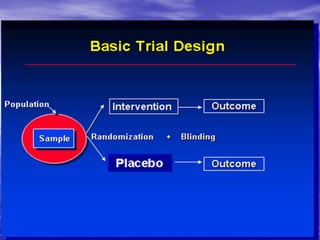
• Exposure assigned in a random way, participant have
equal chance of being in either control or intervention
group
• Balances the known and unknown risk factors for the
outcome under study
– eliminates confounding due to measured and unmeasured
factors
• Methods for randomization
 Simple randomization (fish bowel method, tossing a coin)
 Random number table
 Computer-generated list of assignments
Blinding/ Masking
• The team assessing the outcome are not aware of
treatment assignment
• To prevent the biased assessment of the outcome
Single-blinded study
• Either pts or physicians are blinded to the tx
allocation
Double-blinded study
• Both pts and physicians are blinded to the tx
allocation
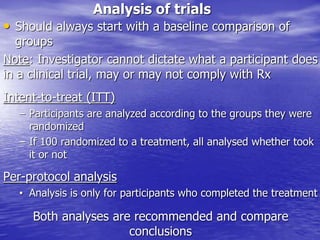
Analysis of trials
• Should always start with a baseline comparison of
groups
Note: Investigator cannot dictate what a participant does
in a clinical trial, may or may not comply with Rx
Intent-to-treat (ITT)
– Participants are analyzed according to the groups they were
randomized
– If 100 randomized to a treatment, all analysed whether took
it or not
Per-protocol analysis
• Analysis is only for participants who completed the treatment
Both analyses are recommended and compare
conclusions
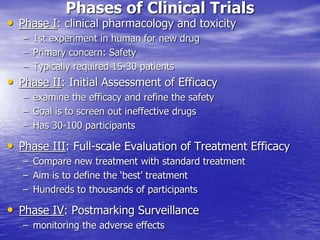
Phases of Clinical Trials
• Phase I: clinical pharmacology and toxicity
– 1st experiment in human for new drug
– Primary concern: Safety
– Typically required 15-30 patients
• Phase II: Initial Assessment of Efficacy
– examine the efficacy and refine the safety
– Goal is to screen out ineffective drugs
– Has 30-100 participants
• Phase III: Full-scale Evaluation of Treatment Efficacy
– Compare new treatment with standard treatment
– Aim is to define the ‘best’ treatment
– Hundreds to thousands of participants
• Phase IV: Postmarking Surveillance
– monitoring the adverse effects
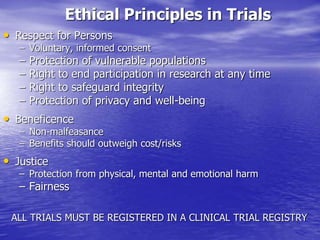
Ethical Principles in Trials
• Respect for Persons
– Voluntary, informed consent
– Protection of vulnerable populations
– Right to end participation in research at any time
– Right to safeguard integrity
– Protection of privacy and well-being
• Beneficence
– Non-malfeasance
– Benefits should outweigh cost/risks
• Justice
– Protection from physical, mental and emotional harm
– Fairness
ALL TRIALS MUST BE REGISTERED IN A CLINICAL TRIAL REGISTRY
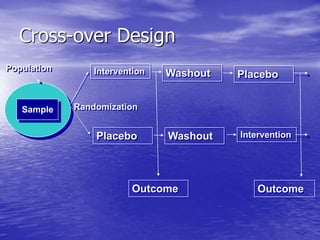
Cross-over Design
Population
Sample
Intervention
Randomization
Placebo
Washout
Washout
Placebo
Intervention
Outcome Outcome
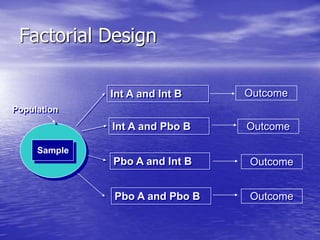
Factorial Design
Population
Sample
Int A and Int B
Int A and Pbo B
Pbo A and Int B
Pbo A and Pbo B
Outcome
Outcome
Outcome
Outcome
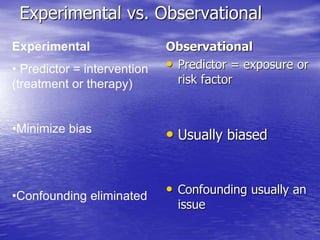
Experimental vs. Observational
Observational
• Predictor = exposure or
risk factor
• Usually biased
• Confounding usually an
issue
Experimental
• Predictor = intervention
(treatment or therapy)
•Minimize bias
•Confounding eliminated

STUDY DESIGNS.ppt

  • 1.
  • 2.
    Learning Objectives • Classifystudy designs • Define the unique features of the study designs • Discuss weaknesses and strengths associated with each study design • Discuss the most appropriate study design to answer certain research questions
  • 3.
    Determining a studydesign • Identify topic of interest • State question of interest • State objectives of the study • Choose the best design to answer question Topic Research question Objectives (Hypothesis)
  • 4.
    Types of StudyDesigns Observational • -- Case report • -- Case series • -- Ecological Studies • -- Cross-sectional • -- Case-control • -- Cohort Experimental • -- Randomized clinical trial
  • 6.
  • 7.
  • 8.
    Case Report /CaseSeries Case reports Case series Selective by nature, providing little information May help identify potential health problems Uses of case series and reports 1 patient: Case Report More patients: Case Series
  • 9.
    Ecological Studies Describe disease occurrenceon population level Evaluate an association using the population -not the individual -as the unit of analysis. The rates of disease are examined in relation to factors described on the population level Example: Association between cancer and fat intake? National Cancer Rate High Low High Low National Diet Fat-Intake
  • 10.
    Ecological Studies Keyissues Ecological fallacy: We do not know if the individuals who have cancer were also the individuals with the high fat intake • Explores correlations between group level exposure and outcomes • Unit of analysis: usually not individual, but clusters (e.g. countries, counties, schools) • Useful for generating hypothesis • Cannot adjust well for confounding due to lack of comparability (due to lack of data on all potential covariates) • Missing data is another concern
  • 11.
  • 12.
    Types of ecologicalstudies • Multiple group study Compares disease rates among many regions during the same period • Time-trend studies Comparison of disease rates over time in one population • Mixed designs Multiple groups + multiple time periods
  • 14.
  • 15.
    Uses of ecologicalstudies • Are appropriate designs when generating • May be used for testing a new hypothesis BUT have limited value due to in-built design errors • Only design possible when adequate measurement of individual-level variables is not possible/not ethical Example: Holding off immunization • When funds or time is limited to do individual level studies
  • 16.
    Advantages of ecologicalstudies • Are low cost and convenience • Simple to analyze and present • Often helpful for generating new hypotheses for further research • Aggregated data on exposure and health outcomes often publicly available in state and national databases
  • 17.
    Disadvantages of ecologicalstudies • Cannot adjust well for confounding due to lack of data on all potential covariates • Measures of exposure are only a proxy based on the average in the population • Lack of available data on confounding factors. • Missing data is another concern • Prone to Ecological fallacy: We do not know if grouped results apply on the individual level
  • 18.
    Ecological fallacy • Alsocalled ecological inference fallacy or population fallacy • is an error where conclusions are inappropriately inferred about individuals from the results of aggregate data • Example: If countries with more Protestants tend to have higher suicide rates, then Protestants must be more likely to commit suicide • How can it be avoided: If individual data is not available difficult to control for except through modelling
  • 19.
    Why ecological studies •Low cost and convenience • Some measurements cannot be made on individuals • Ecologic effects are the main interest (at the population level) • Simplicity of analyses and presentation • Often helpful for generating new hypotheses for further research
  • 20.
    Cross-sectional studies • Exposureand disease are determined simultaneously for each person  a snapshot of the population at one point in time • No follow up in this design • This can only indicate association, but cannot give a time-sequence. • Good for prevalence studies and testing association
  • 23.
    Strengths • Fast • Inexpensive •May answer question of interest • Used to determine both prevalence of outcomes and exposures • May be used to design future studies • Start of cohort study • May even be used for repeat cross-sectional analyses
  • 24.
    Weaknesses • Only prevalencecases, can’t measure incidence • Cannot determine whether exposure preceded outcome (Outcome may precede exposure) • Unable to establish causal relations – need for longitudinal study designs
  • 25.
    Case-Control study Start: Casesand Control Population Cases (with disease) Controls (Without disease) Exposed Non- Exposed Non- Exposed Exposed Direction of inquiry Present Past
  • 26.
    Case-Control study • Comparescases to controls in order find out what factors are associated and could possibly have contributed to the problem • Cases: Diseased • Controls: Not diseased • Association measure = OR
  • 27.
    Features of casecontrol studies • Less expensive than cohort studies and experiments • Small number of participants needed • Bes t design for diseases with long latent period • Very efficient for rare diseases • Multiple etiologic factors can be studied at one time • Cannot yield estimates of incidence or prevalence • Riskier due to biases (especially recall bias)
  • 28.
    Cohort studies • Acohort is a group of subjects that are followed over time starting at a specified point in time and usually have something in common at the start • Cohort study is where participants are selected with respect to exposure • Individuals exposed to a risk factor (study group) are compared those not exposed (the control group). • Starts with measuring exposure, looks forward to the outcome
  • 29.
    Cohort cont…. Purpose • Tostudy incidence of disease or other conditions • To study associations between exposures and outcomes (risk factors, determinants) Measure association = OR /RR
  • 30.
    Nested Case-Control Study Specialcase-control study and is within an ongoing cohort study advantage: no recall bias, temporal relation between exposure and disease possible, on selected group of persons more expensive test can be performed
  • 31.
    WHY OBSERVATIONAL STUDIES •Usually the only option if the predictor is a potentially harmful exposure or risk factor • Even if the predictor is an intervention, an RCT may not be feasible due to duration between exposure and outcome • Financial reasons: intervention studies can be significantly more expensive than observational studie • More intellectually interesting than RCTs?
  • 32.
  • 33.
  • 34.
  • 35.
    Clinical Trial: Definition Aclinical trial is a prospective study comparing the effect of intervention(s) against a control A research activity that involves the administration of a test regimen Note: A proper clinical trial  Always prospective  Must have 1 or more interventions  Must have a control group
  • 37.
    Clinical Trial Objectives •To asses the efficacy of a new intervention or drug • To asses the effectiveness of a new intervention or drug • To asses the safety of a new intervention or drug
  • 38.
    History of ClinicalTrials • Daniel 1:12-16. A diet experiment (Royal food and wine versus vegetables and water) for 10 days • 17th century: Lancaster (captain of a ship) – experiment to examine the effect of lemon juice on scurvy for sailors. – Ships with lemons were free of scurvy compared to ships without lemons having scurvy. • Lind (1753) – Study of 5 tx for scurvy in 10 pts (2/tx) plus 2 pts without tx (control). – First two pts given orange and lemons recovered quickly and was fit for duty after 6 days, compared favorably with all other patients • Smallpox experiment (1721) at the Newgate prison in Great Britain. Voluntary inmates were inoculated and were free from smallpox.
  • 39.
    Key Elements ofa Clinical Trial • Selection of subjects • Allocation of exposure • Blinding • Data collection • Statistical issues • Ethical considerations
  • 40.
    Selection of Subjects Populationat risk/Target population  ENTIRE group of individuals to generalize results  The intervention is intended to benefit this population Accessible population  Population to which the researcher has reasonable access  May be a subset of the target Study population  Group of participants actually studied  Subset of population meeting eligibility criteria  Inclusion criteria – identifies the target population  Exclusion criteria – excludes people from the study, mainly for safety reasons
  • 41.
    Allocation of exposure •Studies without controls –  not a clinical trial although still an experiment • Studies with controls: Types of controls/Comparison groups  Historical controls (compare with the past)  Simultaneous non-randomized controls (concurrent group/quasi experiment)  Randomization - true controls • Importance of controls  For comparisons  Allow to determine if outcome is caused by intervention vs other factors
  • 42.
    Randomized controlled Trials(RCT) • Exposure assigned in a random way, participant have equal chance of being in either control or intervention group • Balances the known and unknown risk factors for the outcome under study – eliminates confounding due to measured and unmeasured factors • Methods for randomization  Simple randomization (fish bowel method, tossing a coin)  Random number table  Computer-generated list of assignments
  • 43.
    Blinding/ Masking • Theteam assessing the outcome are not aware of treatment assignment • To prevent the biased assessment of the outcome Single-blinded study • Either pts or physicians are blinded to the tx allocation Double-blinded study • Both pts and physicians are blinded to the tx allocation
  • 44.
    Analysis of trials •Should always start with a baseline comparison of groups Note: Investigator cannot dictate what a participant does in a clinical trial, may or may not comply with Rx Intent-to-treat (ITT) – Participants are analyzed according to the groups they were randomized – If 100 randomized to a treatment, all analysed whether took it or not Per-protocol analysis • Analysis is only for participants who completed the treatment Both analyses are recommended and compare conclusions
  • 45.
    Phases of ClinicalTrials • Phase I: clinical pharmacology and toxicity – 1st experiment in human for new drug – Primary concern: Safety – Typically required 15-30 patients • Phase II: Initial Assessment of Efficacy – examine the efficacy and refine the safety – Goal is to screen out ineffective drugs – Has 30-100 participants • Phase III: Full-scale Evaluation of Treatment Efficacy – Compare new treatment with standard treatment – Aim is to define the ‘best’ treatment – Hundreds to thousands of participants • Phase IV: Postmarking Surveillance – monitoring the adverse effects
  • 46.
    Ethical Principles inTrials • Respect for Persons – Voluntary, informed consent – Protection of vulnerable populations – Right to end participation in research at any time – Right to safeguard integrity – Protection of privacy and well-being • Beneficence – Non-malfeasance – Benefits should outweigh cost/risks • Justice – Protection from physical, mental and emotional harm – Fairness ALL TRIALS MUST BE REGISTERED IN A CLINICAL TRIAL REGISTRY
  • 47.
  • 48.
    Factorial Design Population Sample Int Aand Int B Int A and Pbo B Pbo A and Int B Pbo A and Pbo B Outcome Outcome Outcome Outcome
  • 49.
    Experimental vs. Observational Observational •Predictor = exposure or risk factor • Usually biased • Confounding usually an issue Experimental • Predictor = intervention (treatment or therapy) •Minimize bias •Confounding eliminated