Cohort study
Introduction
A cohort is a group of people who share a common characteristic or
experience within a defined period.
Cohort study or panel study also called follow-up or incidence studies
is a form of longitudinal study that begins with a group of people who are
free of disease, and who are classified into subgroups according to
exposure to a potential cause of disease or outcome. Variables of
interest are specified and measured and the whole cohort is followed up
to see how the subsequent development of new cases of the disease (or
other outcome) differs between the groups with and without exposure.
Cohort studies provide the best information about the causation of
disease and the most direct measurement of the risk of developing
disease.
fig: Design of cohort study
General consideration while selection of cohorts
 Both the cohorts are free of the disease.
 Both the groups should equally susceptible to disease
 Both the groups should be comparable
 Diagnostic and eligibility criteria for the disease should be defined
well in advance.
Elements of cohort study
 Selection of study subjects
 Obtaining data on exposure
 Selection of comparison group
 Follow up
 Analysis: Calculation of incidence rates among exposed and
nonexposed group.
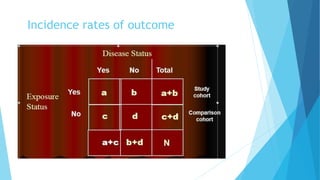
Incidence rates of outcome
Incidence rate
 Incidence among exposed = a/a+b
Incidence among non-exposed = c/c+d
Estimation of risk
 Relative Risk
incidence of disease among exposed
RR = ______________________________
Incidence of disease among non-exposed
a/a+b
= _________
c/c+d
 Attributable Risk
Incidence of disease among exposed – incidence of disease among non
exposed
AR = _______________________________
Incidence of disease among exposed
a/a+b – c/c+d
AR = _______________
a/a+b
Types of Cohort Study
 Prospective cohort study
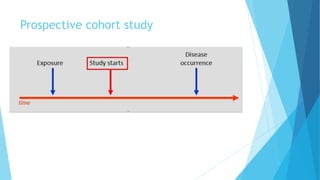
 In a prospective cohort study, you collect exposure information at
the time the study begins and follow the cohort for disease status that
may occur in the future
 Retrospective (historical) cohort study
 In a retrospective cohort study, you collect exposure information
from some time in the past and construct disease incidence (or
mortality) from then until the present.
Prospective cohort study
Retrospective cohort studies
Advantages
 We can find out incidence rate and risk.
 More than one disease related to single exposure.
 Can establish cause and effect.
 Good when exposure is rare.
 Minimize selection and information bias.
Disadvantages
 Often require large sample.
 Losses to follow up
 Ineffective for rare disease.
 Long time to complete.
 Expensive
 Ethical issues.
cohort study

cohort study

  • 1.
  • 2.
    Introduction A cohort isa group of people who share a common characteristic or experience within a defined period. Cohort study or panel study also called follow-up or incidence studies is a form of longitudinal study that begins with a group of people who are free of disease, and who are classified into subgroups according to exposure to a potential cause of disease or outcome. Variables of interest are specified and measured and the whole cohort is followed up to see how the subsequent development of new cases of the disease (or other outcome) differs between the groups with and without exposure. Cohort studies provide the best information about the causation of disease and the most direct measurement of the risk of developing disease.
  • 3.
    fig: Design ofcohort study
  • 4.
    General consideration whileselection of cohorts  Both the cohorts are free of the disease.  Both the groups should equally susceptible to disease  Both the groups should be comparable  Diagnostic and eligibility criteria for the disease should be defined well in advance. Elements of cohort study  Selection of study subjects  Obtaining data on exposure  Selection of comparison group  Follow up  Analysis: Calculation of incidence rates among exposed and nonexposed group.
  • 5.
  • 6.
    Incidence rate  Incidenceamong exposed = a/a+b Incidence among non-exposed = c/c+d Estimation of risk  Relative Risk incidence of disease among exposed RR = ______________________________ Incidence of disease among non-exposed a/a+b = _________ c/c+d
  • 7.
     Attributable Risk Incidenceof disease among exposed – incidence of disease among non exposed AR = _______________________________ Incidence of disease among exposed a/a+b – c/c+d AR = _______________ a/a+b
  • 8.
    Types of CohortStudy  Prospective cohort study  In a prospective cohort study, you collect exposure information at the time the study begins and follow the cohort for disease status that may occur in the future  Retrospective (historical) cohort study  In a retrospective cohort study, you collect exposure information from some time in the past and construct disease incidence (or mortality) from then until the present.
  • 9.
  • 10.
  • 11.
    Advantages  We canfind out incidence rate and risk.  More than one disease related to single exposure.  Can establish cause and effect.  Good when exposure is rare.  Minimize selection and information bias. Disadvantages  Often require large sample.  Losses to follow up  Ineffective for rare disease.  Long time to complete.  Expensive  Ethical issues.