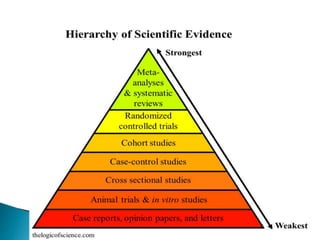
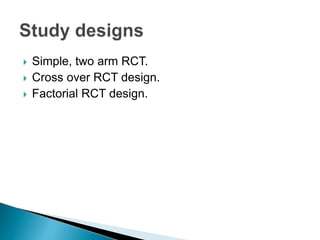
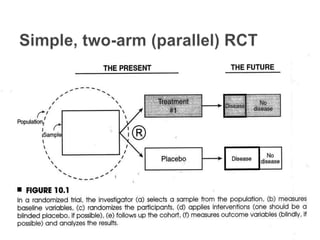
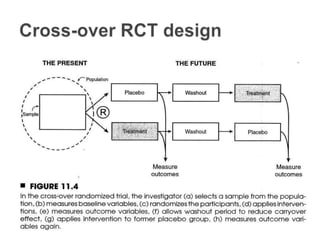
This document provides an overview of randomized controlled trials (RCTs), including their purpose and design. It discusses key aspects of RCTs such as randomization, blinding, and assessing outcomes. It provides examples of simple two-arm and cross-over RCT designs. The document also summarizes a specific cluster RCT that evaluated the effects of various child development and nutrition interventions on outcomes measured in children from birth to age 2 years.
Introduction
Differentstudy designs.
The basic steps with an example
Number needed to treat
Types of RCTs
Blinding and contamination
Summary
References
3.
The randomizedcontrolled trial (RCT) is one of the
simplest, most powerful tools of research.
The RCT is a study in which people are allocated ‘at
random’ to receive one of several interventions.
The intervention is controlled by the investigator
4.
Interventions includevaried actions such as preventive
strategies, diagnostic tests, screening programs, and
treatments.
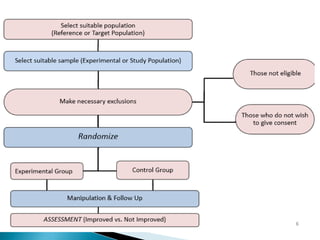
Drawing upa protocol
Selecting reference and experimental populations
Randomization
Manipulation or intervention
Follow up
Assessment of outcome
12.
The protocolspecifies the aims and objectives of the
study.
Criteria for the selection of study and control groups,
sample size, procedure for allocation.
The exposure variable, outcome variable, confounding
variable and co interventions should be defined clearly.
Inclusion and exclusion criteria should be enumerated.
The protocol aims at preventing bias and to reduce the
sources of error in the study.
13.
Objective: Toevaluate effect of stand-alone Care for
Child Development, stand-alone Enhanced Nutrition,
and Combined Care for Child Development and
Enhanced Nutrition.
All children aged birth to 2.5 months were enrolled and
followed to age 2 years.
14.
Reference/target population:population to which the
findings of the trial, if found successful, are expected to
be applicable.
Experimental population: actual population that
participates in the experimental study.
◦ Representative of the population
◦ Qualified or eligible for the trial.
◦ Informed consent.
15.
Experimental population:children less than two years in
Naushero Feroze district of Sindh Province, Pakistan.
Reference population is children less than two years in
other places of Pakistan
16.
It isa statistical procedure.
Assignment is predetermined
Each individual has an equal chance of being allocated
to all groups
Best way to allocate participants to different intervention
groups
Ensures that the only difference between the two
intervention groups is the intervention
17.
Makes theStudy and Control groups comparable
Minimizes chance of confounding even against unknown
confounders
Selection Bias minimized
Facilitates blinding / masking of treatment from
participants and investigators
18.
Unrestricted randomization:
Simplestmethod – is tossing a coin, Use random
number tables, Can use computers to generate random
numbers.
Restricted randomization
Also called block randomization or balanced
randomization
19.
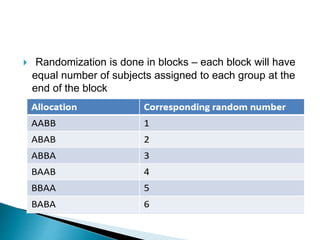
Randomization isdone in blocks – each block will have
equal number of subjects assigned to each group at the
end of the block
20.
Stratified randomization
Block randomization may not protect against obtaining
different distributions of important risk factors for the
outcome in the study groups
Used only when the results of the trial are thought to be
related to a particular factor
Ensures that different subgroups are balanced between
treatment groups
21.
Matched pair randomization:
Itcan be used when the experiment has only two
treatment conditions. Subjects are grouped into pairs
based on some variable and then are randomly
assigned to different intervention
Cluster randomization:
All the methods can be applied to either individuals or
communities
All individuals belonging to a specific group (village,
ethnic, school etc.) communities are allocated
intervention/placebo
22.
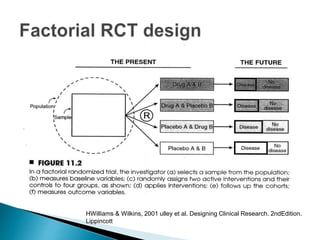
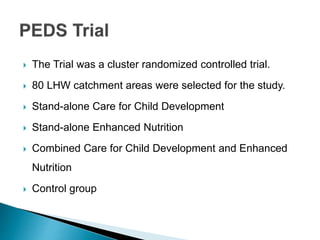
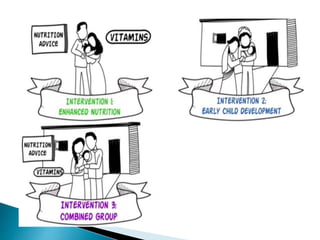
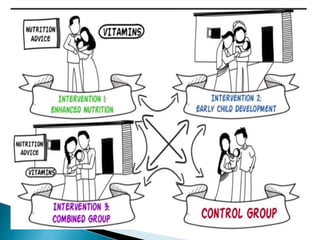
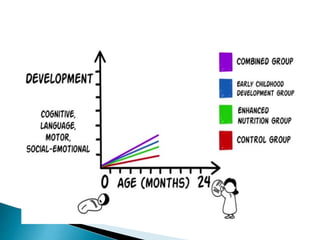
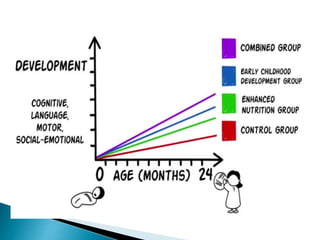
The Trialwas a cluster randomized controlled trial.
80 LHW catchment areas were selected for the study.
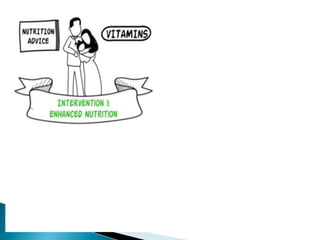
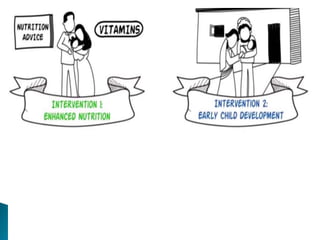
Stand-alone Care for Child Development
Stand-alone Enhanced Nutrition
Combined Care for Child Development and Enhanced
Nutrition
Control group
23.
Introduce theIntervention and Placebo Control
Modalities.
Deliberate application or withdrawal or reduction of the
suspected causal factor as laid down in the protocol.
28.
Examination ofboth the group subjects at defined
intervals of time, under the same given circumstances, in
the same time frame till final assessment of outcome.
Follow up may be short or may require many years
depending upon the study undertaken.
29.
The studyteam undertook in-depth assessments when
enrolled children were 6, 12, 18 and 24 months old.
30.
The incidenceof positive and negative results is
rigorously compared in both the groups, if any
differences are found: tested for statistical significance.
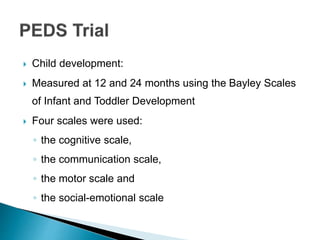
31.
Child development:
Measured at 12 and 24 months using the Bayley Scales
of Infant and Toddler Development
Four scales were used:
◦ the cognitive scale,
◦ the communication scale,
◦ the motor scale and
◦ the social-emotional scale
32.
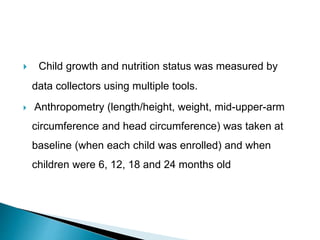
Child growthand nutrition status was measured by
data collectors using multiple tools.
Anthropometry (length/height, weight, mid-upper-arm
circumference and head circumference) was taken at
baseline (when each child was enrolled) and when
children were 6, 12, 18 and 24 months old
35.
Subject variation: participantsmay feel better or report
improvement if they knew they were receiving a new form
of treatment
Observer bias: Investigator measuring the outcome of a trial
may be influenced if he knows beforehand the particular
procedure to which the subject has been subjected
Bias in evaluation: Investigator may subconciously give a
favourable report of the outcome of the trial.
36.
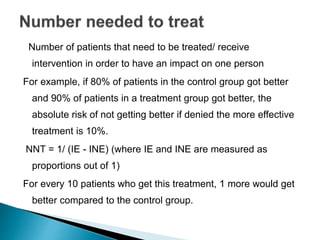
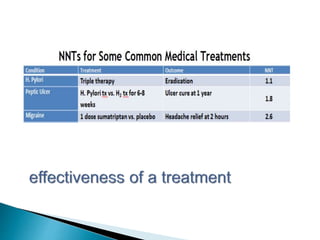
Number of patientsthat need to be treated/ receive
intervention in order to have an impact on one person
For example, if 80% of patients in the control group got better
and 90% of patients in a treatment group got better, the
absolute risk of not getting better if denied the more effective
treatment is 10%.
NNT = 1/ (IE - INE) (where IE and INE are measured as
proportions out of 1)
For every 10 patients who get this treatment, 1 more would get
better compared to the control group.
38.
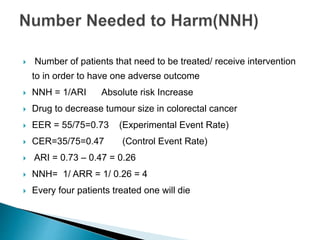
Number ofpatients that need to be treated/ receive intervention
to in order to have one adverse outcome
NNH = 1/ARI Absolute risk Increase
Drug to decrease tumour size in colorectal cancer
EER = 55/75=0.73 (Experimental Event Rate)
CER=35/75=0.47 (Control Event Rate)
ARI = 0.73 – 0.47 = 0.26
NNH= 1/ ARR = 1/ 0.26 = 4
Every four patients treated one will die
39.
Clinical trials:aspirin on cardiovascular mortality
Preventive trials:vaccines and chemo prophylactic drugs
Risk factor trials :on CHD
Cessation experiments: cigarette smoking and lung
cancer
Trial of etiological agents: oxygen for retrolental fibroplasia
Evaluation of health services: domiciliary treatment for TB
40.
Single Blind– Participant does not know which
treatment received
Double Blind – Doctor and Participant, both do not know
which treatment received
Triple Blind – Person analyzing the data, Doctor and
Participant, all do not know which treatment received.
41.
Study participantsdo not receive their allocated
intervention / placebo
Study participants receive the intervention even though
they were in control group
Tends to weaken the observed association
42.
In summary,RCTs are quantitative comparative
controlled experiments in which a group of investigators
study two or more interventions in a series of individuals
who are randomly ‘allocated’ to receive them.
1. Park K.Randomized contolled trials . Parks text book of Preventive and
social medicine. 23rd edition. Jabalpur, M/S Banarsidas Bhanot Publishers.
January 2015 page 80-87
2. Leon Gordis. Epidemiology 4th edition. Elsevier. 2009 page 131-163.
3. Roger detels. Oxford textbook of public health. 5th edition. Oxford 2009
page 527-556
4. Textbook of public health and community medicine 1st edition 2009. AFMC
page 151-158
5. Hulley et al. Designing Clinical Research. 2ndEdition. Lippincott Williams
& Wilkins, 2001
Editor's Notes
#14 The PEDS Trial tested the effects on child development and growth of two intervention packages, Care for Child Development and Enhanced Nutrition, along with a third package that combined both interventions
The Pakistan Early Development Scale-up (PEDS) Trial was implemented in Naushero Feroze district in Sindh Province, Pakistan from June 2009 through March 2012.