
Chapter Seven
Epidemiological Study Designs
Omar Osman
Senior Lecturer
Omarosman@snu.edu.so
C. phone: 61-5-895924
Facebook/Twitter/instagram/LinkedIn
@omarosmaneid
1
Introduction
• Epidemiological studies are conducted to
describe distribution and determinants of
health related status or events
• It is aimed to describe burden of disease or
prevalence of risk factors, Health behaviors or
other characteristics of population that
influence risk of diseases and to evaluate
effectiveness of intervention
What is study design
• A specific plan or protocol for conducting the
study which allows the investigator to
translate the conceptual hypothesis to
operational one.
Types of study designs
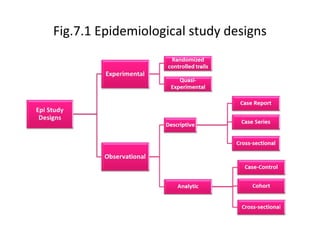
• Scientific study designs have different
methods but in practical epidemiological way
we can classify it into: Observational and
Experimental designs
Cont..
• In observational studies the investigator
observes and systematically collects
information but does not try to change the
people or animals being observed .
• In an experimental by contrast the
investigator intervenes to change something.
Example of observational study
• Taking blood samples to measure blood
cholesterol levels
• A survey of reading habits among students
Examples of experimental designs
• Giving a group of students with resources
(books and handouts) and withholding from
others to see what happens about students
performance
• Giving some patients a drug and then
observing what happens
Fig.7.1 Epidemiological study designs
Descriptive observational Designs
Descriptive studies are observational studies
which describes the pattern of diseases
occurrence in relation to variables such as
person, place and time
Cont..
• Characterize who, where, or when in relation
to what (outcome)
• Person: characteristics (age, sex, occupation)
of the individuals affected by the outcome
• Place: geography (residence, work, hospital)
of the affected individuals
• Time: when events (diagnosis, reporting;
testing) occurred
Cross-Sectional Study as a
Descriptive Study
Purpose: To learn about the characteristics of a
population at one point in time (like a photo “snap shot”)
Design: No comparison group
Population: All members of a small, defined group or
a
sample from a large group
Results: Produces estimates of the prevalence of the
population characteristic of interest
11
When to Conduct a Cross- Sectional
Study
• To estimate prevalence of a health condition
or prevalence of a behavior, risk factor, or
potential for disease
• To learn about characteristics such as
knowledge, attitude and practices of
individuals in a population
• To monitor trends over time with serial cross-
sectional studies
12
Example: Cross-Sectional Study
• Objective: To estimate the magnitude and
patterns of violence against pregnant women
• Study: Population-based, household, cross-
sectional study in Mogadishu and Baidoa Somalia
2015-2016
• Result: Violence experienced by 7% in Mogadishu
and 12% in Baidoa
13
Case report
• Case reports describe the experience of a
single patient or a group of patients with a
similar diagnosis. These types of studies
typically depicts an observant clinician
identifying an unusual feature of a disease or
a patients history
Case Series
• A case series is a report on a series of patients
with an outcome of interest. No control group
is involved. Another way of defining a case
series is that case series are collections of
individual case reports which may occur
within a fairly short period of time and these
are aggregated into one publication.
Analytic studies
• Analytic studies include cohort, case-
control and cross sectional studies, and may
investigate possible associations between risk
factors and disease by either comparing the
risk factor exposure status in animals with
disease to those without, or by comparing the
occurrence of disease amongst 'exposed'
animals to 'unexposed' animals
Cont..
• Analytic studies test hypotheses about
exposure-outcome relationships
• Measure the association between exposure
and outcome
• Include a comparison group
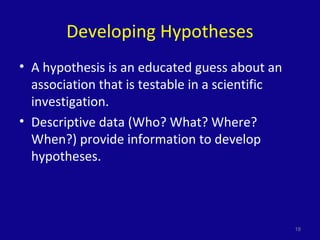
Developing Hypotheses
• A hypothesis is an educated guess about an
association that is testable in a scientific
investigation.
• Descriptive data (Who? What? Where?
When?) provide information to develop
hypotheses.
18
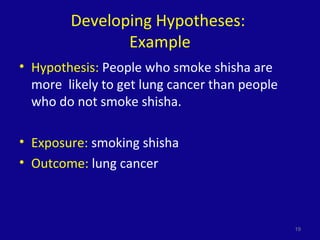
Developing Hypotheses:
Example
• Hypothesis: People who smoke shisha are
more likely to get lung cancer than people
who do not smoke shisha.
• Exposure: smoking shisha
• Outcome: lung cancer
19
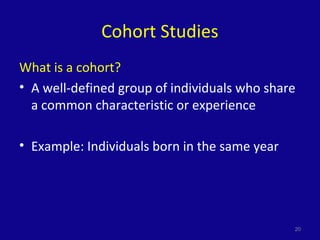
Cohort Studies
What is a cohort?
• A well-defined group of individuals who share
a common characteristic or experience
• Example: Individuals born in the same year
20
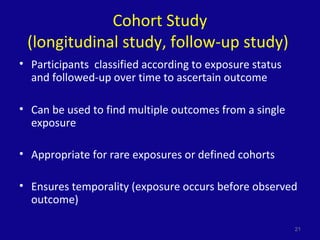
Cohort Study
(longitudinal study, follow-up study)
• Participants classified according to exposure status
and followed-up over time to ascertain outcome
• Can be used to find multiple outcomes from a single
exposure
• Appropriate for rare exposures or defined cohorts
• Ensures temporality (exposure occurs before observed
outcome)
21
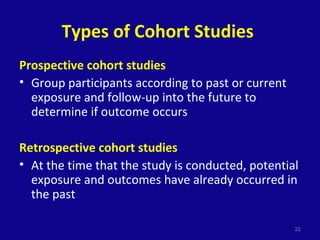
Types of Cohort Studies
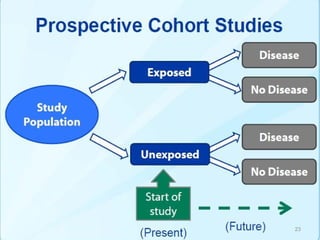
Prospective cohort studies
• Group participants according to past or current
exposure and follow-up into the future to
determine if outcome occurs
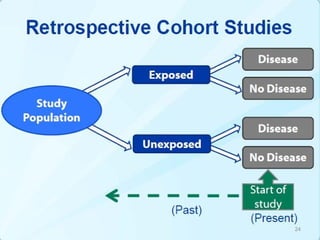
Retrospective cohort studies
• At the time that the study is conducted, potential
exposure and outcomes have already occurred in
the past
22
23
24
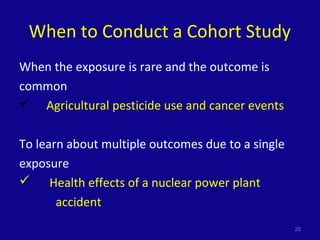
When to Conduct a Cohort Study
When the exposure is rare and the outcome is
common
 Agricultural pesticide use and cancer events
To learn about multiple outcomes due to a single
exposure
 Health effects of a nuclear power plant
accident
25
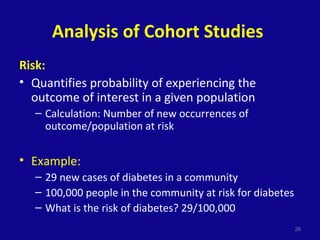
Analysis of Cohort Studies
Risk:
• Quantifies probability of experiencing the
outcome of interest in a given population
– Calculation: Number of new occurrences of
outcome/population at risk
• Example:
– 29 new cases of diabetes in a community
– 100,000 people in the community at risk for diabetes
– What is the risk of diabetes? 29/100,000
26
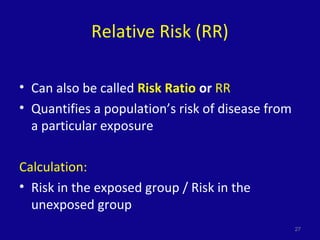
Relative Risk (RR)
• Can also be called Risk Ratio or RR
• Quantifies a population’s risk of disease from
a particular exposure
Calculation:
• Risk in the exposed group / Risk in the
unexposed group
27
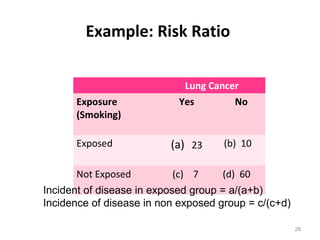
Example: Risk Ratio
Lung Cancer
Exposure
(Smoking)
Yes No
Exposed (a) 23 (b) 10
Not Exposed (c) 7 (d) 60
28
Incident of disease in exposed group = a/(a+b)
Incidence of disease in non exposed group = c/(c+d)
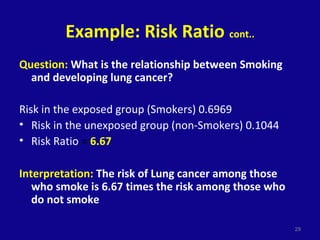
Example: Risk Ratio cont..
Question: What is the relationship between Smoking
and developing lung cancer?
Risk in the exposed group (Smokers) 0.6969
• Risk in the unexposed group (non-Smokers) 0.1044
• Risk Ratio = 6.67
Interpretation: The risk of Lung cancer among those
who smoke is 6.67 times the risk among those who
do not smoke
29
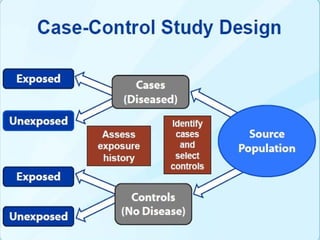
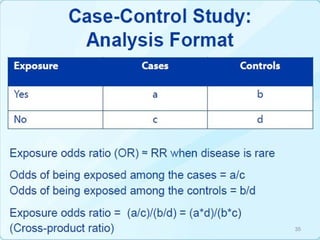
Case-control study
• A case-control study is designed to help
determine if an exposure is associated with an
outcome (i.e., disease or condition of
interest). In theory, the case-control study can
be described simply. First, identify the cases (a
group known to have the outcome) and the
controls (a group known to be free of the
outcome).
Cont..
• Then, look back in time to learn which
subjects in each group had the exposure(s),
comparing the frequency of the exposure in
the case group to the control group
• By definition, a case-control study is always
retrospective because it starts with an
outcome then traces back to investigate
exposures.
Case-Control Study
Purpose:
• To study rare diseases
• To study multiple exposures that may be related
to a single outcome
Study Subjects
• Participants selected based on outcome status:
• Case-subjects have outcome of interest
• Control-subjects do not have outcome of interest
32
33
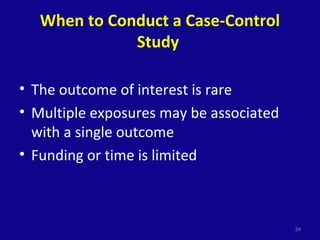
When to Conduct a Case-Control
Study
• The outcome of interest is rare
• Multiple exposures may be associated
with a single outcome
• Funding or time is limited
34
35

Chapter seven. epidemiologic study designs

  • 1.
    Chapter Seven Epidemiological StudyDesigns Omar Osman Senior Lecturer Omarosman@snu.edu.so C. phone: 61-5-895924 Facebook/Twitter/instagram/LinkedIn @omarosmaneid 1
  • 2.
    Introduction • Epidemiological studiesare conducted to describe distribution and determinants of health related status or events • It is aimed to describe burden of disease or prevalence of risk factors, Health behaviors or other characteristics of population that influence risk of diseases and to evaluate effectiveness of intervention
  • 3.
    What is studydesign • A specific plan or protocol for conducting the study which allows the investigator to translate the conceptual hypothesis to operational one.
  • 4.
    Types of studydesigns • Scientific study designs have different methods but in practical epidemiological way we can classify it into: Observational and Experimental designs
  • 5.
    Cont.. • In observationalstudies the investigator observes and systematically collects information but does not try to change the people or animals being observed . • In an experimental by contrast the investigator intervenes to change something.
  • 6.
    Example of observationalstudy • Taking blood samples to measure blood cholesterol levels • A survey of reading habits among students
  • 7.
    Examples of experimentaldesigns • Giving a group of students with resources (books and handouts) and withholding from others to see what happens about students performance • Giving some patients a drug and then observing what happens
  • 8.
  • 9.
    Descriptive observational Designs Descriptivestudies are observational studies which describes the pattern of diseases occurrence in relation to variables such as person, place and time
  • 10.
    Cont.. • Characterize who,where, or when in relation to what (outcome) • Person: characteristics (age, sex, occupation) of the individuals affected by the outcome • Place: geography (residence, work, hospital) of the affected individuals • Time: when events (diagnosis, reporting; testing) occurred
  • 11.
    Cross-Sectional Study asa Descriptive Study Purpose: To learn about the characteristics of a population at one point in time (like a photo “snap shot”) Design: No comparison group Population: All members of a small, defined group or a sample from a large group Results: Produces estimates of the prevalence of the population characteristic of interest 11
  • 12.
    When to Conducta Cross- Sectional Study • To estimate prevalence of a health condition or prevalence of a behavior, risk factor, or potential for disease • To learn about characteristics such as knowledge, attitude and practices of individuals in a population • To monitor trends over time with serial cross- sectional studies 12
  • 13.
    Example: Cross-Sectional Study •Objective: To estimate the magnitude and patterns of violence against pregnant women • Study: Population-based, household, cross- sectional study in Mogadishu and Baidoa Somalia 2015-2016 • Result: Violence experienced by 7% in Mogadishu and 12% in Baidoa 13
  • 14.
    Case report • Casereports describe the experience of a single patient or a group of patients with a similar diagnosis. These types of studies typically depicts an observant clinician identifying an unusual feature of a disease or a patients history
  • 15.
    Case Series • Acase series is a report on a series of patients with an outcome of interest. No control group is involved. Another way of defining a case series is that case series are collections of individual case reports which may occur within a fairly short period of time and these are aggregated into one publication.
  • 16.
    Analytic studies • Analyticstudies include cohort, case- control and cross sectional studies, and may investigate possible associations between risk factors and disease by either comparing the risk factor exposure status in animals with disease to those without, or by comparing the occurrence of disease amongst 'exposed' animals to 'unexposed' animals
  • 17.
    Cont.. • Analytic studiestest hypotheses about exposure-outcome relationships • Measure the association between exposure and outcome • Include a comparison group
  • 18.
    Developing Hypotheses • Ahypothesis is an educated guess about an association that is testable in a scientific investigation. • Descriptive data (Who? What? Where? When?) provide information to develop hypotheses. 18
  • 19.
    Developing Hypotheses: Example • Hypothesis:People who smoke shisha are more likely to get lung cancer than people who do not smoke shisha. • Exposure: smoking shisha • Outcome: lung cancer 19
  • 20.
    Cohort Studies What isa cohort? • A well-defined group of individuals who share a common characteristic or experience • Example: Individuals born in the same year 20
  • 21.
    Cohort Study (longitudinal study,follow-up study) • Participants classified according to exposure status and followed-up over time to ascertain outcome • Can be used to find multiple outcomes from a single exposure • Appropriate for rare exposures or defined cohorts • Ensures temporality (exposure occurs before observed outcome) 21
  • 22.
    Types of CohortStudies Prospective cohort studies • Group participants according to past or current exposure and follow-up into the future to determine if outcome occurs Retrospective cohort studies • At the time that the study is conducted, potential exposure and outcomes have already occurred in the past 22
  • 23.
  • 24.
  • 25.
    When to Conducta Cohort Study When the exposure is rare and the outcome is common  Agricultural pesticide use and cancer events To learn about multiple outcomes due to a single exposure  Health effects of a nuclear power plant accident 25
  • 26.
    Analysis of CohortStudies Risk: • Quantifies probability of experiencing the outcome of interest in a given population – Calculation: Number of new occurrences of outcome/population at risk • Example: – 29 new cases of diabetes in a community – 100,000 people in the community at risk for diabetes – What is the risk of diabetes? 29/100,000 26
  • 27.
    Relative Risk (RR) •Can also be called Risk Ratio or RR • Quantifies a population’s risk of disease from a particular exposure Calculation: • Risk in the exposed group / Risk in the unexposed group 27
  • 28.
    Example: Risk Ratio LungCancer Exposure (Smoking) Yes No Exposed (a) 23 (b) 10 Not Exposed (c) 7 (d) 60 28 Incident of disease in exposed group = a/(a+b) Incidence of disease in non exposed group = c/(c+d)
  • 29.
    Example: Risk Ratiocont.. Question: What is the relationship between Smoking and developing lung cancer? Risk in the exposed group (Smokers) 0.6969 • Risk in the unexposed group (non-Smokers) 0.1044 • Risk Ratio = 6.67 Interpretation: The risk of Lung cancer among those who smoke is 6.67 times the risk among those who do not smoke 29
  • 30.
    Case-control study • Acase-control study is designed to help determine if an exposure is associated with an outcome (i.e., disease or condition of interest). In theory, the case-control study can be described simply. First, identify the cases (a group known to have the outcome) and the controls (a group known to be free of the outcome).
  • 31.
    Cont.. • Then, lookback in time to learn which subjects in each group had the exposure(s), comparing the frequency of the exposure in the case group to the control group • By definition, a case-control study is always retrospective because it starts with an outcome then traces back to investigate exposures.
  • 32.
    Case-Control Study Purpose: • Tostudy rare diseases • To study multiple exposures that may be related to a single outcome Study Subjects • Participants selected based on outcome status: • Case-subjects have outcome of interest • Control-subjects do not have outcome of interest 32
  • 33.
  • 34.
    When to Conducta Case-Control Study • The outcome of interest is rare • Multiple exposures may be associated with a single outcome • Funding or time is limited 34
  • 35.