
State equations model based on
  modulo-2 arithmetic and its
    application on recursive
      convolutional coding

   Ch. N. Tasiopoulos, A.A. Fotopoulos, K.P. Peppas,
                 P.H. Yannakopoulos


                                      International Scientific Conference eRA-6
Introduction


According to the theory of control systems, a time-
invariant system can be represented by a block diagram
with feedback for error correction, such a system can
be modeled by state equations. These equations can be
derived from the transfer function of the given system,
expressed in zeta transformation.


                           2        International Scientific Conference eRA-6
Concepts of Digital Theory


A discrete time controller can be described from the
transfer function:

                                              1
                  U ( z)   b( z )   b0 b1 z       b2 z 2  bn z n
         Gc ( z )                             1
                  E( z)    a( z )   a0 a1 z       a2 z 2  an z n


                                      3                International Scientific Conference eRA-6
Concepts of Digital Theory


Direct hardware
realization model


                    Fig. 10.2.1, pg. 284 “Control Systems”, P.N. Paraskeuopoulos


                          4                International Scientific Conference eRA-6
Concepts of Digital Control Theory


State Equations

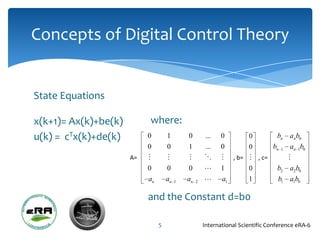
x(k+1)= Ax(k)+be(k)            where:
u(k) = cTx(k)+de(k)        0        1        0         ...   0         0          bn   anb0
                           0        0        1         ...   0         0      bn 1     an 1b0
                      A=                                     , b=  , c=          
                           0        0        0              1         0       b2      a2 b0
                           an       an   1   an   2         a1        1        b1     a1b0

                           and the Constant d=b0

                                5                     International Scientific Conference eRA-6
Concepts of Information
              & Control Theory
Group definition

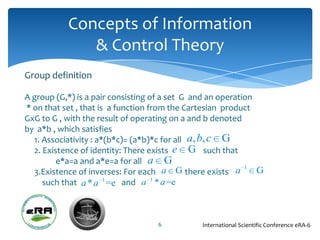
A group (G,*) is a pair consisting of a set G and an operation
* on that set , that is a function from the Cartesian product
GxG to G , with the result of operating on a and b denoted
by a*b , which satisfies
  1. Associativity : a*(b*c)= (a*b)*c for all a, b, c G
  2. Existence of identity: There exists e G such that
         e*a=a and a*e=a for all a G
                                                            1
  3.Existence of inverses: For each a G there exists a         G
     such that a * a 1 =e and a 1 * a =e


                                   6           International Scientific Conference eRA-6
Concepts of Information
                 & Control Theory
Cyclic Groups definition

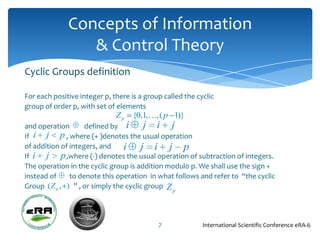
For each positive integer p, there is a group called the cyclic
group of order p, with set of elements
                              Zp   {0,1,,( p 1)}
and operation        defined by i       j i j
If i j p , where (+ )denotes the usual operation
of addition of integers, and     i j i j p
If i j       p ,where (-) denotes the usual operation of subtraction of integers.
The operation in the cyclic group is addition modulo p. We shall use the sign +
instead of      to denote this operation in what follows and refer to “the cyclic
Group ( Z p , ) ” , or simply the cyclic group Z
                                                 p


                                            7              International Scientific Conference eRA-6
Concepts of Information
                  & Control Theory
Ring definition
A ring is a triple ( R, , ) consisting of a set R, and two operations + and , referred
to as addition and multiplication, respectively, which satisfy the following conditions:

1.Associativity of +: a (b c) (a b) c, for all a,b,c R
2.Commutativity of +: a b b a for all a,b R
3.Existence of additive identity: there exists 0 R such that 0 a a and a 0 a for all a R
                                                                          a ( a) 0
4.Existence of additive inverses: for each a R there exists a R such that and ( a) a 0
5.Associativity of    : a (b c) (a b) c, for all a, b, c R
6. Distributivity of   over +: a (b c) (a b)(a c), for all a, b, c R


                                             8              International Scientific Conference eRA-6
Concepts of Information
                     & Control Theory

Cyclic Groups definition
For every positive integer p, there is a ring (Z p ,   , ) , called the cyclic ring of order p,
with set of elements
                                     Zp    {0,1,,( p 1)}

and operations + denoting addition modulo p, and           denoting multiplication modulo p


                                                   9               International Scientific Conference eRA-6
Modulo-2 Arithmetic


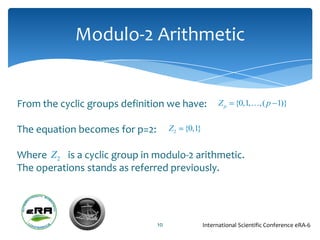
From the cyclic groups definition we have:           Zp     {0,1,,( p 1)}


The equation becomes for p=2:        Z2 {0,1}


Where Z 2 is a cyclic group in modulo-2 arithmetic.
The operations stands as referred previously.


                                10              International Scientific Conference eRA-6
State equations & modulo-2

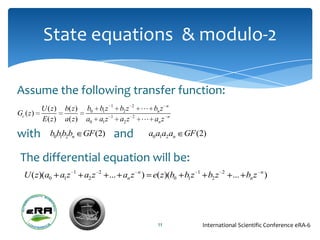
Assume the following transfer function:
                                      1
         U ( z)   b( z )   b0 b1 z        b2 z 2  bn z n
Gc ( z )                              1
         E( z)    a( z )   a0 a1 z        a2 z 2  an z n

with        b0b1b2bn       GF (2)         and     a0 a1a2an   GF (2)


 The differential equation will be:
                      1           2
  U ( z)(a0 a1z            a2 z       ... an z n ) e( z)(b0 b1z   1
                                                                        b2 z   2
                                                                                   ... bn z n )


                                                     11               International Scientific Conference eRA-6
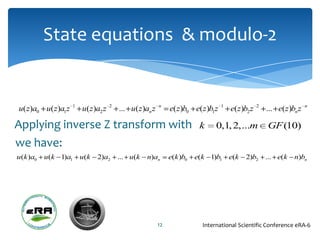
State equations & modulo-2


                   1               2                  n                       1               2                   n
u( z)a0 u( z)a1z       u( z)a2 z       ... u(z)an z        e(z )b0 e(z )b1z       e(z )b2 z       ... e(z )bn z

Applying inverse Z transform with                                     k     0,1, 2,...m           GF (10)
we have:
u(k )a0   u(k 1)a1     u(k   2)a2      ... u(k   n)an      e(k )b0   e(k 1)b1     e(k   2)b2      ... e(k   n)bn


                                                      12               International Scientific Conference eRA-6
State equations & modulo-2

The above differential
equation has the
following
direct hardware
realization:


                         Fig. 10.2.1, pg. 284 “Control Systems”, P.N. Paraskeuopoulos
                               13                International Scientific Conference eRA-6
State equations & modulo-2


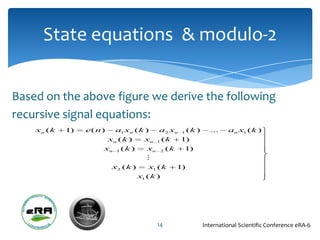
Based on the above figure we derive the following
recursive signal equations:
    xn ( k   1)   e( n )     a1 xn ( k )        a2 xn        1   (k )     ...    an x1 (k )
                           xn ( k )       xn    1   (k      1)
                       xn    1   (k )      xn      2   (k    1)
                                           
                            x2 ( k )       x1 ( k           1)
                                        x1 ( k )


                                                14                      International Scientific Conference eRA-6
State equations & modulo-2

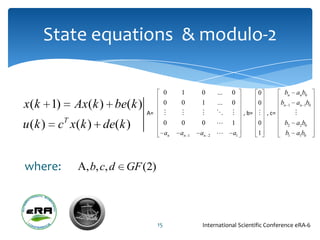
                                         0    1        0        ...   0         0        bn   anb0
x( k 1)     Ax ( k ) be( k )             0    0        1        ...   0         0      bn 1   an 1b0
                               A=                                     , b=  , c=        
u (k )   cT x( k ) de( k )               0    0        0             1         0       b2    a2 b0
                                         an   an   1   an   2        a1        1        b1   a1b0


where:         , b, c, d   GF (2)


                                    15                 International Scientific Conference eRA-6
Implementation in recursive
   convolutional coding


             16   International Scientific Conference eRA-6
Description of Recursive
 Convolutional Encoder


           17    International Scientific Conference eRA-6
Description of Recursive
            Convolutional Encoder

o The convolutionally encoding data, requires the use of n memory
  registers, each holding 1 input bit, unless otherwise specified. All
  memory      registers  start  with    a    value  of    zero    (0).

o The encoder has n modulo-2 adders and n generator polynomials

o Using the generator polynomials and the existing values in the
  remaining   registers,  the    encoder   outputs     n    bits.

o I(n) consists the Input data and C1,C2,Cn the output data


                                  18          International Scientific Conference eRA-6
Recursive Convolutional Encoder


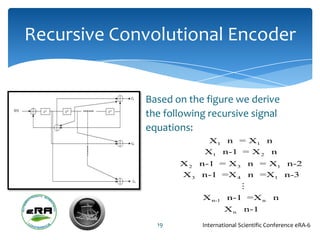
             Based on the figure we derive
             the following recursive signal
             equations:
                           X1 n = X1 n
                          X1 n-1 = X 2 n
                    X 2 n-1 = X 3 n = X1 n-2
                    X 3 n-1 =X 4 n =X1 n-3
                                     
                         X n-1    n-1 =X n         n
                                 Xn     n-1

               19        International Scientific Conference eRA-6
Algebraic Form of State Equations of
  Recursive Convolutional Encoder in modulo-2


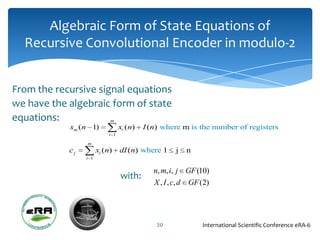
From the recursive signal equations
we have the algebraic form of state
equations:                  m
            xm (n 1)             xi (n)   I (n) where m is the number of registers
                           i 1

                 m
            cj         xi (n)    dI (n) where 1     j   n
                 i 1


                                             n, m, i, j GF (10)
                                 with:
                                             X , I , c, d GF (2)


                                              20             International Scientific Conference eRA-6
Vector Form of State Equations of Recursive
       Convolutional Encoder in modulo-2


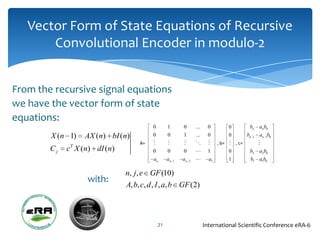
From the recursive signal equations
we have the vector form of state
equations:
                                         0        1        0        ...     0         0        bn   anb0
        X (n 1)   AX (n) bI (n)          0        0        1        ...     0         0      bn 1   an 1b0
                                    A=                                      , b=  , c=        
        Cj   cT X (n) dI (n)             0        0        0               1         0       b2    a2 b0
                                         an       an   1   an   2          a1        1        b1   a1b0

                               n, j, e GF (10)
                   with:
                               A, b, c, d , I , a, b GF (2)


                                             21                           International Scientific Conference eRA-6
Numerical Example


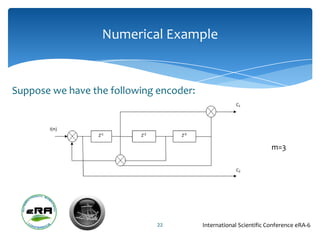
Suppose we have the following encoder:


                                                                   m=3


                              22         International Scientific Conference eRA-6
Numerical Example


By applying the recursive signal formula for this particular model
we have:
                         X1(n)=X1(n)

                         X1(n-1)=X2(n)

                         X2(n-1)=X3(n)

                         X3(n-1)=X1(n)-I(n)-X3(n)-X2(n)


                                       23           International Scientific Conference eRA-6
Numerical Example


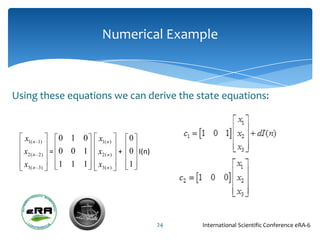
Using these equations we can derive the state equations:


  x1( n   1)
                 0 1 0   x1( n )   0
  x2( n   2)   = 0 0 1   x2( n ) + 0 I(n)
  x3( n   3)
                 1 1 1   x3( n )   1


                                            24   International Scientific Conference eRA-6
Numerical Example


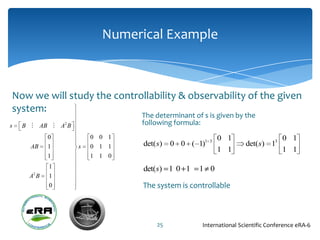
Now we will study the controllability & observability of the given
system:
                                The determinant of s is given by the
s   B  AB  A2 B               following formula:
           0            0 0 1                            0 1                 0 1
                                                   1 3                        3
      AB   1        s   0 1 1   det( s)   0 0 ( 1)                 det( s) 1
                                                         1 1                 1 1
           1            1 1 0
           1                    det(s) 1 0 1      1 0
       2
      AB   1
           0                    The system is controllable


                                     25            International Scientific Conference eRA-6
Numerical Example


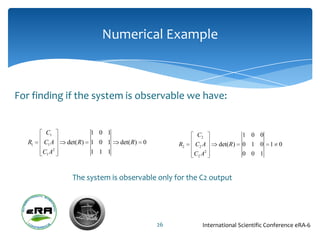
For finding if the system is observable we have:


         C1               1 0 1                          C2                  1 0 0
   R1   C1 A    det( R)   1 0 1   det( R) 0        R2   C2 A      det( R )   0 1 0   1 0
        C1 A2             1 1 1                         C2 A 2               0 0 1


                  The system is observable only for the C2 output


                                              26            International Scientific Conference eRA-6
Thank you for your attention


Evariste Galois
  1811-1832


                     27      International Scientific Conference eRA-6

State equations model based on modulo 2 arithmetic and its applciation on recursice convolutional coding

  • 1.
    State equations modelbased on modulo-2 arithmetic and its application on recursive convolutional coding Ch. N. Tasiopoulos, A.A. Fotopoulos, K.P. Peppas, P.H. Yannakopoulos International Scientific Conference eRA-6
  • 2.
    Introduction According to thetheory of control systems, a time- invariant system can be represented by a block diagram with feedback for error correction, such a system can be modeled by state equations. These equations can be derived from the transfer function of the given system, expressed in zeta transformation. 2 International Scientific Conference eRA-6
  • 3.
    Concepts of DigitalTheory A discrete time controller can be described from the transfer function: 1 U ( z) b( z ) b0 b1 z b2 z 2  bn z n Gc ( z ) 1 E( z) a( z ) a0 a1 z a2 z 2  an z n 3 International Scientific Conference eRA-6
  • 4.
    Concepts of DigitalTheory Direct hardware realization model Fig. 10.2.1, pg. 284 “Control Systems”, P.N. Paraskeuopoulos 4 International Scientific Conference eRA-6
  • 5.
    Concepts of DigitalControl Theory State Equations x(k+1)= Ax(k)+be(k) where: u(k) = cTx(k)+de(k) 0 1 0 ... 0 0 bn anb0 0 0 1 ... 0 0 bn 1 an 1b0 A=      , b=  , c=  0 0 0  1 0 b2 a2 b0 an an 1 an 2  a1 1 b1 a1b0 and the Constant d=b0 5 International Scientific Conference eRA-6
  • 6.
    Concepts of Information & Control Theory Group definition A group (G,*) is a pair consisting of a set G and an operation * on that set , that is a function from the Cartesian product GxG to G , with the result of operating on a and b denoted by a*b , which satisfies 1. Associativity : a*(b*c)= (a*b)*c for all a, b, c G 2. Existence of identity: There exists e G such that e*a=a and a*e=a for all a G 1 3.Existence of inverses: For each a G there exists a G such that a * a 1 =e and a 1 * a =e 6 International Scientific Conference eRA-6
  • 7.
    Concepts of Information & Control Theory Cyclic Groups definition For each positive integer p, there is a group called the cyclic group of order p, with set of elements Zp {0,1,,( p 1)} and operation defined by i j i j If i j p , where (+ )denotes the usual operation of addition of integers, and i j i j p If i j p ,where (-) denotes the usual operation of subtraction of integers. The operation in the cyclic group is addition modulo p. We shall use the sign + instead of to denote this operation in what follows and refer to “the cyclic Group ( Z p , ) ” , or simply the cyclic group Z p 7 International Scientific Conference eRA-6
  • 8.
    Concepts of Information & Control Theory Ring definition A ring is a triple ( R, , ) consisting of a set R, and two operations + and , referred to as addition and multiplication, respectively, which satisfy the following conditions: 1.Associativity of +: a (b c) (a b) c, for all a,b,c R 2.Commutativity of +: a b b a for all a,b R 3.Existence of additive identity: there exists 0 R such that 0 a a and a 0 a for all a R a ( a) 0 4.Existence of additive inverses: for each a R there exists a R such that and ( a) a 0 5.Associativity of : a (b c) (a b) c, for all a, b, c R 6. Distributivity of over +: a (b c) (a b)(a c), for all a, b, c R 8 International Scientific Conference eRA-6
  • 9.
    Concepts of Information & Control Theory Cyclic Groups definition For every positive integer p, there is a ring (Z p , , ) , called the cyclic ring of order p, with set of elements Zp {0,1,,( p 1)} and operations + denoting addition modulo p, and denoting multiplication modulo p 9 International Scientific Conference eRA-6
  • 10.
    Modulo-2 Arithmetic From thecyclic groups definition we have: Zp {0,1,,( p 1)} The equation becomes for p=2: Z2 {0,1} Where Z 2 is a cyclic group in modulo-2 arithmetic. The operations stands as referred previously. 10 International Scientific Conference eRA-6
  • 11.
    State equations &modulo-2 Assume the following transfer function: 1 U ( z) b( z ) b0 b1 z b2 z 2  bn z n Gc ( z ) 1 E( z) a( z ) a0 a1 z a2 z 2  an z n with b0b1b2bn GF (2) and a0 a1a2an GF (2) The differential equation will be: 1 2 U ( z)(a0 a1z a2 z ... an z n ) e( z)(b0 b1z 1 b2 z 2 ... bn z n ) 11 International Scientific Conference eRA-6
  • 12.
    State equations &modulo-2 1 2 n 1 2 n u( z)a0 u( z)a1z u( z)a2 z ... u(z)an z e(z )b0 e(z )b1z e(z )b2 z ... e(z )bn z Applying inverse Z transform with k 0,1, 2,...m GF (10) we have: u(k )a0 u(k 1)a1 u(k 2)a2 ... u(k n)an e(k )b0 e(k 1)b1 e(k 2)b2 ... e(k n)bn 12 International Scientific Conference eRA-6
  • 13.
    State equations &modulo-2 The above differential equation has the following direct hardware realization: Fig. 10.2.1, pg. 284 “Control Systems”, P.N. Paraskeuopoulos 13 International Scientific Conference eRA-6
  • 14.
    State equations &modulo-2 Based on the above figure we derive the following recursive signal equations: xn ( k 1) e( n ) a1 xn ( k ) a2 xn 1 (k ) ... an x1 (k ) xn ( k ) xn 1 (k 1) xn 1 (k ) xn 2 (k 1)  x2 ( k ) x1 ( k 1) x1 ( k ) 14 International Scientific Conference eRA-6
  • 15.
    State equations &modulo-2 0 1 0 ... 0 0 bn anb0 x( k 1) Ax ( k ) be( k ) 0 0 1 ... 0 0 bn 1 an 1b0 A=      , b=  , c=  u (k ) cT x( k ) de( k ) 0 0 0  1 0 b2 a2 b0 an an 1 an 2  a1 1 b1 a1b0 where: , b, c, d GF (2) 15 International Scientific Conference eRA-6
  • 16.
    Implementation in recursive convolutional coding 16 International Scientific Conference eRA-6
  • 17.
    Description of Recursive Convolutional Encoder 17 International Scientific Conference eRA-6
  • 18.
    Description of Recursive Convolutional Encoder o The convolutionally encoding data, requires the use of n memory registers, each holding 1 input bit, unless otherwise specified. All memory registers start with a value of zero (0). o The encoder has n modulo-2 adders and n generator polynomials o Using the generator polynomials and the existing values in the remaining registers, the encoder outputs n bits. o I(n) consists the Input data and C1,C2,Cn the output data 18 International Scientific Conference eRA-6
  • 19.
    Recursive Convolutional Encoder Based on the figure we derive the following recursive signal equations: X1 n = X1 n X1 n-1 = X 2 n X 2 n-1 = X 3 n = X1 n-2 X 3 n-1 =X 4 n =X1 n-3  X n-1 n-1 =X n n Xn n-1 19 International Scientific Conference eRA-6
  • 20.
    Algebraic Form ofState Equations of Recursive Convolutional Encoder in modulo-2 From the recursive signal equations we have the algebraic form of state equations: m xm (n 1) xi (n) I (n) where m is the number of registers i 1 m cj xi (n) dI (n) where 1 j n i 1 n, m, i, j GF (10) with: X , I , c, d GF (2) 20 International Scientific Conference eRA-6
  • 21.
    Vector Form ofState Equations of Recursive Convolutional Encoder in modulo-2 From the recursive signal equations we have the vector form of state equations: 0 1 0 ... 0 0 bn anb0 X (n 1) AX (n) bI (n) 0 0 1 ... 0 0 bn 1 an 1b0 A=      , b=  , c=  Cj cT X (n) dI (n) 0 0 0  1 0 b2 a2 b0 an an 1 an 2  a1 1 b1 a1b0 n, j, e GF (10) with: A, b, c, d , I , a, b GF (2) 21 International Scientific Conference eRA-6
  • 22.
    Numerical Example Suppose wehave the following encoder: m=3 22 International Scientific Conference eRA-6
  • 23.
    Numerical Example By applyingthe recursive signal formula for this particular model we have: X1(n)=X1(n) X1(n-1)=X2(n) X2(n-1)=X3(n) X3(n-1)=X1(n)-I(n)-X3(n)-X2(n) 23 International Scientific Conference eRA-6
  • 24.
    Numerical Example Using theseequations we can derive the state equations: x1( n 1) 0 1 0 x1( n ) 0 x2( n 2) = 0 0 1 x2( n ) + 0 I(n) x3( n 3) 1 1 1 x3( n ) 1 24 International Scientific Conference eRA-6
  • 25.
    Numerical Example Now wewill study the controllability & observability of the given system: The determinant of s is given by the s B  AB  A2 B following formula: 0 0 0 1 0 1 0 1 1 3 3 AB 1 s 0 1 1 det( s) 0 0 ( 1) det( s) 1 1 1 1 1 1 1 1 0 1 det(s) 1 0 1 1 0 2 AB 1 0 The system is controllable 25 International Scientific Conference eRA-6
  • 26.
    Numerical Example For findingif the system is observable we have: C1 1 0 1 C2 1 0 0 R1 C1 A det( R) 1 0 1 det( R) 0 R2 C2 A det( R ) 0 1 0 1 0 C1 A2 1 1 1 C2 A 2 0 0 1 The system is observable only for the C2 output 26 International Scientific Conference eRA-6
  • 27.
    Thank you foryour attention Evariste Galois 1811-1832 27 International Scientific Conference eRA-6