

By
CHANDAN
M.E. SCHOLAR,
NATIONAL INSTITUTE OF TECHNICAL TEACHERS TRANINING AND RESEARCH
(NITTTR), CHANDIGARH, INDIA
(PAPER ID - 28)
AN INTELLIGENT MACHINE
LEARNING MODEL FOR SOIL
IMAGE CLASSIFICATION
2
Contents of the presentation
• Introduction
• Introduction to Soil Classification
• Introduction to Machine Learning
Techniques
• Image Processing as a method for
Machine Learning Technique
• Initial findings from Literature
Review.
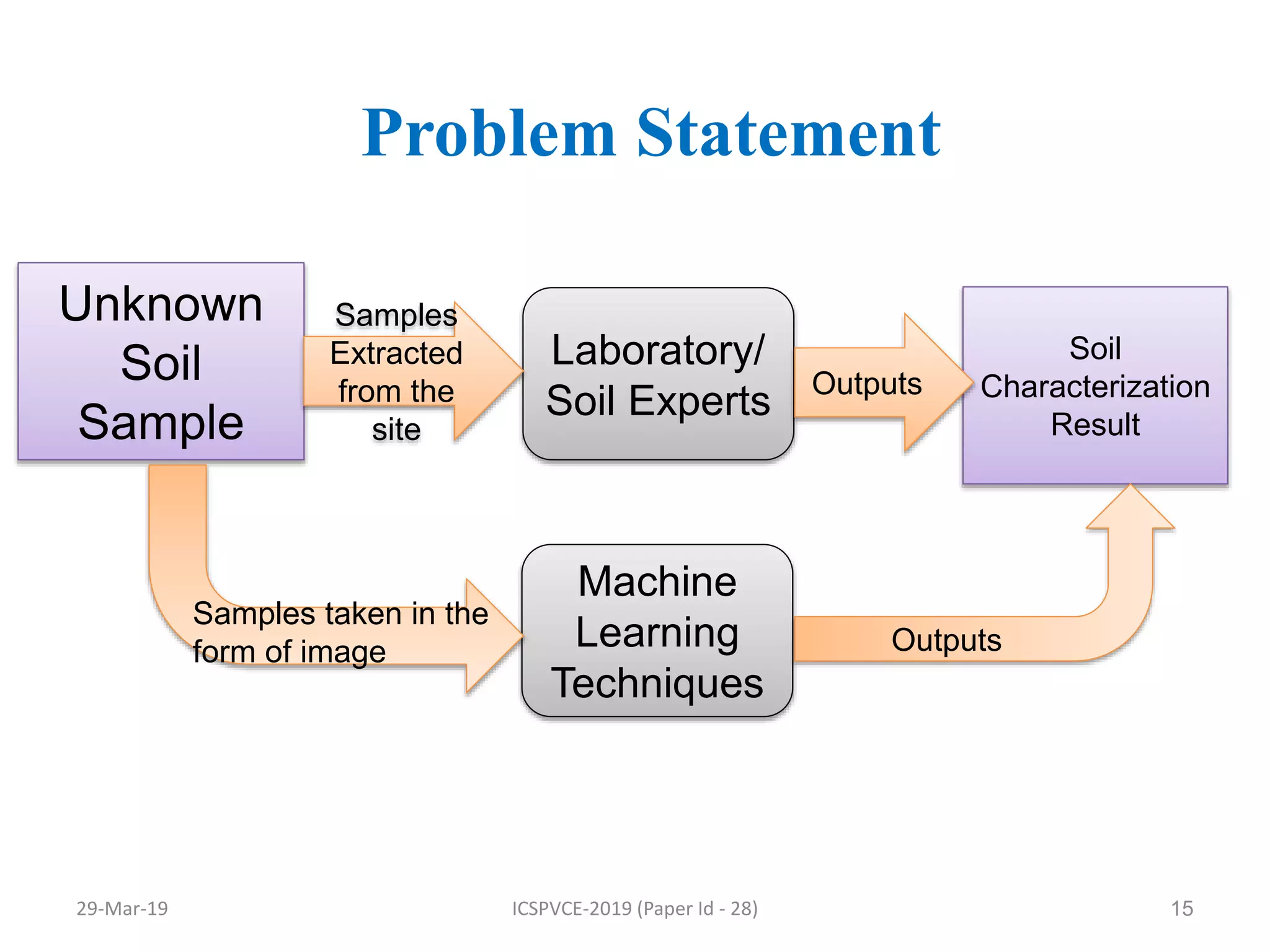
• Problem Statement
• Objectives
• Our approach
• Methodology
• Experimental Work
• Results and Discussion
• References
29-Mar-19 ICSPVCE-2019 (Paper Id - 28)
3
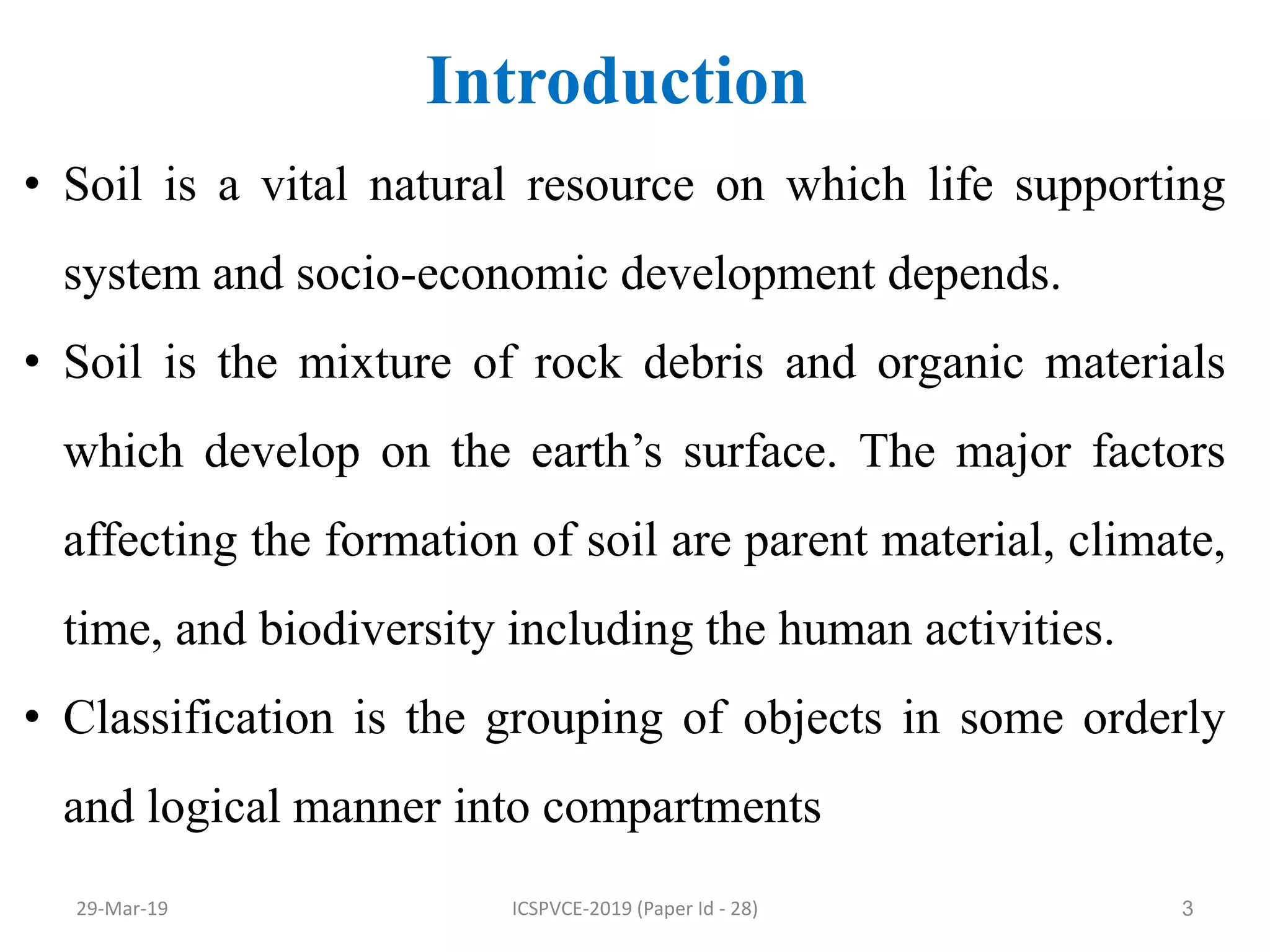
Introduction
• Soil is a vital natural resource on which life supporting
system and socio-economic development depends.
• Soil is the mixture of rock debris and organic materials
which develop on the earth’s surface. The major factors
affecting the formation of soil are parent material, climate,
time, and biodiversity including the human activities.
• Classification is the grouping of objects in some orderly
and logical manner into compartments
29-Mar-19 ICSPVCE-2019 (Paper Id - 28)
4
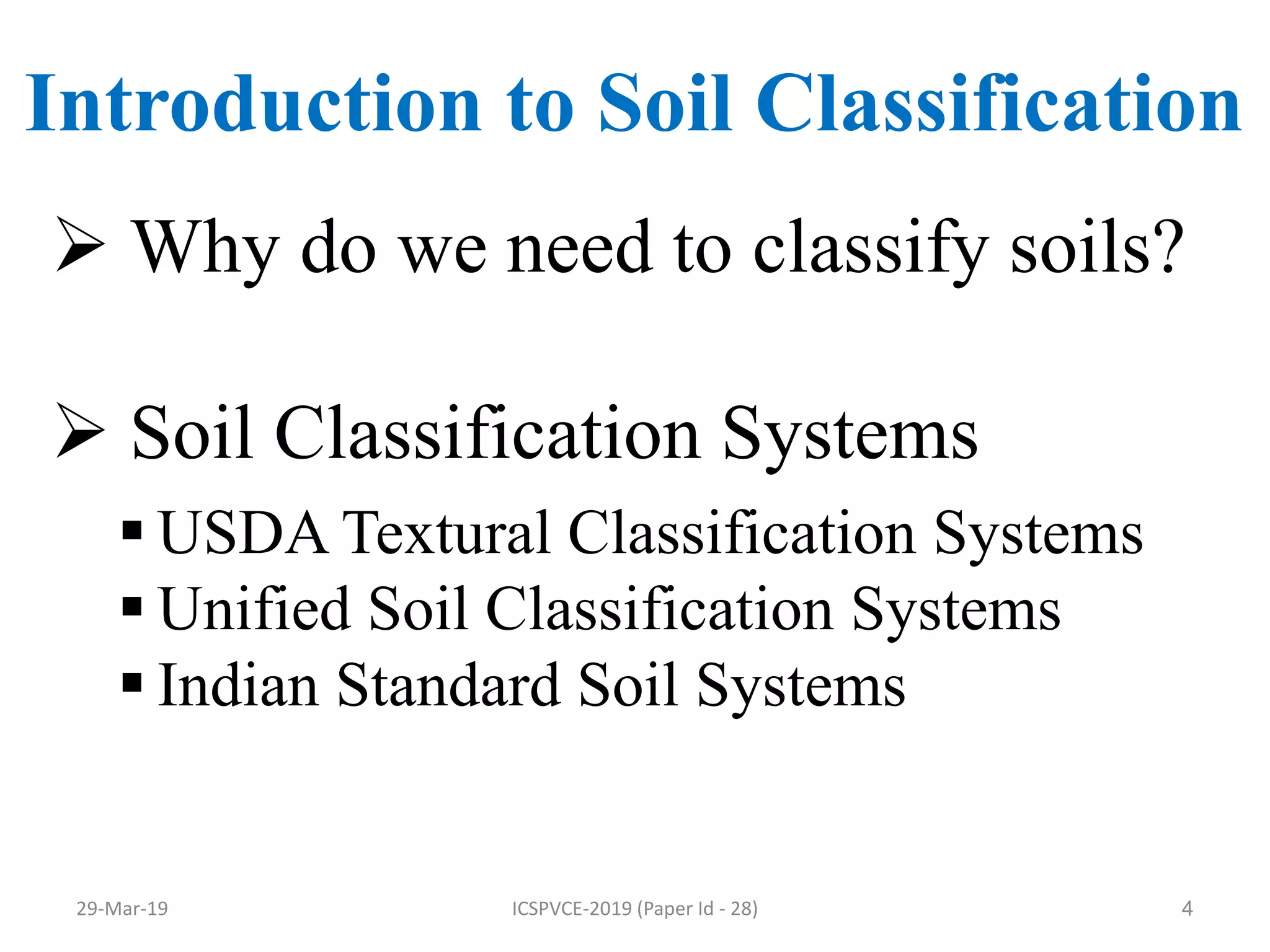
Introduction to Soil Classification
 Why do we need to classify soils?
 Soil Classification Systems
 USDA Textural Classification Systems
 Unified Soil Classification Systems
 Indian Standard Soil Systems
29-Mar-19 ICSPVCE-2019 (Paper Id - 28)
5
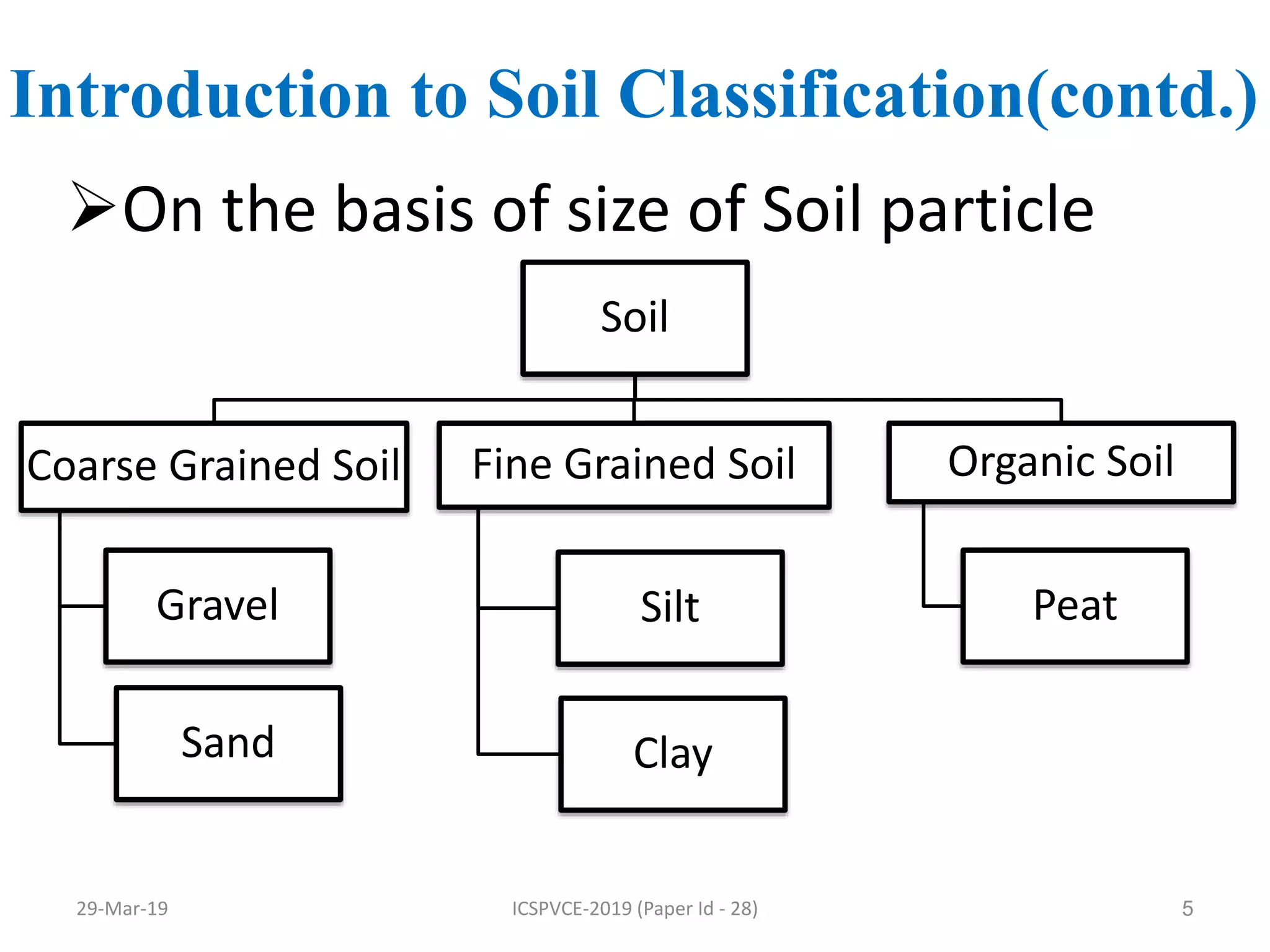
Introduction to Soil Classification(contd.)
On the basis of size of Soil particle
Soil
Coarse Grained Soil
Gravel
Sand
Fine Grained Soil
Silt
Clay
Organic Soil
Peat
29-Mar-19 ICSPVCE-2019 (Paper Id - 28)
6
Introduction to Soil Classification(contd.)
On the basis of size of Soil particle
29-Mar-19 ICSPVCE-2019 (Paper Id - 28)
7
Introduction to Soil Classification(contd.)
On the basis of size of Soil particle
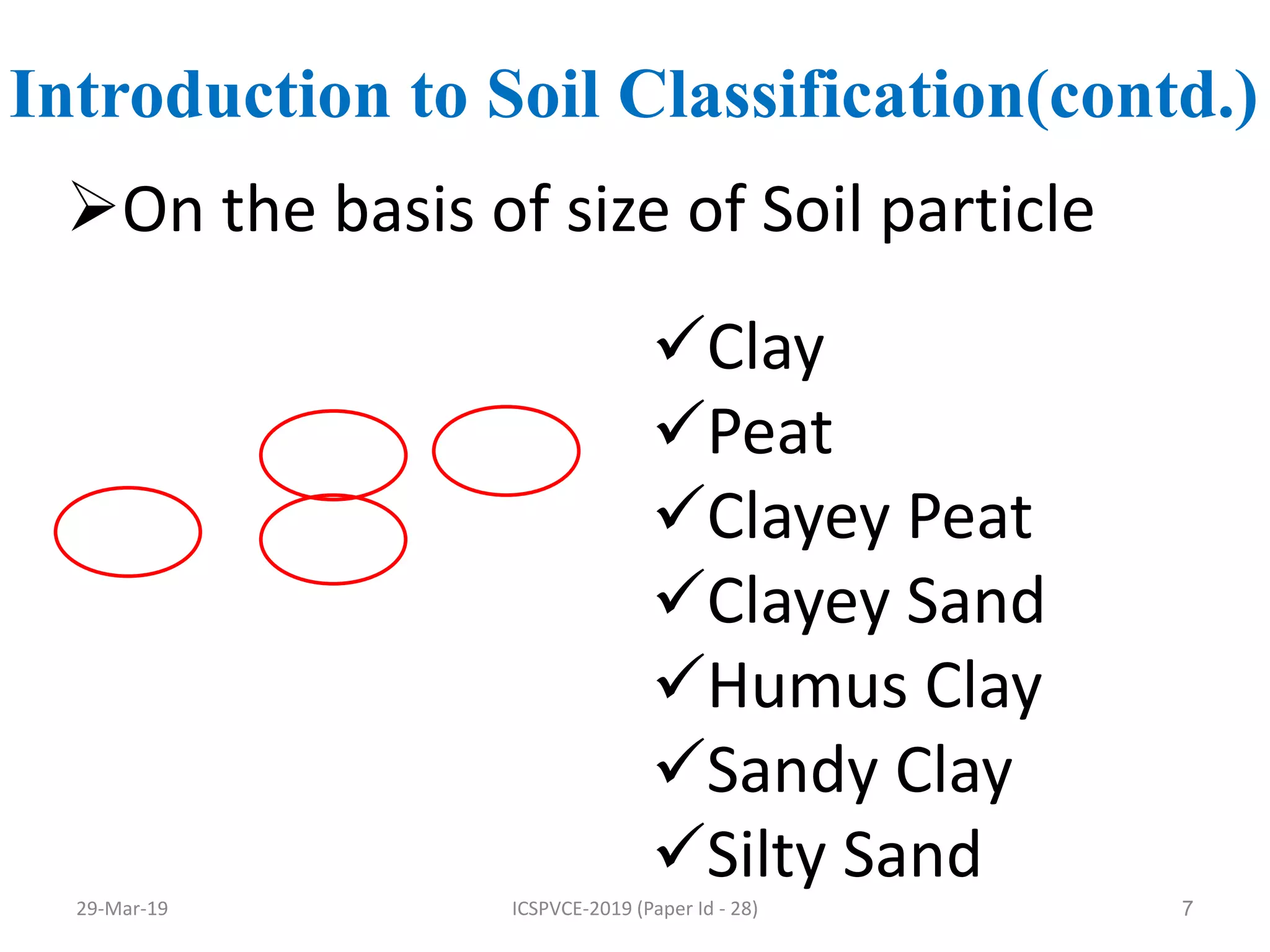
Clay
Peat
Clayey Peat
Clayey Sand
Humus Clay
Sandy Clay
Silty Sand
29-Mar-19 ICSPVCE-2019 (Paper Id - 28)
8
Introduction to
Machine Learning Techniques
 Machine Learning (ML) and
Artificial Intelligence(AI).
 What we need for ML ?
 Types of ML?
29-Mar-19 ICSPVCE-2019 (Paper Id - 28)
9
Introduction to
Machine Learning Techniques
 Machine Learning (ML) and
Artificial Intelligence(AI).
 What we need for ML ?
 Types of ML?
A Huge Dataset
A Classifier
29-Mar-19 ICSPVCE-2019 (Paper Id - 28)
10
Introduction to
Machine Learning Techniques
 Machine Learning (ML) and
Artificial Intelligence(AI).
 What we need for ML ?
 Types of ML?
Supervised Learning
Unsupervised Learning
Reinforcement Learning
29-Mar-19 ICSPVCE-2019 (Paper Id - 28)
11
Image Processing as a method
for Machine Learning
oTypes of Images.
oFeatures in an Image.
oFeature Detection.
oFeature Extraction
29-Mar-19 ICSPVCE-2019 (Paper Id - 28)
12
Image Processing as a method
for Machine Learning
oTypes of Images.
oFeatures in an Image.
oFeature Detection.
oFeature Extraction
Why use
features
and not
pixel
values?
29-Mar-19 ICSPVCE-2019 (Paper Id - 28)
13
Initial findings from Literature
Review
Prior to the construction of engineering structures,
it is required to inspect the site to determine its
suitability for the intended structure[1].
Four major in situ tests include Standard
Penetration Test (SPT)[2], Cone Penetration Test
(CPT)[3], Pressure Meter Test (PMT)[4], and Vane
Shear Test (VST).
Image classification using ML refers to the process
of labeling a wide set of images into a number of
predefined categories, decided by the user’s
requirement[5].
29-Mar-19 ICSPVCE-2019 (Paper Id - 28)
14
Inferences Drawn out of
Literature Review
With the advancement of image
classification research procedures, many
advance techniques for classification such as
ANN, SVM, Fuzzy classification and k-NN
have been developed[6][7].
SVM has been identified as a better method
than ANN and k-NN for classification[8].
29-Mar-19 ICSPVCE-2019 (Paper Id - 28)
15
Unknown
Soil
Sample
Soil
Characterization
Result
Laboratory/
Soil Experts
Samples
Extracted
from the
site
Outputs
Machine
Learning
Techniques
Outputs
Samples taken in the
form of image
Problem Statement
29-Mar-19 ICSPVCE-2019 (Paper Id - 28)
Objectives
1. Study of various conventional and machine learning soil
classification techniques and methods.
2. Comparative study of various already implemented machine
learning techniques for soil classification
3. Comparison of results of best machine learning techniques
4. Development of a user friendly GUI using the selected
machine learning technique.
• Seven standard soil types are chosen for preliminary
classification of soil.
• Best machine learning techniques are tested on the sample
data
• GUI is developed for easy and portable classification.
Approach
1629-Mar-19 ICSPVCE-2019 (Paper Id - 28)
Methodology
17
Soil Image
Data Set
Image
Preprocessing
Feature
Extraction
Training of SVM Model
Training of k-NN Model
Training of ANN Model
Accuracy
Comparison
Classifier
Selection
Development of
GUI29-Mar-19 ICSPVCE-2019 (Paper Id - 28)
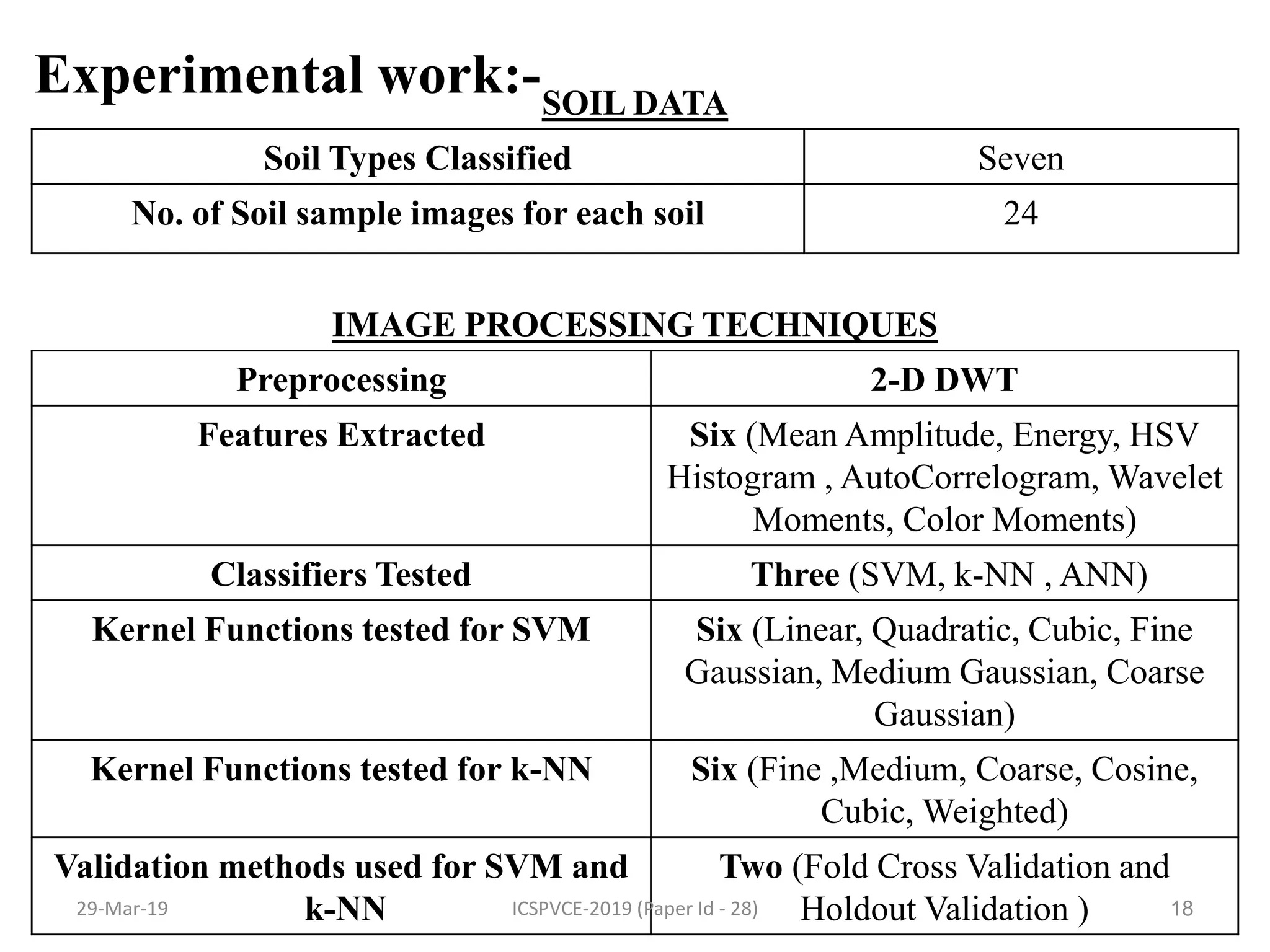
Experimental work:-
18
SOIL DATA
Soil Types Classified Seven
No. of Soil sample images for each soil 24
IMAGE PROCESSING TECHNIQUES
Preprocessing 2-D DWT
Features Extracted Six (Mean Amplitude, Energy, HSV
Histogram , AutoCorrelogram, Wavelet
Moments, Color Moments)
Classifiers Tested Three (SVM, k-NN , ANN)
Kernel Functions tested for SVM Six (Linear, Quadratic, Cubic, Fine
Gaussian, Medium Gaussian, Coarse
Gaussian)
Kernel Functions tested for k-NN Six (Fine ,Medium, Coarse, Cosine,
Cubic, Weighted)
Validation methods used for SVM and
k-NN
Two (Fold Cross Validation and
Holdout Validation )29-Mar-19 ICSPVCE-2019 (Paper Id - 28)
Results and Discussion
19
KNN at Cross
Validation
factor 12
MeanAmplitude
WaveletMomentsAutoCorrelogram
HSVHistogram
ColorMoments
Energy
EnergyEnergy
Energy Energy
29-Mar-19 ICSPVCE-2019 (Paper Id - 28)
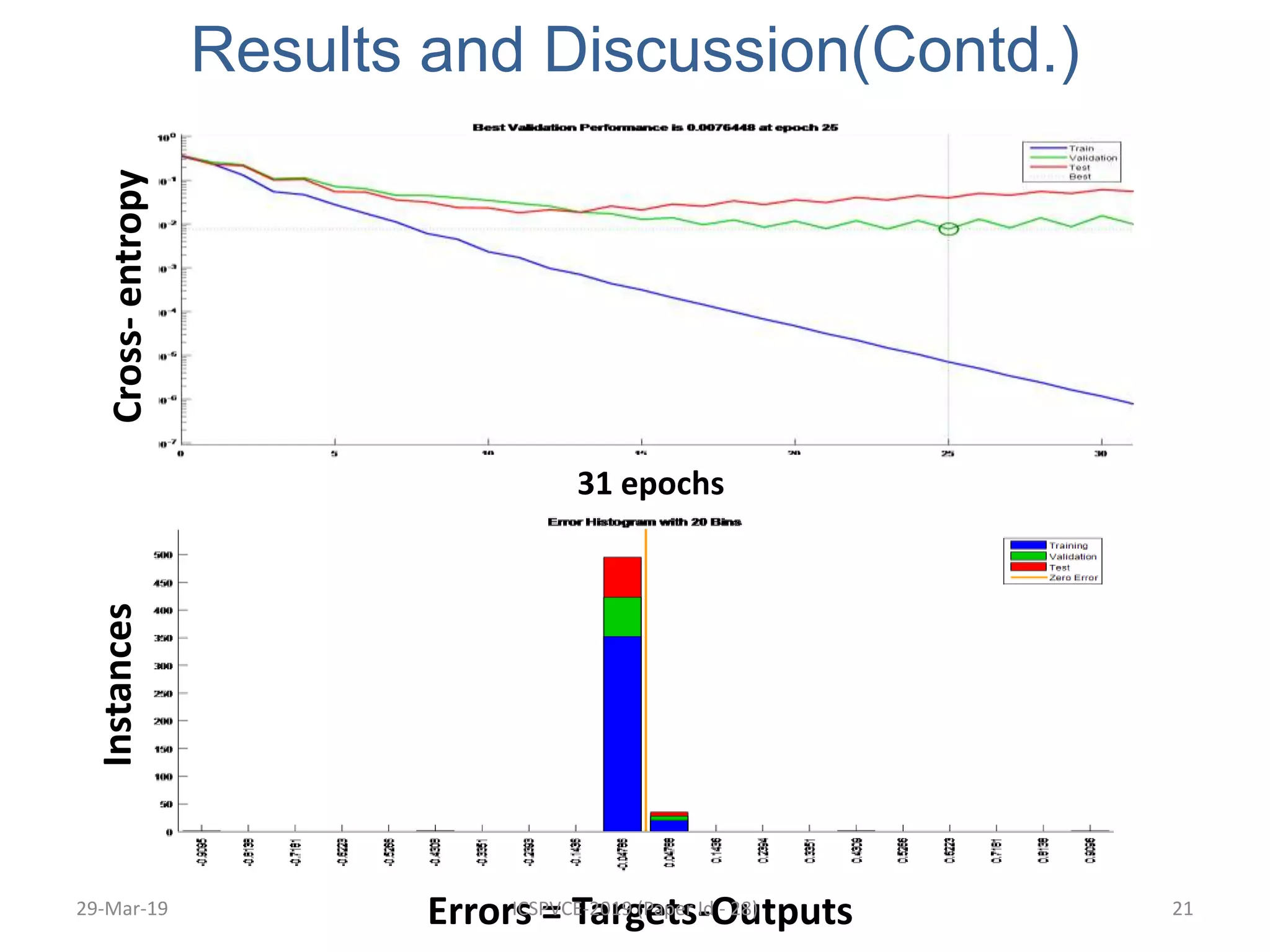
Results and Discussion(Contd.)
20
SVM at Fold
Cross Validation
40%
TrueClass
TrueClass
TrueClass
Predicted Class Predicted Class
Predicted Class
29-Mar-19 ICSPVCE-2019 (Paper Id - 28)
Results and Discussion(Contd.)
21
31 epochs
Cross-entropyInstances
Errors = Targets-Outputs29-Mar-19 ICSPVCE-2019 (Paper Id - 28)
Results and Discussion(Contd.)
22
1. Clay
2. Peat
3. Clayey Peat
4. Clayey Sand
5. Humus Clay
6. Sandy Clay
7. Silty Sand
29-Mar-19 ICSPVCE-2019 (Paper Id - 28)
Results and Discussion(Contd.)
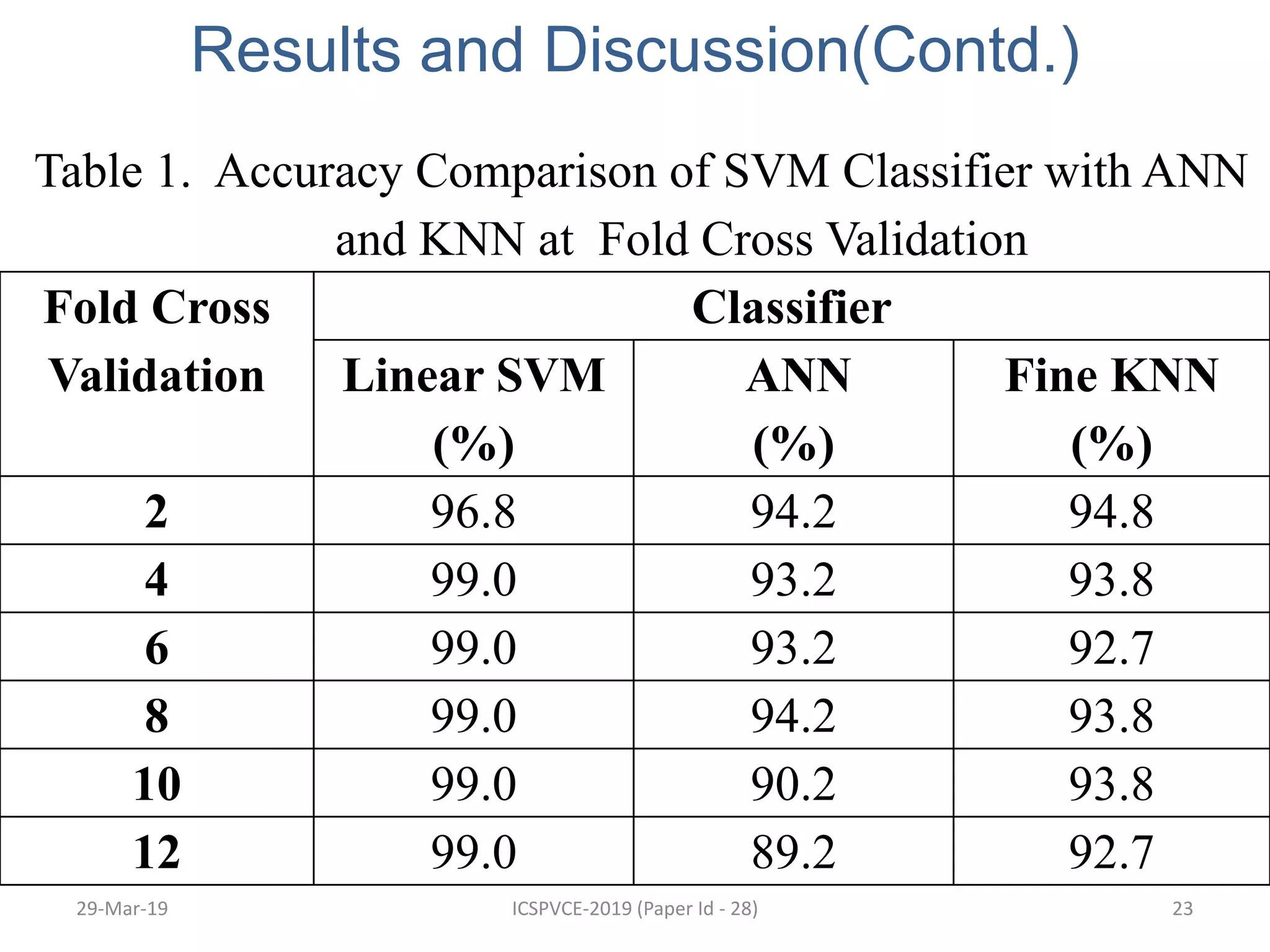
23
Table 1. Accuracy Comparison of SVM Classifier with ANN
and KNN at Fold Cross Validation
Fold Cross
Validation
Classifier
Linear SVM
(%)
ANN
(%)
Fine KNN
(%)
2 96.8 94.2 94.8
4 99.0 93.2 93.8
6 99.0 93.2 92.7
8 99.0 94.2 93.8
10 99.0 90.2 93.8
12 99.0 89.2 92.7
29-Mar-19 ICSPVCE-2019 (Paper Id - 28)
Results and Discussion(Contd.)
24
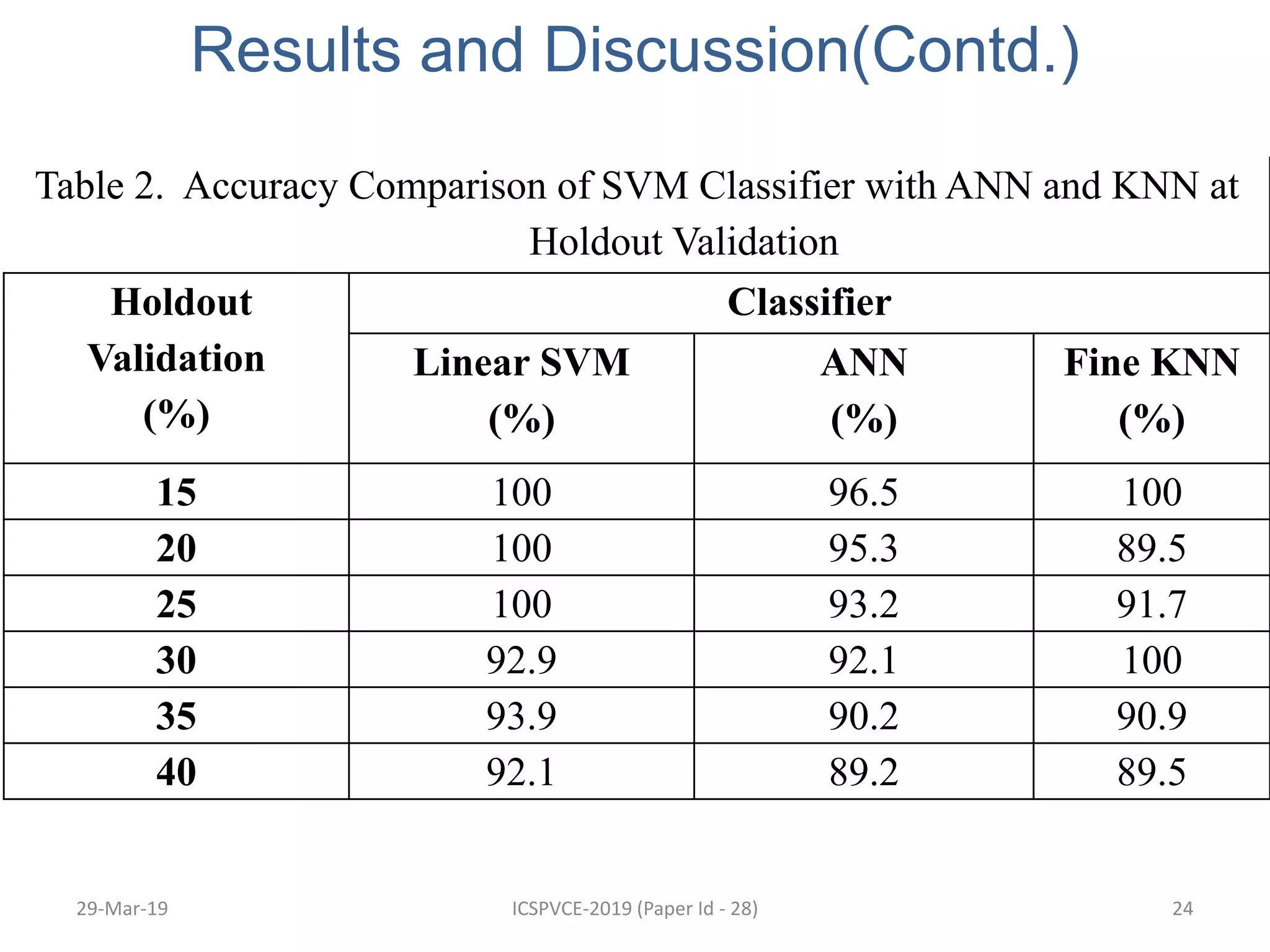
Table 2. Accuracy Comparison of SVM Classifier with ANN and KNN at
Holdout Validation
Holdout
Validation
(%)
Classifier
Linear SVM
(%)
ANN
(%)
Fine KNN
(%)
15 100 96.5 100
20 100 95.3 89.5
25 100 93.2 91.7
30 92.9 92.1 100
35 93.9 90.2 90.9
40 92.1 89.2 89.5
29-Mar-19 ICSPVCE-2019 (Paper Id - 28)
Results and Discussion(Contd.)
25
70
75
80
85
90
95
100
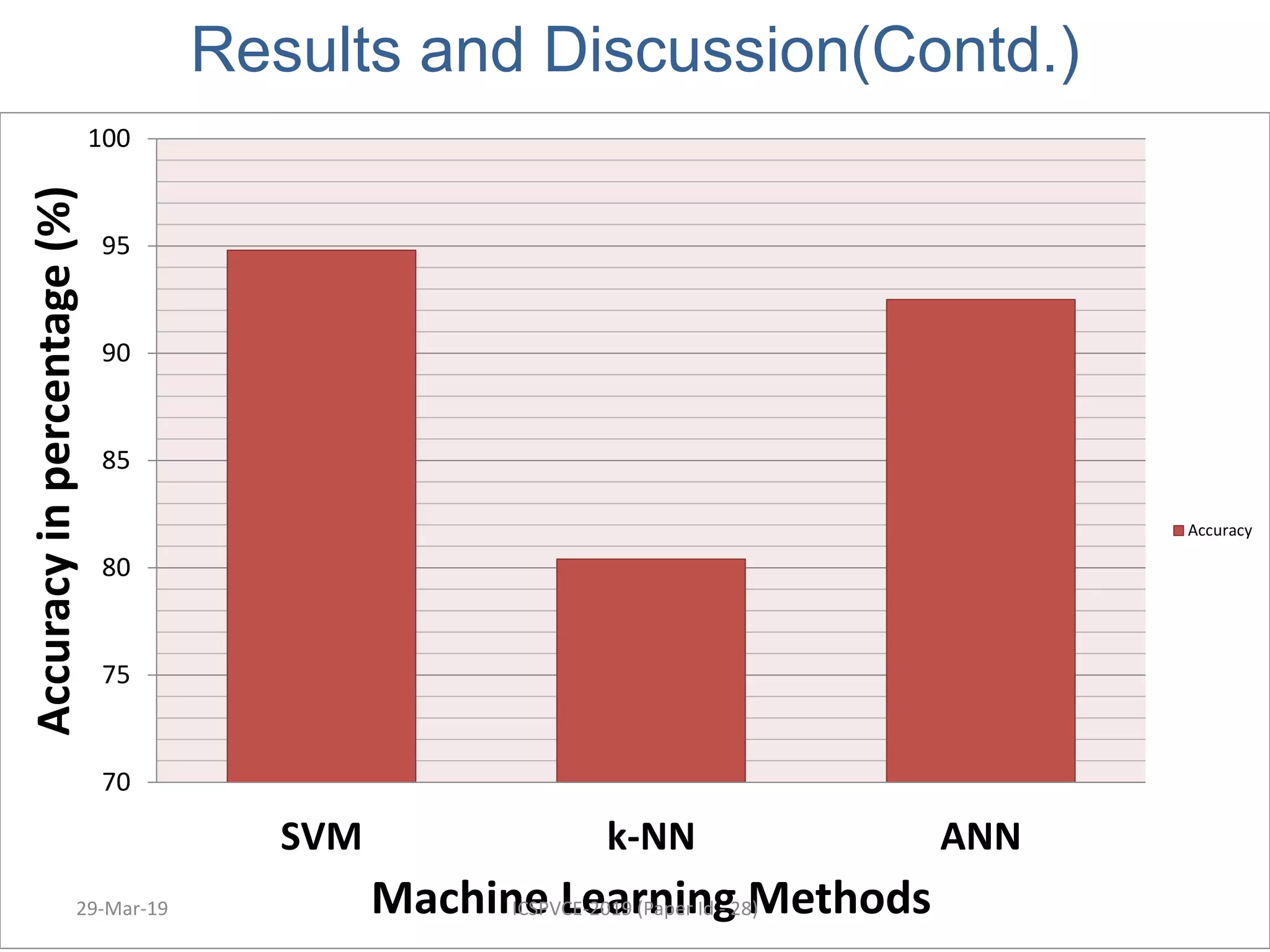
SVM k-NN ANN
Accuracyinpercentage(%)
Machine Learning Methods
Accuracy
29-Mar-19 ICSPVCE-2019 (Paper Id - 28)
Results and Discussion(Contd.)
26
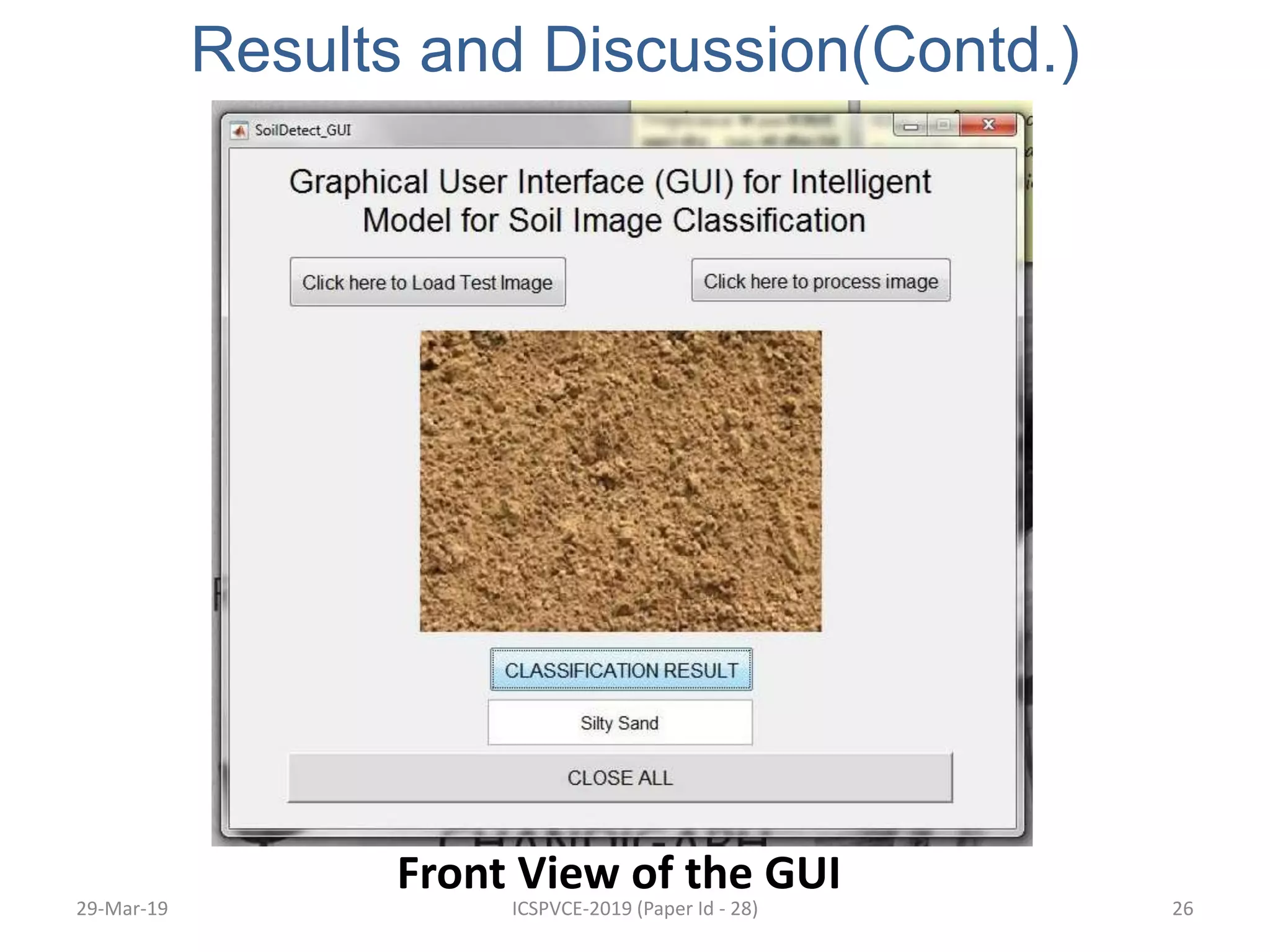
Front View of the GUI
29-Mar-19 ICSPVCE-2019 (Paper Id - 28)
27
Conclusion
1. Machine Learning methods can make the complicated
tasks of soil classification simple.
2. SVM has highest classification accuracy , when compared
with other classifiers namely ANN and k-NN in both cases
at fold cross validation and holdout validation.
3. With the development of GUI , the classification
procedure using machine learning can be made user-
friendly.
29-Mar-19 ICSPVCE-2019 (Paper Id - 28)
28
References
[1]. BB Mishra. “Indian System of Soil Classification: A way
Forward”, Agri Res & Tech, vol. 3, no.2, 2016.
[2]. Wazoh, H. and Mallo, “Standard Penetration Test in
Engineering Geological Site Investigations – A Review”, The
International Journal Of Engineering And Science, vol 3, no.
7, pp. 40-48, 2014
[3]. Adrian-Traian Iliesi, Ana-Luciana Tofan And Diego Lo
Presti .2012. “Use Of Cone Penetration Tests And Cone
Penetration Tests With Porewater Pressure Measurement
For Difficult Soils Profiling”, Bul. Inst. Polit. Iaşi, T. Lviii ,Vol.
3,2012
[4]. Frikha, Wissem & burlon, Sebastien & Monaco, Paola,”
Session report: Pressure meter and Dilatometer” , 2016.
29-Mar-19 ICSPVCE-2019 (Paper Id - 28)
29
References (Contd.)
[5]. Bhattacharya, Biswanath, and Dimitri P. Solomatine.
"Machine learning in soil classification", Neural networks ,
vol.19, no.2, pp.186-195,2006.
[6]. Ashwini Rao, Janhavi, Abhishek Gowda, Manjunath,
Mrs. Rafega Beham, “Machine Learning in Soil Classification
and Crop Detection”, International Journal for Scientific
Research & Development, Vol. 4, No. 1, 2016
[7]. MilošKovačević ,BranislavBajat, Boško Gajić, “Soil type
classification and estimation of soil properties using support
vector machines”, Geoderma, Vol. 154, pp. 340–347, 2010
[8]. Małgorzata Charytanowicz and Piotr Kulczycki, An
Image Analysis Algorithm for Soil Structure Identification,
Intelligent Systems, Vol. 323, pp. 681-691, 2015
29-Mar-19 ICSPVCE-2019 (Paper Id - 28)
Thank You.
29-Mar-19 ICSPVCE-2019 (Paper Id - 28) 30

AN INTELLIGENT MACHINE LEARNING MODEL FOR SOIL IMAGE CLASSIFICATION

  • 1.
    By CHANDAN M.E. SCHOLAR, NATIONAL INSTITUTEOF TECHNICAL TEACHERS TRANINING AND RESEARCH (NITTTR), CHANDIGARH, INDIA (PAPER ID - 28) AN INTELLIGENT MACHINE LEARNING MODEL FOR SOIL IMAGE CLASSIFICATION
  • 2.
    2 Contents of thepresentation • Introduction • Introduction to Soil Classification • Introduction to Machine Learning Techniques • Image Processing as a method for Machine Learning Technique • Initial findings from Literature Review. • Problem Statement • Objectives • Our approach • Methodology • Experimental Work • Results and Discussion • References 29-Mar-19 ICSPVCE-2019 (Paper Id - 28)
  • 3.
    3 Introduction • Soil isa vital natural resource on which life supporting system and socio-economic development depends. • Soil is the mixture of rock debris and organic materials which develop on the earth’s surface. The major factors affecting the formation of soil are parent material, climate, time, and biodiversity including the human activities. • Classification is the grouping of objects in some orderly and logical manner into compartments 29-Mar-19 ICSPVCE-2019 (Paper Id - 28)
  • 4.
    4 Introduction to SoilClassification  Why do we need to classify soils?  Soil Classification Systems  USDA Textural Classification Systems  Unified Soil Classification Systems  Indian Standard Soil Systems 29-Mar-19 ICSPVCE-2019 (Paper Id - 28)
  • 5.
    5 Introduction to SoilClassification(contd.) On the basis of size of Soil particle Soil Coarse Grained Soil Gravel Sand Fine Grained Soil Silt Clay Organic Soil Peat 29-Mar-19 ICSPVCE-2019 (Paper Id - 28)
  • 6.
    6 Introduction to SoilClassification(contd.) On the basis of size of Soil particle 29-Mar-19 ICSPVCE-2019 (Paper Id - 28)
  • 7.
    7 Introduction to SoilClassification(contd.) On the basis of size of Soil particle Clay Peat Clayey Peat Clayey Sand Humus Clay Sandy Clay Silty Sand 29-Mar-19 ICSPVCE-2019 (Paper Id - 28)
  • 8.
    8 Introduction to Machine LearningTechniques  Machine Learning (ML) and Artificial Intelligence(AI).  What we need for ML ?  Types of ML? 29-Mar-19 ICSPVCE-2019 (Paper Id - 28)
  • 9.
    9 Introduction to Machine LearningTechniques  Machine Learning (ML) and Artificial Intelligence(AI).  What we need for ML ?  Types of ML? A Huge Dataset A Classifier 29-Mar-19 ICSPVCE-2019 (Paper Id - 28)
  • 10.
    10 Introduction to Machine LearningTechniques  Machine Learning (ML) and Artificial Intelligence(AI).  What we need for ML ?  Types of ML? Supervised Learning Unsupervised Learning Reinforcement Learning 29-Mar-19 ICSPVCE-2019 (Paper Id - 28)
  • 11.
    11 Image Processing asa method for Machine Learning oTypes of Images. oFeatures in an Image. oFeature Detection. oFeature Extraction 29-Mar-19 ICSPVCE-2019 (Paper Id - 28)
  • 12.
    12 Image Processing asa method for Machine Learning oTypes of Images. oFeatures in an Image. oFeature Detection. oFeature Extraction Why use features and not pixel values? 29-Mar-19 ICSPVCE-2019 (Paper Id - 28)
  • 13.
    13 Initial findings fromLiterature Review Prior to the construction of engineering structures, it is required to inspect the site to determine its suitability for the intended structure[1]. Four major in situ tests include Standard Penetration Test (SPT)[2], Cone Penetration Test (CPT)[3], Pressure Meter Test (PMT)[4], and Vane Shear Test (VST). Image classification using ML refers to the process of labeling a wide set of images into a number of predefined categories, decided by the user’s requirement[5]. 29-Mar-19 ICSPVCE-2019 (Paper Id - 28)
  • 14.
    14 Inferences Drawn outof Literature Review With the advancement of image classification research procedures, many advance techniques for classification such as ANN, SVM, Fuzzy classification and k-NN have been developed[6][7]. SVM has been identified as a better method than ANN and k-NN for classification[8]. 29-Mar-19 ICSPVCE-2019 (Paper Id - 28)
  • 15.
  • 16.
    Objectives 1. Study ofvarious conventional and machine learning soil classification techniques and methods. 2. Comparative study of various already implemented machine learning techniques for soil classification 3. Comparison of results of best machine learning techniques 4. Development of a user friendly GUI using the selected machine learning technique. • Seven standard soil types are chosen for preliminary classification of soil. • Best machine learning techniques are tested on the sample data • GUI is developed for easy and portable classification. Approach 1629-Mar-19 ICSPVCE-2019 (Paper Id - 28)
  • 17.
    Methodology 17 Soil Image Data Set Image Preprocessing Feature Extraction Trainingof SVM Model Training of k-NN Model Training of ANN Model Accuracy Comparison Classifier Selection Development of GUI29-Mar-19 ICSPVCE-2019 (Paper Id - 28)
  • 18.
    Experimental work:- 18 SOIL DATA SoilTypes Classified Seven No. of Soil sample images for each soil 24 IMAGE PROCESSING TECHNIQUES Preprocessing 2-D DWT Features Extracted Six (Mean Amplitude, Energy, HSV Histogram , AutoCorrelogram, Wavelet Moments, Color Moments) Classifiers Tested Three (SVM, k-NN , ANN) Kernel Functions tested for SVM Six (Linear, Quadratic, Cubic, Fine Gaussian, Medium Gaussian, Coarse Gaussian) Kernel Functions tested for k-NN Six (Fine ,Medium, Coarse, Cosine, Cubic, Weighted) Validation methods used for SVM and k-NN Two (Fold Cross Validation and Holdout Validation )29-Mar-19 ICSPVCE-2019 (Paper Id - 28)
  • 19.
    Results and Discussion 19 KNNat Cross Validation factor 12 MeanAmplitude WaveletMomentsAutoCorrelogram HSVHistogram ColorMoments Energy EnergyEnergy Energy Energy 29-Mar-19 ICSPVCE-2019 (Paper Id - 28)
  • 20.
    Results and Discussion(Contd.) 20 SVMat Fold Cross Validation 40% TrueClass TrueClass TrueClass Predicted Class Predicted Class Predicted Class 29-Mar-19 ICSPVCE-2019 (Paper Id - 28)
  • 21.
    Results and Discussion(Contd.) 21 31epochs Cross-entropyInstances Errors = Targets-Outputs29-Mar-19 ICSPVCE-2019 (Paper Id - 28)
  • 22.
    Results and Discussion(Contd.) 22 1.Clay 2. Peat 3. Clayey Peat 4. Clayey Sand 5. Humus Clay 6. Sandy Clay 7. Silty Sand 29-Mar-19 ICSPVCE-2019 (Paper Id - 28)
  • 23.
    Results and Discussion(Contd.) 23 Table1. Accuracy Comparison of SVM Classifier with ANN and KNN at Fold Cross Validation Fold Cross Validation Classifier Linear SVM (%) ANN (%) Fine KNN (%) 2 96.8 94.2 94.8 4 99.0 93.2 93.8 6 99.0 93.2 92.7 8 99.0 94.2 93.8 10 99.0 90.2 93.8 12 99.0 89.2 92.7 29-Mar-19 ICSPVCE-2019 (Paper Id - 28)
  • 24.
    Results and Discussion(Contd.) 24 Table2. Accuracy Comparison of SVM Classifier with ANN and KNN at Holdout Validation Holdout Validation (%) Classifier Linear SVM (%) ANN (%) Fine KNN (%) 15 100 96.5 100 20 100 95.3 89.5 25 100 93.2 91.7 30 92.9 92.1 100 35 93.9 90.2 90.9 40 92.1 89.2 89.5 29-Mar-19 ICSPVCE-2019 (Paper Id - 28)
  • 25.
    Results and Discussion(Contd.) 25 70 75 80 85 90 95 100 SVMk-NN ANN Accuracyinpercentage(%) Machine Learning Methods Accuracy 29-Mar-19 ICSPVCE-2019 (Paper Id - 28)
  • 26.
    Results and Discussion(Contd.) 26 FrontView of the GUI 29-Mar-19 ICSPVCE-2019 (Paper Id - 28)
  • 27.
    27 Conclusion 1. Machine Learningmethods can make the complicated tasks of soil classification simple. 2. SVM has highest classification accuracy , when compared with other classifiers namely ANN and k-NN in both cases at fold cross validation and holdout validation. 3. With the development of GUI , the classification procedure using machine learning can be made user- friendly. 29-Mar-19 ICSPVCE-2019 (Paper Id - 28)
  • 28.
    28 References [1]. BB Mishra.“Indian System of Soil Classification: A way Forward”, Agri Res & Tech, vol. 3, no.2, 2016. [2]. Wazoh, H. and Mallo, “Standard Penetration Test in Engineering Geological Site Investigations – A Review”, The International Journal Of Engineering And Science, vol 3, no. 7, pp. 40-48, 2014 [3]. Adrian-Traian Iliesi, Ana-Luciana Tofan And Diego Lo Presti .2012. “Use Of Cone Penetration Tests And Cone Penetration Tests With Porewater Pressure Measurement For Difficult Soils Profiling”, Bul. Inst. Polit. Iaşi, T. Lviii ,Vol. 3,2012 [4]. Frikha, Wissem & burlon, Sebastien & Monaco, Paola,” Session report: Pressure meter and Dilatometer” , 2016. 29-Mar-19 ICSPVCE-2019 (Paper Id - 28)
  • 29.
    29 References (Contd.) [5]. Bhattacharya,Biswanath, and Dimitri P. Solomatine. "Machine learning in soil classification", Neural networks , vol.19, no.2, pp.186-195,2006. [6]. Ashwini Rao, Janhavi, Abhishek Gowda, Manjunath, Mrs. Rafega Beham, “Machine Learning in Soil Classification and Crop Detection”, International Journal for Scientific Research & Development, Vol. 4, No. 1, 2016 [7]. MilošKovačević ,BranislavBajat, Boško Gajić, “Soil type classification and estimation of soil properties using support vector machines”, Geoderma, Vol. 154, pp. 340–347, 2010 [8]. Małgorzata Charytanowicz and Piotr Kulczycki, An Image Analysis Algorithm for Soil Structure Identification, Intelligent Systems, Vol. 323, pp. 681-691, 2015 29-Mar-19 ICSPVCE-2019 (Paper Id - 28)
  • 30.