BAC
Bacterial Artificial chromosome
Afnan, Aleena Khalid, Shoaib, Sarmad
introduction
• Natural Chromosomes (Chromosome) A threadlike linear strand of DNA and associated proteins in the
nucleus of eukaryotic cells that carries the genes and functions in the transmission of hereditary information.
• Characteristics of Artificial Chromosomes
• ORI- A sequence that allows for the propagation of itself in the host.
• MCS- An insertion site for the foreign DNA also called a multiple cloning site that can be cut by several
restriction enzymes. i.e Recognition site for restriction enzymes.
• SELECTABLE MARKER- A method for selection of the host cells that contain the insert DNA of interest. This is
most often done through the use of selectable markers for drug resistance.
Types of Artificial Chromosome
• Bacterial artificial chromosome (BAC)
• P1 derived artificial chromosome (PAC)
• Yeast artificial chromosome (YAC)
• Human artificial chromosome (HAC)
• Mammalian artificial chromosome (MAC)
introduction
• Bacterial Artificial Chromosomes (BACs) are specialized DNA
vectors derived from the naturally occurring F (fertility)
plasmid in Escherichia coli (E. coli).
• First artificial chromosome was designed by Hiroaki Shizuya
in 1992 at California Institute of Technology by altering
plasmid F factor.
• They are widely used in molecular biology and genomics for
cloning and manipulating large fragments of DNA, typically
ranging from 100 to 300 kilobases (kb).
• Used instead of YAC
Components
• • oriS, repE – it is responsible origin of replication and for
replication and regulation of copy number of F plasmid.
• • parA and parB – they are mainly responsible in partitioning
of F plasmid DNA to daughter cells at time of splitting up
and guarantee stable maintenance of BAC.
• • Selectable markers for antibiotic resistance, in some BACs
they also contain lacZ at cloning site for blue/white
screening purpose. • T7 & Sp6 phage promoters are
involved in transcription of inserted genes into BAC. (
Structure of a Bacterial Artificial
Chromosome
• • CMR is a selectable marker for chloramphenicol resistance.
• • oriS, repE, parA, and parB are F factor genes for replication
and regulation of copy number.
• • cosN is the cos site from phage.
• • HindIII and BamHI are cloning sites at which foreign DNA
is inserted.
• • The two promoters are for transcribing the inserted
fragment.
• • The NotI sites are used for cutting out the inserted
fragment.
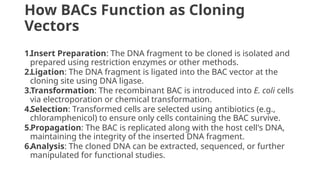
How BACs Function as Cloning
Vectors
1.Insert Preparation: The DNA fragment to be cloned is isolated and
prepared using restriction enzymes or other methods.
2.Ligation: The DNA fragment is ligated into the BAC vector at the
cloning site using DNA ligase.
3.Transformation: The recombinant BAC is introduced into E. coli cells
via electroporation or chemical transformation.
4.Selection: Transformed cells are selected using antibiotics (e.g.,
chloramphenicol) to ensure only cells containing the BAC survive.
5.Propagation: The BAC is replicated along with the host cell's DNA,
maintaining the integrity of the inserted DNA fragment.
6.Analysis: The cloned DNA can be extracted, sequenced, or further
manipulated for functional studies.
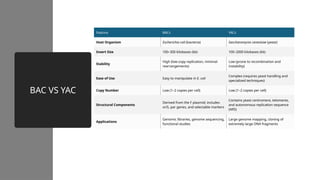
BAC VS YAC
Feature BACs YACs
Host Organism Escherichia coli (bacteria) Saccharomyces cerevisiae (yeast)
Insert Size 100–300 kilobases (kb) 100–2000 kilobases (kb)
Stability
High (low-copy replication, minimal
rearrangements)
Low (prone to recombination and
instability)
Ease of Use Easy to manipulate in E. coli
Complex (requires yeast handling and
specialized techniques)
Copy Number Low (1–2 copies per cell) Low (1–2 copies per cell)
Structural Components
Derived from the F plasmid; includes
oriS, par genes, and selectable markers
Contains yeast centromere, telomeres,
and autonomous replication sequence
(ARS)
Applications
Genomic libraries, genome sequencing,
functional studies
Large genome mapping, cloning of
extremely large DNA fragments
ROLE IN RECOMBINANT PROTEIN
TECHNOLOGY
• High Cloning Capacity:
• BACs can accommodate DNA inserts up to 300 kb, making them ideal for cloning large genes, gene clusters, or regulatory regions that are often too
large for traditional plasmid vectors.
• Stability in Host Cells:
• Ease of Manipulation:
• Low-Copy Replication:
• Faithful Gene Expression:
• Reduced Risk of Silencing:
• Applications in Mammalian Cell Expression Systems
• Functional Genomics:
• Recombinant Protein Production:
• Gene Therapy and Vaccine Development:
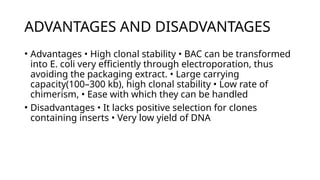
ADVANTAGES AND DISADVANTAGES
• Advantages • High clonal stability • BAC can be transformed
into E. coli very efficiently through electroporation, thus
avoiding the packaging extract. • Large carrying
capacity(100–300 kb), high clonal stability • Low rate of
chimerism, • Ease with which they can be handled
• Disadvantages • It lacks positive selection for clones
containing inserts • Very low yield of DNA
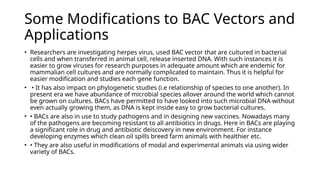
Some Modifications to BAC Vectors and
Applications
• Researchers are investigating herpes virus, used BAC vector that are cultured in bacterial
cells and when transferred in animal cell, release inserted DNA. With such instances it is
easier to grow viruses for research purposes in adequate amount which are endemic for
mammalian cell cultures and are normally complicated to maintain. Thus it is helpful for
easier modification and studies each gene function.
• • It has also impact on phylogenetic studies (i.e relationship of species to one another). In
present era we have abundance of microbial species allover around the world which cannot
be grown on cultures. BACs have permitted to have looked into such microbial DNA without
even actually growing them, as DNA is kept inside easy to grow bacterial cultures.
• • BACs are also in use to study pathogens and in designing new vaccines. Nowadays many
of the pathogens are becoming resistant to all antibiotics in drugs. Here in BACs are playing
a significant role in drug and antibiotic deiscovery in new environment. For instance
developing enzymes which clean oil spills breed farm animals with healthier etc.
• • They are also useful in modifications of modal and experimental animals via using wider
variety of BACs.
CASE STUDY
1. Source DNA Preparation:
1. Genomic DNA is isolated from the organism of interest.
2. The DNA is partially digested with restriction enzymes (e.g., HindIII or EcoRI) to generate large fragments (100–300
kb).
2. Vector Preparation:
1. The BAC vector is prepared by linearizing it with the same restriction enzyme used for genomic DNA digestion.
2. The vector contains essential elements such as an origin of replication (oriS), selectable markers (e.g.,
chloramphenicol resistance), and cloning sites.
3. Ligation:
1. The digested genomic DNA fragments are ligated into the BAC vector using DNA ligase.
2. The ligation mixture is then transformed into E. coli cells via electroporation.
4. Selection and Screening:
1. Transformed cells are plated on selective media (e.g., chloramphenicol) to identify colonies containing recombinant
BACs.
2. Individual clones are picked and stored in microtiter plates, creating a BAC library.
5. Characterization:
1. The library is characterized by determining the average insert size and coverage of the genome.
2. End-sequencing or fingerprinting is often performed to map the clones and ensure comprehensive genome
coverage.
Advances in BAC Technology
1. nhanced Cloning Capacity:
1. Researchers are working to increase the insert size capacity of BACs beyond the current limit of ~300 kb. This could involve
modifying the BAC vector or developing hybrid systems that combine the best features of BACs and other vectors (e.g., YACs or
cosmids).
2. Larger insert sizes would enable the cloning of even more complex genomic regions, such as entire gene clusters or chromosomal
segments.
2. Improved Stability and Fidelity:
1. Advances in understanding the mechanisms of DNA replication and recombination in E. coli could lead to BACs with even greater
stability and reduced risk of insert rearrangements.
2. Engineering BAC vectors with additional stability elements (e.g., stronger partitioning systems) could further enhance their
reliability.
3. Automation and High-Throughput Screening:
1. Automation technologies, such as robotic systems for colony picking and DNA isolation, are making it easier to construct and
screen large BAC libraries.
2. High-throughput sequencing and bioinformatics tools are enabling rapid characterization and mapping of BAC clones, accelerating
genomic research.
4. CRISPR/Cas9 Integration:
1. The CRISPR/Cas9 system is being used to engineer BACs more efficiently, enabling precise modifications to the insert DNA or vector
backbone.
2. This technology can be used to introduce mutations, insert reporter genes, or delete specific regions within BAC clones.
Potential Improvements for Higher Expression Efficiency
1.Optimized Regulatory Elements:
1. Incorporating stronger promoters, enhancers, and other regulatory elements into BACs could improve the
expression of cloned genes, especially in heterologous systems like mammalian cells.
2. Synthetic biology approaches can be used to design and test novel regulatory sequences for enhanced
expression.
2.Epigenetic Modifications:
1. Adding epigenetic modifiers (e.g., histone acetyltransferases or DNA methyltransferases) to BACs could
help maintain an open chromatin structure, reducing the risk of gene silencing and improving expression
efficiency.
3.Host Cell Engineering:
1. Engineering host cells (e.g., E. coli or mammalian cells) to support higher expression levels from BACs could
involve modifying transcription factors, translation machinery, or post-translational modification pathways.
2. For example, mammalian cell lines could be engineered to enhance the expression of BAC-derived
proteins.
4.Inducible Expression Systems:
1. Incorporating inducible promoters (e.g., tetracycline- or arabinose-inducible systems) into BACs would
allow for precise control of gene expression, reducing the burden on host cells and improving protein
yields.
CONCLUSION
• As we look to the future, advances in BAC technology—such
as increased cloning capacity, improved expression
efficiency, and integration with cutting-edge synthetic
biology approaches—promise to further expand their
potential. These innovations will enable researchers to
tackle even more complex biological challenges, from
designing artificial genomes to developing novel
therapeutics and sustainable biotechnologies.
• QUOTE OF THE DAY: Recombinant protein technology is like
cooking in a lab—except instead of burning dinner, you might
accidentally create a mutant protein that glows in the dark. Bon
apitite
Bacterial Artificial Chromosome (BAC).pptx

  • 1.
    BAC Bacterial Artificial chromosome Afnan,Aleena Khalid, Shoaib, Sarmad
  • 2.
    introduction • Natural Chromosomes(Chromosome) A threadlike linear strand of DNA and associated proteins in the nucleus of eukaryotic cells that carries the genes and functions in the transmission of hereditary information. • Characteristics of Artificial Chromosomes • ORI- A sequence that allows for the propagation of itself in the host. • MCS- An insertion site for the foreign DNA also called a multiple cloning site that can be cut by several restriction enzymes. i.e Recognition site for restriction enzymes. • SELECTABLE MARKER- A method for selection of the host cells that contain the insert DNA of interest. This is most often done through the use of selectable markers for drug resistance. Types of Artificial Chromosome • Bacterial artificial chromosome (BAC) • P1 derived artificial chromosome (PAC) • Yeast artificial chromosome (YAC) • Human artificial chromosome (HAC) • Mammalian artificial chromosome (MAC)
  • 3.
    introduction • Bacterial ArtificialChromosomes (BACs) are specialized DNA vectors derived from the naturally occurring F (fertility) plasmid in Escherichia coli (E. coli). • First artificial chromosome was designed by Hiroaki Shizuya in 1992 at California Institute of Technology by altering plasmid F factor. • They are widely used in molecular biology and genomics for cloning and manipulating large fragments of DNA, typically ranging from 100 to 300 kilobases (kb). • Used instead of YAC
  • 4.
    Components • • oriS,repE – it is responsible origin of replication and for replication and regulation of copy number of F plasmid. • • parA and parB – they are mainly responsible in partitioning of F plasmid DNA to daughter cells at time of splitting up and guarantee stable maintenance of BAC. • • Selectable markers for antibiotic resistance, in some BACs they also contain lacZ at cloning site for blue/white screening purpose. • T7 & Sp6 phage promoters are involved in transcription of inserted genes into BAC. (
  • 5.
    Structure of aBacterial Artificial Chromosome • • CMR is a selectable marker for chloramphenicol resistance. • • oriS, repE, parA, and parB are F factor genes for replication and regulation of copy number. • • cosN is the cos site from phage. • • HindIII and BamHI are cloning sites at which foreign DNA is inserted. • • The two promoters are for transcribing the inserted fragment. • • The NotI sites are used for cutting out the inserted fragment.
  • 6.
    How BACs Functionas Cloning Vectors 1.Insert Preparation: The DNA fragment to be cloned is isolated and prepared using restriction enzymes or other methods. 2.Ligation: The DNA fragment is ligated into the BAC vector at the cloning site using DNA ligase. 3.Transformation: The recombinant BAC is introduced into E. coli cells via electroporation or chemical transformation. 4.Selection: Transformed cells are selected using antibiotics (e.g., chloramphenicol) to ensure only cells containing the BAC survive. 5.Propagation: The BAC is replicated along with the host cell's DNA, maintaining the integrity of the inserted DNA fragment. 6.Analysis: The cloned DNA can be extracted, sequenced, or further manipulated for functional studies.
  • 7.
    BAC VS YAC FeatureBACs YACs Host Organism Escherichia coli (bacteria) Saccharomyces cerevisiae (yeast) Insert Size 100–300 kilobases (kb) 100–2000 kilobases (kb) Stability High (low-copy replication, minimal rearrangements) Low (prone to recombination and instability) Ease of Use Easy to manipulate in E. coli Complex (requires yeast handling and specialized techniques) Copy Number Low (1–2 copies per cell) Low (1–2 copies per cell) Structural Components Derived from the F plasmid; includes oriS, par genes, and selectable markers Contains yeast centromere, telomeres, and autonomous replication sequence (ARS) Applications Genomic libraries, genome sequencing, functional studies Large genome mapping, cloning of extremely large DNA fragments
  • 8.
    ROLE IN RECOMBINANTPROTEIN TECHNOLOGY • High Cloning Capacity: • BACs can accommodate DNA inserts up to 300 kb, making them ideal for cloning large genes, gene clusters, or regulatory regions that are often too large for traditional plasmid vectors. • Stability in Host Cells: • Ease of Manipulation: • Low-Copy Replication: • Faithful Gene Expression: • Reduced Risk of Silencing: • Applications in Mammalian Cell Expression Systems • Functional Genomics: • Recombinant Protein Production: • Gene Therapy and Vaccine Development:
  • 9.
    ADVANTAGES AND DISADVANTAGES •Advantages • High clonal stability • BAC can be transformed into E. coli very efficiently through electroporation, thus avoiding the packaging extract. • Large carrying capacity(100–300 kb), high clonal stability • Low rate of chimerism, • Ease with which they can be handled • Disadvantages • It lacks positive selection for clones containing inserts • Very low yield of DNA
  • 10.
    Some Modifications toBAC Vectors and Applications • Researchers are investigating herpes virus, used BAC vector that are cultured in bacterial cells and when transferred in animal cell, release inserted DNA. With such instances it is easier to grow viruses for research purposes in adequate amount which are endemic for mammalian cell cultures and are normally complicated to maintain. Thus it is helpful for easier modification and studies each gene function. • • It has also impact on phylogenetic studies (i.e relationship of species to one another). In present era we have abundance of microbial species allover around the world which cannot be grown on cultures. BACs have permitted to have looked into such microbial DNA without even actually growing them, as DNA is kept inside easy to grow bacterial cultures. • • BACs are also in use to study pathogens and in designing new vaccines. Nowadays many of the pathogens are becoming resistant to all antibiotics in drugs. Here in BACs are playing a significant role in drug and antibiotic deiscovery in new environment. For instance developing enzymes which clean oil spills breed farm animals with healthier etc. • • They are also useful in modifications of modal and experimental animals via using wider variety of BACs.
  • 11.
    CASE STUDY 1. SourceDNA Preparation: 1. Genomic DNA is isolated from the organism of interest. 2. The DNA is partially digested with restriction enzymes (e.g., HindIII or EcoRI) to generate large fragments (100–300 kb). 2. Vector Preparation: 1. The BAC vector is prepared by linearizing it with the same restriction enzyme used for genomic DNA digestion. 2. The vector contains essential elements such as an origin of replication (oriS), selectable markers (e.g., chloramphenicol resistance), and cloning sites. 3. Ligation: 1. The digested genomic DNA fragments are ligated into the BAC vector using DNA ligase. 2. The ligation mixture is then transformed into E. coli cells via electroporation. 4. Selection and Screening: 1. Transformed cells are plated on selective media (e.g., chloramphenicol) to identify colonies containing recombinant BACs. 2. Individual clones are picked and stored in microtiter plates, creating a BAC library. 5. Characterization: 1. The library is characterized by determining the average insert size and coverage of the genome. 2. End-sequencing or fingerprinting is often performed to map the clones and ensure comprehensive genome coverage.
  • 12.
    Advances in BACTechnology 1. nhanced Cloning Capacity: 1. Researchers are working to increase the insert size capacity of BACs beyond the current limit of ~300 kb. This could involve modifying the BAC vector or developing hybrid systems that combine the best features of BACs and other vectors (e.g., YACs or cosmids). 2. Larger insert sizes would enable the cloning of even more complex genomic regions, such as entire gene clusters or chromosomal segments. 2. Improved Stability and Fidelity: 1. Advances in understanding the mechanisms of DNA replication and recombination in E. coli could lead to BACs with even greater stability and reduced risk of insert rearrangements. 2. Engineering BAC vectors with additional stability elements (e.g., stronger partitioning systems) could further enhance their reliability. 3. Automation and High-Throughput Screening: 1. Automation technologies, such as robotic systems for colony picking and DNA isolation, are making it easier to construct and screen large BAC libraries. 2. High-throughput sequencing and bioinformatics tools are enabling rapid characterization and mapping of BAC clones, accelerating genomic research. 4. CRISPR/Cas9 Integration: 1. The CRISPR/Cas9 system is being used to engineer BACs more efficiently, enabling precise modifications to the insert DNA or vector backbone. 2. This technology can be used to introduce mutations, insert reporter genes, or delete specific regions within BAC clones.
  • 13.
    Potential Improvements forHigher Expression Efficiency 1.Optimized Regulatory Elements: 1. Incorporating stronger promoters, enhancers, and other regulatory elements into BACs could improve the expression of cloned genes, especially in heterologous systems like mammalian cells. 2. Synthetic biology approaches can be used to design and test novel regulatory sequences for enhanced expression. 2.Epigenetic Modifications: 1. Adding epigenetic modifiers (e.g., histone acetyltransferases or DNA methyltransferases) to BACs could help maintain an open chromatin structure, reducing the risk of gene silencing and improving expression efficiency. 3.Host Cell Engineering: 1. Engineering host cells (e.g., E. coli or mammalian cells) to support higher expression levels from BACs could involve modifying transcription factors, translation machinery, or post-translational modification pathways. 2. For example, mammalian cell lines could be engineered to enhance the expression of BAC-derived proteins. 4.Inducible Expression Systems: 1. Incorporating inducible promoters (e.g., tetracycline- or arabinose-inducible systems) into BACs would allow for precise control of gene expression, reducing the burden on host cells and improving protein yields.
  • 14.
    CONCLUSION • As welook to the future, advances in BAC technology—such as increased cloning capacity, improved expression efficiency, and integration with cutting-edge synthetic biology approaches—promise to further expand their potential. These innovations will enable researchers to tackle even more complex biological challenges, from designing artificial genomes to developing novel therapeutics and sustainable biotechnologies. • QUOTE OF THE DAY: Recombinant protein technology is like cooking in a lab—except instead of burning dinner, you might accidentally create a mutant protein that glows in the dark. Bon apitite