ENVIRONMENTAL
BIOTECHNOLOGY
Presentation By: Group #4 Biotechnology (Batch 2)
Group Members:
(Group Leader) Mohammad Daniyal
Aleesha Syed
Sarmad Durrani
Sarosh Khan
PRESENTED TO: SIR FAZLI WAHID
What is environmental Biotechnology?
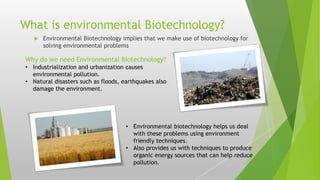
 Environmental Biotechnology implies that we make use of biotechnology for
solving environmental problems
Why do we need Environmental Biotechnology?
• Industrialization and urbanization causes
environmental pollution.
• Natural disasters such as floods, earthquakes also
damage the environment.
• Environmental biotechnology helps us deal
with these problems using environment
friendly techniques.
• Also provides us with techniques to produce
organic energy sources that can help reduce
pollution.
ENVIRONMENTAL
BIOTECHNOLOGY FOR A
SUSTAINABLE
ECOSYSTEM
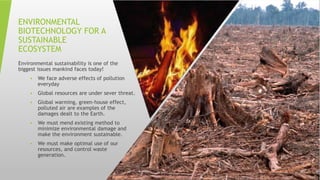
Environmental sustainability is one of the
biggest issues mankind faces today!
 We face adverse effects of pollution
everyday
 Global resources are under sever threat.
 Global warming, green-house effect,
polluted air are examples of the
damages dealt to the Earth.
 We must mend existing method to
minimize environmental damage and
make the environment sustainable.
 We must make optimal use of our
resources, and control waste
generation.
Implementation of Biotechnology to
reduce pollution
BIOPLASTICS
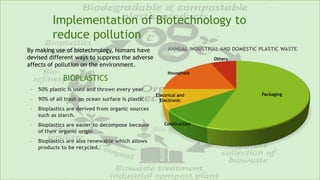
• 50% plastic is used and thrown every year
• 90% of all trash on ocean surface is plastic
• Bioplastics are derived from organic sources
such as starch.
• Bioplastics are easier to decompose because
of their organic origin
• Bioplastics are also renewable which allows
products to be recycled.
By making use of biotechnology, humans have
devised different ways to suppress the adverse
affects of pollution on the environment.
Packaging
Construction
Electrical and
Electronic
Household
Others
ANNUAL INDUSTRIAL AND DOMESTIC PLASTIC WASTE
BIOREMEDIATION
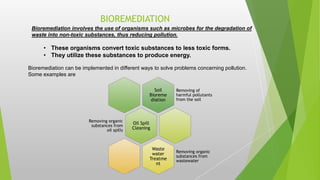
Bioremediation involves the use of organisms such as microbes for the degradation of
waste into non-toxic substances, thus reducing pollution.
• These organisms convert toxic substances to less toxic forms.
• They utilize these substances to produce energy.
Bioremediation can be implemented in different ways to solve problems concerning pollution.
Some examples are
Soil
Bioreme
diation
Removing of
harmful pollutants
from the soil
Oil Spill
Cleaning
Removing organic
substances from
oil spills
Waste
water
Treatme
nt
Removing organic
substances from
wastewater
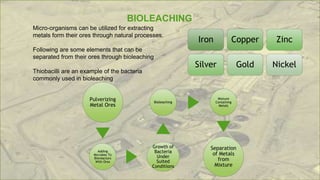
BIOLEACHING
Micro-organisms can be utilized for extracting
metals form their ores through natural processes.
Following are some elements that can be
separated from their ores through bioleaching
Thiobacilli are an example of the bacteria
commonly used in bioleaching
Iron Copper Zinc
Silver Gold Nickel
Pulverizing
Metal Ores
Adding
Microbes To
Bioreactors
With Ores
Growth of
Bacteria
Under
Suited
Conditions
Bioleaching
Mixture
Containing
Metals
Separation
of Metals
from
Mixture
Oil spills are a frequent occurring that
cause water pollution.
 Bioremediation can be used to
remove these spills as well as other
petroleum based waste in water.
 Micro-organisms like bacteria can be
used to break down petroleum
compounds into simpler forms.
 Relevant micro-organisms are sprayed
onto the oil layer which degrade the
hydrocarbons over time.
 The process takes longer than
conventional processes but is cost
effective.
CLEANING OF OIL SPILLS
Biowaste in
Wastewater
Decomposing
microbes
Sludge/Biomass
+ CO2
AEROBIC TREATMENT ANAEROBIC TREATMENT
Treatment in presence of air In the absence of air
High biomass production Low biomass production
Faster reaction speed Slower reaction speed
Higher energy input Low energy input
More sludge Less sludge
Less odor Less efficient and more odor
Anaerobic Aerobic
Sludge Methane CO2 Effluent
WASTEWATER TREATMENT
• Microorganisms can be used to treat
domestic and industrial wastewater
• Microbes break down organic waste
in the water to produce energy
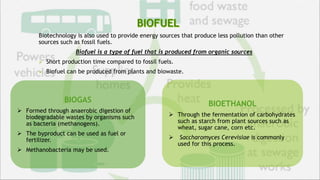
Biotechnology is also used to provide energy sources that produce less pollution than other
sources such as fossil fuels.
Biofuel is a type of fuel that is produced from organic sources
 Short production time compared to fossil fuels.
 Biofuel can be produced from plants and biowaste.
BIOGAS
 Formed through anaerobic digestion of
biodegradable wastes by organisms such
as bacteria (methanogens).
 The byproduct can be used as fuel or
fertilizer.
 Methanobacteria may be used.
BIOETHANOL
 Through the fermentation of carbohydrates
such as starch from plant sources such as
wheat, sugar cane, corn etc.
 Saccharomyces Cerevisiae is commonly
used for this process.
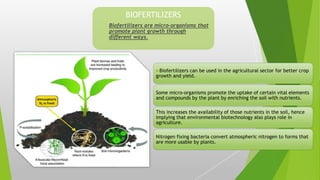
Biofertilizers can be used in the agricultural sector for better crop
growth and yield.
Some micro-organisms promote the uptake of certain vital elements
and compounds by the plant by enriching the soil with nutrients.
This increases the availability of those nutrients in the soil, hence
implying that environmental biotechnology also plays role in
agriculture.
Nitrogen fixing bacteria convert atmospheric nitrogen to forms that
are more usable by plants.
BIOFERTILIZERS
Biofertilizers are micro-organisms that
promote plant growth through
different ways.
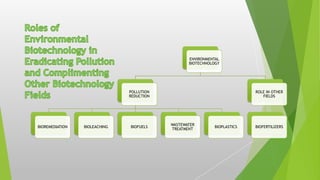
ENVIRONMENTAL
BIOTECHNOLOGY
POLLUTION
REDUCTION
BIOREMEDIATION BIOLEACHING BIOFUELS
WASTEWATER
TREATMENT
BIOPLASTICS
ROLE IN OTHER
FIELDS
BIOFERTILIZERS
ADVANTAGES OF ADOPTING
BIOTECHNOLOLIGAL TECHNIQUES FOR
SOLVING ENVIRONMENTAL PROBLEMS
Executable on
large scale
Requires less labor
Ecofriendly
products minimize
environmental
damage
Provides reusable
organic
alternatives
The techniques
used are mostly
ecofriendly
Some of the techniques such as bioremediation might not
be practically applicable in certain situations.
Large scale growth of genetically modified organisms
might lead to less diversity in genetic variations.
Some techniques are expensive.
Some techniques are time consuming.
Environmental
biotechnology is a
broad research field,
and plays roles in
various social work-
fields.
A number of private
firms worldwide are
seeking experts to
serve a greater cause.
While mankind has
devised alternatives
to harmful
industrialization, the
world still needs to
make progress in
green sciences to
battle pollution to a
greater extent.
Since environmental
biotechnology works
in discipline with
other sectors, areas
such as agriculture,
microbiology, and
even industries such
food and beverages
have environmental
aspects.

ENVIRONMENTAL BIOTECHNOLOGY presentation.pptx

  • 1.
    ENVIRONMENTAL BIOTECHNOLOGY Presentation By: Group#4 Biotechnology (Batch 2) Group Members: (Group Leader) Mohammad Daniyal Aleesha Syed Sarmad Durrani Sarosh Khan PRESENTED TO: SIR FAZLI WAHID
  • 2.
    What is environmentalBiotechnology?  Environmental Biotechnology implies that we make use of biotechnology for solving environmental problems Why do we need Environmental Biotechnology? • Industrialization and urbanization causes environmental pollution. • Natural disasters such as floods, earthquakes also damage the environment. • Environmental biotechnology helps us deal with these problems using environment friendly techniques. • Also provides us with techniques to produce organic energy sources that can help reduce pollution.
  • 3.
    ENVIRONMENTAL BIOTECHNOLOGY FOR A SUSTAINABLE ECOSYSTEM Environmentalsustainability is one of the biggest issues mankind faces today!  We face adverse effects of pollution everyday  Global resources are under sever threat.  Global warming, green-house effect, polluted air are examples of the damages dealt to the Earth.  We must mend existing method to minimize environmental damage and make the environment sustainable.  We must make optimal use of our resources, and control waste generation.
  • 4.
    Implementation of Biotechnologyto reduce pollution BIOPLASTICS • 50% plastic is used and thrown every year • 90% of all trash on ocean surface is plastic • Bioplastics are derived from organic sources such as starch. • Bioplastics are easier to decompose because of their organic origin • Bioplastics are also renewable which allows products to be recycled. By making use of biotechnology, humans have devised different ways to suppress the adverse affects of pollution on the environment. Packaging Construction Electrical and Electronic Household Others ANNUAL INDUSTRIAL AND DOMESTIC PLASTIC WASTE
  • 5.
    BIOREMEDIATION Bioremediation involves theuse of organisms such as microbes for the degradation of waste into non-toxic substances, thus reducing pollution. • These organisms convert toxic substances to less toxic forms. • They utilize these substances to produce energy. Bioremediation can be implemented in different ways to solve problems concerning pollution. Some examples are Soil Bioreme diation Removing of harmful pollutants from the soil Oil Spill Cleaning Removing organic substances from oil spills Waste water Treatme nt Removing organic substances from wastewater
  • 6.
    BIOLEACHING Micro-organisms can beutilized for extracting metals form their ores through natural processes. Following are some elements that can be separated from their ores through bioleaching Thiobacilli are an example of the bacteria commonly used in bioleaching Iron Copper Zinc Silver Gold Nickel Pulverizing Metal Ores Adding Microbes To Bioreactors With Ores Growth of Bacteria Under Suited Conditions Bioleaching Mixture Containing Metals Separation of Metals from Mixture
  • 7.
    Oil spills area frequent occurring that cause water pollution.  Bioremediation can be used to remove these spills as well as other petroleum based waste in water.  Micro-organisms like bacteria can be used to break down petroleum compounds into simpler forms.  Relevant micro-organisms are sprayed onto the oil layer which degrade the hydrocarbons over time.  The process takes longer than conventional processes but is cost effective. CLEANING OF OIL SPILLS
  • 8.
    Biowaste in Wastewater Decomposing microbes Sludge/Biomass + CO2 AEROBICTREATMENT ANAEROBIC TREATMENT Treatment in presence of air In the absence of air High biomass production Low biomass production Faster reaction speed Slower reaction speed Higher energy input Low energy input More sludge Less sludge Less odor Less efficient and more odor Anaerobic Aerobic Sludge Methane CO2 Effluent WASTEWATER TREATMENT • Microorganisms can be used to treat domestic and industrial wastewater • Microbes break down organic waste in the water to produce energy
  • 9.
    Biotechnology is alsoused to provide energy sources that produce less pollution than other sources such as fossil fuels. Biofuel is a type of fuel that is produced from organic sources  Short production time compared to fossil fuels.  Biofuel can be produced from plants and biowaste. BIOGAS  Formed through anaerobic digestion of biodegradable wastes by organisms such as bacteria (methanogens).  The byproduct can be used as fuel or fertilizer.  Methanobacteria may be used. BIOETHANOL  Through the fermentation of carbohydrates such as starch from plant sources such as wheat, sugar cane, corn etc.  Saccharomyces Cerevisiae is commonly used for this process.
  • 10.
    Biofertilizers can beused in the agricultural sector for better crop growth and yield. Some micro-organisms promote the uptake of certain vital elements and compounds by the plant by enriching the soil with nutrients. This increases the availability of those nutrients in the soil, hence implying that environmental biotechnology also plays role in agriculture. Nitrogen fixing bacteria convert atmospheric nitrogen to forms that are more usable by plants. BIOFERTILIZERS Biofertilizers are micro-organisms that promote plant growth through different ways.
  • 11.
  • 12.
    ADVANTAGES OF ADOPTING BIOTECHNOLOLIGALTECHNIQUES FOR SOLVING ENVIRONMENTAL PROBLEMS Executable on large scale Requires less labor Ecofriendly products minimize environmental damage Provides reusable organic alternatives The techniques used are mostly ecofriendly
  • 13.
    Some of thetechniques such as bioremediation might not be practically applicable in certain situations. Large scale growth of genetically modified organisms might lead to less diversity in genetic variations. Some techniques are expensive. Some techniques are time consuming.
  • 14.
    Environmental biotechnology is a broadresearch field, and plays roles in various social work- fields. A number of private firms worldwide are seeking experts to serve a greater cause. While mankind has devised alternatives to harmful industrialization, the world still needs to make progress in green sciences to battle pollution to a greater extent. Since environmental biotechnology works in discipline with other sectors, areas such as agriculture, microbiology, and even industries such food and beverages have environmental aspects.