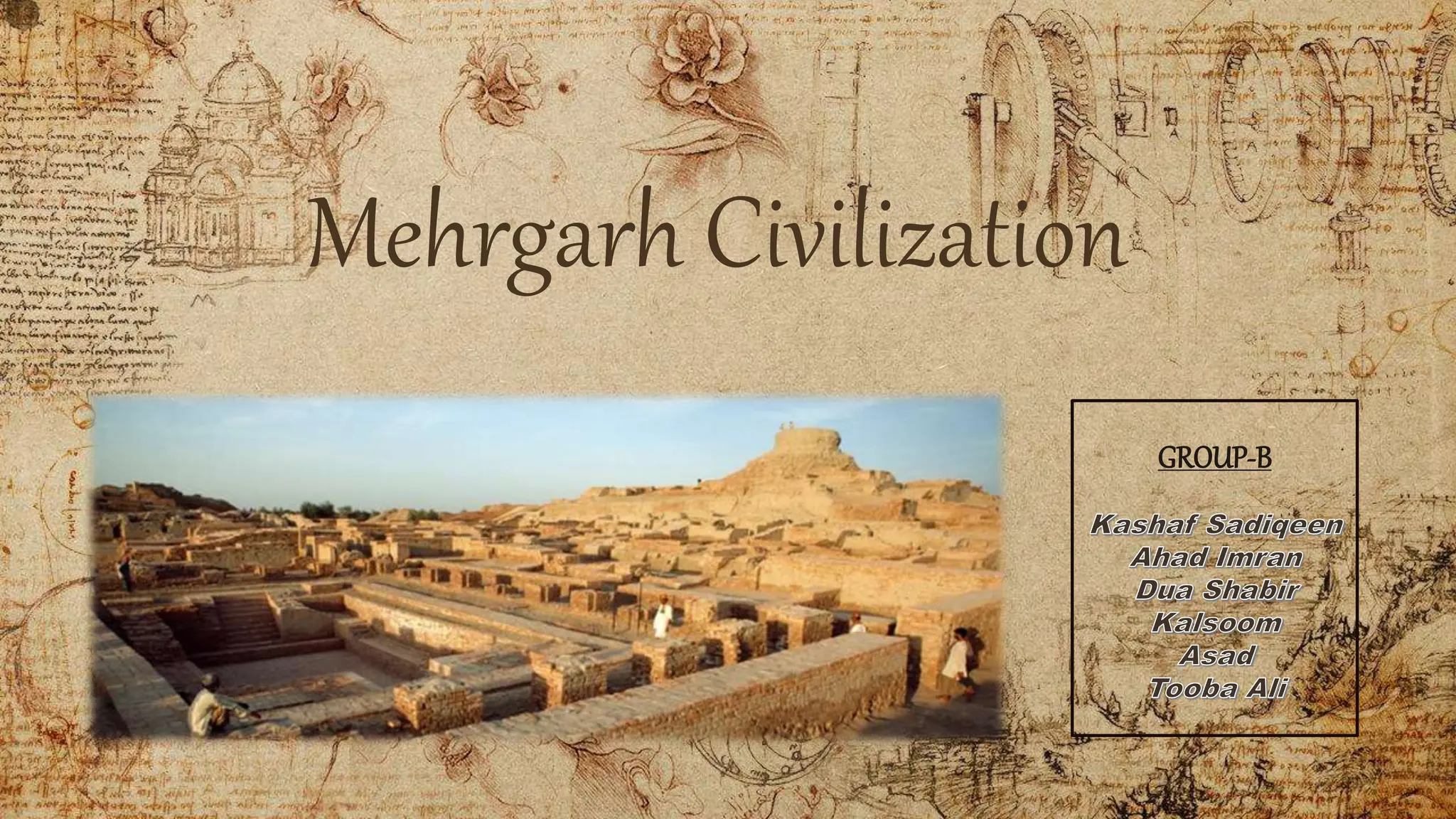
Mehrgarh Civilization
GROUP-B
CONTENT
 Discovery
 Location
 Different eras
 Artifacts
 Restoration
 Contribution to Pakistan
economy
DISCOVERY
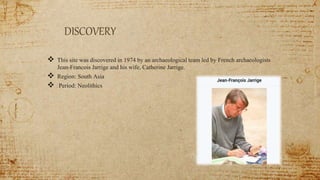
 This site was discovered in 1974 by an archaeological team led by French archaeologists
Jean-Francois Jarrige and his wife, Catherine Jarrige.
 Region: South Asia
 Period: Neolithics
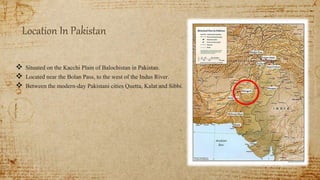
Location In Pakistan
 Situated on the Kacchi Plain of Balochistan in Pakistan.
 Located near the Bolan Pass, to the west of the Indus River.
 Between the modern-day Pakistani cities Quetta, Kalat and Sibbi.
✣ DIVISION OF MEHRGARH
CIVILIZATION
✣ IN DIFFERENT ERAS…
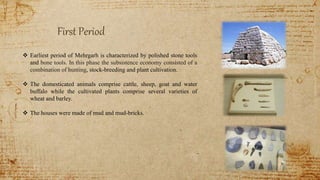
First Period
 Earliest period of Mehrgarh is characterized by polished stone tools
and bone tools. In this phase the subsistence economy consisted of a
combination of hunting, stock-breeding and plant cultivation.
 The domesticated animals comprise cattle, sheep, goat and water
buffalo while the cultivated plants comprise several varieties of
wheat and barley.
 The houses were made of mud and mud-bricks.
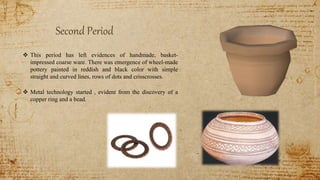
Second Period
 This period has left evidences of handmade, basket-
impressed coarse ware. There was emergence of wheel-made
pottery painted in reddish and black color with simple
straight and curved lines, rows of dots and crisscrosses.
 Metal technology started , evident from the discovery of a
copper ring and a bead.
Third Period
 The Vessels were now decorated with paintings of birds and
animals as also with geometric designs. Oats and another
variety of wheat was added to the agriculture.
 Stone bead manufacturing and copper smelting started.
Fourth Period
 Emergence of polychrome pottery with a tall goblet with
wide mouth and a pedestal base as a new shape.
 Extensive use of timber in the construction of houses.
Fifth Period
 A marked decline in polychrome decoration on pottery.
Sixth Period
 Dramatically increase in pottery styles and the first evidence
of pottery kilns.
 Pipal leaf and humped bull designs appear on pottery which
anticipate Harappan motifs.
Seventh Period
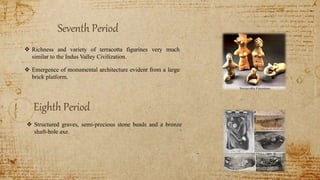
 Richness and variety of terracotta figurines very much
similar to the Indus Valley Civilization.
 Emergence of monumental architecture evident from a large
brick platform.
Eighth Period
 Structured graves, semi-precious stone beads and a bronze
shaft-hole axe.
✣ MEHRGARH
ARTIFACTS
HUMAN FIGURINES
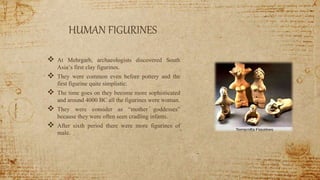
 At Mehrgarh, archaeologists discovered South
Asia’s first clay figurines.
 They were common even before pottery and the
first figurine quite simplistic.
 The time goes on they become more sophisticated
and around 4000 BC all the figurines were woman.
 They were consider as “mother goddesses”
because they were often seen cradling infants.
 After sixth period there were more figurines of
male.
BURIALS
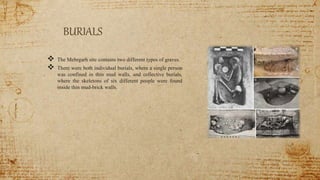
 The Mehrgarh site contains two different types of graves.
 There were both individual burials, where a single person
was confined in thin mud walls, and collective burials,
where the skeletons of six different people were found
inside thin mud-brick walls.
POTTERY
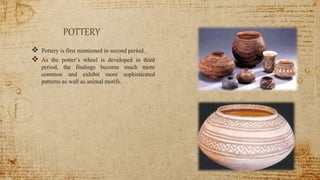
 Pottery is first mentioned in second period.
 As the potter’s wheel is developed in third
period, the findings become much more
common and exhibit more sophisticated
patterns as wall as animal motifs.
RESTORATION
THE DAMAGE
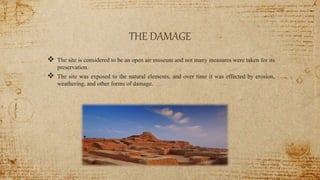
 The site is considered to be an open air museum and not many measures were taken for its
preservation.
 The site was exposed to the natural elements, and over time it was effected by erosion,
weathering, and other forms of damage.
RESTORATION EFFORTS
 In light of the damage sustained by the site, various efforts have been made to restore and
preserve Mehrgarh.
 These efforts have included stabilizing the site's architecture, preserving its artifacts, and
increasing security to protect the site from looting.
 Additionally, conservationists have also been working on preserving the geological
structures and promoting sustainable tourism.
CONTINUING CHALLENGES
 Despite the restoration efforts, there are still several challenges to preserving Mehrgarh.
One of the major challenges is the lack of funding and resources for ongoing preservation
efforts. Another challenge is the lack of trained personnel to carry out preservation work.
Additionally, the site is still exposed to the elements, and there is always the risk of
natural disasters like floods.
 It's worth noting that the Mehrgarh is an ongoing excavation and preservation process,
and things are subject to change as new discoveries and understanding of the site are
made.
CONTRIBUTION OF
ARCHAEOLOGICAL SITES IN
PAKISTAN’S ECONOMY
 Archaeological sites can make a significant contribution to a country's economy,
particularly in terms of tourism.
 In Pakistan, there are many ancient sites and ruins that attract both domestic and
international tourists.
 For example, Mohenjo-Daro and Harappa are two of the most significant archaeological
sites in the country, and they are both UNESCO World Heritage sites.
 These ancient cities were part of the Indus Valley Civilization, which is one of the earliest
civilizations in the world.
 Tourism is a major industry in Pakistan and the government has been working to promote
it as a way to boost the economy.
 In addition to the revenue generated by ticket sales and souvenirs, archaeological sites
can also help to create jobs in the tourism sector, such as tour guides, hotel and restaurant
staff, and transportation providers.
Any Question ?

Mehrgarh Civilization.pptx

  • 1.
  • 2.
    CONTENT  Discovery  Location Different eras  Artifacts  Restoration  Contribution to Pakistan economy
  • 3.
    DISCOVERY  This sitewas discovered in 1974 by an archaeological team led by French archaeologists Jean-Francois Jarrige and his wife, Catherine Jarrige.  Region: South Asia  Period: Neolithics
  • 4.
    Location In Pakistan Situated on the Kacchi Plain of Balochistan in Pakistan.  Located near the Bolan Pass, to the west of the Indus River.  Between the modern-day Pakistani cities Quetta, Kalat and Sibbi.
  • 5.
    ✣ DIVISION OFMEHRGARH CIVILIZATION ✣ IN DIFFERENT ERAS…
  • 6.
    First Period  Earliestperiod of Mehrgarh is characterized by polished stone tools and bone tools. In this phase the subsistence economy consisted of a combination of hunting, stock-breeding and plant cultivation.  The domesticated animals comprise cattle, sheep, goat and water buffalo while the cultivated plants comprise several varieties of wheat and barley.  The houses were made of mud and mud-bricks.
  • 7.
    Second Period  Thisperiod has left evidences of handmade, basket- impressed coarse ware. There was emergence of wheel-made pottery painted in reddish and black color with simple straight and curved lines, rows of dots and crisscrosses.  Metal technology started , evident from the discovery of a copper ring and a bead.
  • 8.
    Third Period  TheVessels were now decorated with paintings of birds and animals as also with geometric designs. Oats and another variety of wheat was added to the agriculture.  Stone bead manufacturing and copper smelting started.
  • 9.
    Fourth Period  Emergenceof polychrome pottery with a tall goblet with wide mouth and a pedestal base as a new shape.  Extensive use of timber in the construction of houses.
  • 10.
    Fifth Period  Amarked decline in polychrome decoration on pottery. Sixth Period  Dramatically increase in pottery styles and the first evidence of pottery kilns.  Pipal leaf and humped bull designs appear on pottery which anticipate Harappan motifs.
  • 11.
    Seventh Period  Richnessand variety of terracotta figurines very much similar to the Indus Valley Civilization.  Emergence of monumental architecture evident from a large brick platform. Eighth Period  Structured graves, semi-precious stone beads and a bronze shaft-hole axe.
  • 12.
  • 13.
    HUMAN FIGURINES  AtMehrgarh, archaeologists discovered South Asia’s first clay figurines.  They were common even before pottery and the first figurine quite simplistic.  The time goes on they become more sophisticated and around 4000 BC all the figurines were woman.  They were consider as “mother goddesses” because they were often seen cradling infants.  After sixth period there were more figurines of male.
  • 14.
    BURIALS  The Mehrgarhsite contains two different types of graves.  There were both individual burials, where a single person was confined in thin mud walls, and collective burials, where the skeletons of six different people were found inside thin mud-brick walls.
  • 15.
    POTTERY  Pottery isfirst mentioned in second period.  As the potter’s wheel is developed in third period, the findings become much more common and exhibit more sophisticated patterns as wall as animal motifs.
  • 16.
  • 17.
    THE DAMAGE  Thesite is considered to be an open air museum and not many measures were taken for its preservation.  The site was exposed to the natural elements, and over time it was effected by erosion, weathering, and other forms of damage.
  • 18.
    RESTORATION EFFORTS  Inlight of the damage sustained by the site, various efforts have been made to restore and preserve Mehrgarh.  These efforts have included stabilizing the site's architecture, preserving its artifacts, and increasing security to protect the site from looting.  Additionally, conservationists have also been working on preserving the geological structures and promoting sustainable tourism.
  • 19.
    CONTINUING CHALLENGES  Despitethe restoration efforts, there are still several challenges to preserving Mehrgarh. One of the major challenges is the lack of funding and resources for ongoing preservation efforts. Another challenge is the lack of trained personnel to carry out preservation work. Additionally, the site is still exposed to the elements, and there is always the risk of natural disasters like floods.  It's worth noting that the Mehrgarh is an ongoing excavation and preservation process, and things are subject to change as new discoveries and understanding of the site are made.
  • 20.
    CONTRIBUTION OF ARCHAEOLOGICAL SITESIN PAKISTAN’S ECONOMY
  • 21.
     Archaeological sitescan make a significant contribution to a country's economy, particularly in terms of tourism.  In Pakistan, there are many ancient sites and ruins that attract both domestic and international tourists.  For example, Mohenjo-Daro and Harappa are two of the most significant archaeological sites in the country, and they are both UNESCO World Heritage sites.
  • 22.
     These ancientcities were part of the Indus Valley Civilization, which is one of the earliest civilizations in the world.  Tourism is a major industry in Pakistan and the government has been working to promote it as a way to boost the economy.  In addition to the revenue generated by ticket sales and souvenirs, archaeological sites can also help to create jobs in the tourism sector, such as tour guides, hotel and restaurant staff, and transportation providers.
  • 23.