UNDERSTANDING
CLINICAL TRIALS
Presented by
Ahad Imran
B22F0767BTY0004
Biosafety & Bioethics
Topics covered
What are clinical trials?
Characteristics of clinical trials
Types of clinical trials
Phases of clinical trials
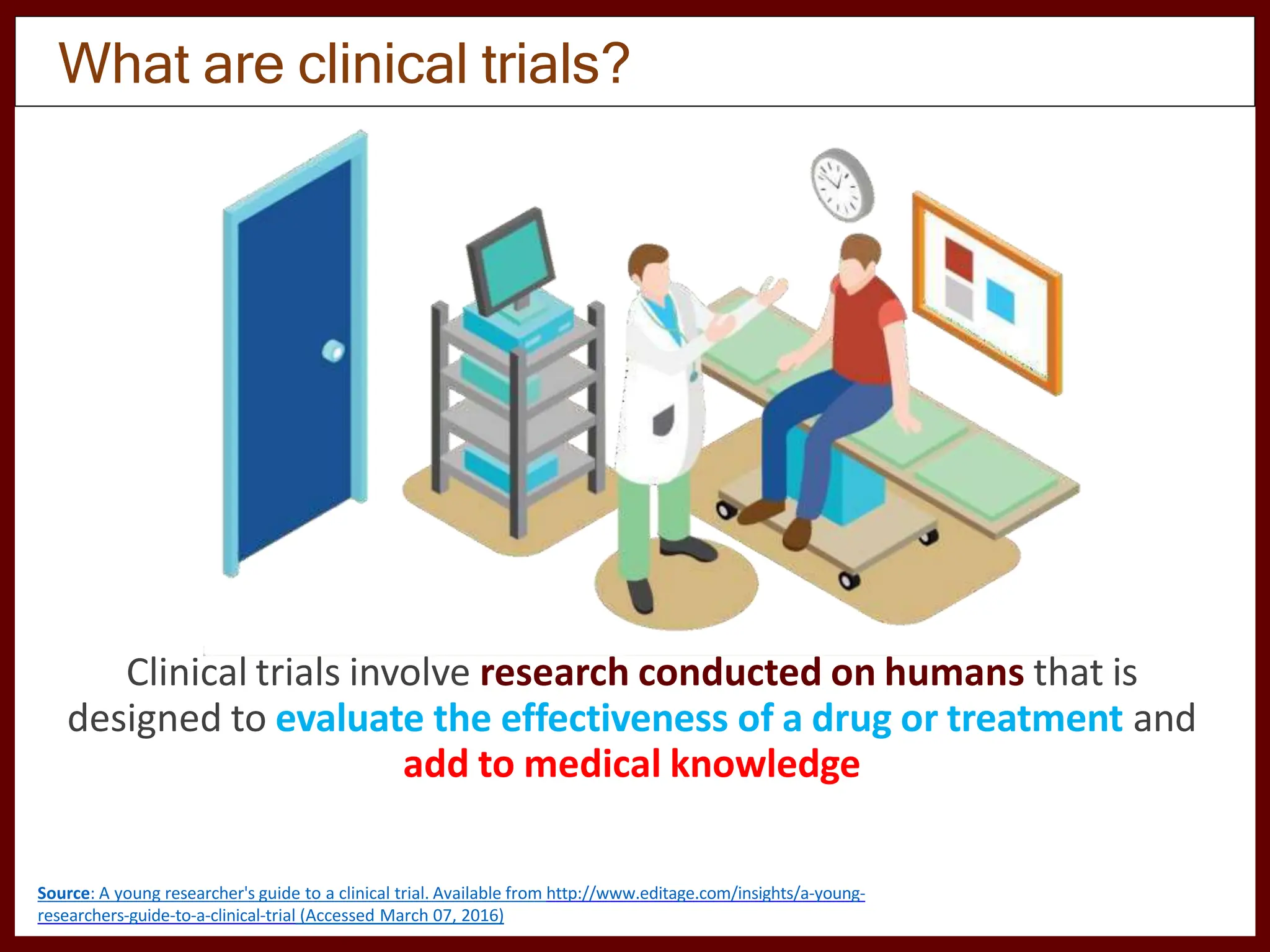
What are clinical trials?
Clinical trials involve research conducted on humans that is
designed to evaluate the effectiveness of a drug or treatment and
add to medical knowledge
Source: A young researcher's guide to a clinical trial. Available from http://www.editage.com/insights/a-young-
researchers-guide-to-a-clinical-trial (Accessed March 07, 2016)
Clinical trials as defined by NIH
*NIH: National Institutes of Health, USA
Source: What are clinical trials? Available from http://www.nhlbi.nih.gov/studies/clinicaltrials (Accessed
March 07, 2016)
Clinical trials are research studies that explore whether
a medical strategy, treatment, or device is safe and
effective for humans. These studies also may show
which medical approaches work best for certain
illnesses or groups of people.
Human subjects volunteer
to participate
Last for about 5-7 years
*First, a new medical strategy, drug, treatment, or device is developed in the lab, then it is tested on animals, and
finally tested on humans to see how safe or effective it is.
Approval of relevant
governing and ethical
committees is essential
Usually medical or clinical
studies
Constitute the last
step of the research
process
Investigations are carefully
conducted following a pre-
determined research
protocol
Characteristics of clinical trials
Types of clinical trials
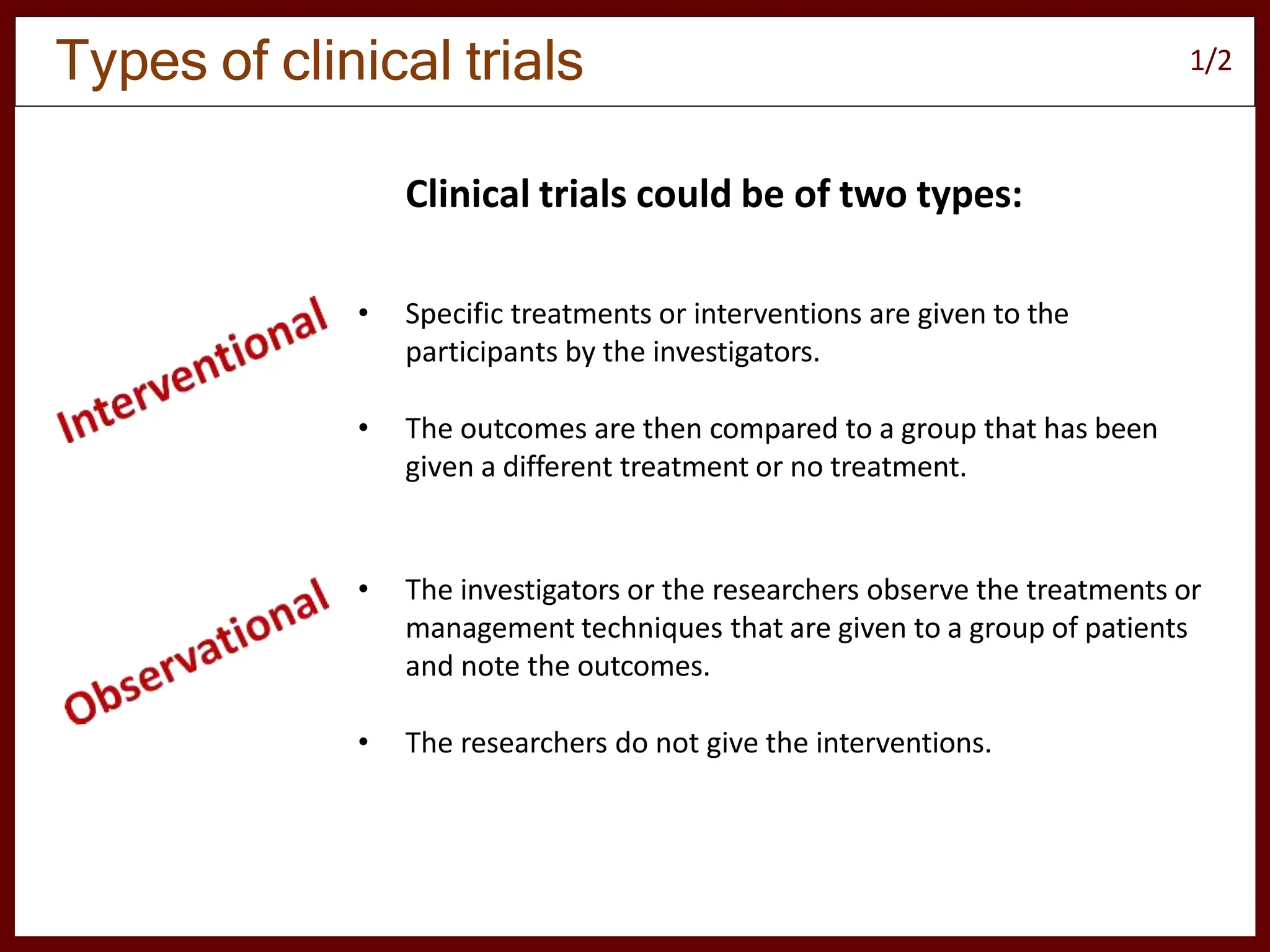
Clinical trials could be of two types:
• Specific treatments or interventions are given to the
participants by the investigators.
• The outcomes are then compared to a group that has been
given a different treatment or no treatment.
• The investigators or the researchers observe the treatments or
management techniques that are given to a group of patients
and note the outcomes.
• The researchers do not give the interventions.
1/2
More trials types defined by the NIH 2/2
Explore ways to improve the comfort and quality
of life of people with a chronic illness (also known
as supportive care trials)
Come up with better tests or procedures
for diagnosing a disease or health
condition
Test new treatments,
combinations of drugs, surgical
approaches, or radiation therapy
Find ways to prevent diseases;
include medicines, vaccination,
or lifestyle change
Test the best way to detect
specific diseases or health
conditions
Phases of clinical trials
Clinical trials are conducted in several phases and each phase has a different purpose.
PHASE I TRIALS
A new drug or treatment is tested on a small
group of people (20–80)
Purpose
To evaluate its safety and identify the side
effects, and to obtain early signs of
effectiveness
PHASE II TRIALS
The drug or treatment is given to a larger
group of people (100–300)
Purpose
To evaluate its effectiveness and obtain more
information about the side effects and risks
of the treatment
PHASE III TRIALS
The drug or treatment is administered to
very large groups of people (1,000–3,000)
Purpose
To confirm its effectiveness, compare it with
other modes of treatment, and evaluate the
overall risk-benefit equation
PHASE IV TRIALS
These studies are conducted after the drug’s
approval and launch in the market (also
called post-marketing surveillance studies)
Purpose
To obtain additional information about its
risks, benefits, and optimal use
"In the realm of medicine,
clinical trials are the crucible
where scientific curiosity
meets the compassion to heal,
forging innovations that
illuminate the path towards
better health for all."
THANKS

clinical trials presentation by Ahad Imran.pptx

  • 1.
    UNDERSTANDING CLINICAL TRIALS Presented by AhadImran B22F0767BTY0004 Biosafety & Bioethics
  • 2.
    Topics covered What areclinical trials? Characteristics of clinical trials Types of clinical trials Phases of clinical trials
  • 3.
    What are clinicaltrials? Clinical trials involve research conducted on humans that is designed to evaluate the effectiveness of a drug or treatment and add to medical knowledge Source: A young researcher's guide to a clinical trial. Available from http://www.editage.com/insights/a-young- researchers-guide-to-a-clinical-trial (Accessed March 07, 2016)
  • 4.
    Clinical trials asdefined by NIH *NIH: National Institutes of Health, USA Source: What are clinical trials? Available from http://www.nhlbi.nih.gov/studies/clinicaltrials (Accessed March 07, 2016) Clinical trials are research studies that explore whether a medical strategy, treatment, or device is safe and effective for humans. These studies also may show which medical approaches work best for certain illnesses or groups of people.
  • 5.
    Human subjects volunteer toparticipate Last for about 5-7 years *First, a new medical strategy, drug, treatment, or device is developed in the lab, then it is tested on animals, and finally tested on humans to see how safe or effective it is. Approval of relevant governing and ethical committees is essential Usually medical or clinical studies Constitute the last step of the research process Investigations are carefully conducted following a pre- determined research protocol Characteristics of clinical trials
  • 6.
    Types of clinicaltrials Clinical trials could be of two types: • Specific treatments or interventions are given to the participants by the investigators. • The outcomes are then compared to a group that has been given a different treatment or no treatment. • The investigators or the researchers observe the treatments or management techniques that are given to a group of patients and note the outcomes. • The researchers do not give the interventions. 1/2
  • 7.
    More trials typesdefined by the NIH 2/2 Explore ways to improve the comfort and quality of life of people with a chronic illness (also known as supportive care trials) Come up with better tests or procedures for diagnosing a disease or health condition Test new treatments, combinations of drugs, surgical approaches, or radiation therapy Find ways to prevent diseases; include medicines, vaccination, or lifestyle change Test the best way to detect specific diseases or health conditions
  • 8.
    Phases of clinicaltrials Clinical trials are conducted in several phases and each phase has a different purpose. PHASE I TRIALS A new drug or treatment is tested on a small group of people (20–80) Purpose To evaluate its safety and identify the side effects, and to obtain early signs of effectiveness PHASE II TRIALS The drug or treatment is given to a larger group of people (100–300) Purpose To evaluate its effectiveness and obtain more information about the side effects and risks of the treatment PHASE III TRIALS The drug or treatment is administered to very large groups of people (1,000–3,000) Purpose To confirm its effectiveness, compare it with other modes of treatment, and evaluate the overall risk-benefit equation PHASE IV TRIALS These studies are conducted after the drug’s approval and launch in the market (also called post-marketing surveillance studies) Purpose To obtain additional information about its risks, benefits, and optimal use
  • 9.
    "In the realmof medicine, clinical trials are the crucible where scientific curiosity meets the compassion to heal, forging innovations that illuminate the path towards better health for all." THANKS