By: Muhammad Naveed Shaikh
INSTRUCTED BY
MUHAMMAD NAVEED SHAIKH
Telecom Systems & Networks
Lecture 1
By: Muhammad Naveed Shaikh
Definition : Telecommunication
• Communications at a distance
• The transmission of signals over long
distance, such as by telegraph, radio or
television.
• Telecommunication encompasses the
electrical communication at a distance of
voice, data, and image information
By: Muhammad Naveed Shaikh
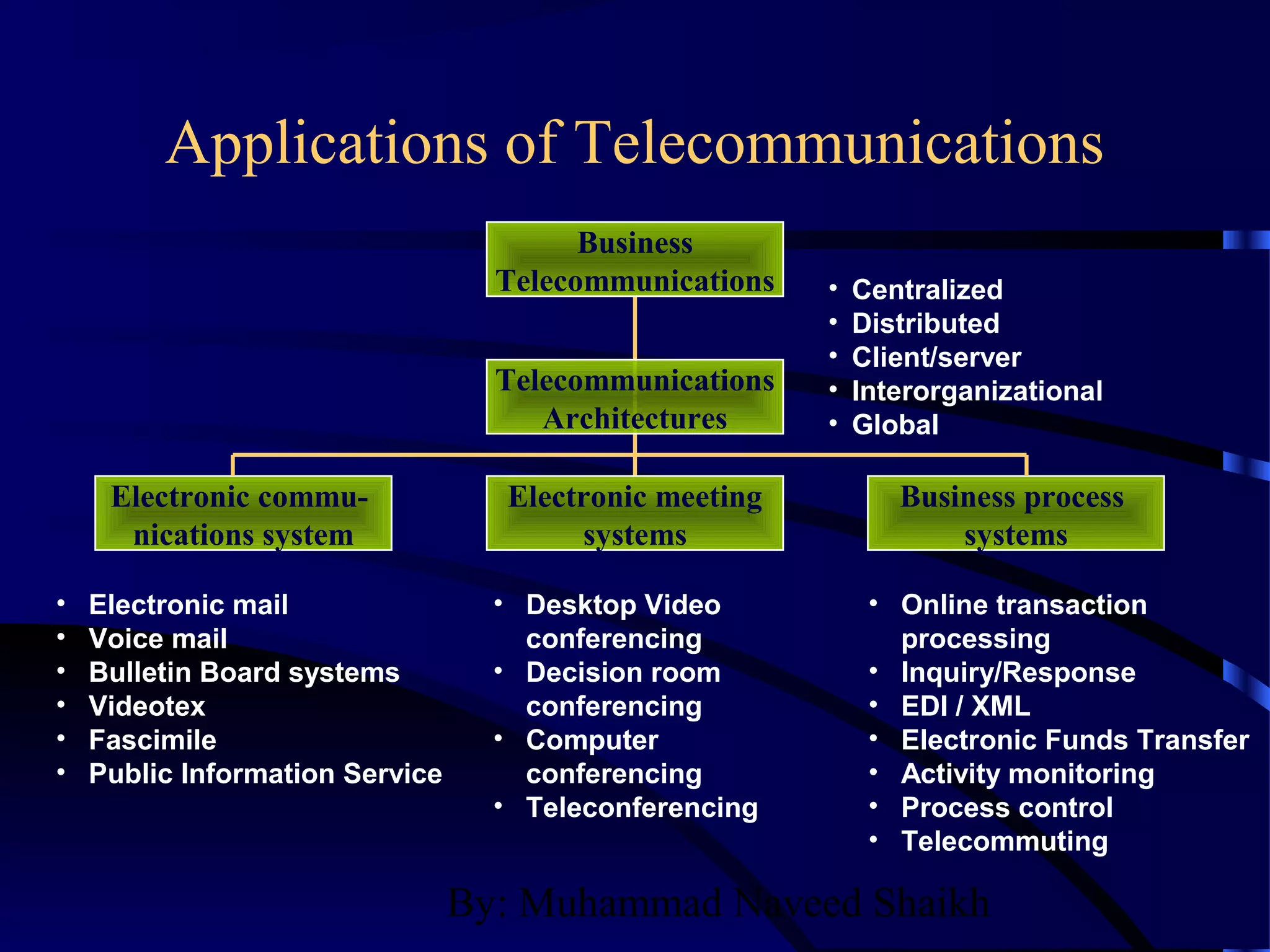
Applications of Telecommunications
Business
Telecommunications
Telecommunications
Architectures
Electronic commu-
nications system
Electronic meeting
systems
Business process
systems
• Centralized
• Distributed
• Client/server
• Interorganizational
• Global
• Electronic mail
• Voice mail
• Bulletin Board systems
• Videotex
• Fascimile
• Public Information Service
• Desktop Video
conferencing
• Decision room
conferencing
• Computer
conferencing
• Teleconferencing
• Online transaction
processing
• Inquiry/Response
• EDI / XML
• Electronic Funds Transfer
• Activity monitoring
• Process control
• Telecommuting
By: Muhammad Naveed Shaikh
INTRODUCTORY TOPICS IN
TELECOMMUNICATIONS
End-Users
• End-users, as the term tells us, provide the
inputs to the network and are recipients of
network outputs.
• The end-user employs what is called an I/O,
standing for input/ output (device).
By: Muhammad Naveed Shaikh
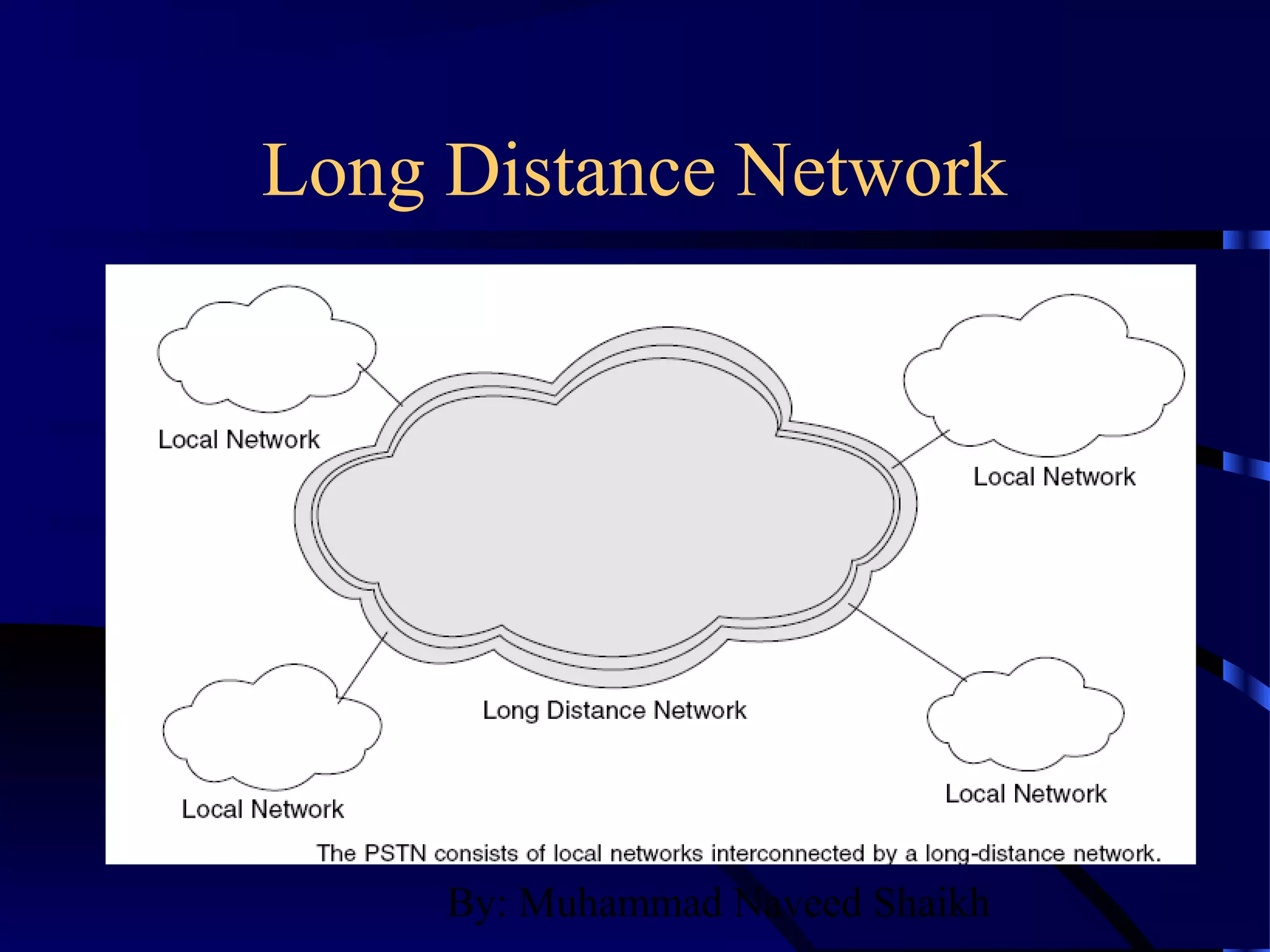
Long Distance Network
By: Muhammad Naveed Shaikh
Nodes & Connectivity
• Nodes
– End-users usually connect to nodes.
– A node is a point or junction in a transmission system
where lines and trunks meet.
– A node usually carries out a switching function.
• Connectivity
– connects an end-user to a node, and from there possibly
through other nodes to some final end-user destination
with which the initiating end-user wants to
communicate.
By: Muhammad Naveed Shaikh
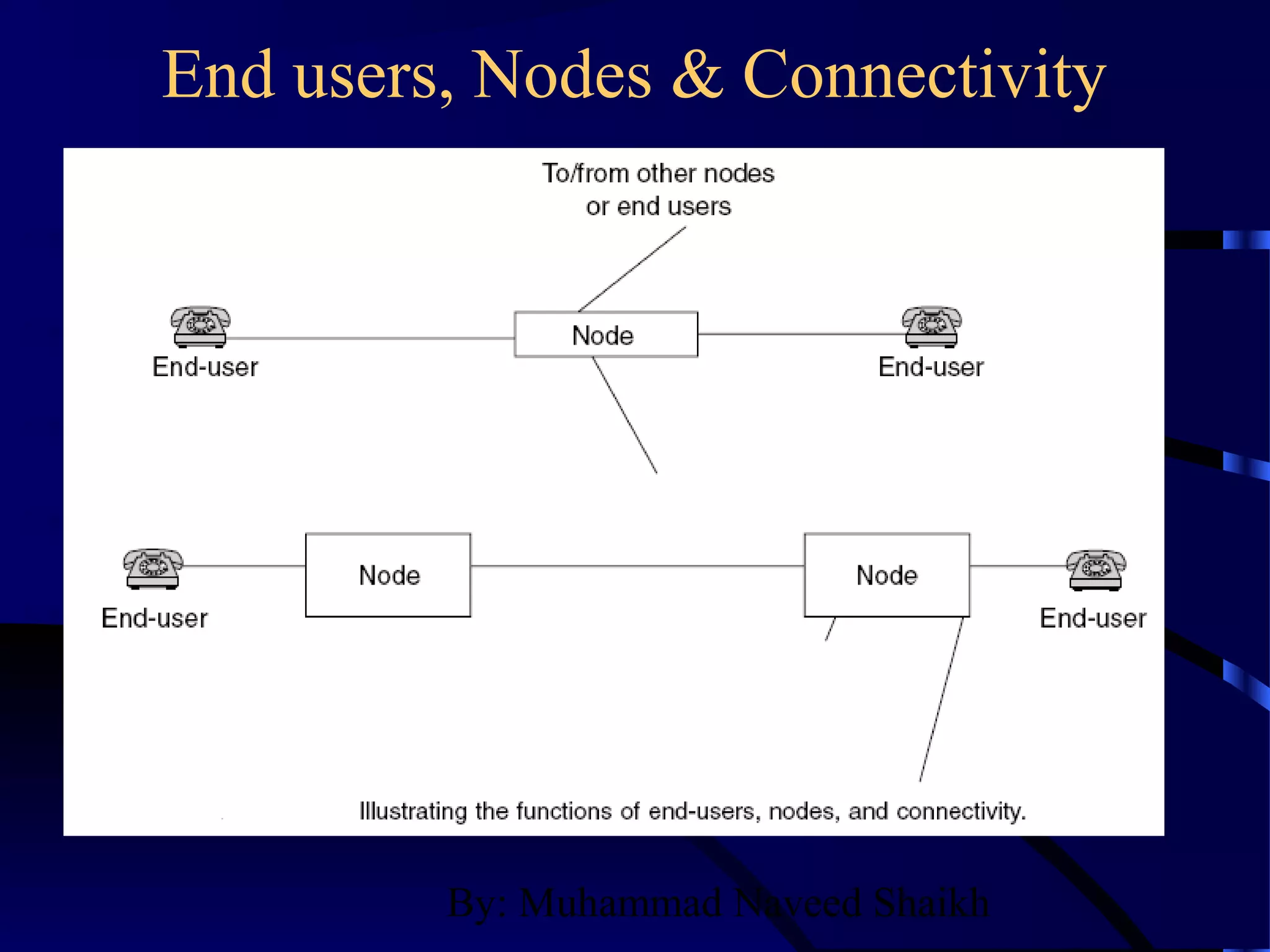
End users, Nodes & Connectivity
By: Muhammad Naveed Shaikh
• The IEEE (Ref. 2) defines a connection as
“an association of channels, switching
systems, and other functional units set up to
provide means for a transfer of information
between two or more points in a
telecommunications network.”
By: Muhammad Naveed Shaikh
Stages to telephone call
• There are three sequential stages to a
telephone call:
1. Call setup;
2. Information exchange; and
3. Call take down.
By: Muhammad Naveed Shaikh
• Call setup is the stage where a circuit is established and
activated. The setup is facilitated by signaling,
• It is initiated by the calling subscriber (user) going off-
hook.
• “the action of taking the telephone instrument out
of its cradle.”
• Two little knobs in the cradle pop up, pushed by a spring
action, causing an electrical closure.
By: Muhammad Naveed Shaikh
• If we turn a light on, we have an electrical closure
allowing electrical current to pass.
• The same thing happens with our telephone set; it now
passes current.
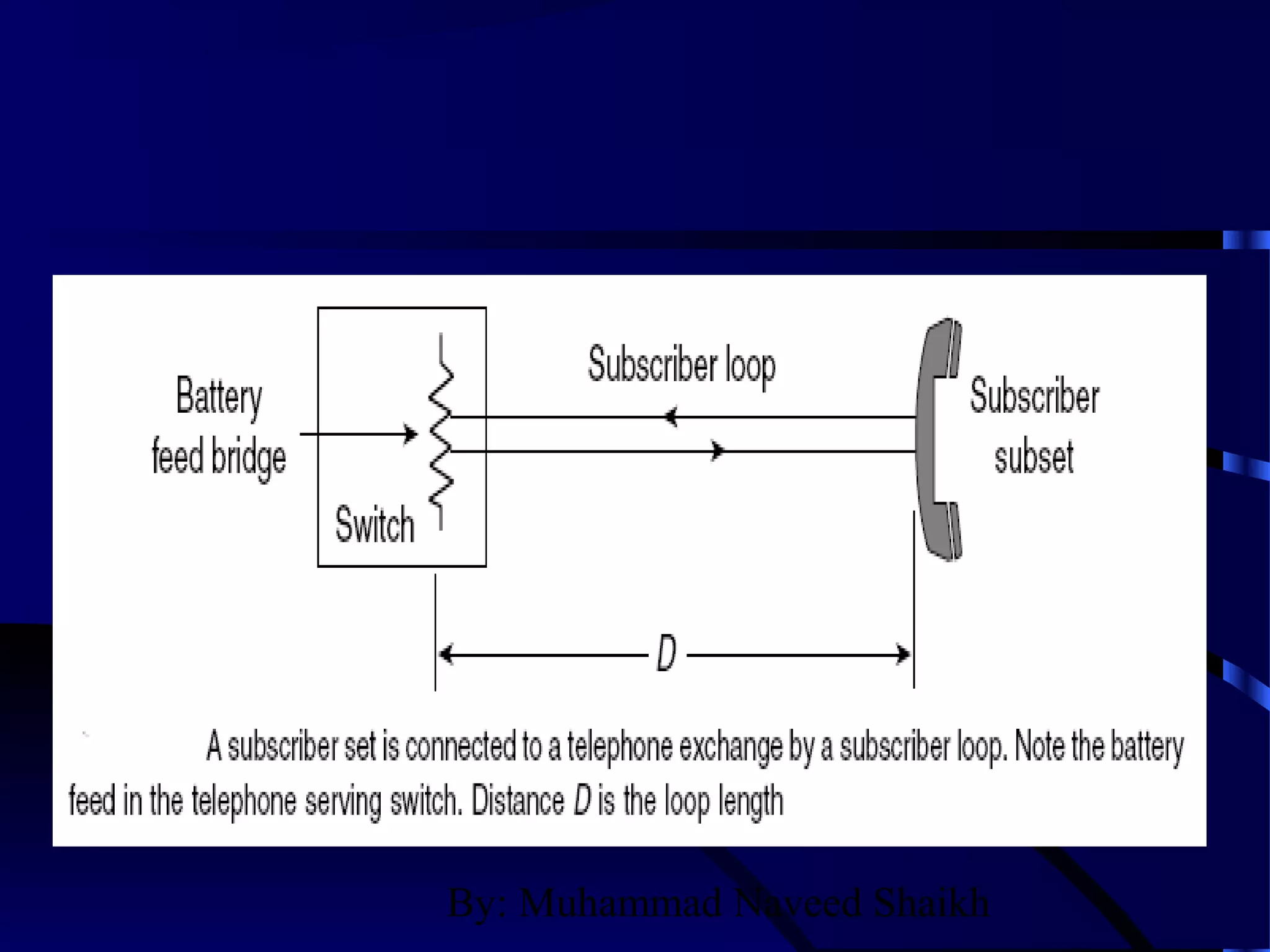
• The current source is a “battery” that resides at the local
serving switch.
• It is connected by the subscriber loop.
• This is just a pair of copper wires connecting the battery
and switch out to the subscriber premises and then to the
subscriber instrument.
By: Muhammad Naveed Shaikh
• Suppose now that a subscriber wishes to call another
telephone subscriber outside the local serving area of her/
his switch.
• The call setup will be similar as before, except that
at the calling subscriber serving switch the call will be
connected to an outgoing trunk.
• Trunks are transmission pathways that interconnect
switches.
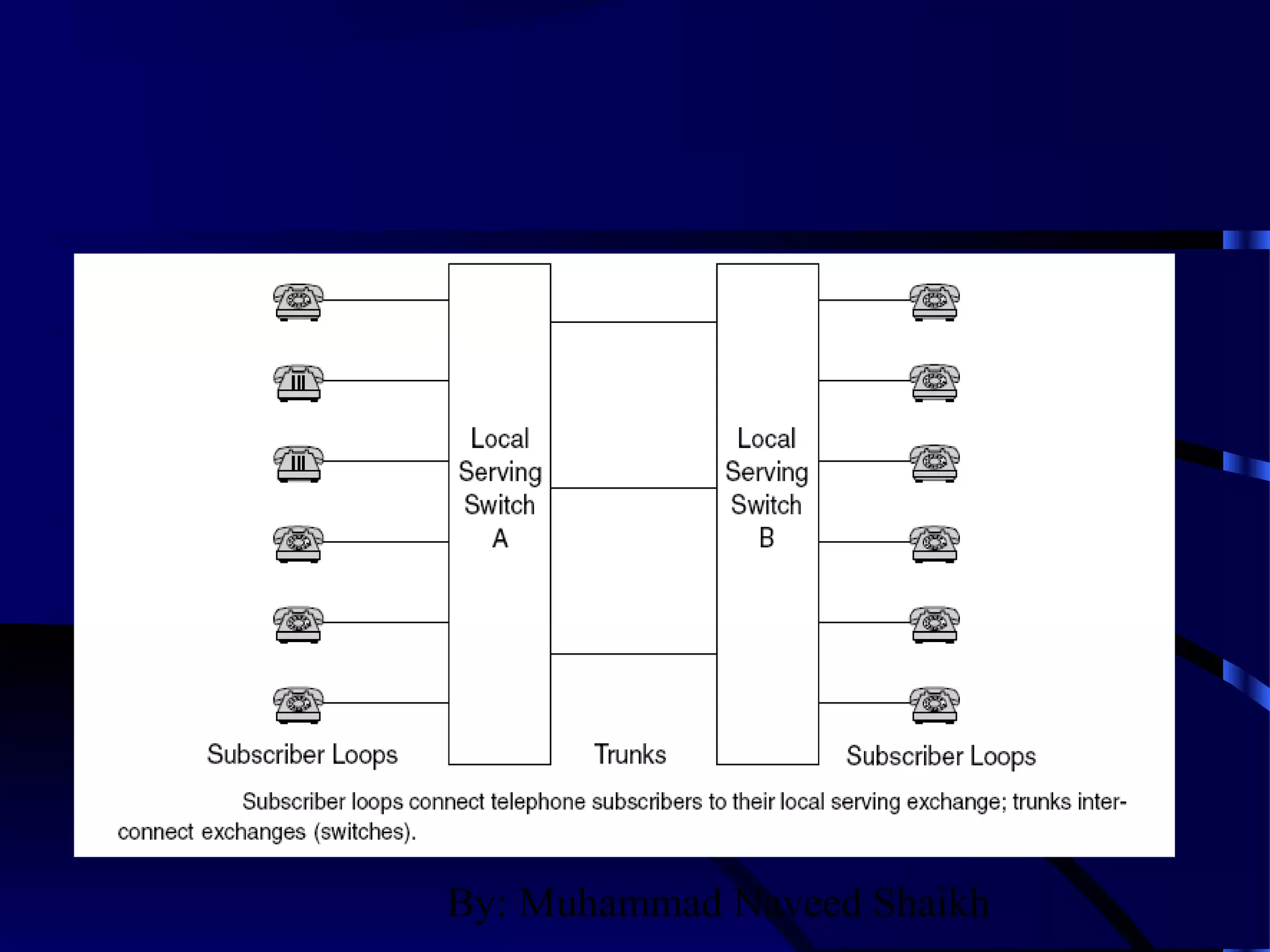
• To repeat: subscriber loops connect end-users (subscriber)
to a local serving switch; trunks interconnect exchanges or
switches.
By: Muhammad Naveed Shaikh
Telephone Numbering and Routing
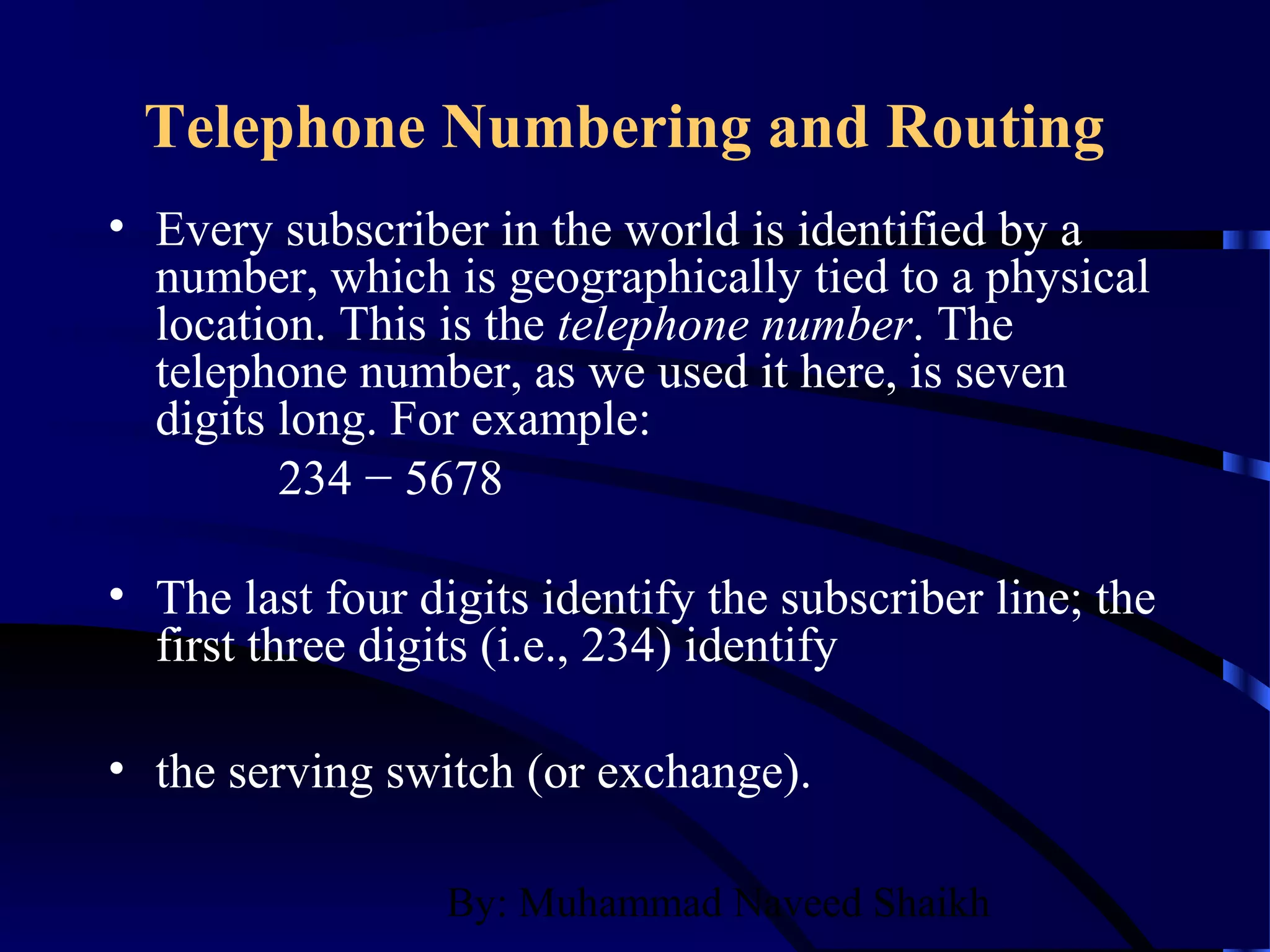
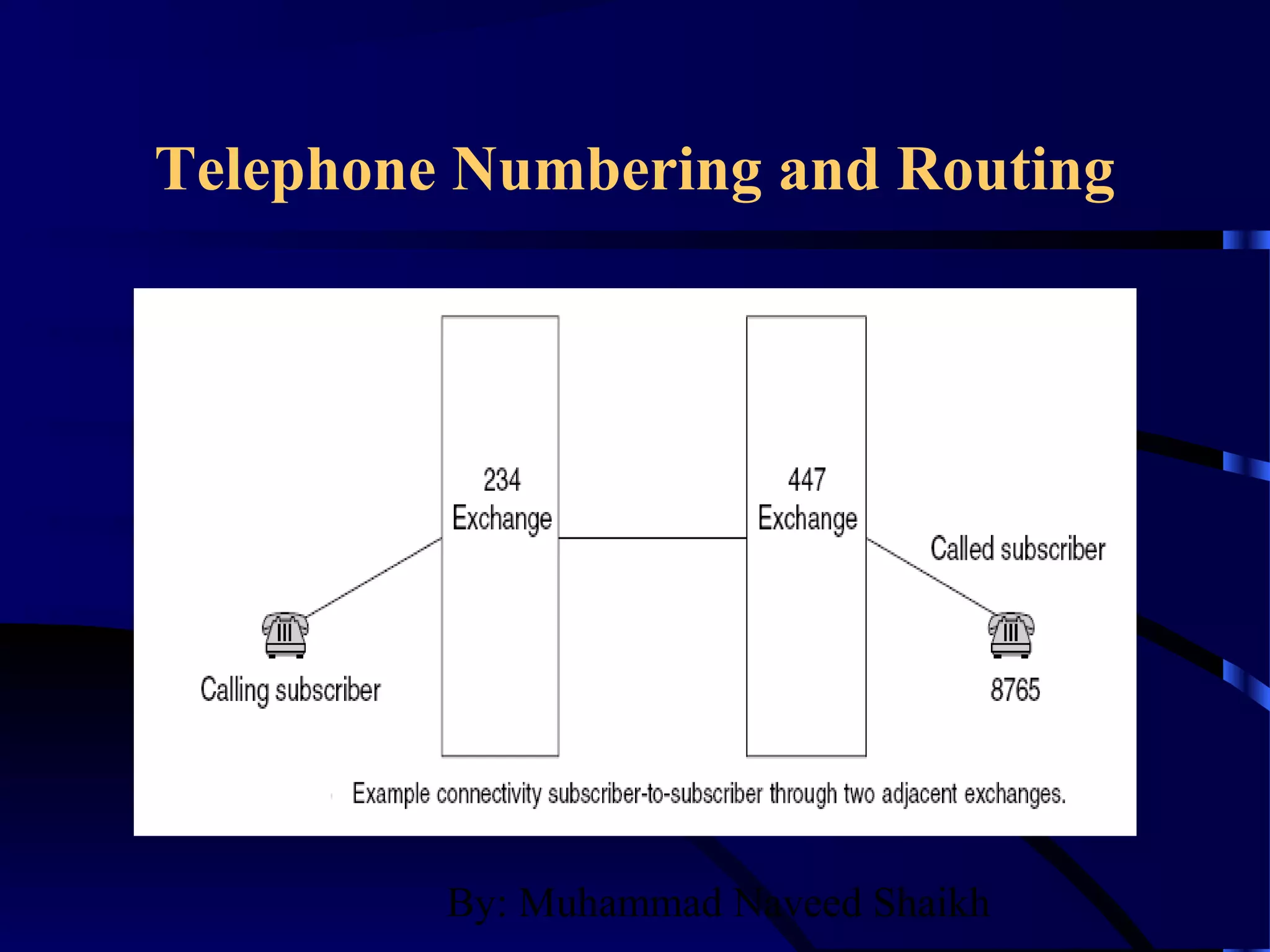
• Every subscriber in the world is identified by a
number, which is geographically tied to a physical
location. This is the telephone number. The
telephone number, as we used it here, is seven
digits long. For example:
234 − 5678
• The last four digits identify the subscriber line; the
first three digits (i.e., 234) identify
• the serving switch (or exchange).
By: Muhammad Naveed Shaikh
Telephone Numbering and Routing
By: Muhammad Naveed Shaikh
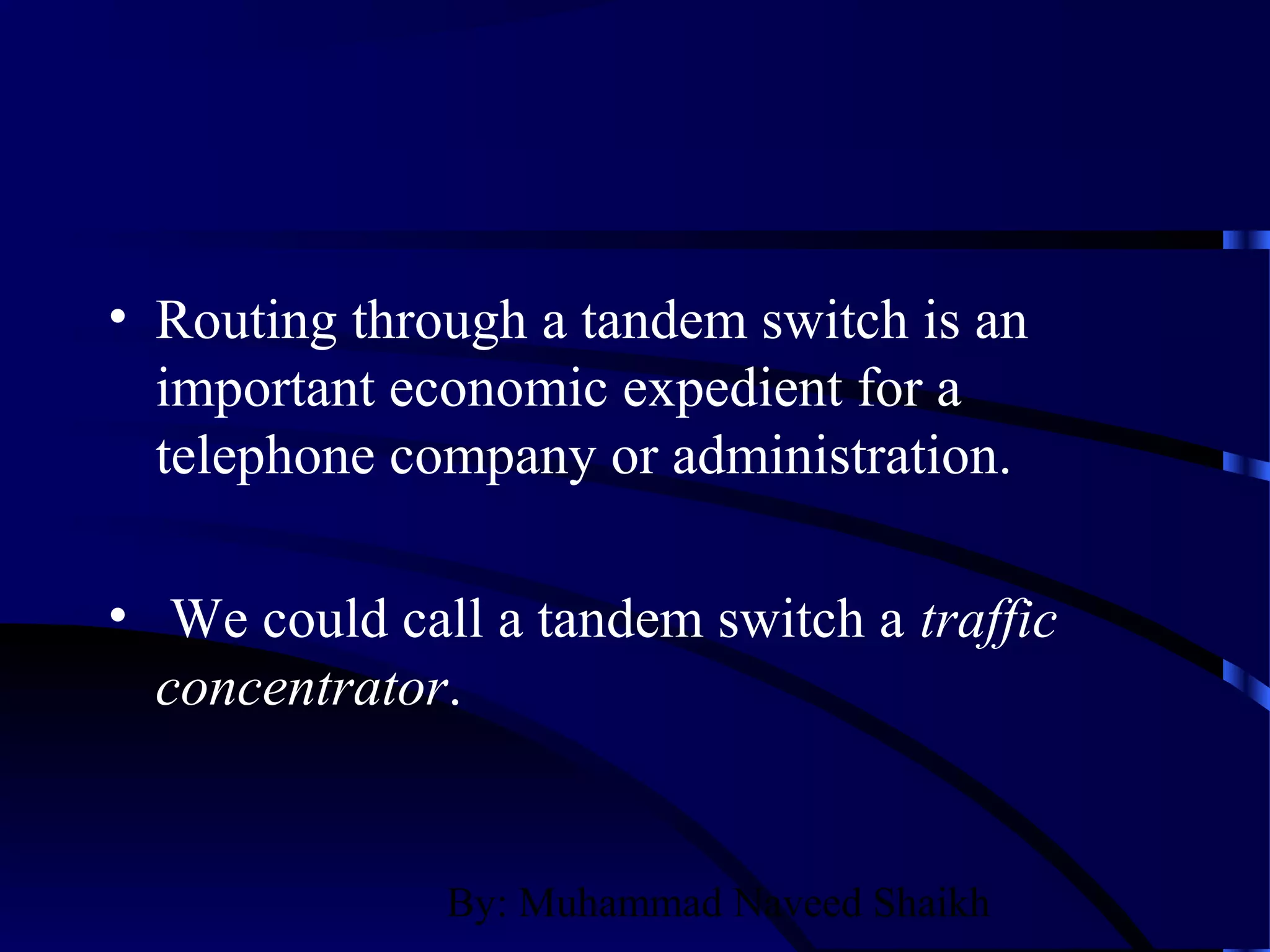
• Routing through a tandem switch is an
important economic expedient for a
telephone company or administration.
• We could call a tandem switch a traffic
concentrator.
By: Muhammad Naveed Shaikh
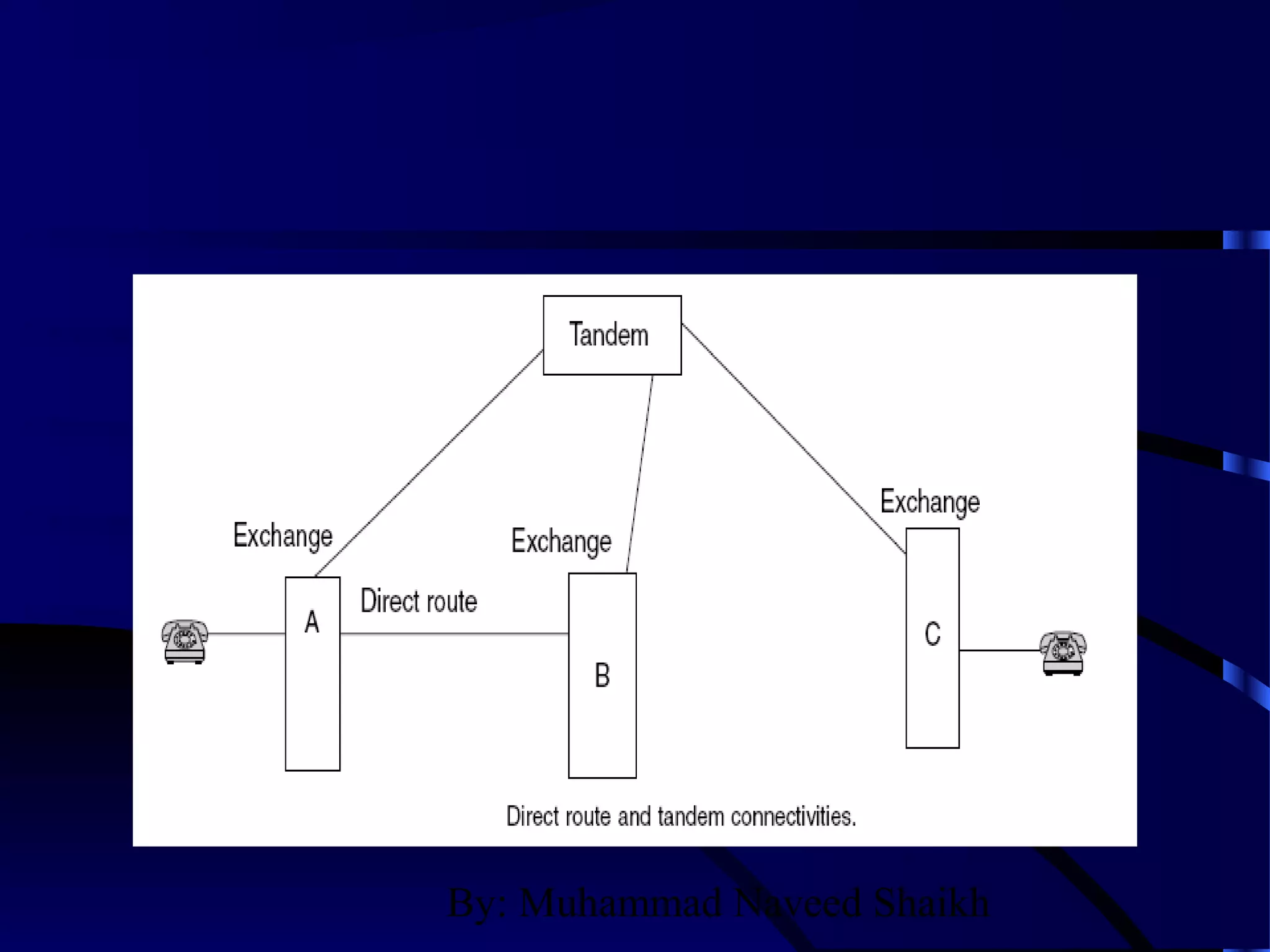
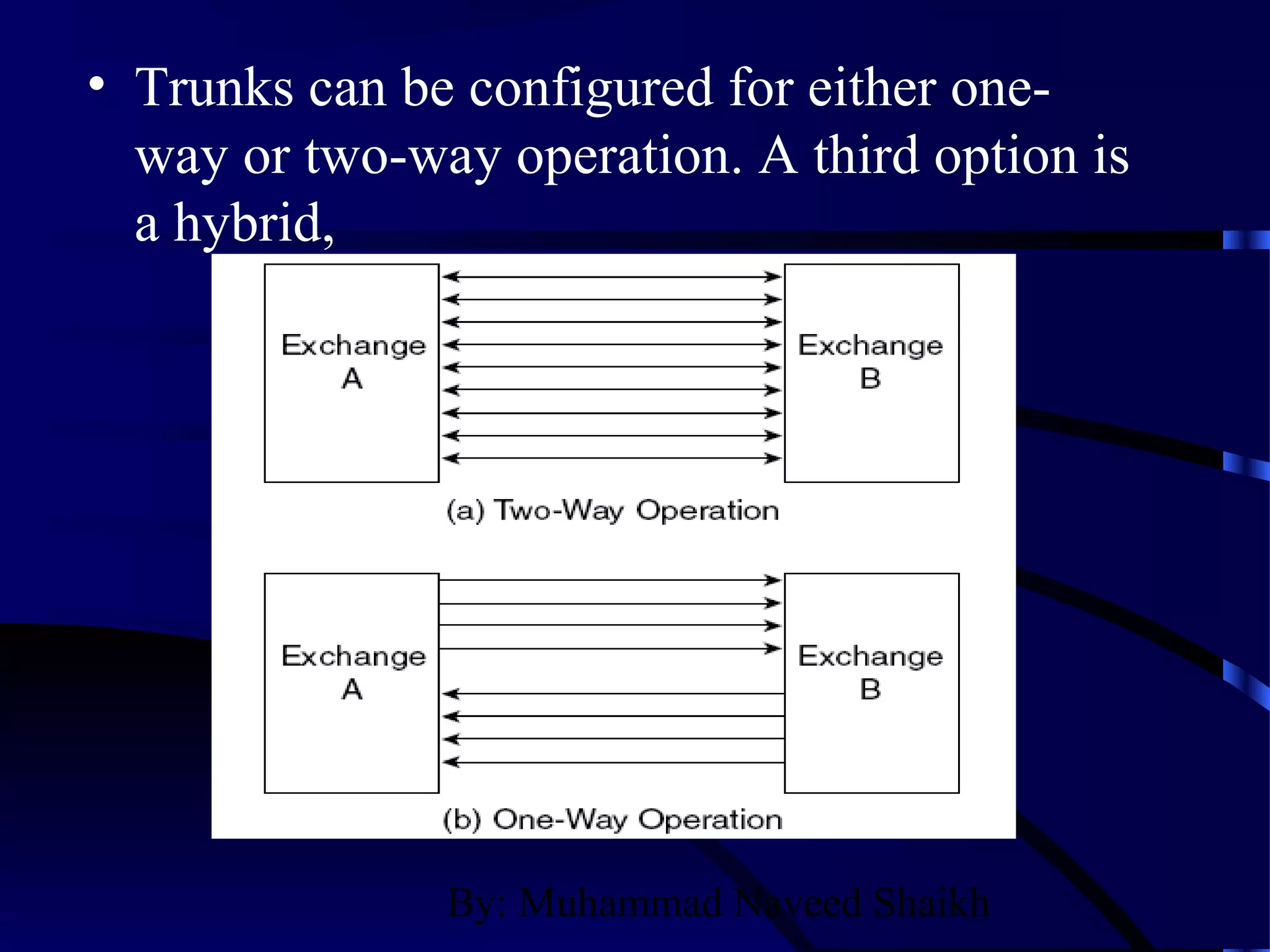
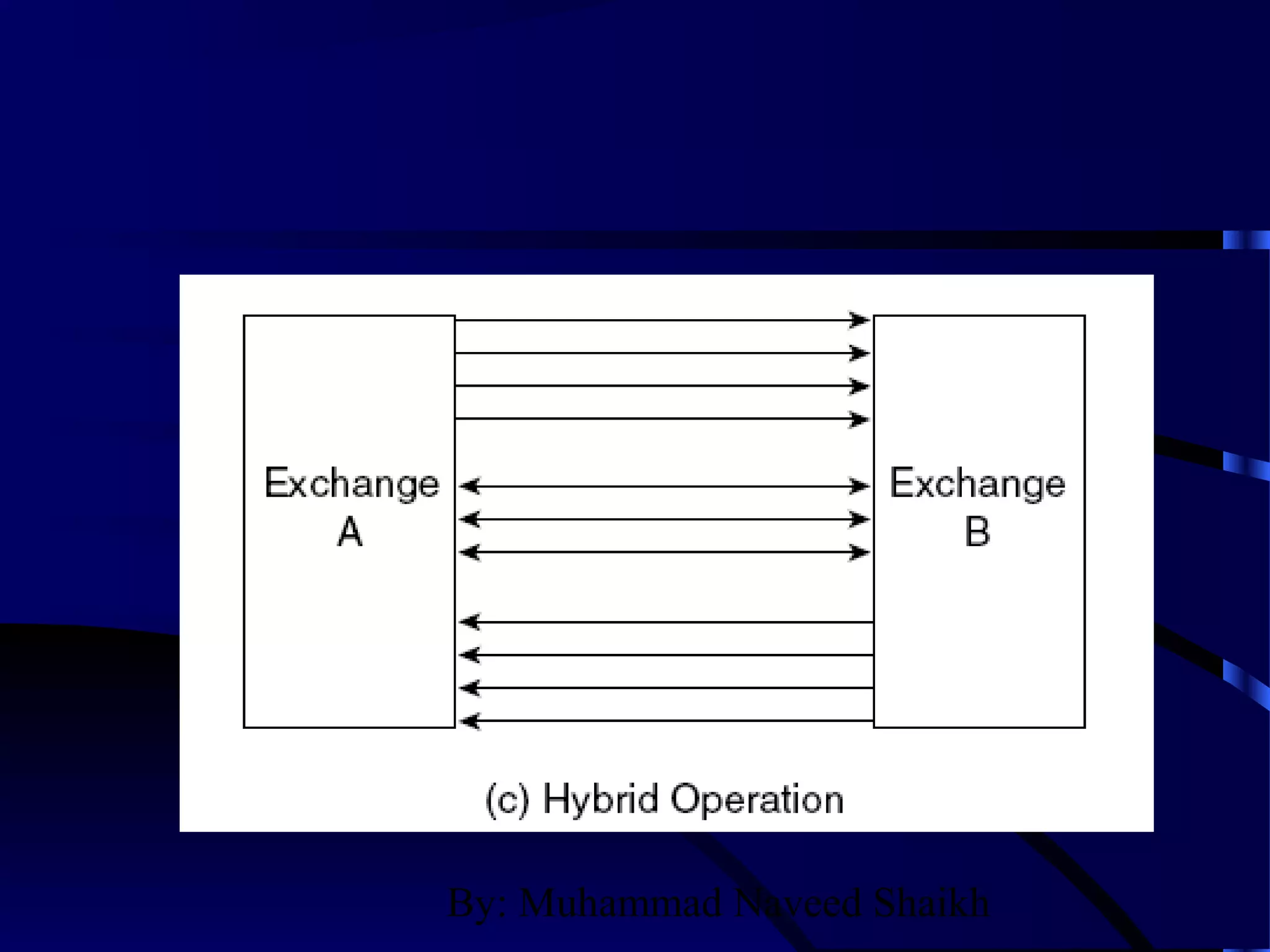
• Trunks can be configured for either one-
way or two-way operation. A third option is
a hybrid,
By: Muhammad Naveed Shaikh

Telecom lect 2

  • 1.
    By: Muhammad NaveedShaikh INSTRUCTED BY MUHAMMAD NAVEED SHAIKH Telecom Systems & Networks Lecture 1
  • 2.
    By: Muhammad NaveedShaikh Definition : Telecommunication • Communications at a distance • The transmission of signals over long distance, such as by telegraph, radio or television. • Telecommunication encompasses the electrical communication at a distance of voice, data, and image information
  • 3.
    By: Muhammad NaveedShaikh Applications of Telecommunications Business Telecommunications Telecommunications Architectures Electronic commu- nications system Electronic meeting systems Business process systems • Centralized • Distributed • Client/server • Interorganizational • Global • Electronic mail • Voice mail • Bulletin Board systems • Videotex • Fascimile • Public Information Service • Desktop Video conferencing • Decision room conferencing • Computer conferencing • Teleconferencing • Online transaction processing • Inquiry/Response • EDI / XML • Electronic Funds Transfer • Activity monitoring • Process control • Telecommuting
  • 4.
    By: Muhammad NaveedShaikh INTRODUCTORY TOPICS IN TELECOMMUNICATIONS End-Users • End-users, as the term tells us, provide the inputs to the network and are recipients of network outputs. • The end-user employs what is called an I/O, standing for input/ output (device).
  • 5.
    By: Muhammad NaveedShaikh Long Distance Network
  • 6.
    By: Muhammad NaveedShaikh Nodes & Connectivity • Nodes – End-users usually connect to nodes. – A node is a point or junction in a transmission system where lines and trunks meet. – A node usually carries out a switching function. • Connectivity – connects an end-user to a node, and from there possibly through other nodes to some final end-user destination with which the initiating end-user wants to communicate.
  • 7.
    By: Muhammad NaveedShaikh End users, Nodes & Connectivity
  • 8.
    By: Muhammad NaveedShaikh • The IEEE (Ref. 2) defines a connection as “an association of channels, switching systems, and other functional units set up to provide means for a transfer of information between two or more points in a telecommunications network.”
  • 9.
    By: Muhammad NaveedShaikh Stages to telephone call • There are three sequential stages to a telephone call: 1. Call setup; 2. Information exchange; and 3. Call take down.
  • 10.
    By: Muhammad NaveedShaikh • Call setup is the stage where a circuit is established and activated. The setup is facilitated by signaling, • It is initiated by the calling subscriber (user) going off- hook. • “the action of taking the telephone instrument out of its cradle.” • Two little knobs in the cradle pop up, pushed by a spring action, causing an electrical closure.
  • 11.
    By: Muhammad NaveedShaikh • If we turn a light on, we have an electrical closure allowing electrical current to pass. • The same thing happens with our telephone set; it now passes current. • The current source is a “battery” that resides at the local serving switch. • It is connected by the subscriber loop. • This is just a pair of copper wires connecting the battery and switch out to the subscriber premises and then to the subscriber instrument.
  • 12.
  • 13.
    By: Muhammad NaveedShaikh • Suppose now that a subscriber wishes to call another telephone subscriber outside the local serving area of her/ his switch. • The call setup will be similar as before, except that at the calling subscriber serving switch the call will be connected to an outgoing trunk. • Trunks are transmission pathways that interconnect switches. • To repeat: subscriber loops connect end-users (subscriber) to a local serving switch; trunks interconnect exchanges or switches.
  • 14.
  • 15.
    By: Muhammad NaveedShaikh Telephone Numbering and Routing • Every subscriber in the world is identified by a number, which is geographically tied to a physical location. This is the telephone number. The telephone number, as we used it here, is seven digits long. For example: 234 − 5678 • The last four digits identify the subscriber line; the first three digits (i.e., 234) identify • the serving switch (or exchange).
  • 16.
    By: Muhammad NaveedShaikh Telephone Numbering and Routing
  • 17.
    By: Muhammad NaveedShaikh • Routing through a tandem switch is an important economic expedient for a telephone company or administration. • We could call a tandem switch a traffic concentrator.
  • 18.
  • 19.
    By: Muhammad NaveedShaikh • Trunks can be configured for either one- way or two-way operation. A third option is a hybrid,
  • 20.