CABLE:-
Cables are used to carry the electric
signal.In electronic circuit the magnitude of
current is not much so cable are to carry
the signal only. Howewer in the output
circuit and in power electrics the value of
current is more. The core of wire is of
copper or aluminium which is of more
strands. Insulation of p.v.c. is provided
over the core.
Genral specification of cable:-
• General specifications of cable are as
following.
• (1) characteristic impedance
• (2) current carrying capacity
• (3) size of cable
• (4) flexibility
(1). Characteristic impedance
• As per international standerds the
characteristic impedance of cable is
50Ω,and 75Ω,cable of 50Ω is the
comprimise between the required power
rating and the attenulation is required ,
cable of 75Ω impudence is used. And
when cable with very low capicitance is
required, cable with 100Ω impudence or
125 Ω impudence is used.
(2) Current carrying capicity:-
• Current carrying capacity of cable is
proportional to its area of current section
of its core . The voltage drop in the cable
and the heat produced when specified
current is passed should be within the
specified limits .
• the current carrying capacity of 7/0.2
cable i.e . Cable with copperb conducter
of seven stands each of 0.2 mm is 1
ampere . Table shows maximum current
rating of different size of cable.
SIZE OF CABLE..
Conducter
• 7/0.2
• 16/0.2
• 24/0.2
• 32/0.2
Maximum current
• 1A
• 3A
• 5A
• 10A
(3) Size of cable :
• while deciding the size of the cable . Attenuation and power/
voltage handling capaity are considered . Attenuation is
inversely propertional to the diameter of the conductor while
power or voltage rating is propertional to the diameter while
the weight and cost are propertional to the square of the
diameter .
• Attenuation ά 1/d
• voltage / power rating ά d
• Wieght and cost άd²
• so to reduce the cost . The diameter should be kept low
but it reduces the mechanical strength and increase the
attenuation. So after considering all these factors. The
standerd size be chosen.
(4) Flexibility:
• flexibility of the core cable is less and
there is possibility of breaking. Flexibility
of the standerd cable is more but the
losses are increased .
TYPES OF CABLE:
• there are many types of wires or cables such as
single core. Two- core, three- core , four-core,
ribbon- core , screened-cable , co-axial cable ,
twin bore cable , twisted pair-cable, Teflon
coated –cable , fiber optic-cable etc, here we shall
study the following types of cables .
• (1) ribbon cable
• (2) screened cable
• (3) co-axial cable
• (4) twisted pair cable
• (5) fiber optic cable
RIBBON CABLE:
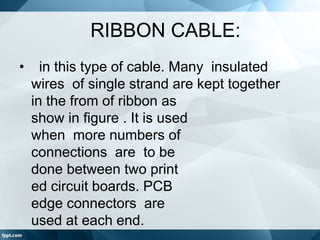
• in this type of cable. Many insulated
wires of single strand are kept together
in the from of ribbon as
show in figure . It is used
when more numbers of
connections are to be
done between two print
ed circuit boards. PCB
edge connectors are
used at each end.
SCREENED CABLE:
• when a signal is transmitted throught single core ,
radio frequency disturbance signals ride on the
information signal. So the noice is also transmitted
along with the information signal. Screened cable is
used to prevent this .
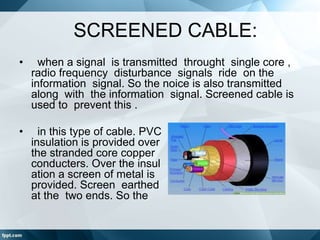
• in this type of cable. PVC
insulation is provided over
the stranded core copper
conducters. Over the insul
ation a screen of metal is
provided. Screen earthed
at the two ends. So the
• So the radio frequency disturbance signals are earthe and
they do not ride on the signal.
Co-axial cable :-
This is screened type of cable.
Ther is one core of stranded
Copper conductors or single
Core of Copper conducter.
Co-axial cable
• over the core the insulation made of PVC is
provided. Surrounding the insulation a metal
screen is provided.
• In thin type co-axial cable. Thickness of the
core is less . While the thickness is more in
thick type co-axial cable.
• type of co- axial cables :
• (1) RG-8 and RG-11(Thicknet)
• (2) RG-58(Thinnet)
Application of co-axial cables:
• 1. It is used in cables for TV camera.
• 2. Co-axial cables of less attenuation and
reducer capacitance are
used for transmission of RF power .
• 3. It is used in multiplexed tele-data
acquisition system
• 4. low noise RF cables are used for the
space craft signals.
• 5. It is used in mines for communication .
• 6. It is used in CCTV system.
Twisted pair cable:-
• In this type of cable, there are more than
two(normally four)twisted pairs.
• Ther are two types:-
(1)UTP:-Un shieded twisted pair cables.
(2)STP:-Shielded twistd pair cables.
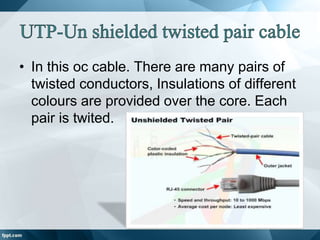
• In this oc cable. There are many pairs of
twisted conductors, Insulations of different
colours are provided over the core. Each
pair is twited.
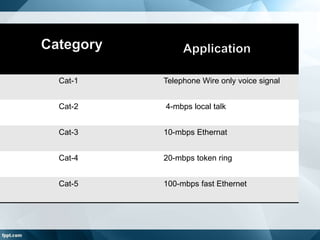
Cat-1 Telephone Wire only voice signal
Cat-2 4-mbps local talk
Cat-3 10-mbps Ethernat
Cat-4 20-mbps token ring
Cat-5 100-mbps fast Ethernet
• In this type of cable , a metal screen or
metal foil is wrapped round each twisted
pair . Numbers of twisted pairs are four.
Over it a thick insuction is provided.Due to
this the cross talk is reducd but the cost
increases and the flexibility of the cable
decreases.
• This type of cable is used
for fiber optic communication.
In this , fiber is used in place
of conductor and light ray is
used instead of electric
current.
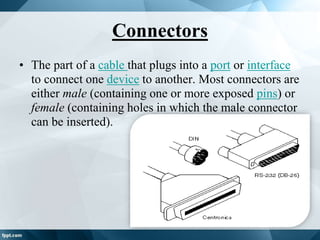
Connectors
• The part of a cable that plugs into a port or interface
to connect one device to another. Most connectors are
either male (containing one or more exposed pins) or
female (containing holes in which the male connector
can be inserted).

Cable

  • 2.
    CABLE:- Cables are usedto carry the electric signal.In electronic circuit the magnitude of current is not much so cable are to carry the signal only. Howewer in the output circuit and in power electrics the value of current is more. The core of wire is of copper or aluminium which is of more strands. Insulation of p.v.c. is provided over the core.
  • 3.
    Genral specification ofcable:- • General specifications of cable are as following. • (1) characteristic impedance • (2) current carrying capacity • (3) size of cable • (4) flexibility
  • 4.
    (1). Characteristic impedance •As per international standerds the characteristic impedance of cable is 50Ω,and 75Ω,cable of 50Ω is the comprimise between the required power rating and the attenulation is required , cable of 75Ω impudence is used. And when cable with very low capicitance is required, cable with 100Ω impudence or 125 Ω impudence is used.
  • 5.
    (2) Current carryingcapicity:- • Current carrying capacity of cable is proportional to its area of current section of its core . The voltage drop in the cable and the heat produced when specified current is passed should be within the specified limits . • the current carrying capacity of 7/0.2 cable i.e . Cable with copperb conducter of seven stands each of 0.2 mm is 1 ampere . Table shows maximum current rating of different size of cable.
  • 6.
    SIZE OF CABLE.. Conducter •7/0.2 • 16/0.2 • 24/0.2 • 32/0.2 Maximum current • 1A • 3A • 5A • 10A
  • 7.
    (3) Size ofcable : • while deciding the size of the cable . Attenuation and power/ voltage handling capaity are considered . Attenuation is inversely propertional to the diameter of the conductor while power or voltage rating is propertional to the diameter while the weight and cost are propertional to the square of the diameter . • Attenuation ά 1/d • voltage / power rating ά d • Wieght and cost άd² • so to reduce the cost . The diameter should be kept low but it reduces the mechanical strength and increase the attenuation. So after considering all these factors. The standerd size be chosen.
  • 8.
    (4) Flexibility: • flexibilityof the core cable is less and there is possibility of breaking. Flexibility of the standerd cable is more but the losses are increased .
  • 9.
    TYPES OF CABLE: •there are many types of wires or cables such as single core. Two- core, three- core , four-core, ribbon- core , screened-cable , co-axial cable , twin bore cable , twisted pair-cable, Teflon coated –cable , fiber optic-cable etc, here we shall study the following types of cables . • (1) ribbon cable • (2) screened cable • (3) co-axial cable • (4) twisted pair cable • (5) fiber optic cable
  • 10.
    RIBBON CABLE: • inthis type of cable. Many insulated wires of single strand are kept together in the from of ribbon as show in figure . It is used when more numbers of connections are to be done between two print ed circuit boards. PCB edge connectors are used at each end.
  • 11.
    SCREENED CABLE: • whena signal is transmitted throught single core , radio frequency disturbance signals ride on the information signal. So the noice is also transmitted along with the information signal. Screened cable is used to prevent this . • in this type of cable. PVC insulation is provided over the stranded core copper conducters. Over the insul ation a screen of metal is provided. Screen earthed at the two ends. So the
  • 12.
    • So theradio frequency disturbance signals are earthe and they do not ride on the signal. Co-axial cable :- This is screened type of cable. Ther is one core of stranded Copper conductors or single Core of Copper conducter. Co-axial cable
  • 13.
    • over thecore the insulation made of PVC is provided. Surrounding the insulation a metal screen is provided. • In thin type co-axial cable. Thickness of the core is less . While the thickness is more in thick type co-axial cable. • type of co- axial cables : • (1) RG-8 and RG-11(Thicknet) • (2) RG-58(Thinnet)
  • 14.
    Application of co-axialcables: • 1. It is used in cables for TV camera. • 2. Co-axial cables of less attenuation and reducer capacitance are used for transmission of RF power . • 3. It is used in multiplexed tele-data acquisition system • 4. low noise RF cables are used for the space craft signals. • 5. It is used in mines for communication . • 6. It is used in CCTV system.
  • 15.
    Twisted pair cable:- •In this type of cable, there are more than two(normally four)twisted pairs. • Ther are two types:- (1)UTP:-Un shieded twisted pair cables. (2)STP:-Shielded twistd pair cables.
  • 16.
    • In thisoc cable. There are many pairs of twisted conductors, Insulations of different colours are provided over the core. Each pair is twited.
  • 17.
    Cat-1 Telephone Wireonly voice signal Cat-2 4-mbps local talk Cat-3 10-mbps Ethernat Cat-4 20-mbps token ring Cat-5 100-mbps fast Ethernet
  • 18.
    • In thistype of cable , a metal screen or metal foil is wrapped round each twisted pair . Numbers of twisted pairs are four. Over it a thick insuction is provided.Due to this the cross talk is reducd but the cost increases and the flexibility of the cable decreases.
  • 20.
    • This typeof cable is used for fiber optic communication. In this , fiber is used in place of conductor and light ray is used instead of electric current.
  • 21.
    Connectors • The partof a cable that plugs into a port or interface to connect one device to another. Most connectors are either male (containing one or more exposed pins) or female (containing holes in which the male connector can be inserted).