COMPUTER NETWORKS- (20MCA23C)
UNIT-II
‘THE PHYSICAL LAYER’
FACULTY:
DR. R.A. ROSELINE, M.SC., M.PHIL., PH.D.,
ASSOCIATE PROFESSOR AND HEAD,
POST GRADUATE AND RESEARCH DEPARTMENT OF COMPUTER APPLICATIONS,
GOVERNMENT ARTS COLLEGE (AUTONOMOUS),COIMBATORE – 641 018.
THETHEORETICAL BASIS FOR DATA
COMMUNICATION
 Fourier Analysis
 Bandwidth-Limited Signals
 Maximum Data Rate of a Channel
BANDWIDTH-LIMITED SIGNALS
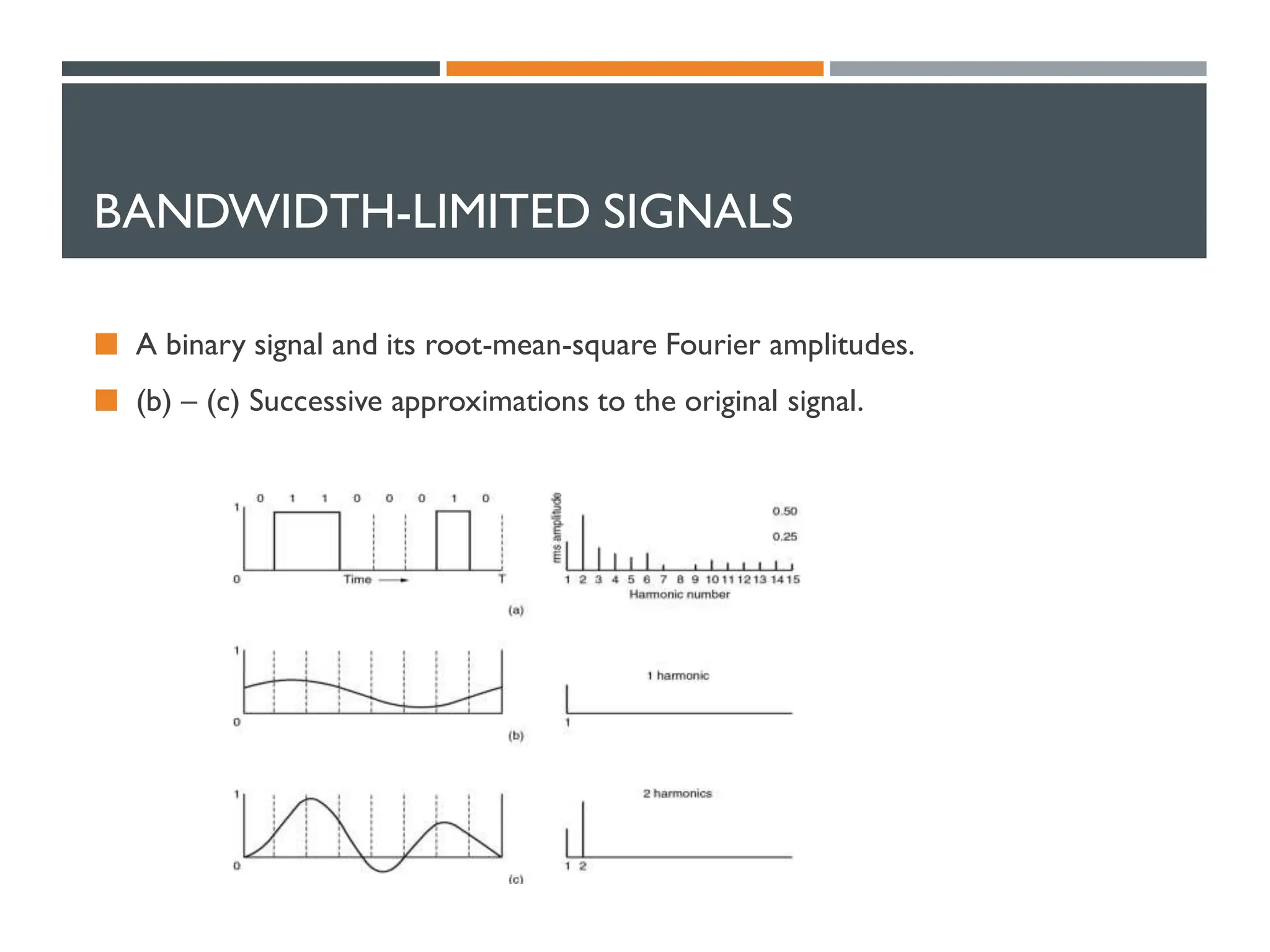
 A binary signal and its root-mean-square Fourier amplitudes.
 (b) – (c) Successive approximations to the original signal.
BANDWIDTH-LIMITED SIGNALS (2)
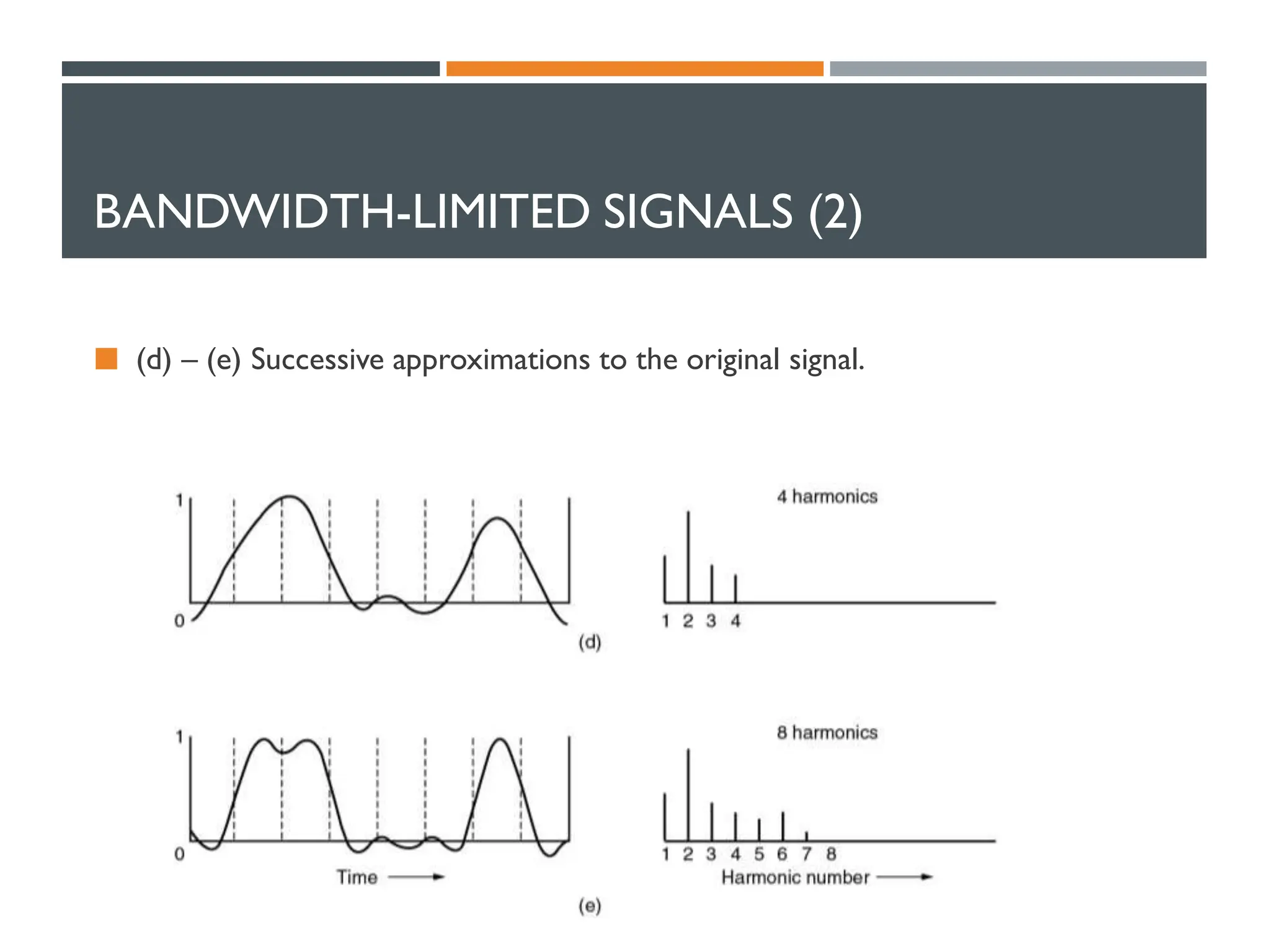
 (d) – (e) Successive approximations to the original signal.
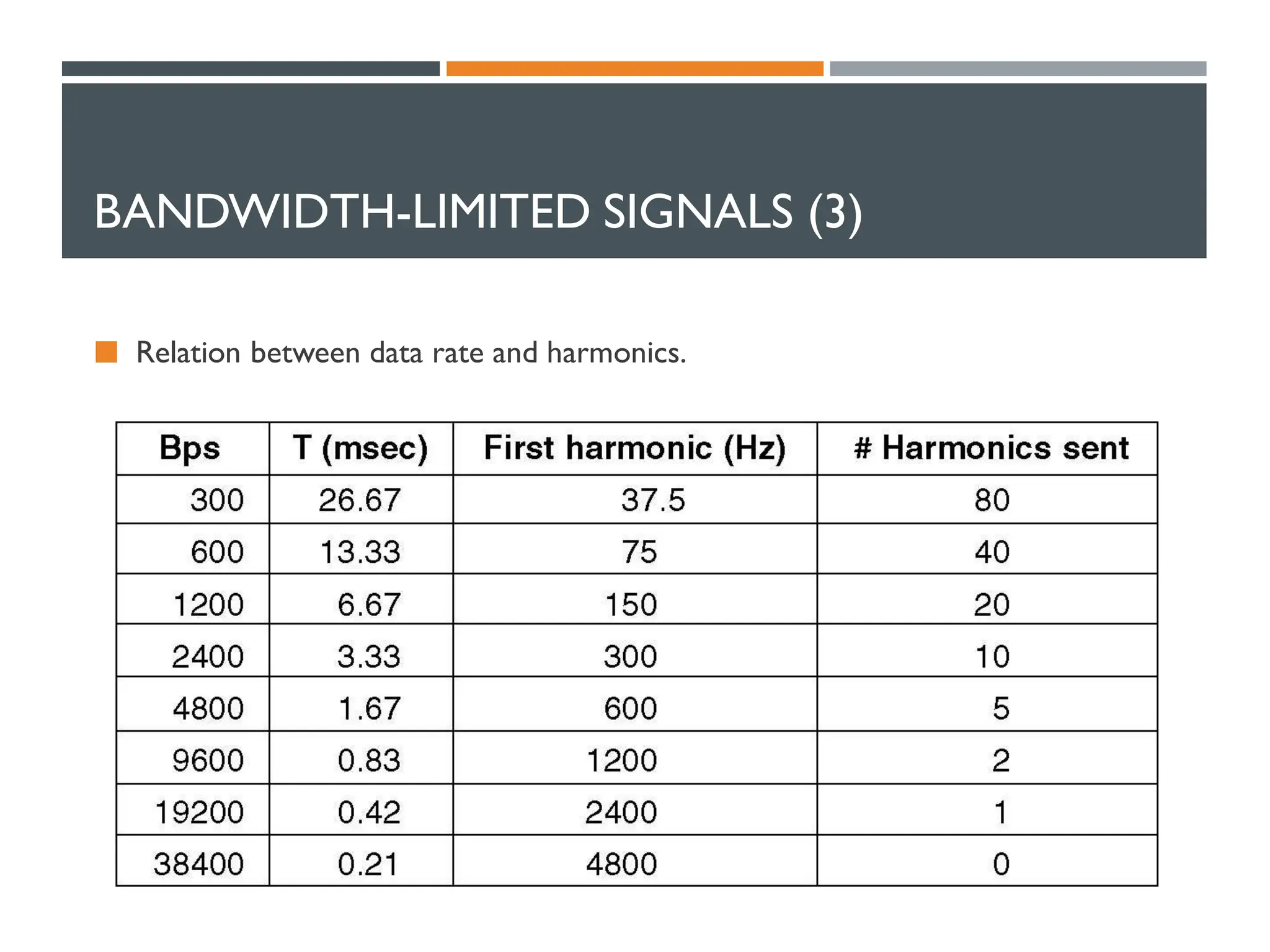
BANDWIDTH-LIMITED SIGNALS (3)
 Relation between data rate and harmonics.
GUIDEDTRANSMISSION MEDIA
 Magnetic Media
 Twisted Pair
 Coaxial Cable
 Fiber Optics
TWISTED PAIR
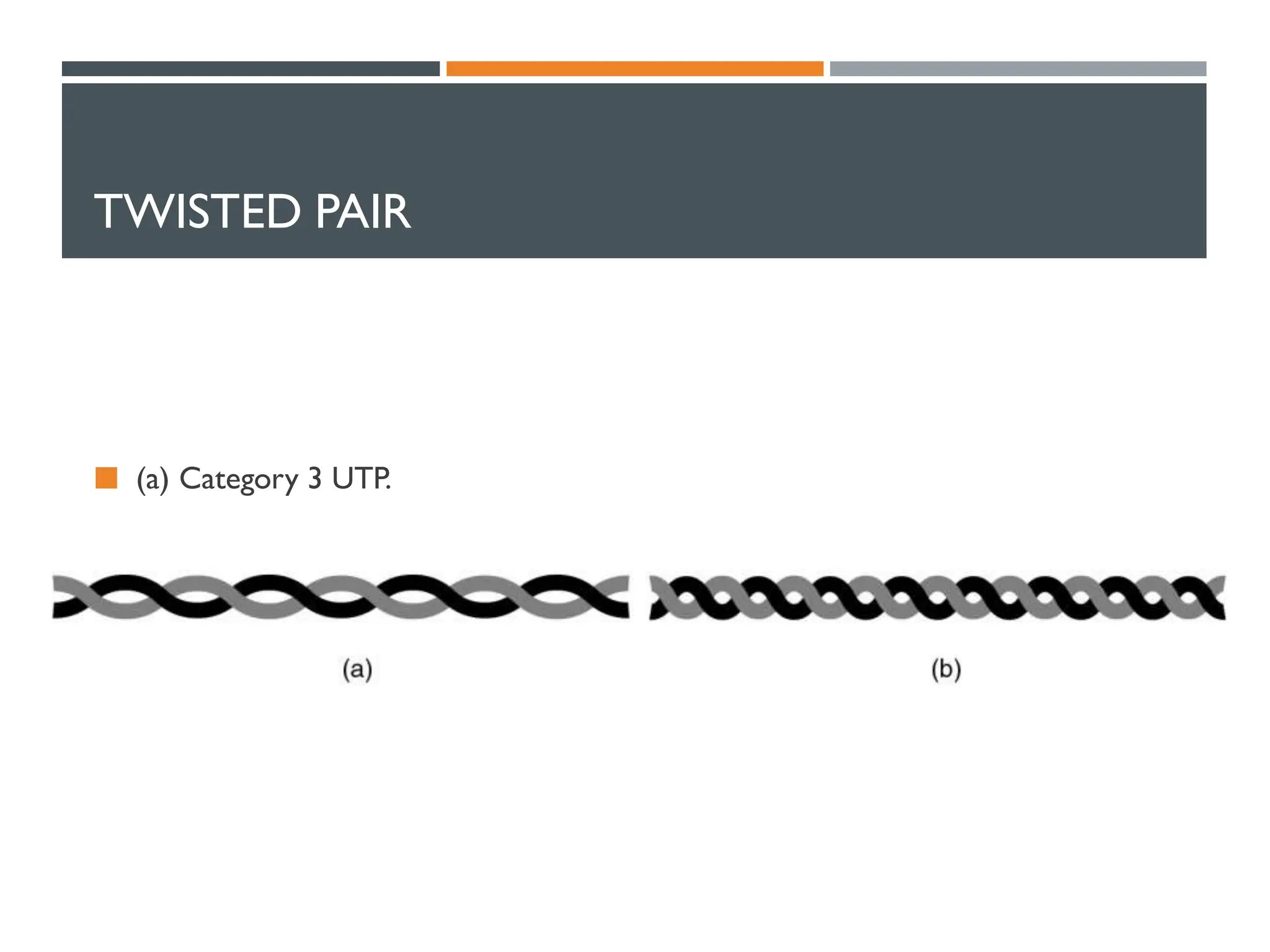
 (a) Category 3 UTP.
 (b) Category 5 UTP.
COAXIAL CABLE
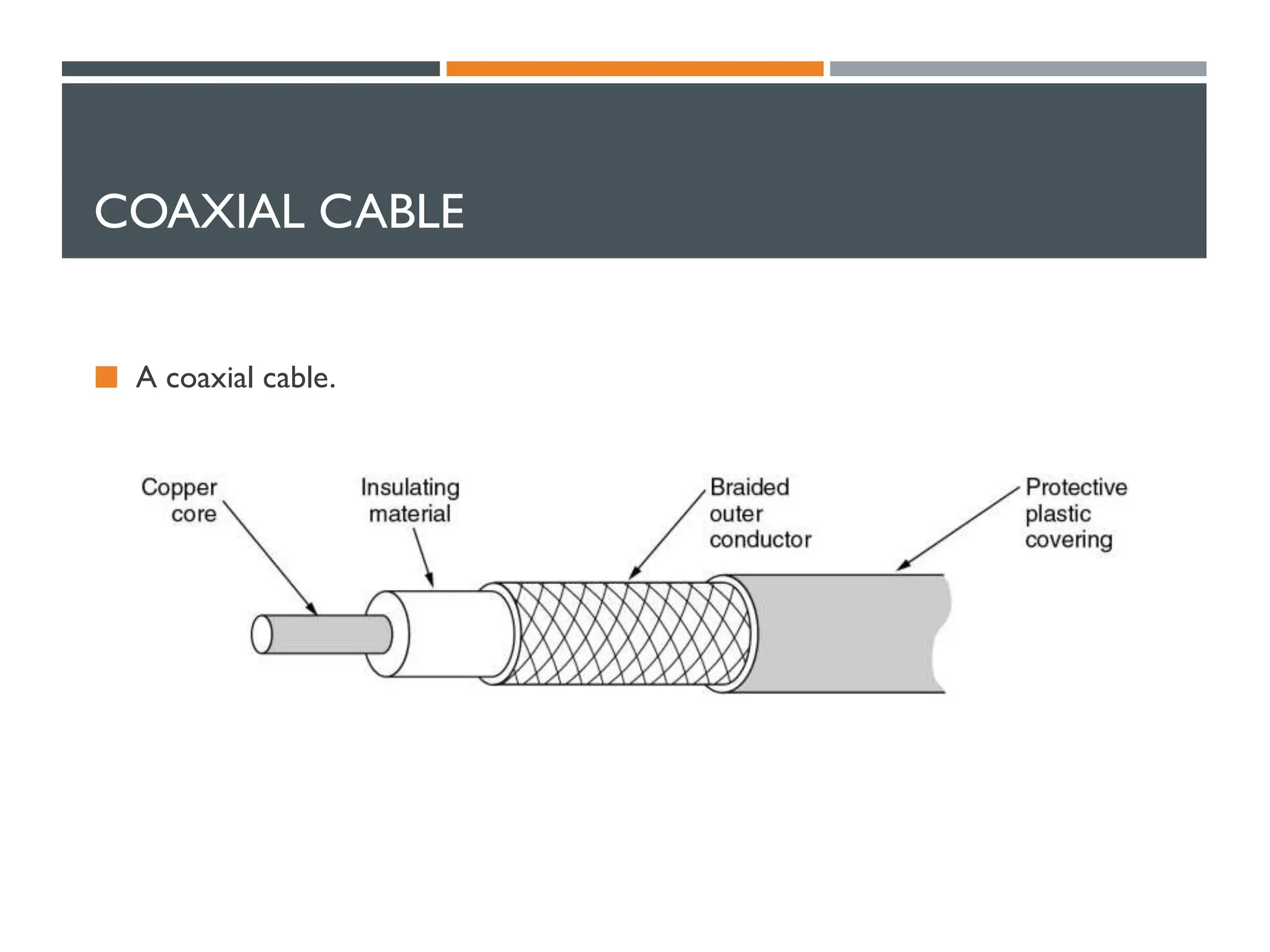
 A coaxial cable.
FIBER OPTICS
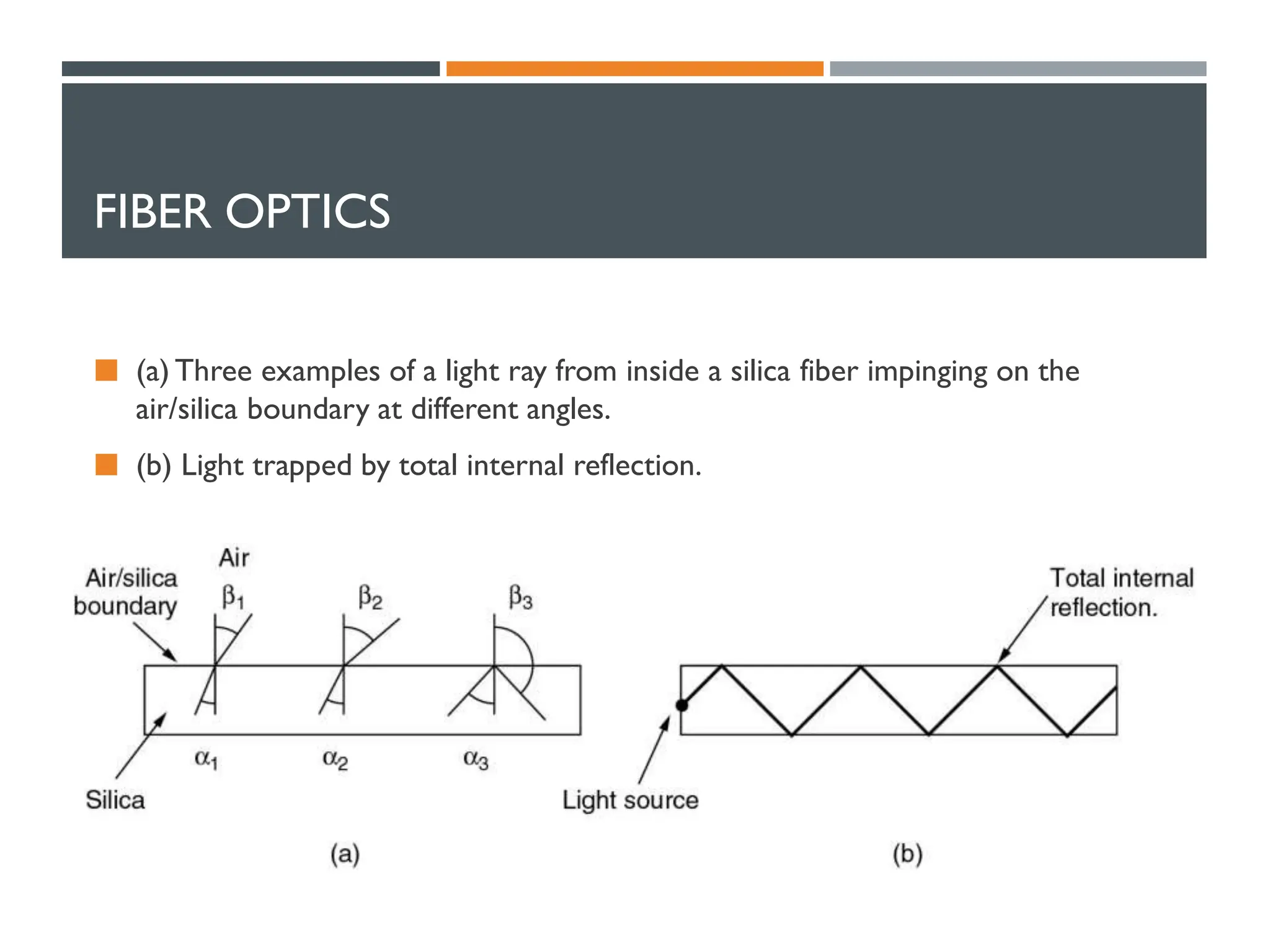
 (a) Three examples of a light ray from inside a silica fiber impinging on the
air/silica boundary at different angles.
 (b) Light trapped by total internal reflection.
TRANSMISSION OF LIGHTTHROUGH FIBER
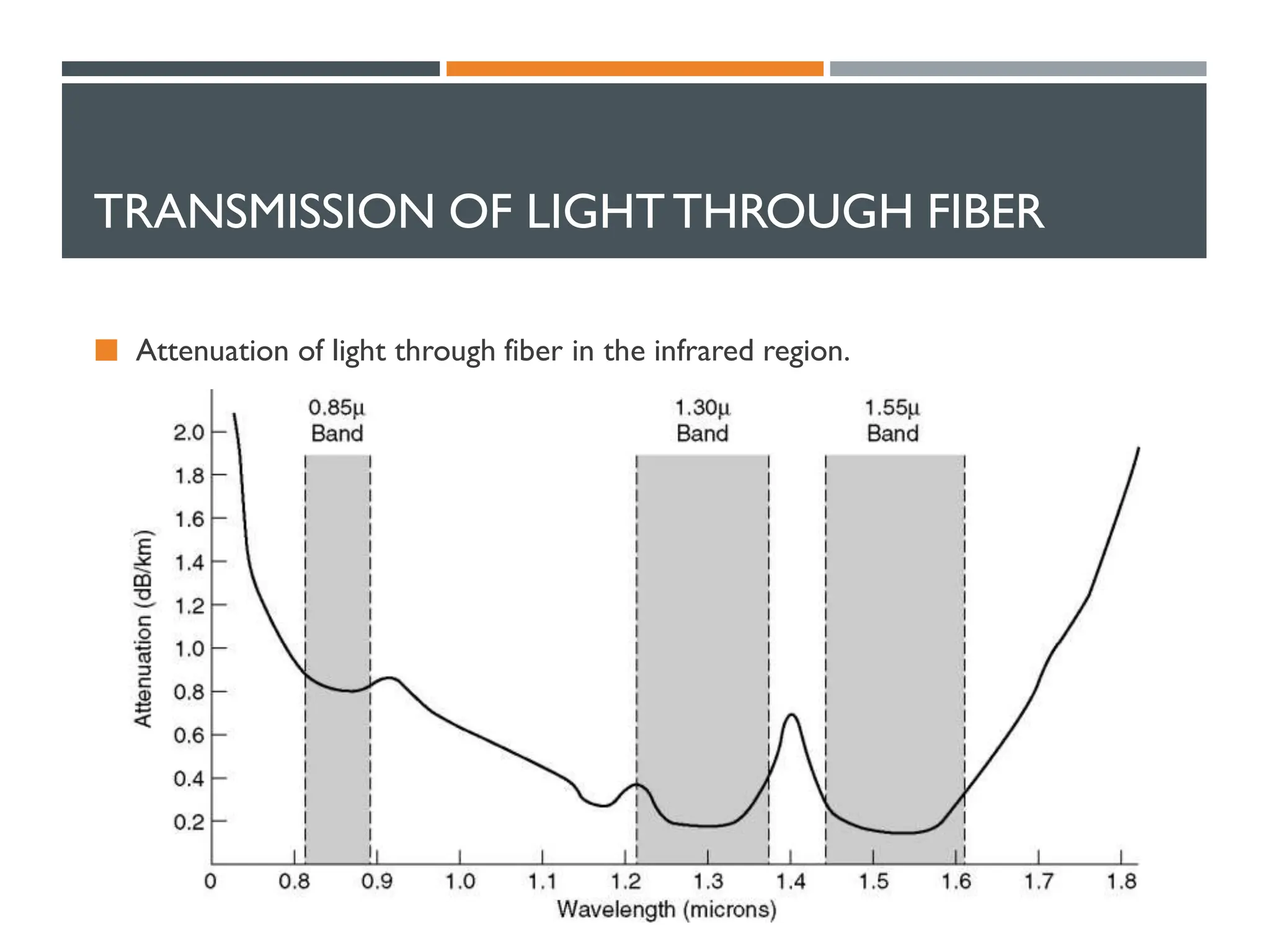
 Attenuation of light through fiber in the infrared region.
FIBER CABLES
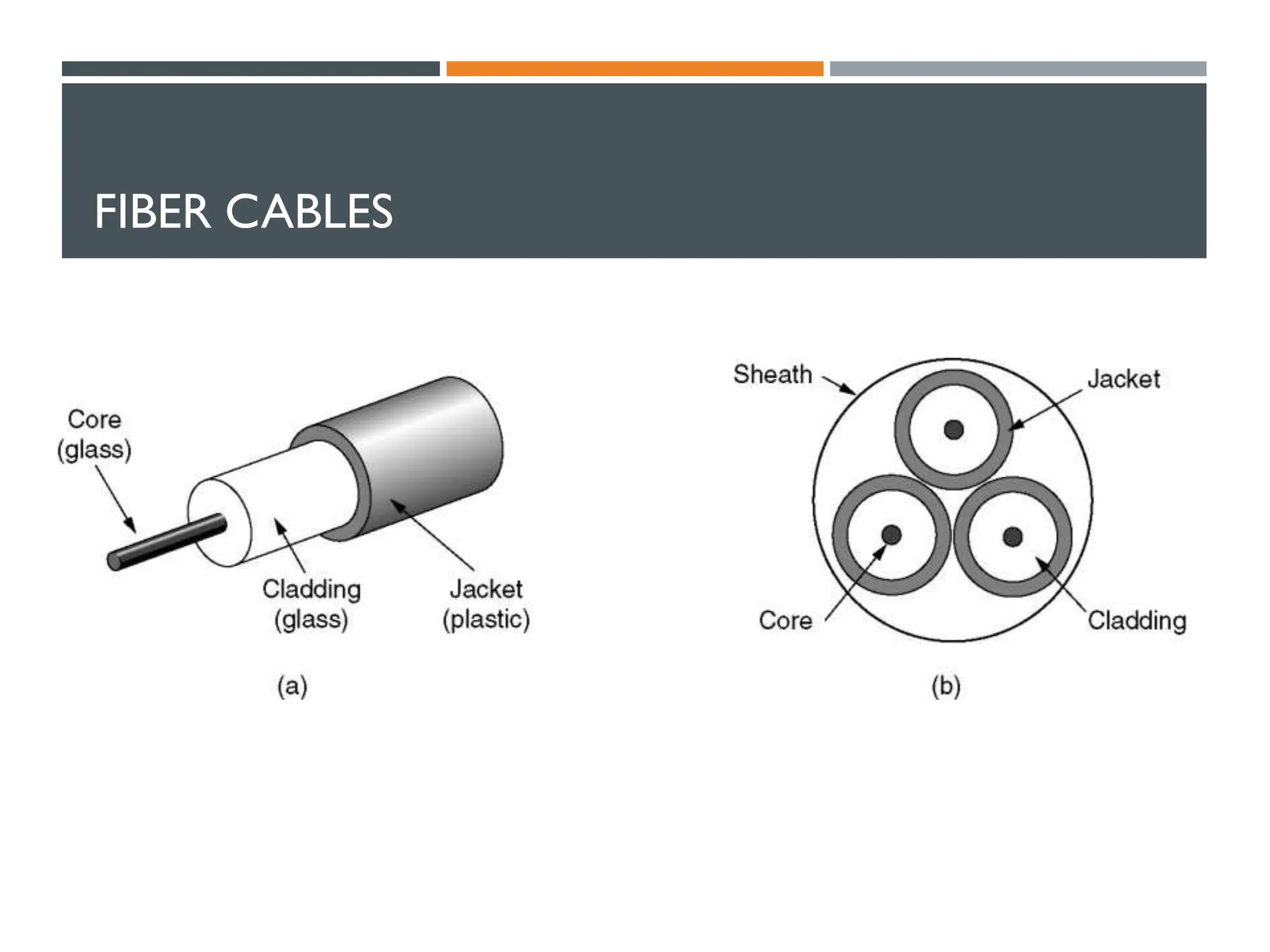
 (a) Side view of a single fiber.
 (b) End view of a sheath with three fibers.
FIBER CABLES (2)
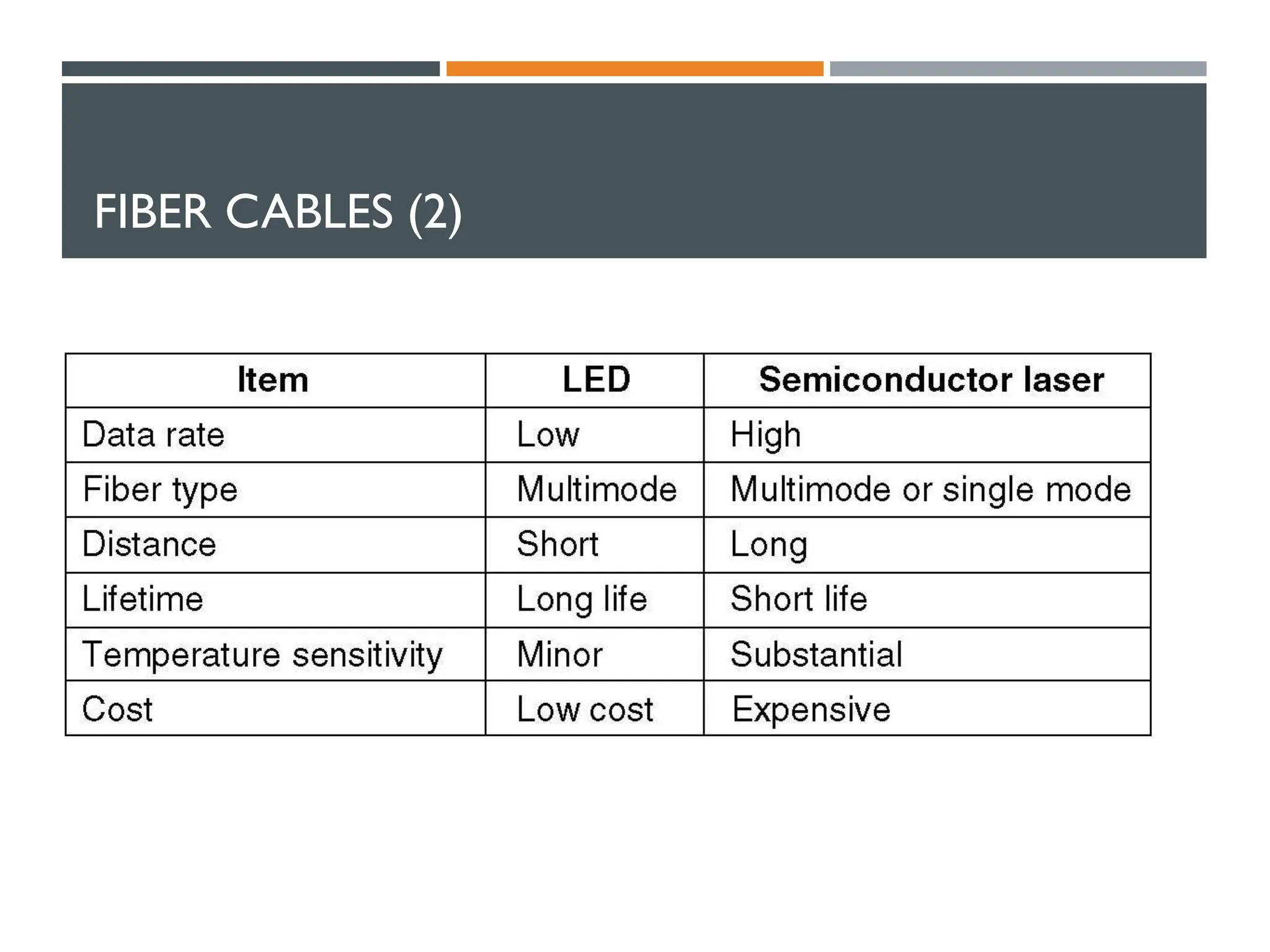
 A comparison of semiconductor diodes and LEDs as light sources.
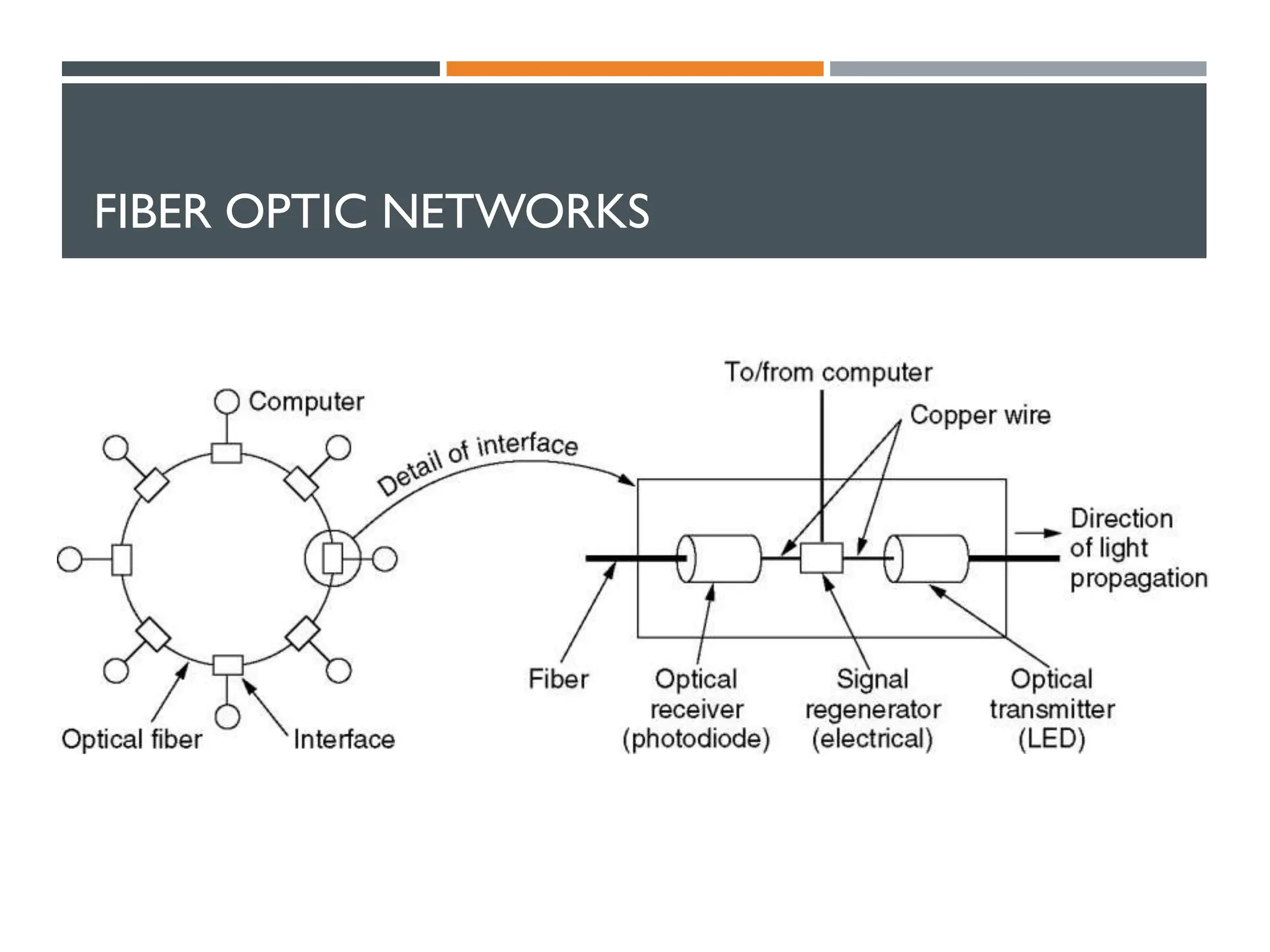
FIBER OPTIC NETWORKS
 A fiber optic ring with active repeaters.
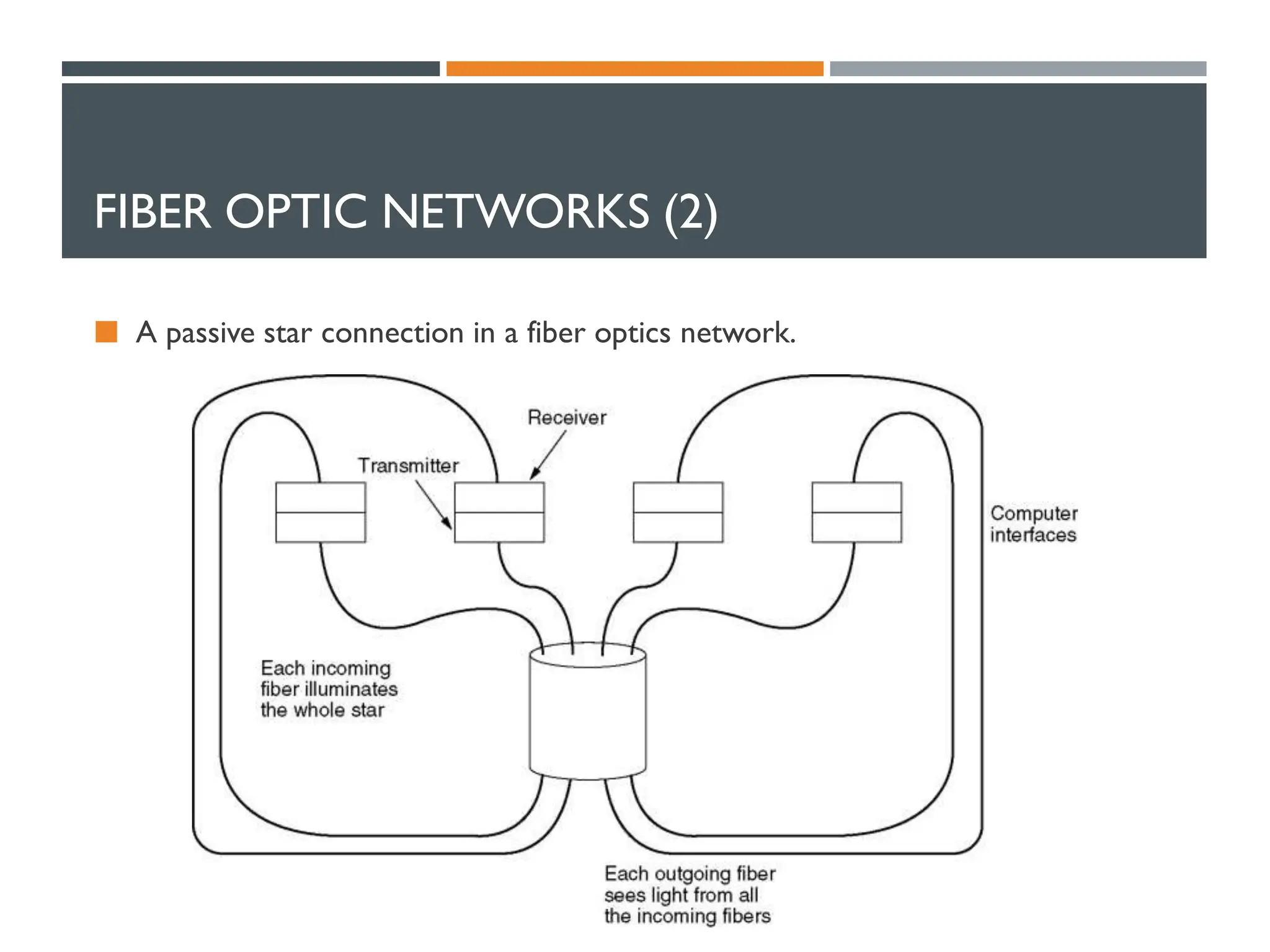
FIBER OPTIC NETWORKS (2)
 A passive star connection in a fiber optics network.
WIRELESSTRANSMISSION
 The Electromagnetic Spectrum
 Radio Transmission
 Microwave Transmission
 Infrared and Millimeter Waves
 Lightwave Transmission
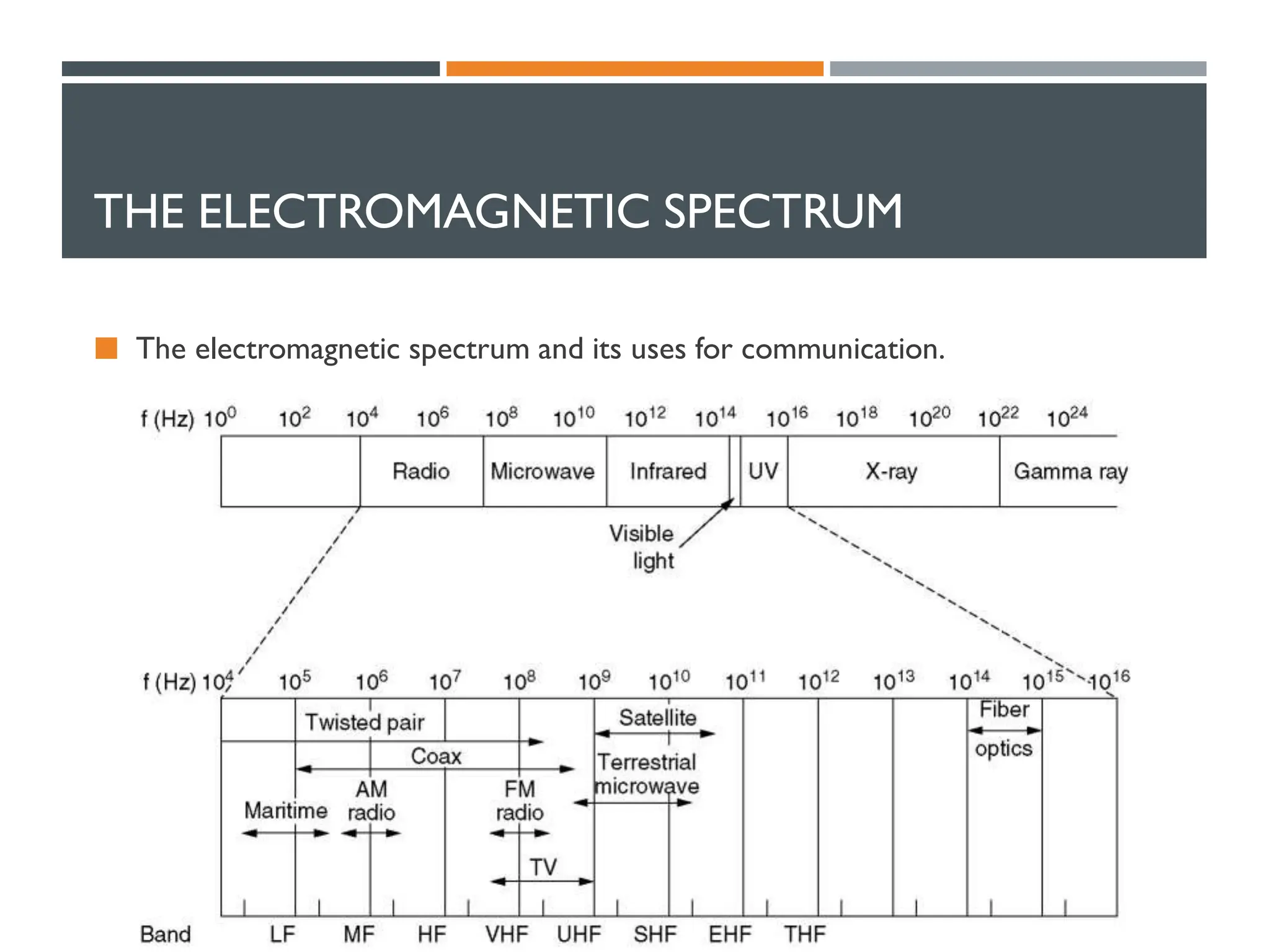
THE ELECTROMAGNETIC SPECTRUM
 The electromagnetic spectrum and its uses for communication.
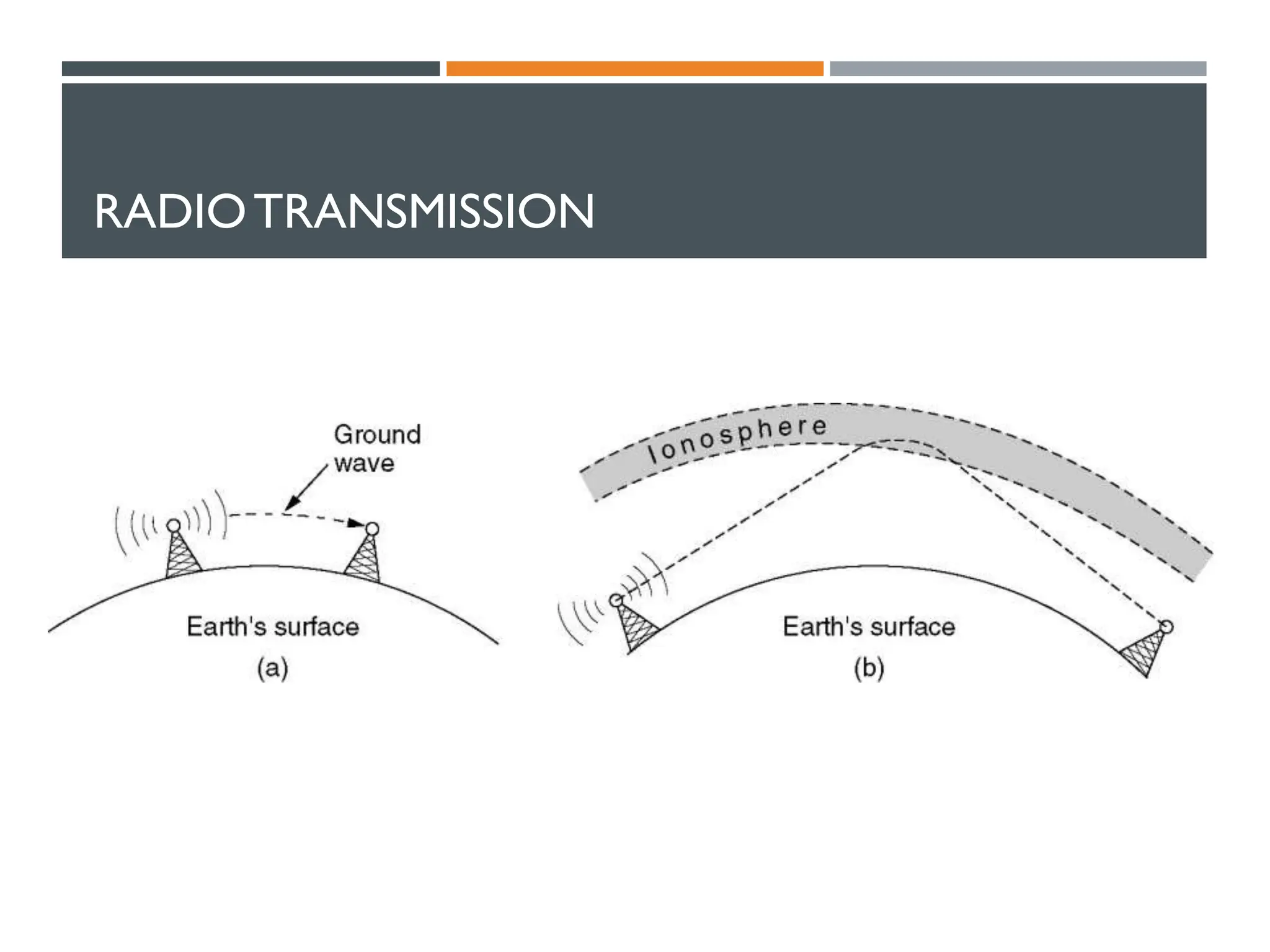
RADIOTRANSMISSION
 (a) In theVLF, LF, and MF bands, radio waves follow the curvature of the earth.
 (b) In the HF band, they bounce off the ionosphere.
POLITICS OFTHE ELECTROMAGNETIC
SPECTRUM
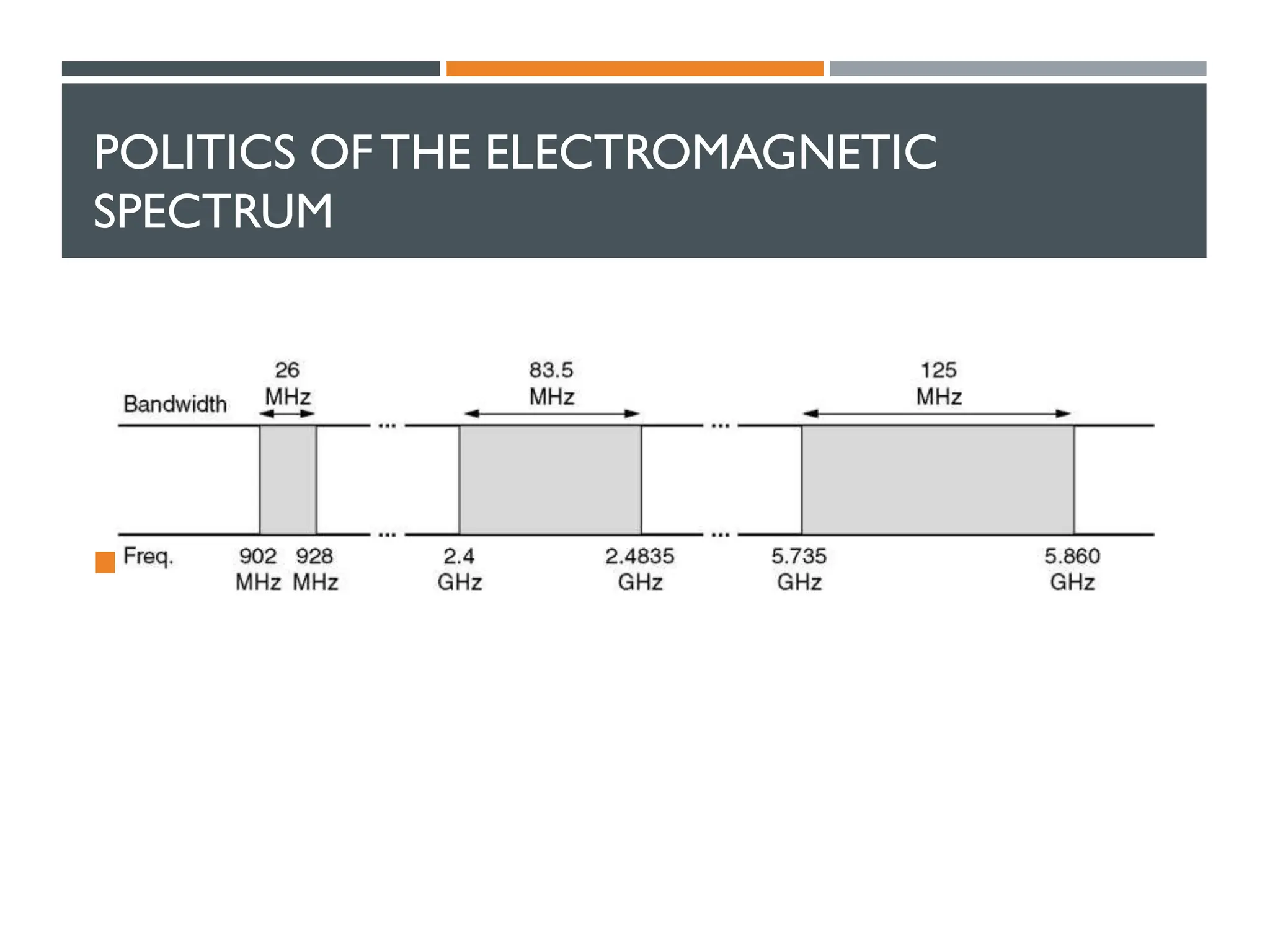
 The ISM bands in the United States.
LIGHTWAVETRANSMISSION
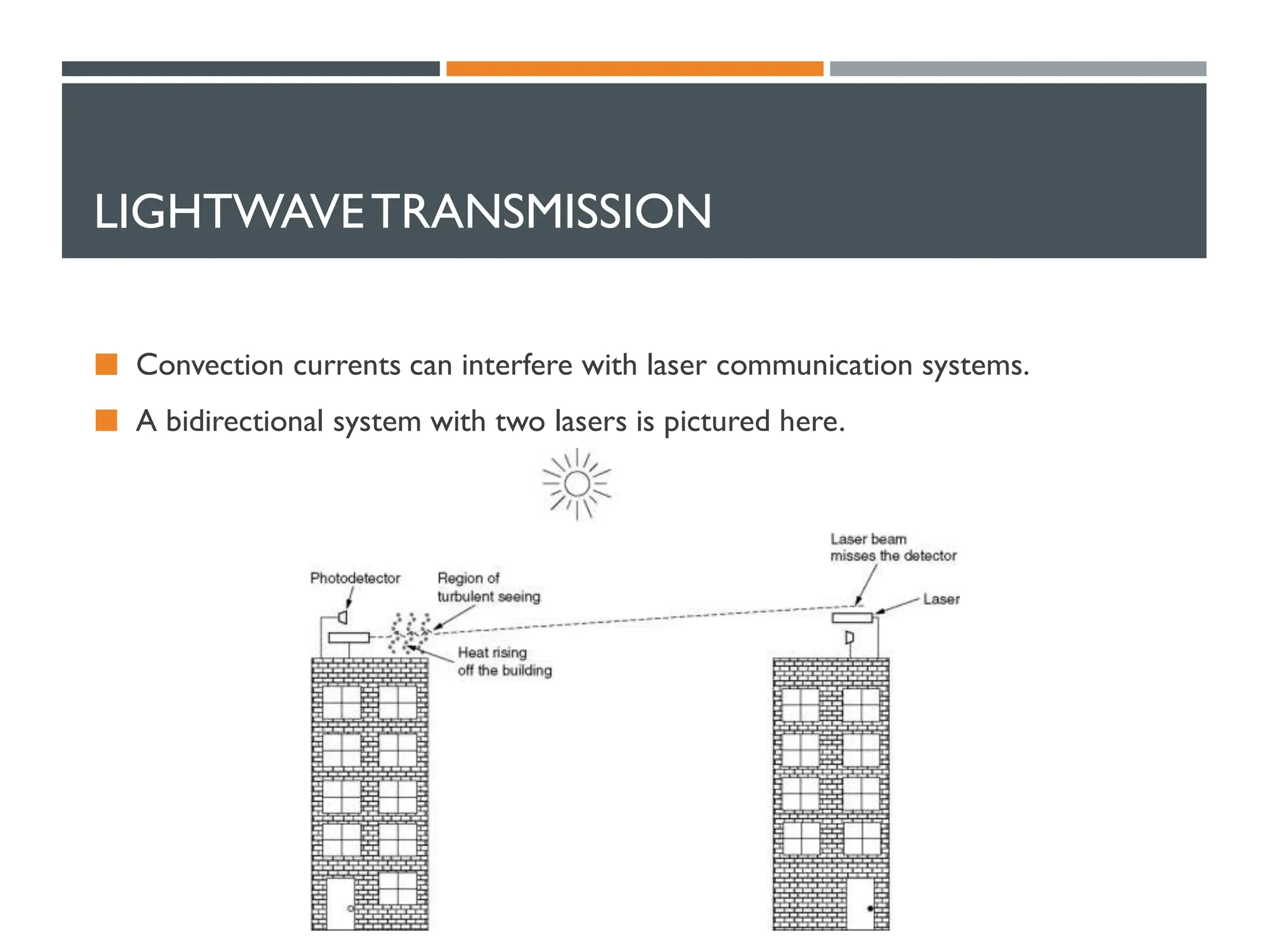
 Convection currents can interfere with laser communication systems.
 A bidirectional system with two lasers is pictured here.
COMMUNICATION SATELLITES
 Geostationary Satellites
 Medium-Earth Orbit Satellites
 Low-Earth Orbit Satellites
 Satellites versus Fiber
COMMUNICATION SATELLITES
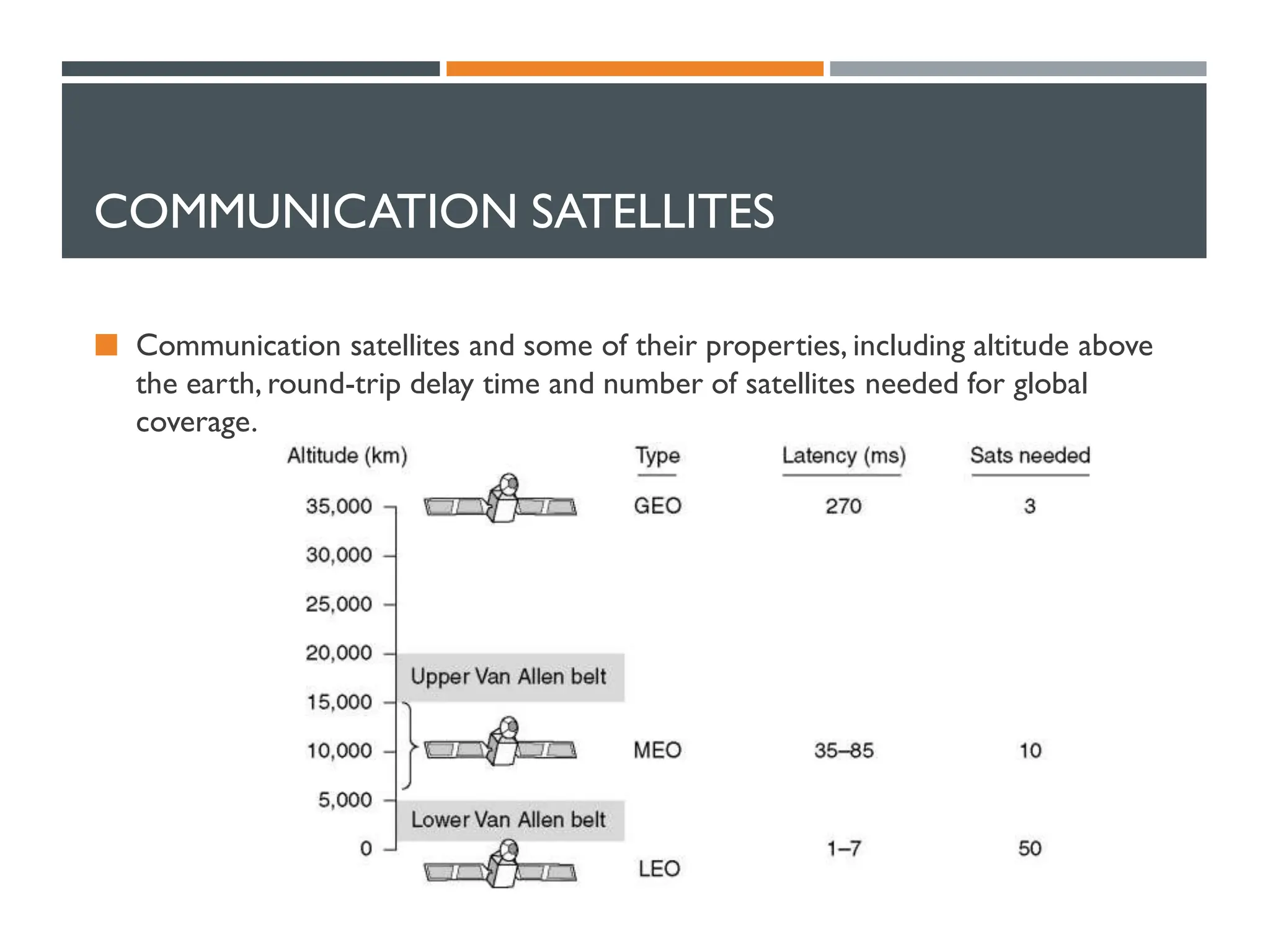
 Communication satellites and some of their properties, including altitude above
the earth, round-trip delay time and number of satellites needed for global
coverage.
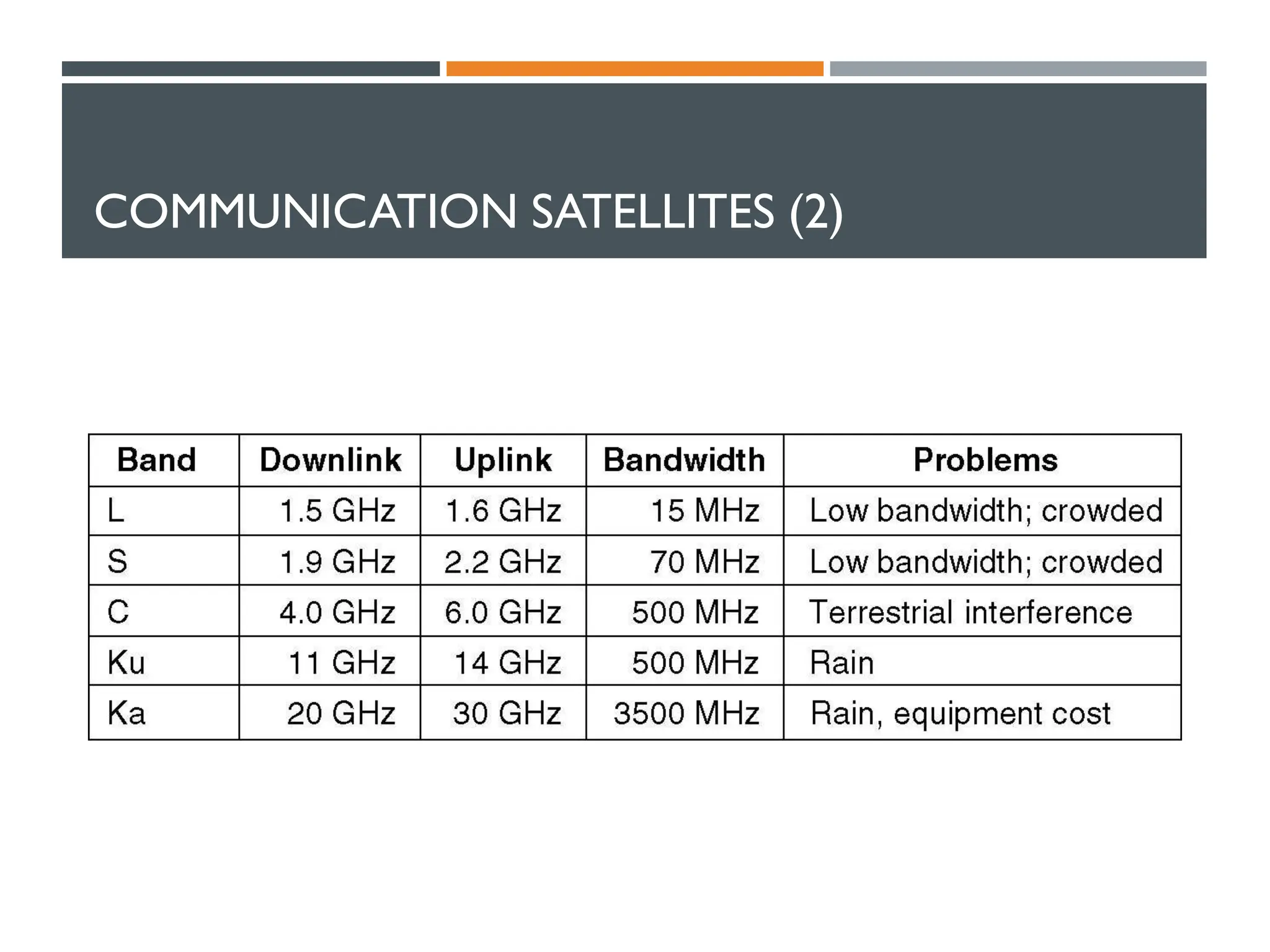
COMMUNICATION SATELLITES (2)
 The principal satellite bands.
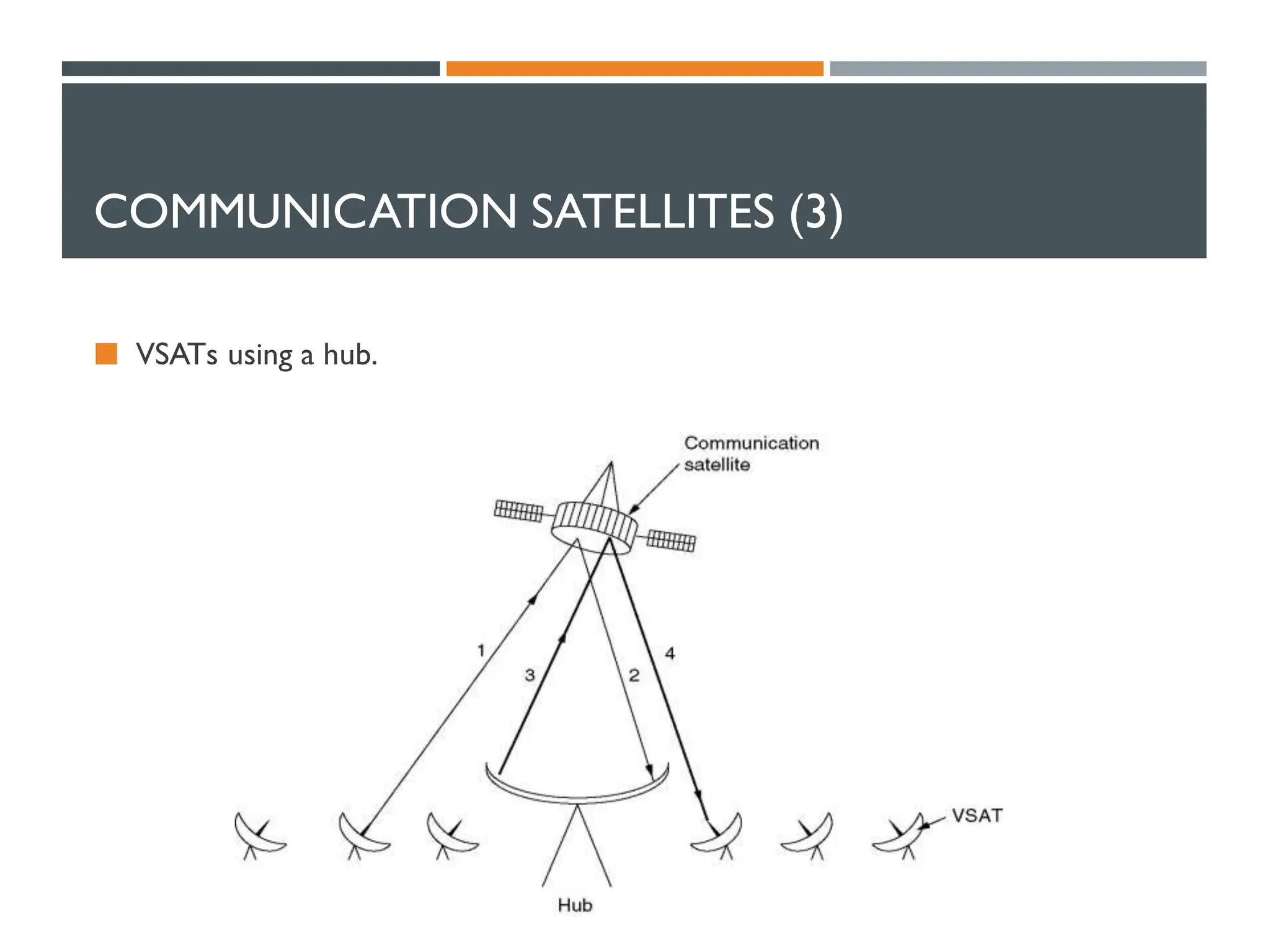
COMMUNICATION SATELLITES (3)
 VSATs using a hub.
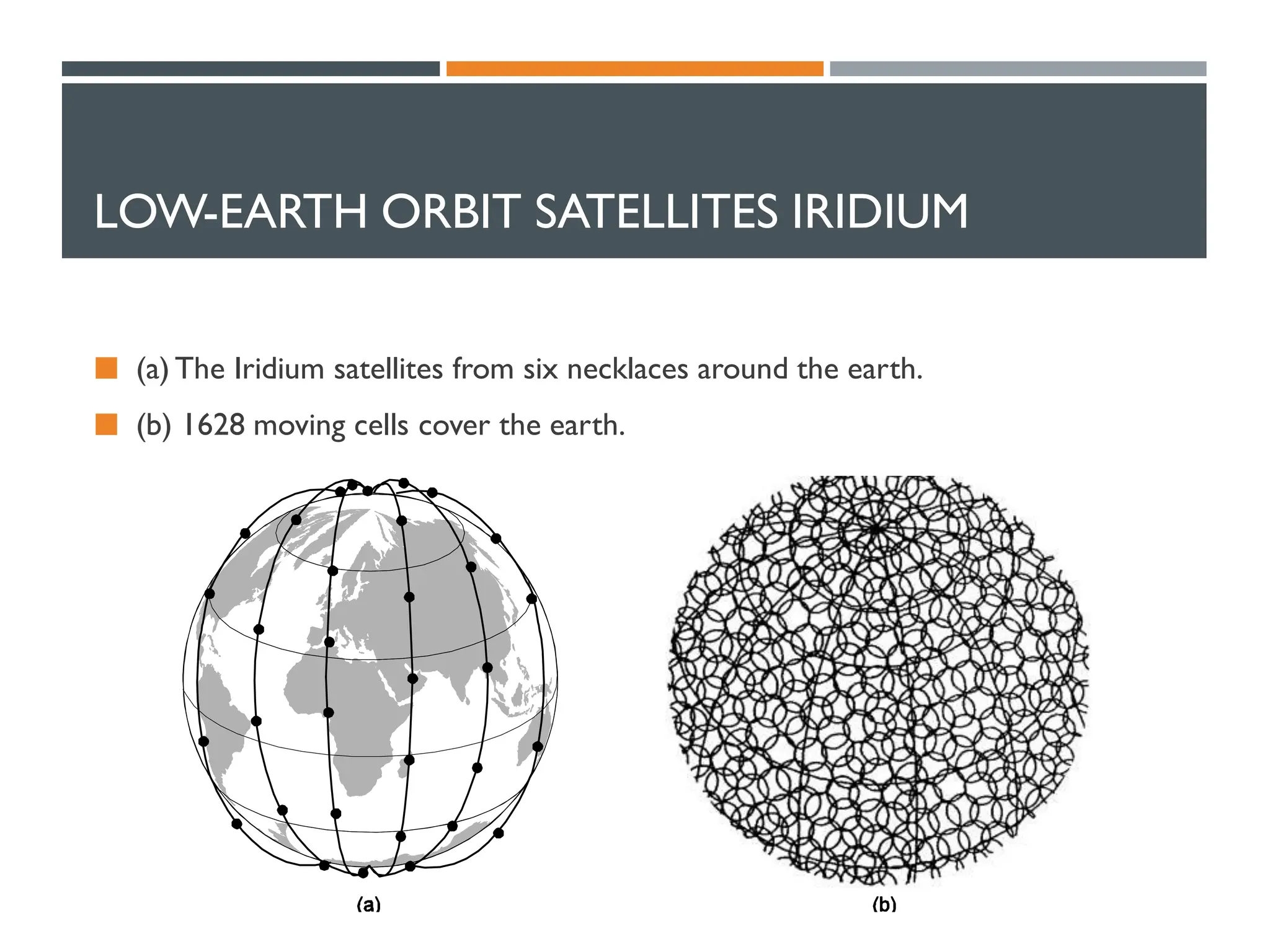
LOW-EARTH ORBIT SATELLITES IRIDIUM
 (a) The Iridium satellites from six necklaces around the earth.
 (b) 1628 moving cells cover the earth.
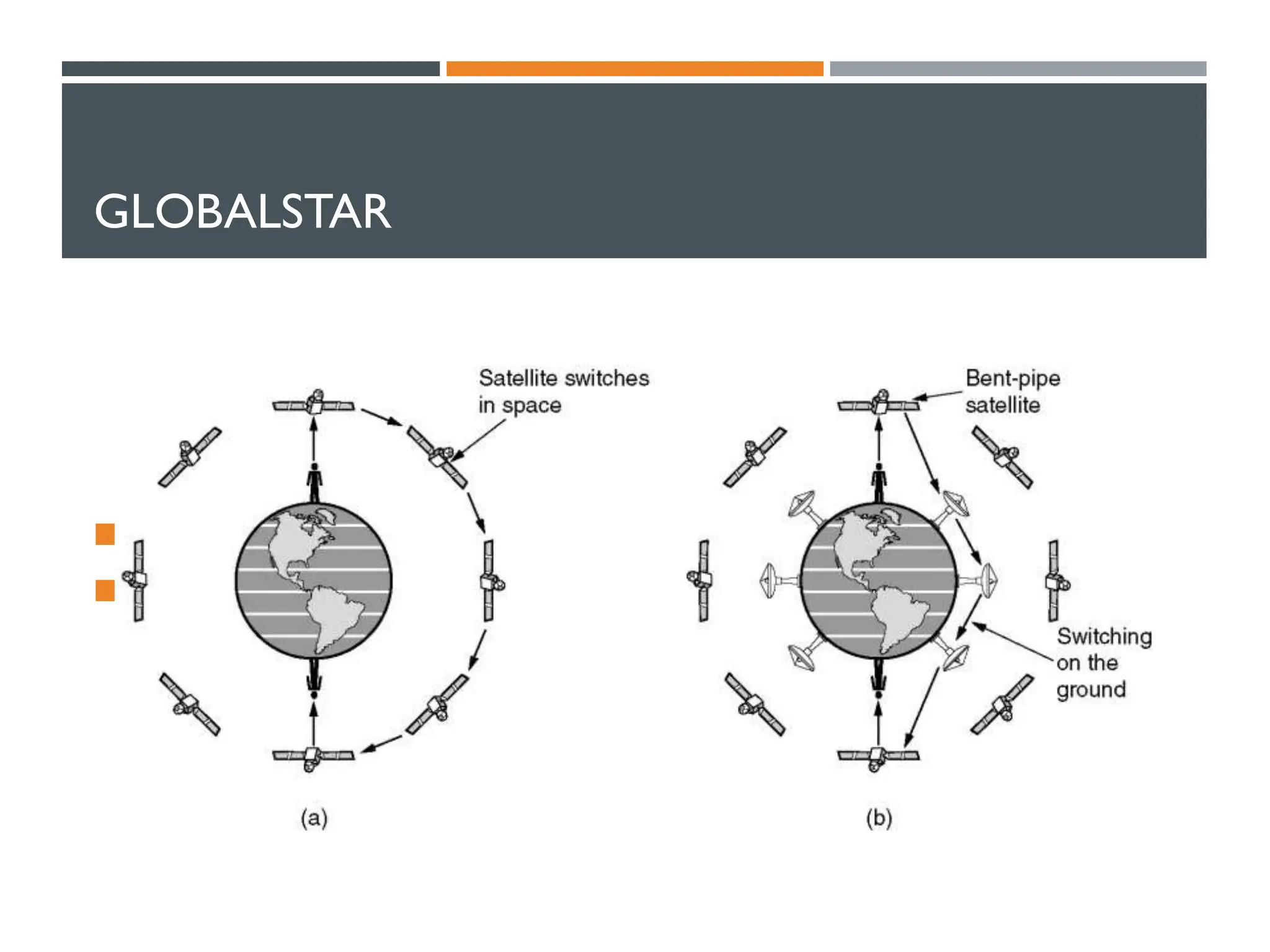
GLOBALSTAR
 (a) Relaying in space.
 (b) Relaying on the ground.
PUBLIC SWITCHEDTELEPHONE NETWORK
 The public switched telephone network (PSTN) refers to the international
telephone system that uses copper wires to carry analog voice data. It
consists of a collection of individual telephones that are hardwired to a public
exchange.
PROPERTIES OF PSTN
 It is also known as Plain Old Telephone Service (POTS)
 It has evolved from the invention of telephone by Alexander Graham Bell.
 The individual networks can be owned by national government, regional
government or private telephone operators.
 Its main objective is to transmit human voice in a recognizable form.
 It is an aggregation of circuit-switched networks of the world.
 Originally, it was an entirely analog network laid with copper cables and
switches.
 Presently, most part of PSTN networks is digitized and comprises of a wide
variety communicating devices.
 The present PSTNs comprises of copper telephone lines, fibre optic cables,
communication satellites, microwave transmission links and undersea telephone
lines. It is also linked to the cellular networks.
 The interconnection between the different parts of the telephone system is
done by switching centres.This allows multiple telephone and cellular networks
to communicate with each other.
 Present telephone systems are tightly coupled with WANs (wide area networks)
and are used for both data and voice communications.
 The operation of PSTN networks follows the ITU-T standards.
PUBLIC SWITCHEDTELEPHONE SYSTEM
 Structure of theTelephone System
 The Politics of Telephones
 The Local Loop: Modems,ADSL andWireless
 Trunks and Multiplexing
 Switching
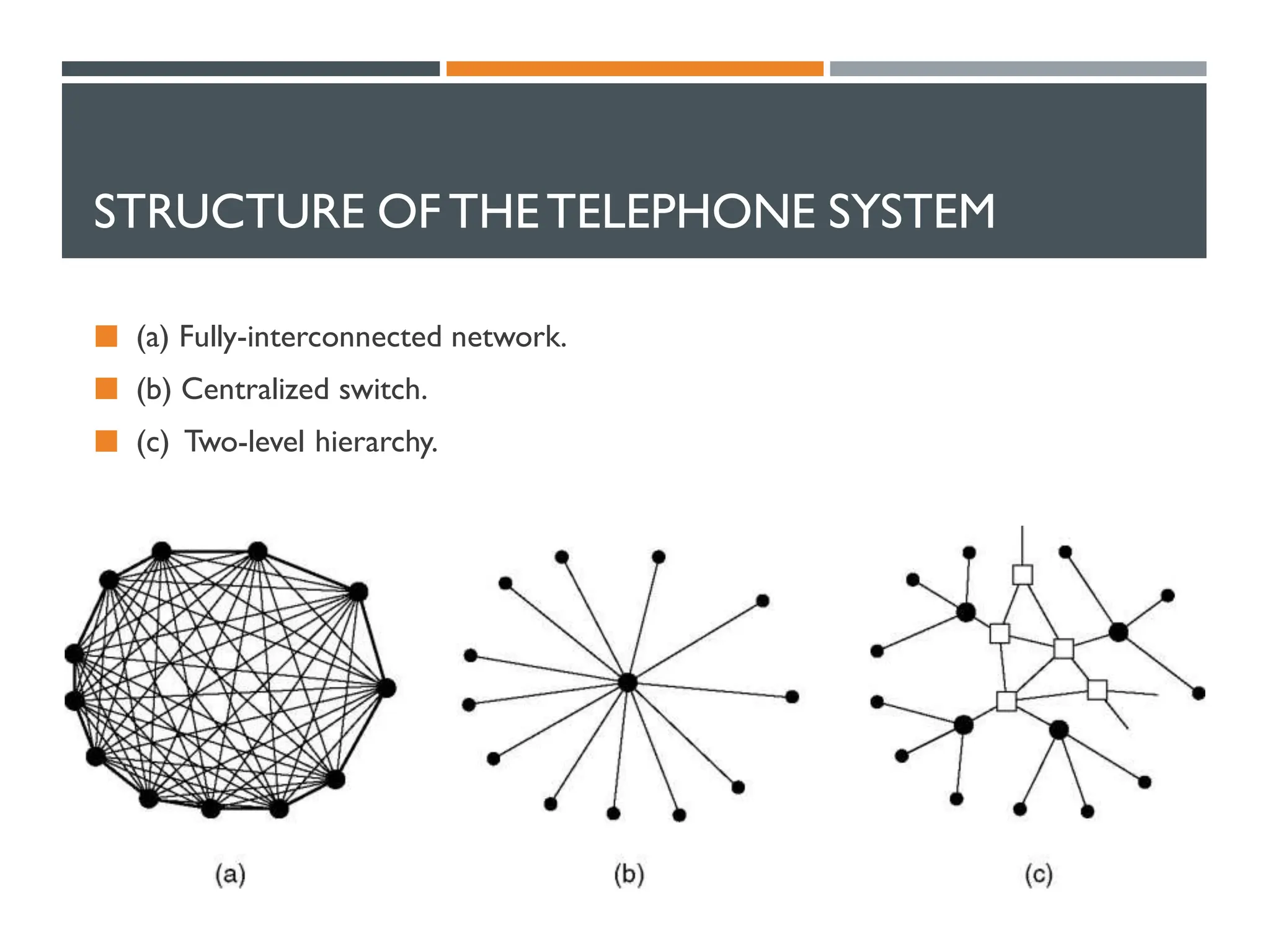
STRUCTURE OF THETELEPHONE SYSTEM
 (a) Fully-interconnected network.
 (b) Centralized switch.
 (c) Two-level hierarchy.
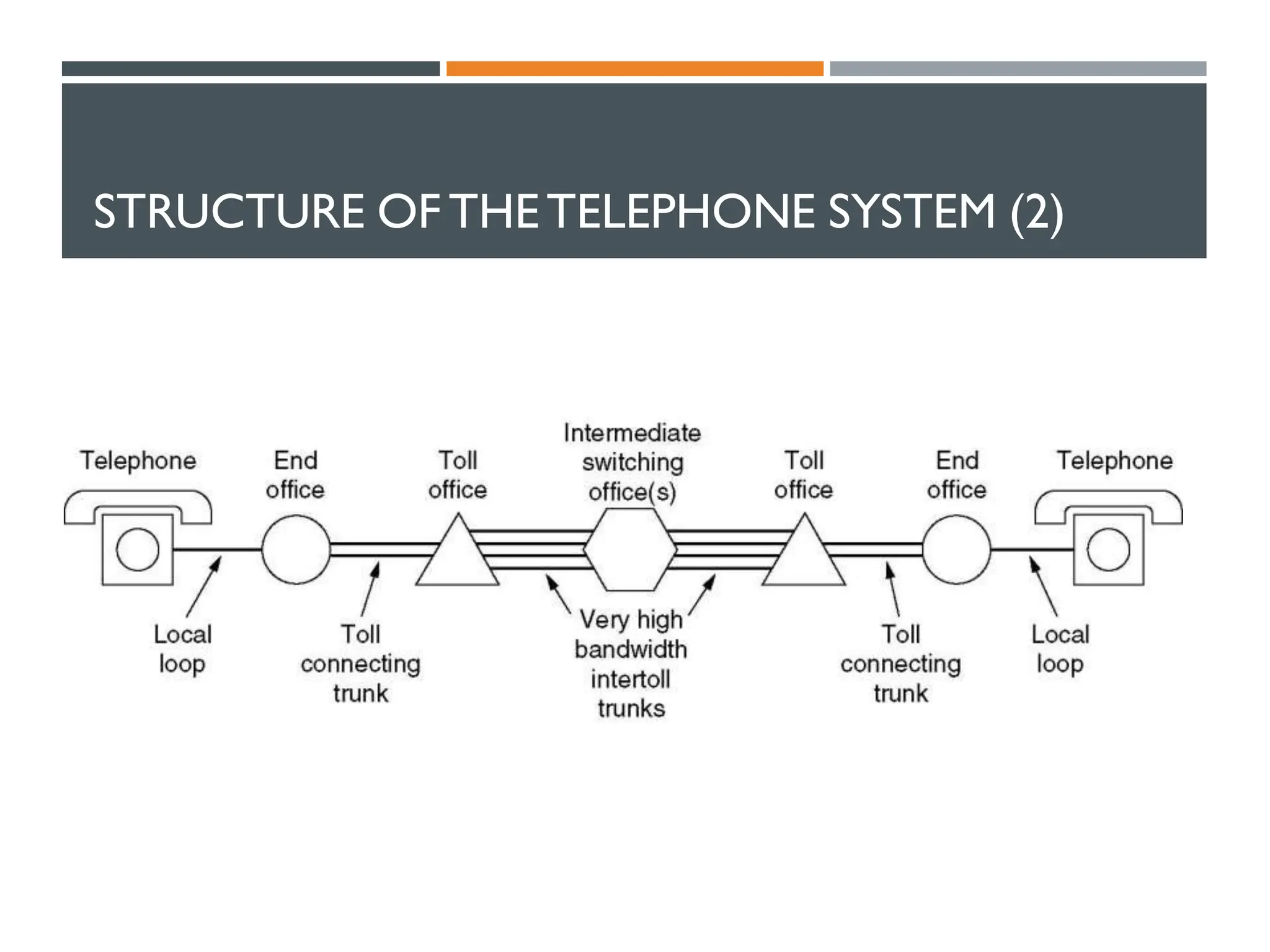
STRUCTURE OF THETELEPHONE SYSTEM (2)
 A typical circuit route for a medium-distance call.
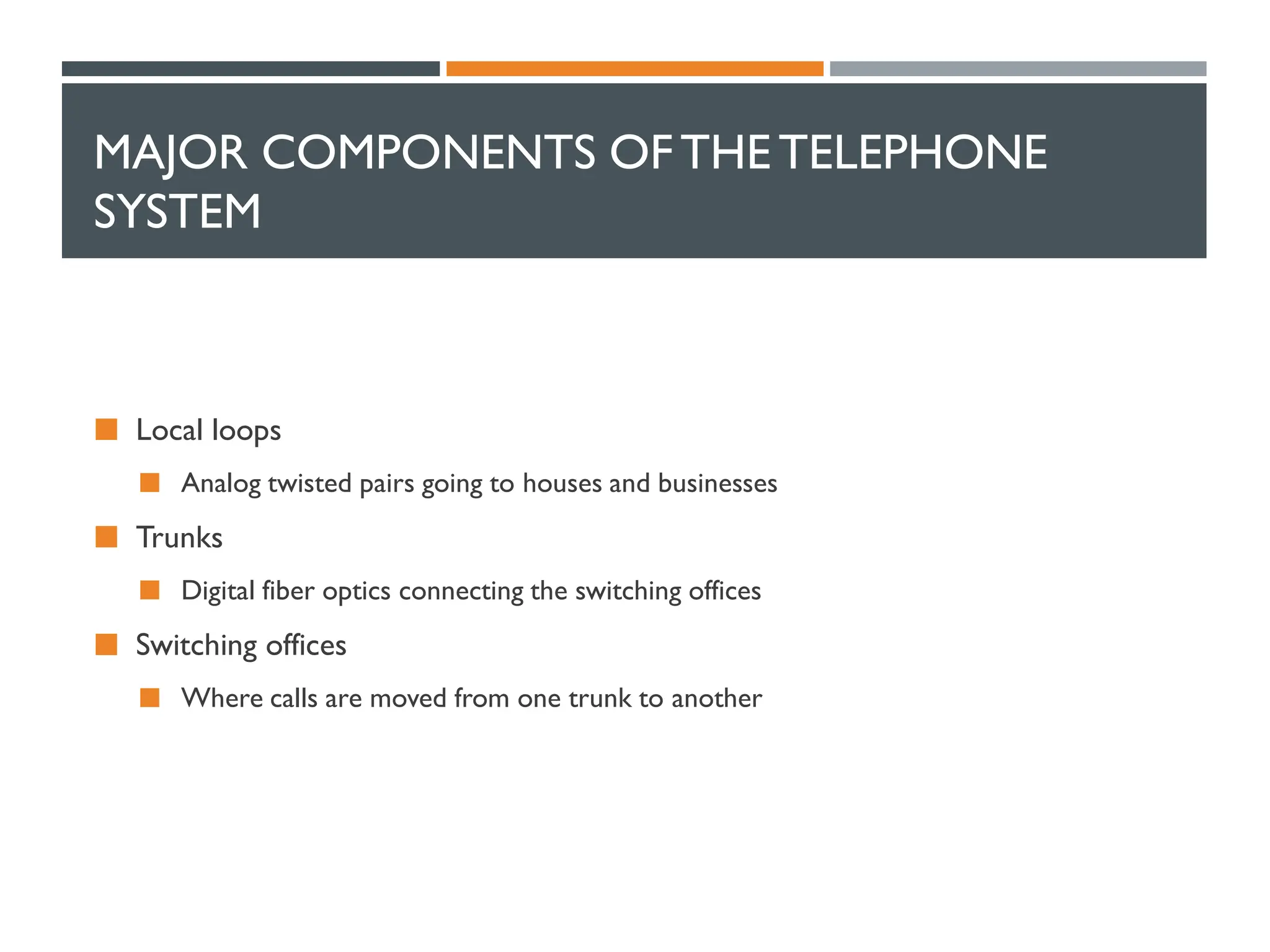
MAJOR COMPONENTS OFTHETELEPHONE
SYSTEM
 Local loops
 Analog twisted pairs going to houses and businesses
 Trunks
 Digital fiber optics connecting the switching offices
 Switching offices
 Where calls are moved from one trunk to another
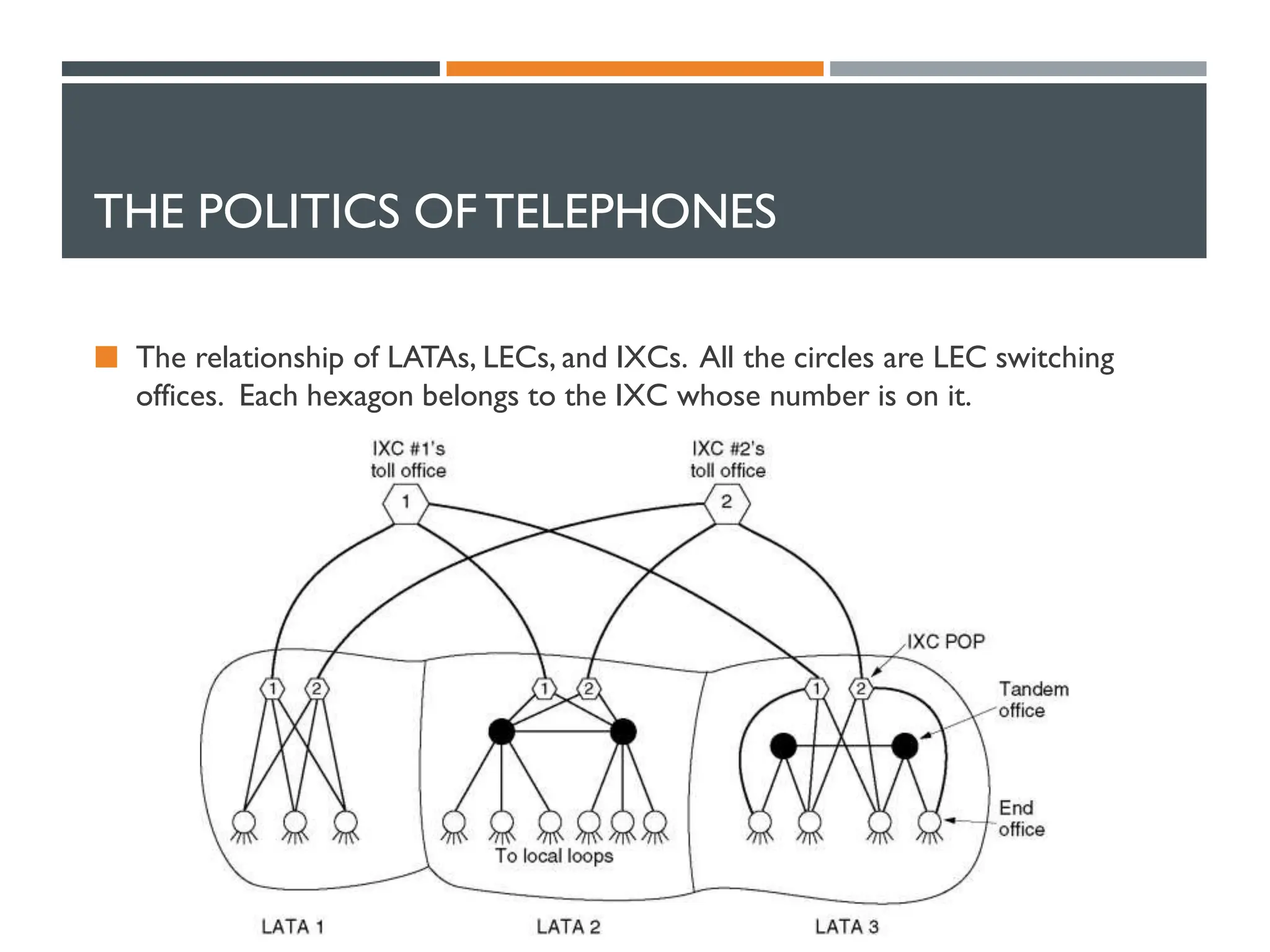
THE POLITICS OFTELEPHONES
 The relationship of LATAs, LECs, and IXCs. All the circles are LEC switching
offices. Each hexagon belongs to the IXC whose number is on it.
THE LOCAL LOOP: MODEMS,ADSL,AND
WIRELESS
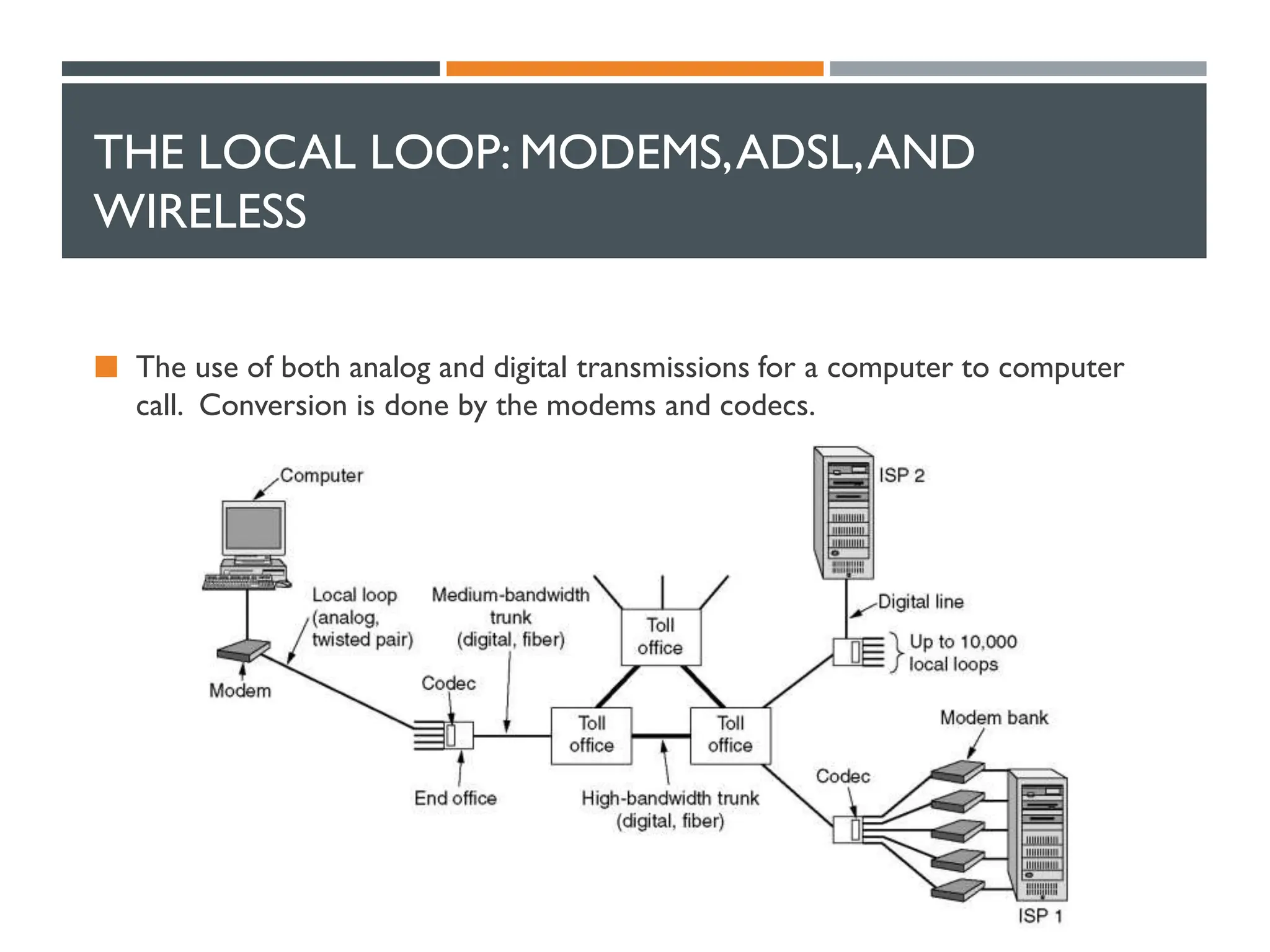
 The use of both analog and digital transmissions for a computer to computer
call. Conversion is done by the modems and codecs.
MODEMS
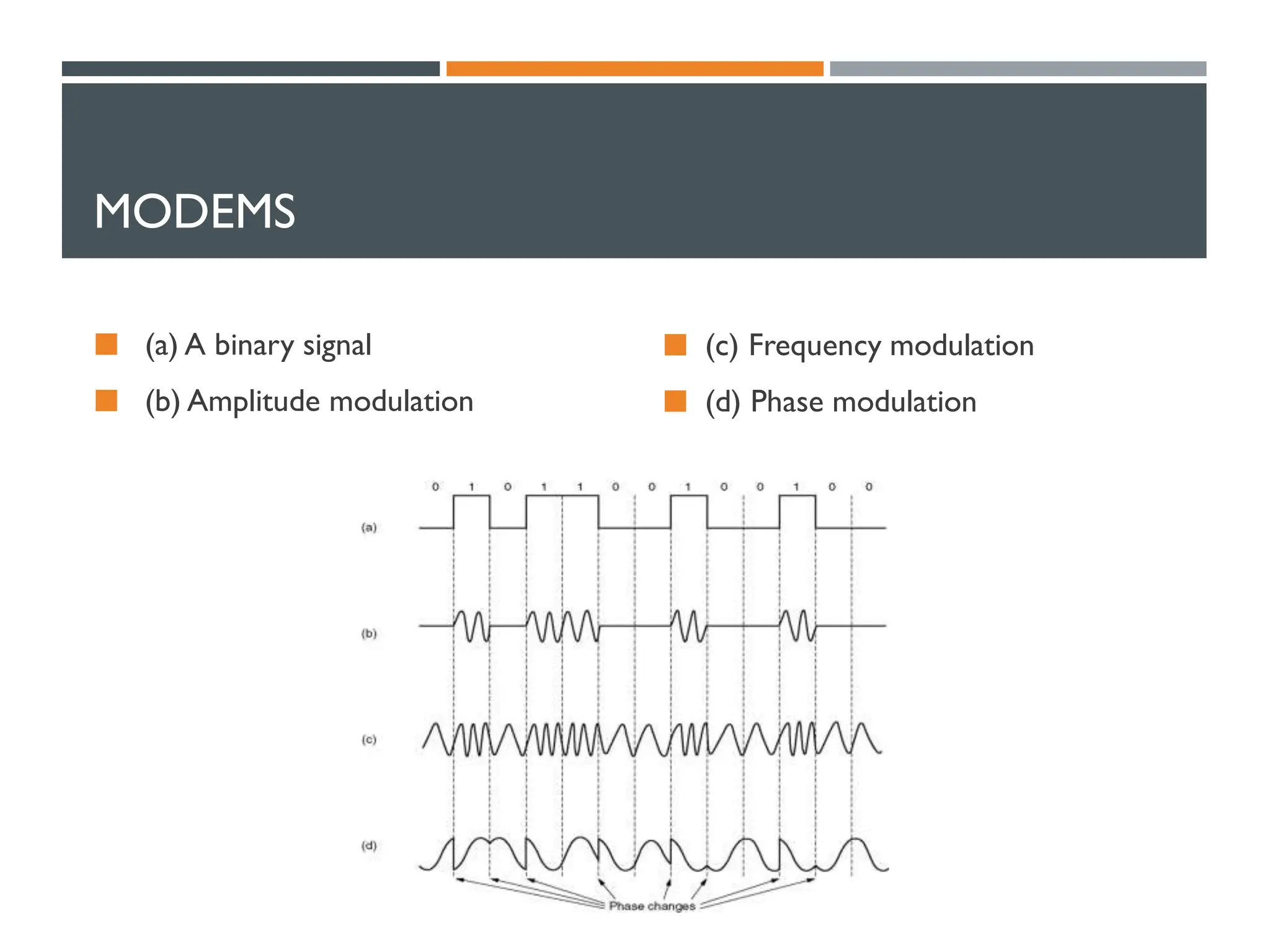
 (a) A binary signal
 (b) Amplitude modulation
 (c) Frequency modulation
 (d) Phase modulation
MODEMS (2)
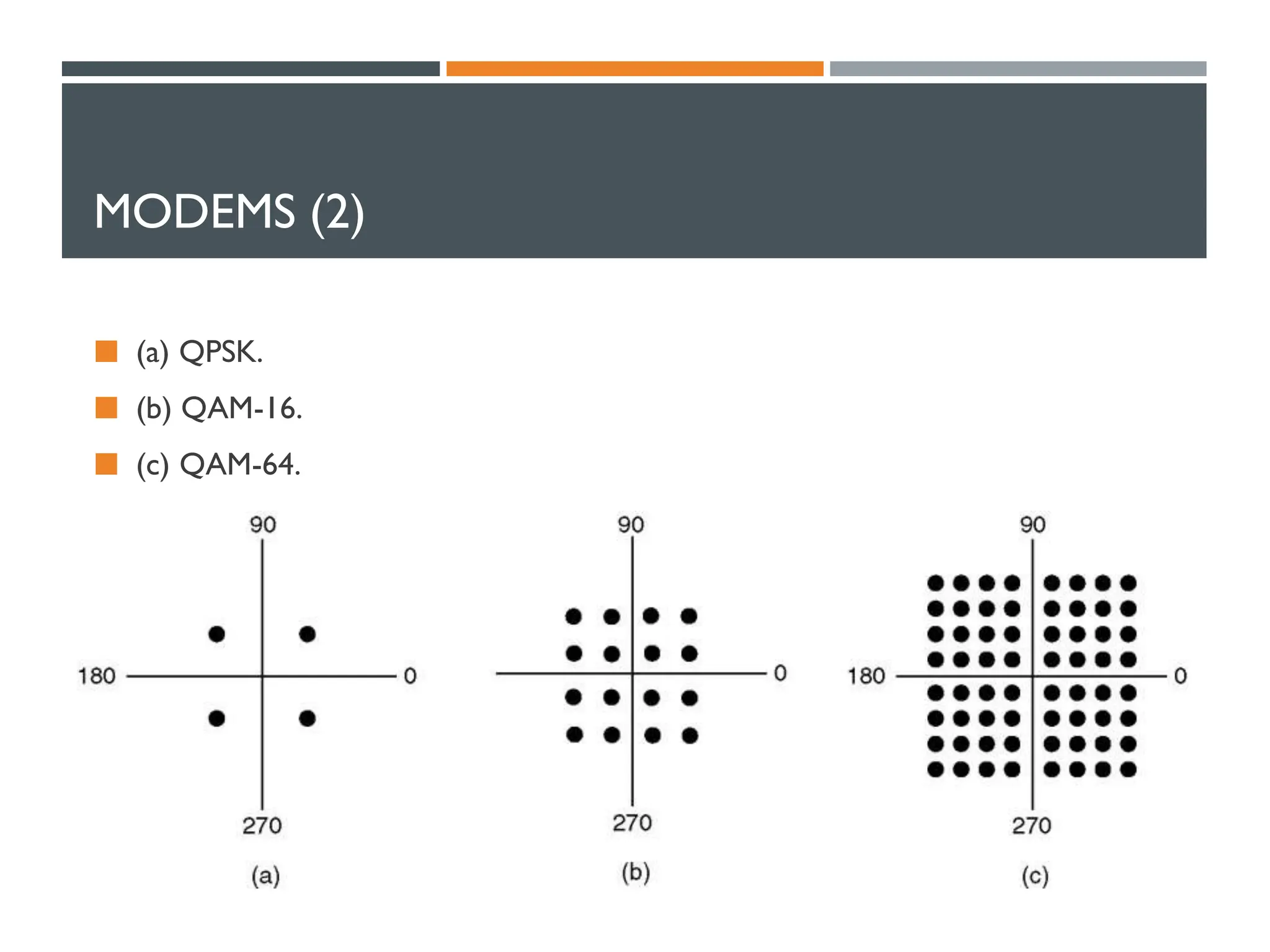
 (a) QPSK.
 (b) QAM-16.
 (c) QAM-64.
MODEMS (3)
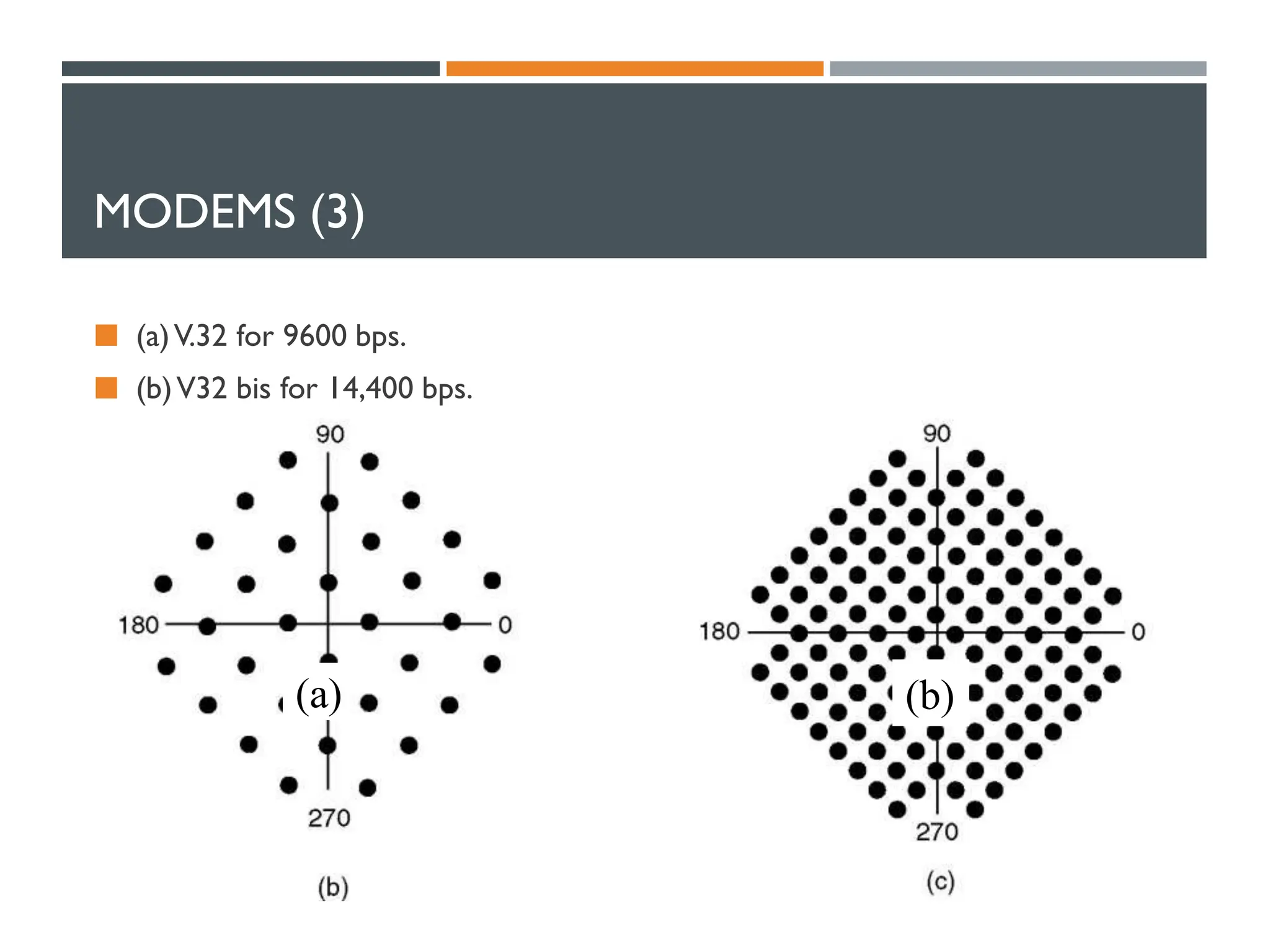
 (a)V.32 for 9600 bps.
 (b)V32 bis for 14,400 bps.
(a) (b)
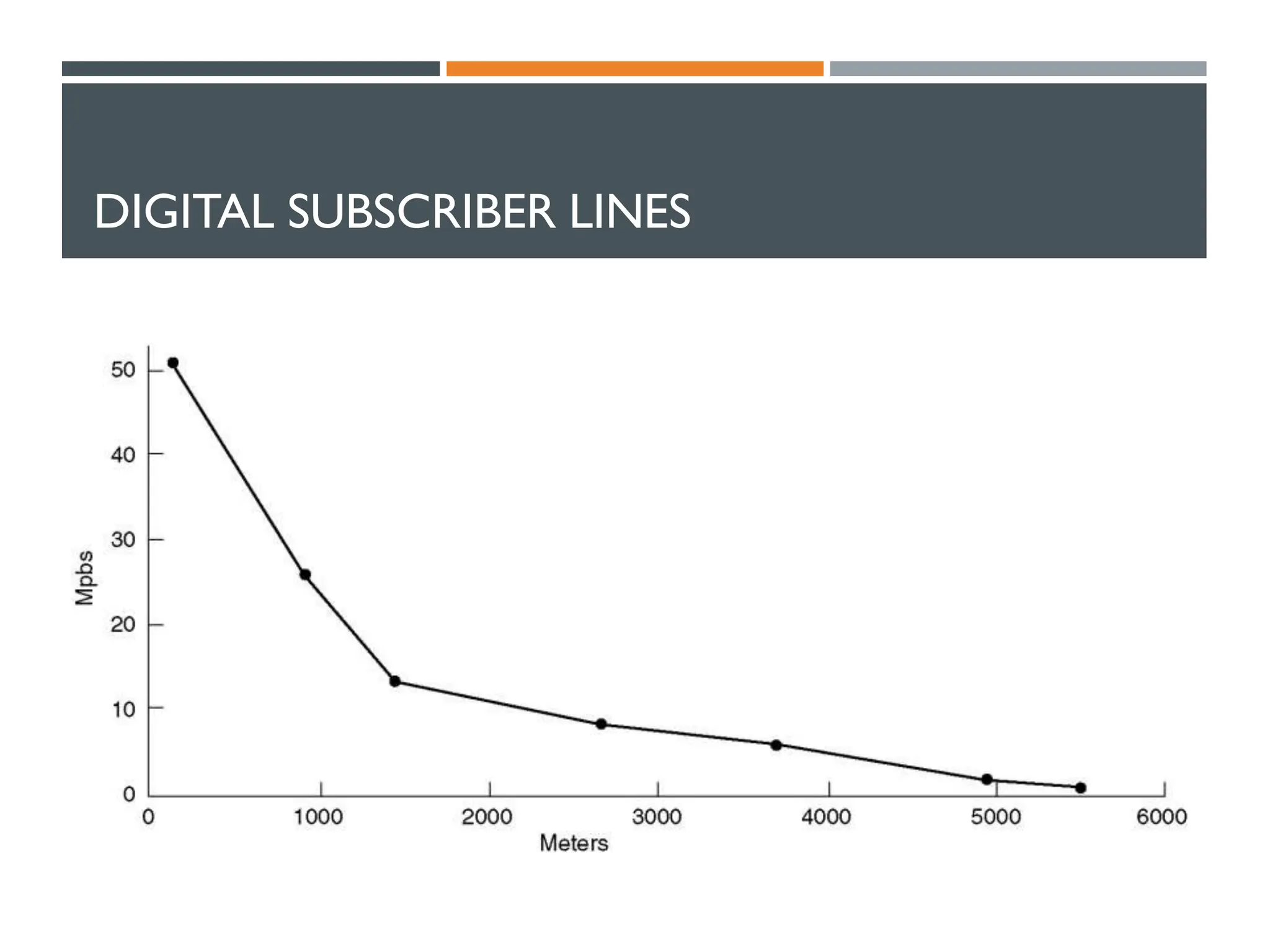
DIGITAL SUBSCRIBER LINES
 Bandwidth versus distanced over category 3 UTP for DSL.
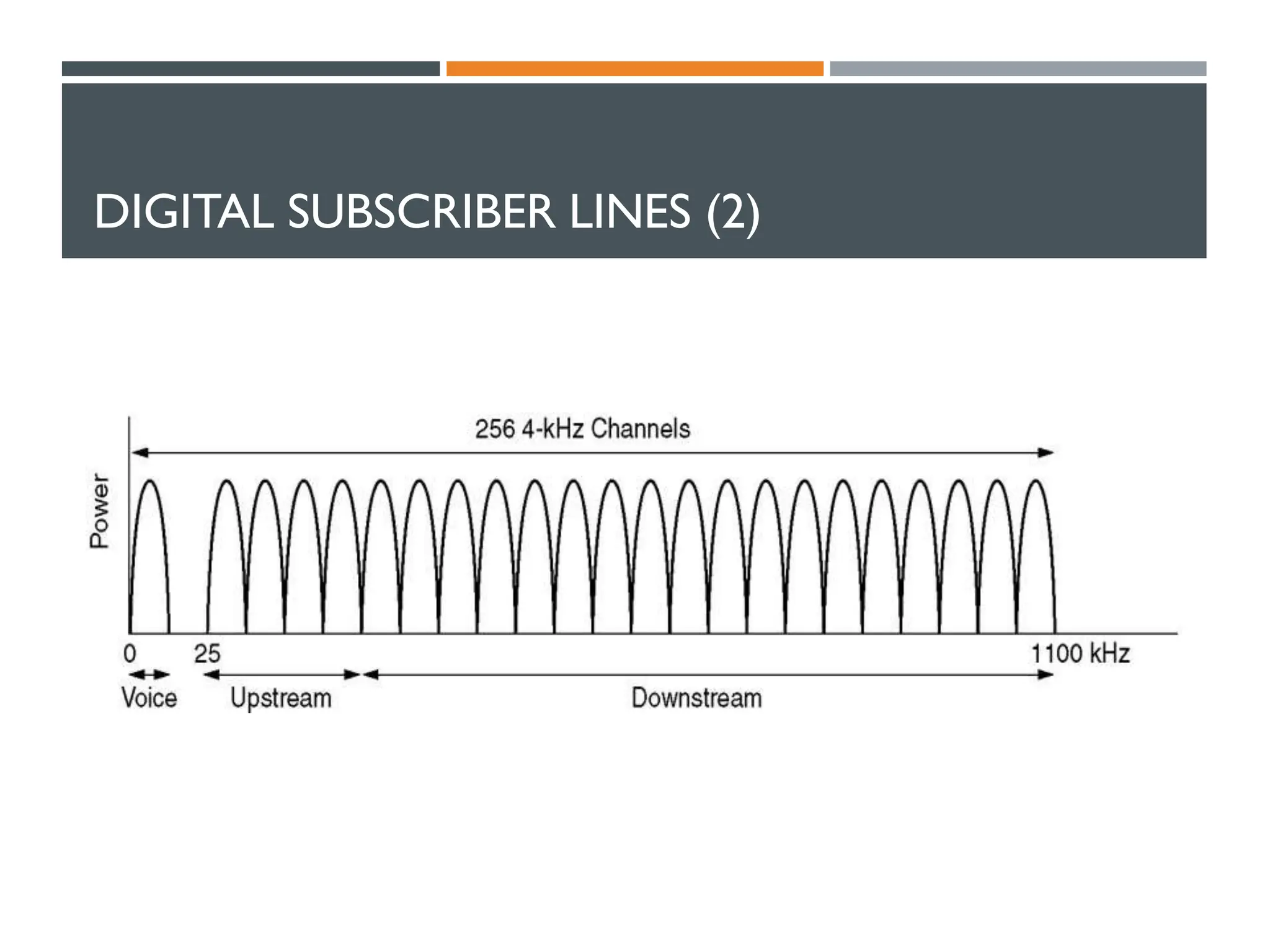
DIGITAL SUBSCRIBER LINES (2)
 Operation of ADSL using discrete multitone modulation.
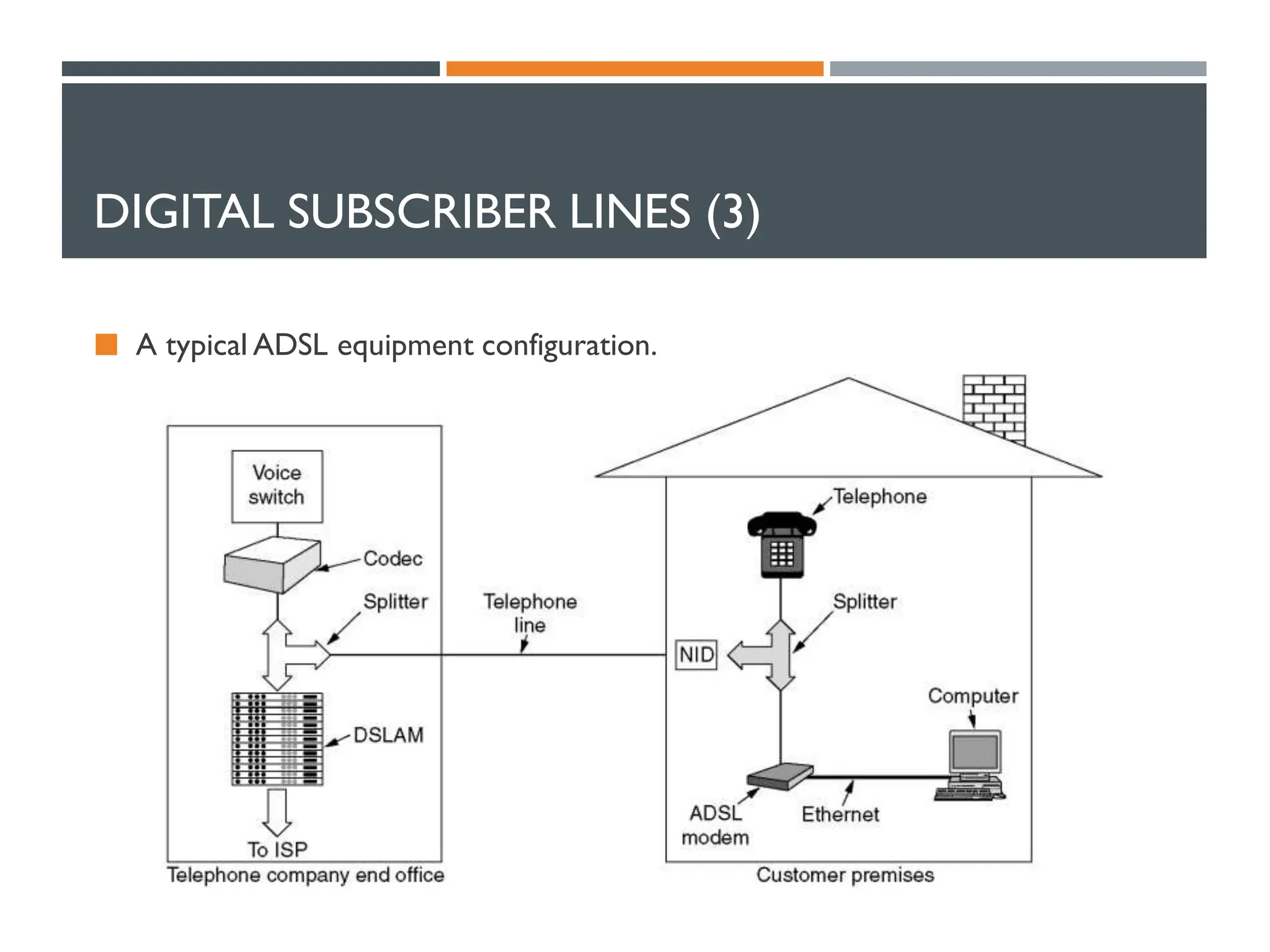
DIGITAL SUBSCRIBER LINES (3)
 A typical ADSL equipment configuration.
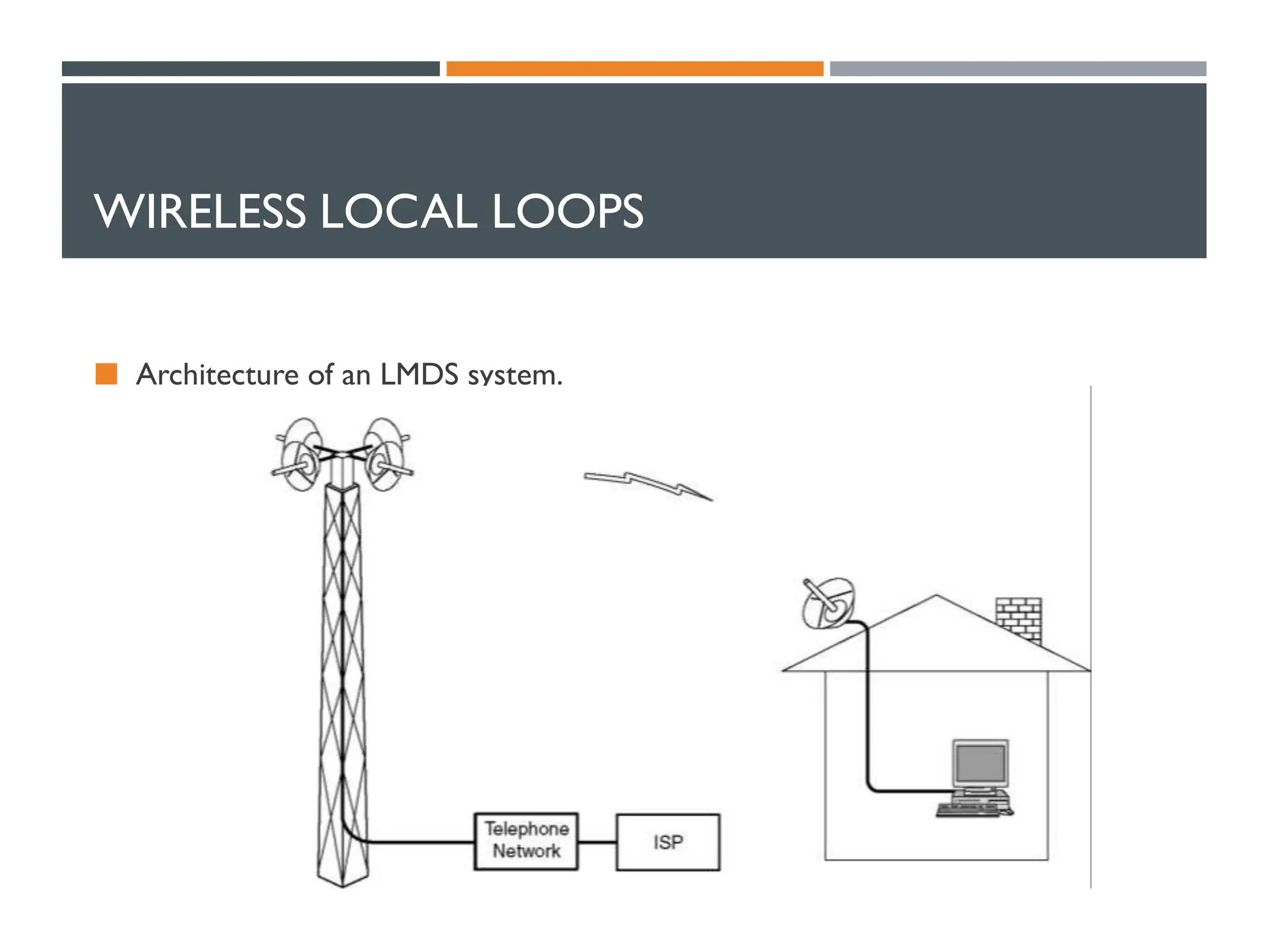
WIRELESS LOCAL LOOPS
 Architecture of an LMDS system.
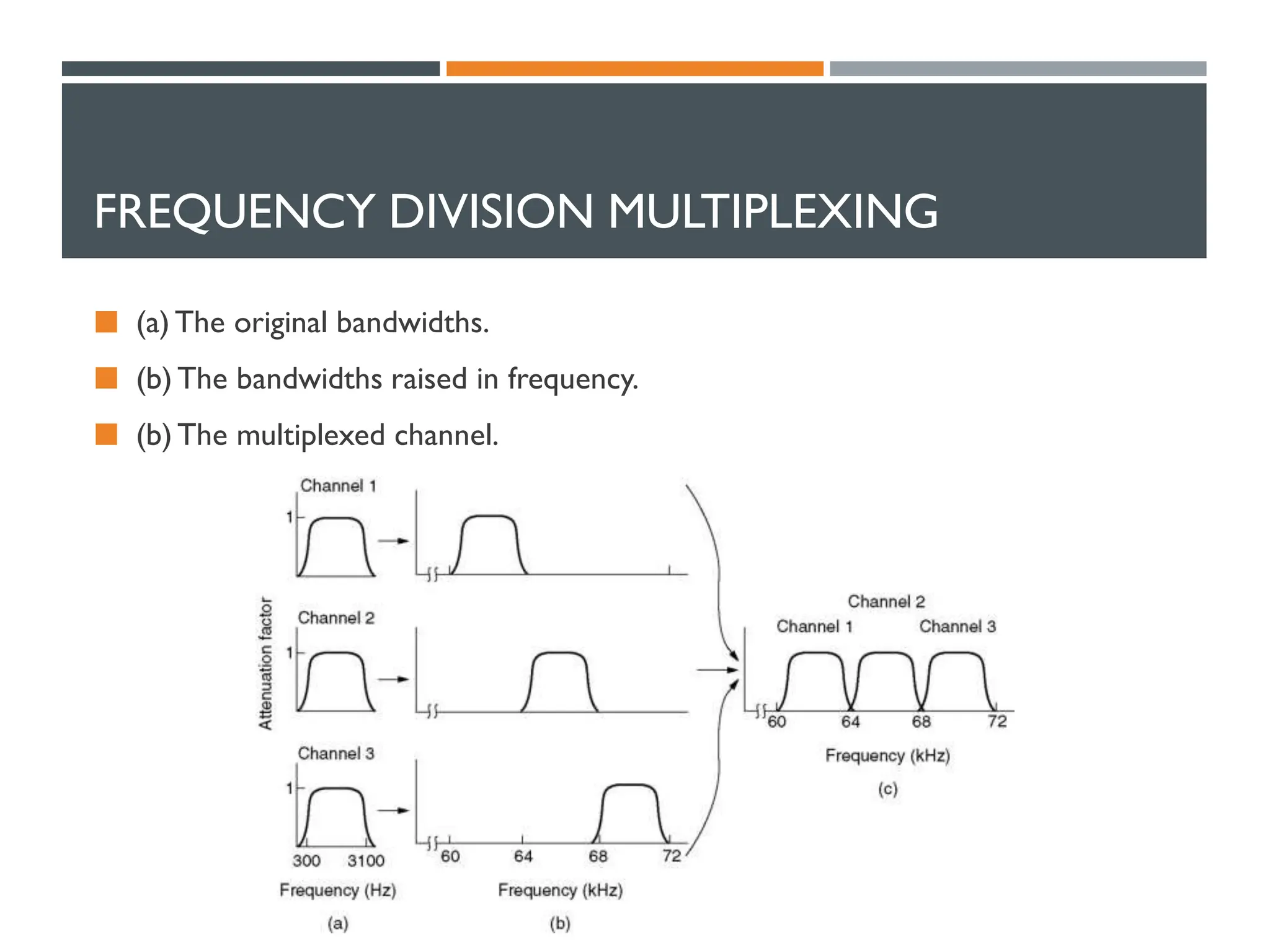
FREQUENCY DIVISION MULTIPLEXING
 (a) The original bandwidths.
 (b) The bandwidths raised in frequency.
 (b) The multiplexed channel.
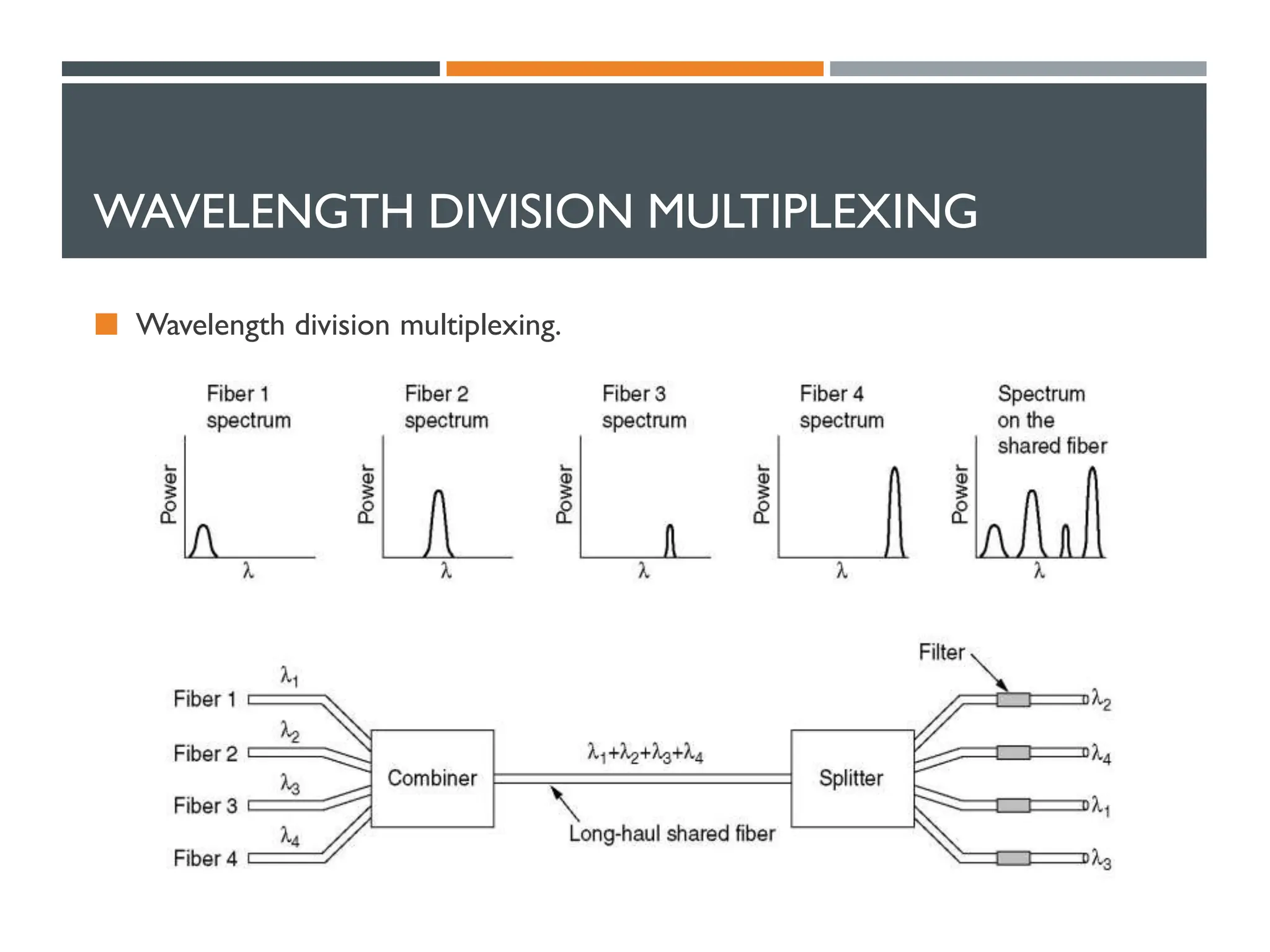
WAVELENGTH DIVISION MULTIPLEXING
 Wavelength division multiplexing.
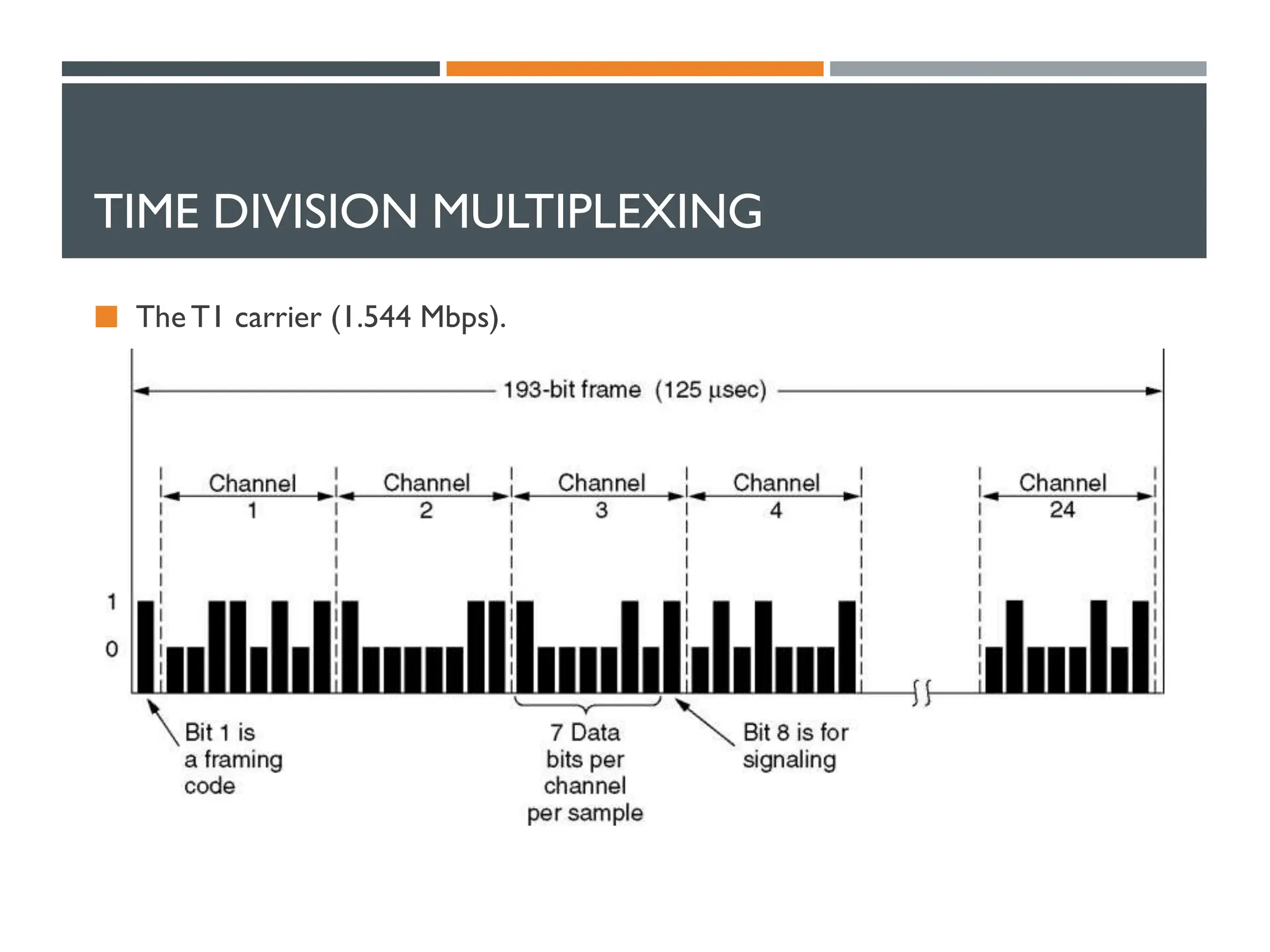
TIME DIVISION MULTIPLEXING
 TheT1 carrier (1.544 Mbps).
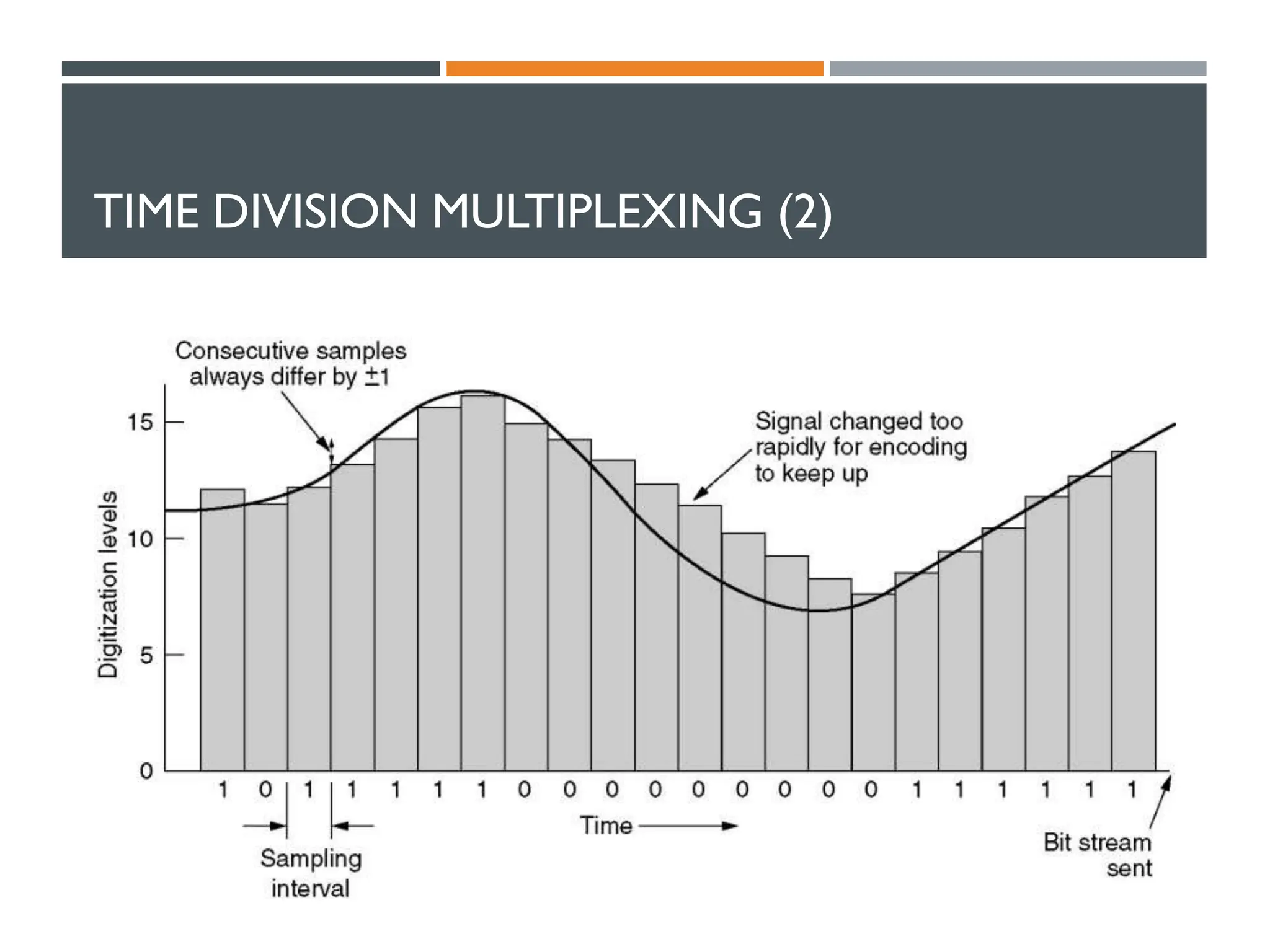
TIME DIVISION MULTIPLEXING (2)
 Delta modulation.
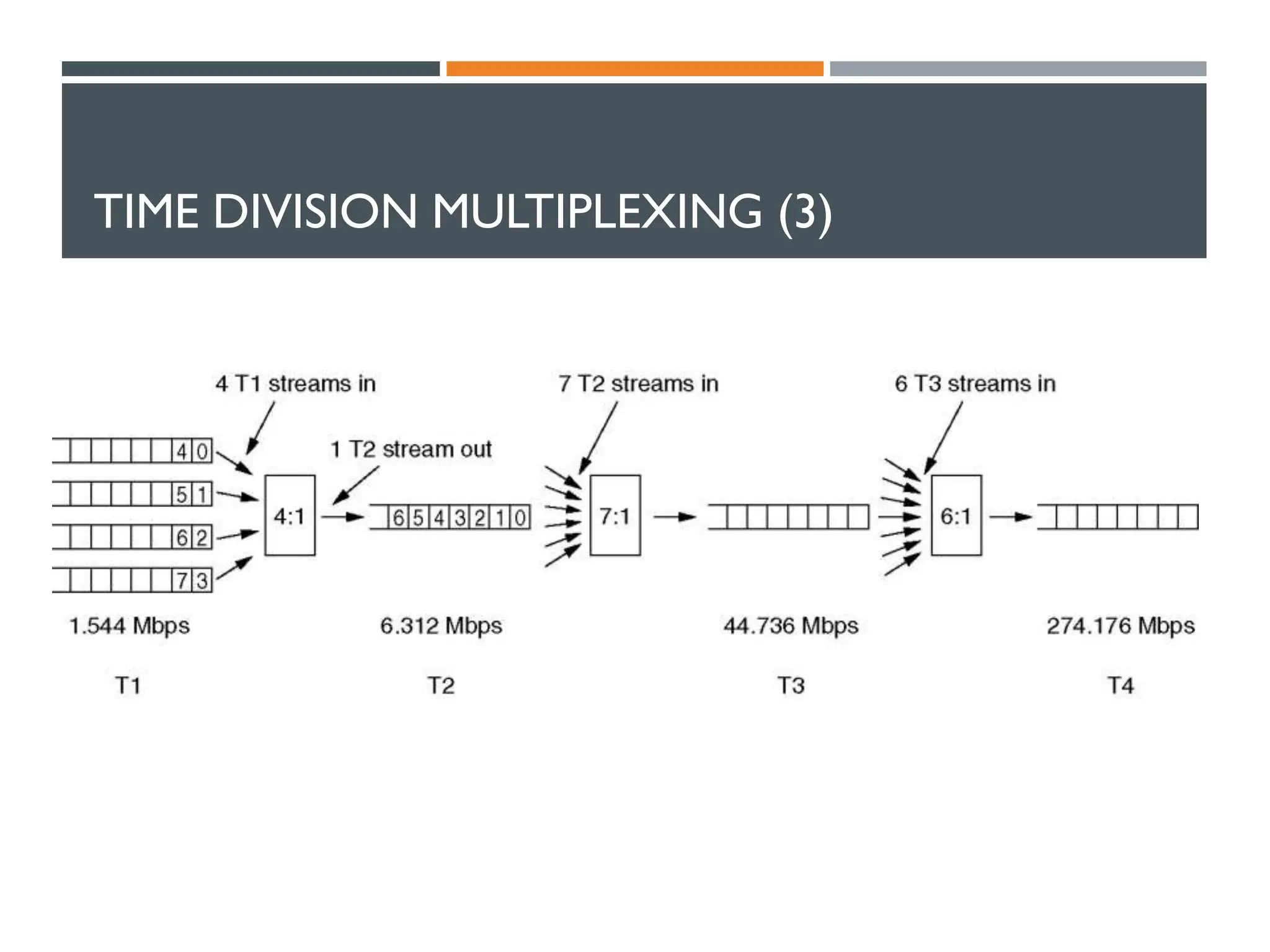
TIME DIVISION MULTIPLEXING (3)
 MultiplexingT1 streams into higher carriers.
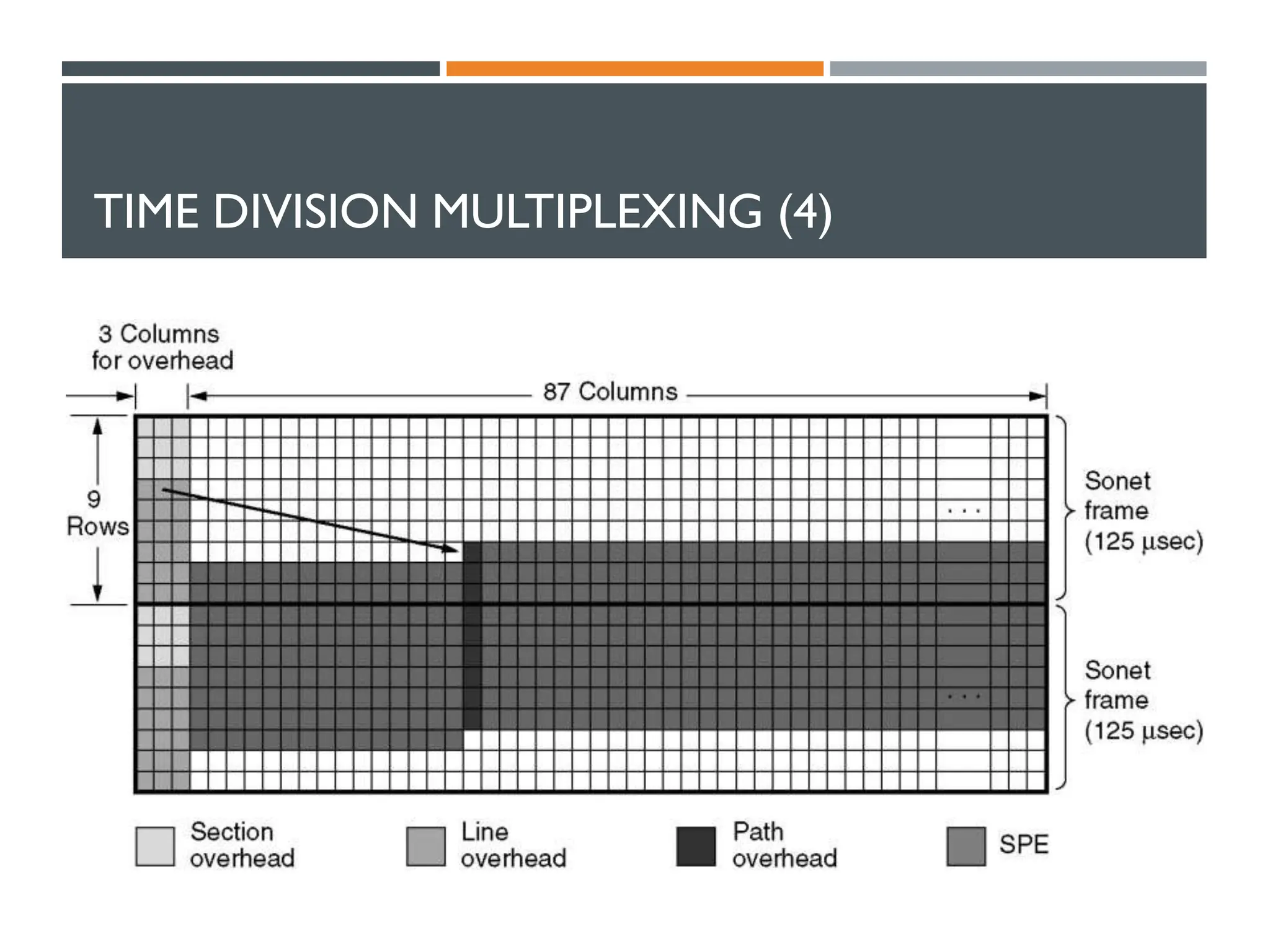
TIME DIVISION MULTIPLEXING (4)
 Two back-to-back SONET frames.
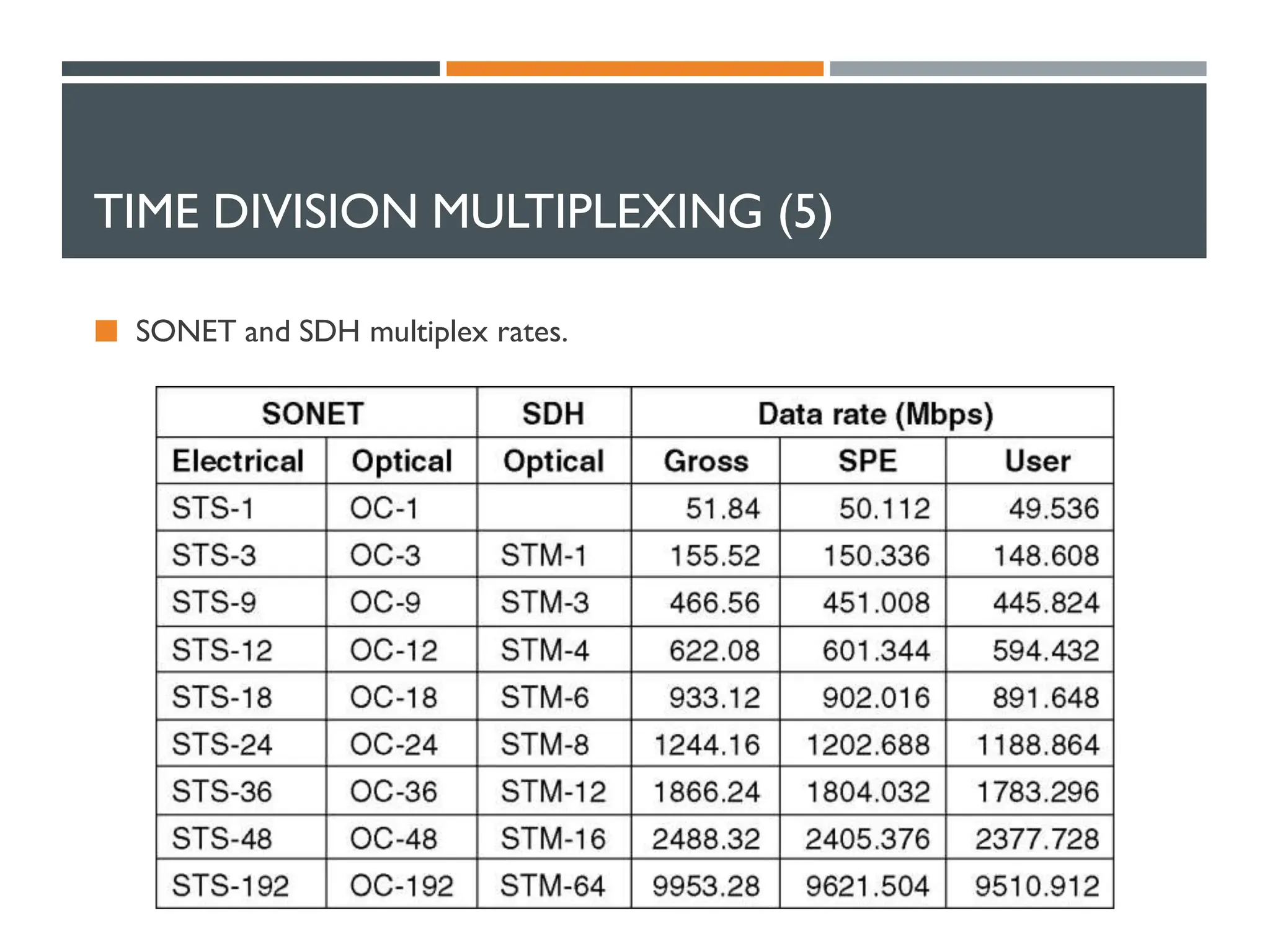
TIME DIVISION MULTIPLEXING (5)
 SONET and SDH multiplex rates.
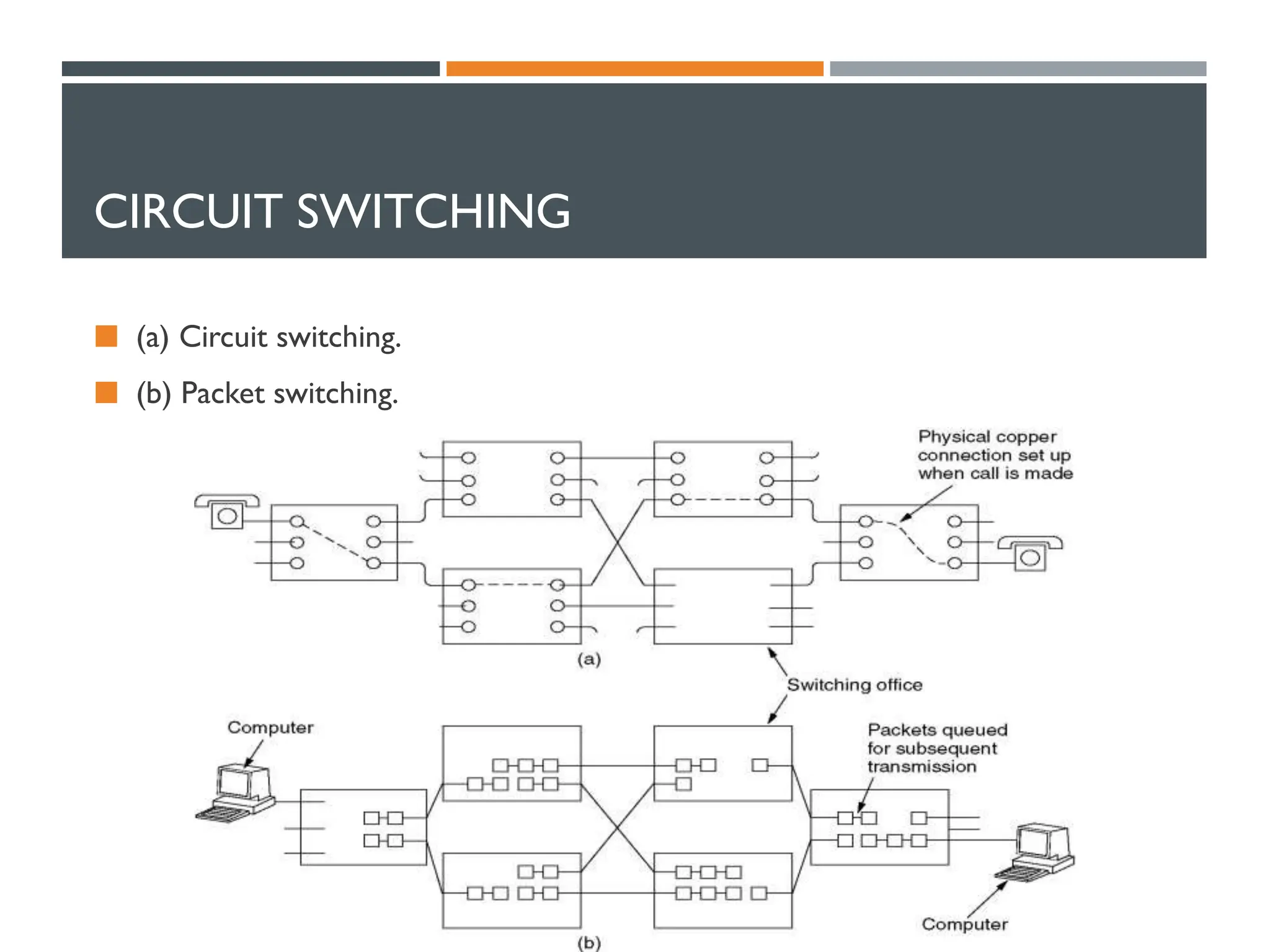
CIRCUIT SWITCHING
 (a) Circuit switching.
 (b) Packet switching.
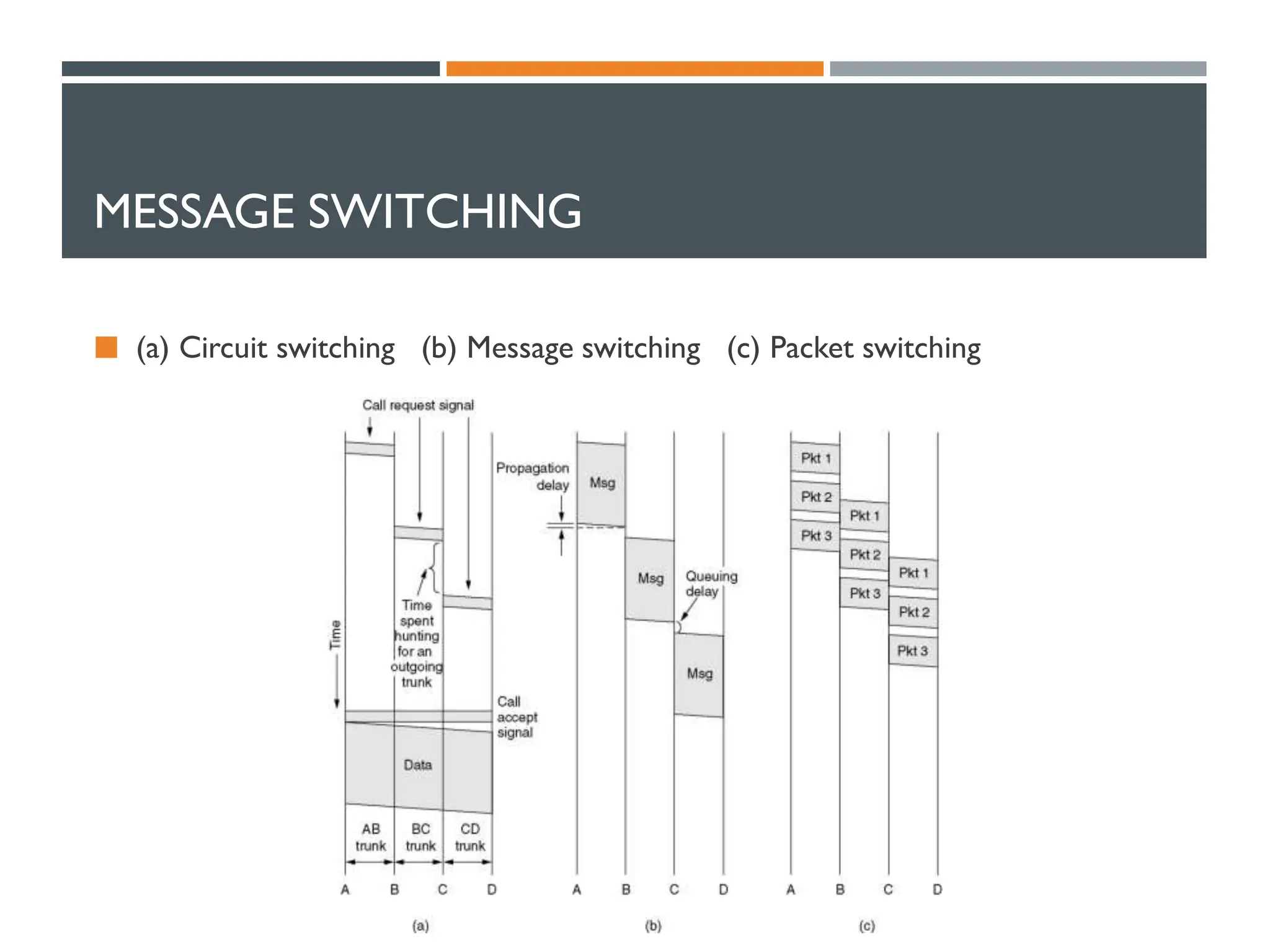
MESSAGE SWITCHING
 (a) Circuit switching (b) Message switching (c) Packet switching
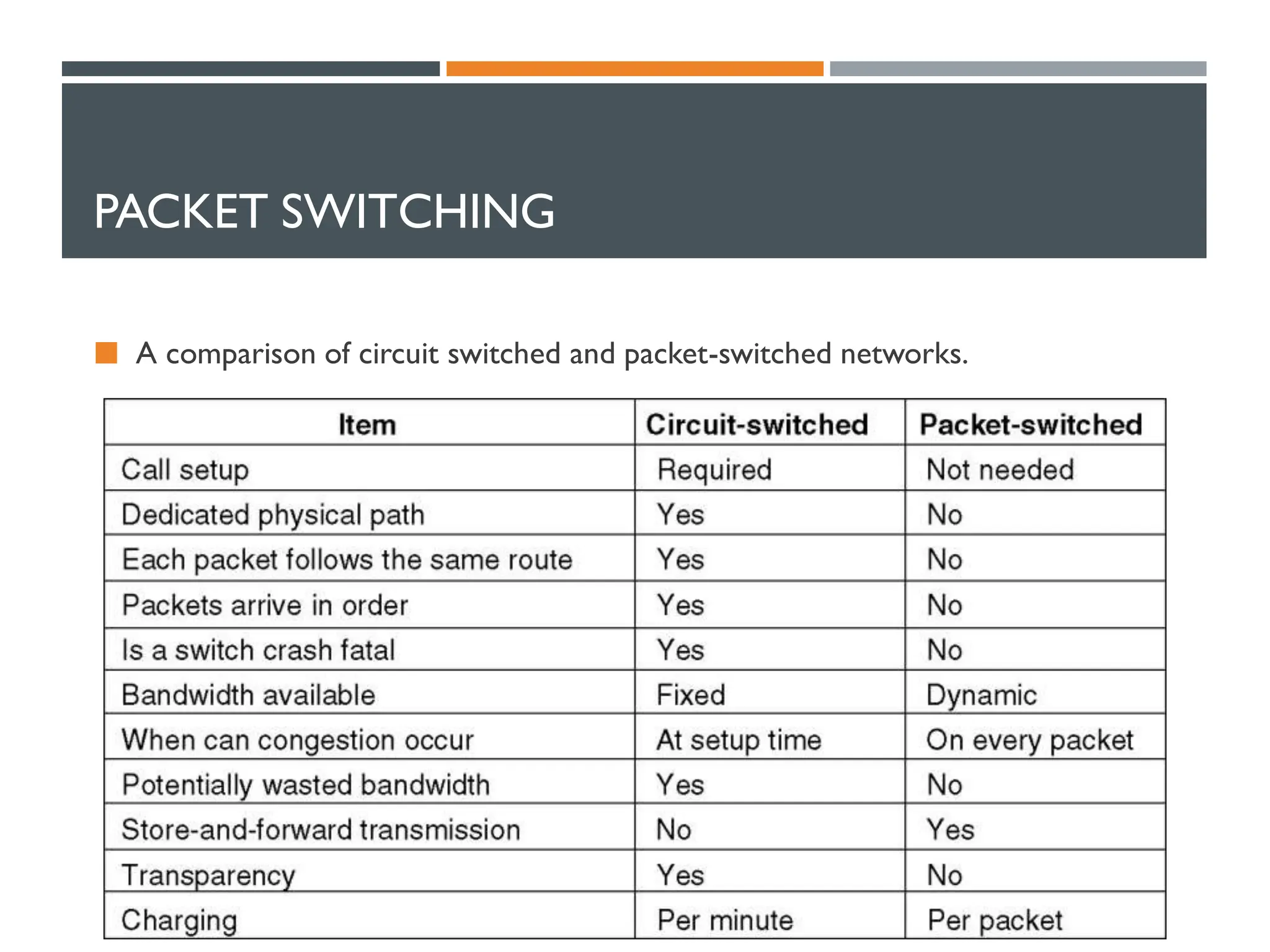
PACKET SWITCHING
 A comparison of circuit switched and packet-switched networks.
THE MOBILETELEPHONE SYSTEM
 First-Generation Mobile Phones:
AnalogVoice
 Second-Generation Mobile Phones:
DigitalVoice
 Third-Generation Mobile Phones:
DigitalVoice and Data
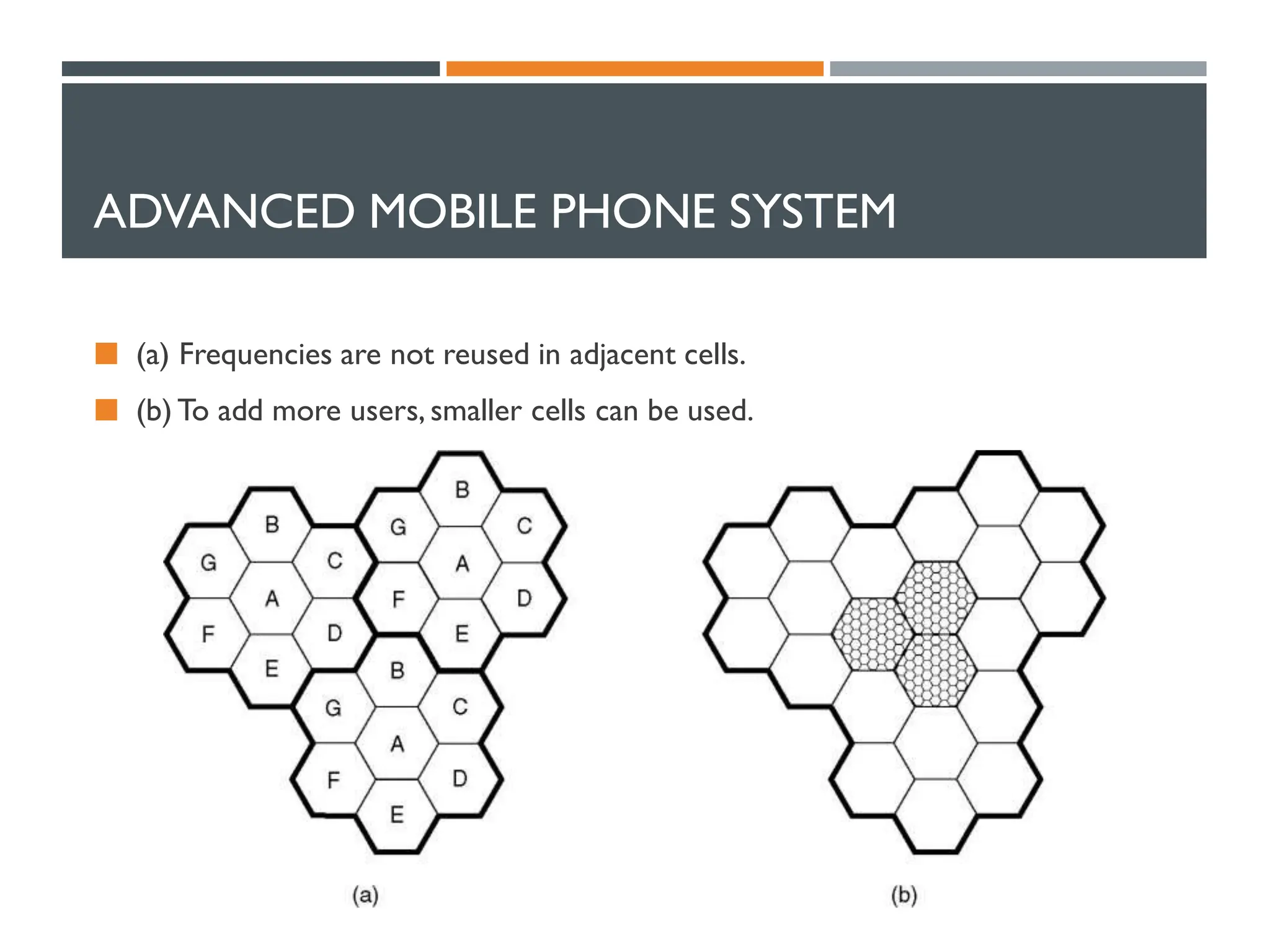
ADVANCED MOBILE PHONE SYSTEM
 (a) Frequencies are not reused in adjacent cells.
 (b) To add more users, smaller cells can be used.
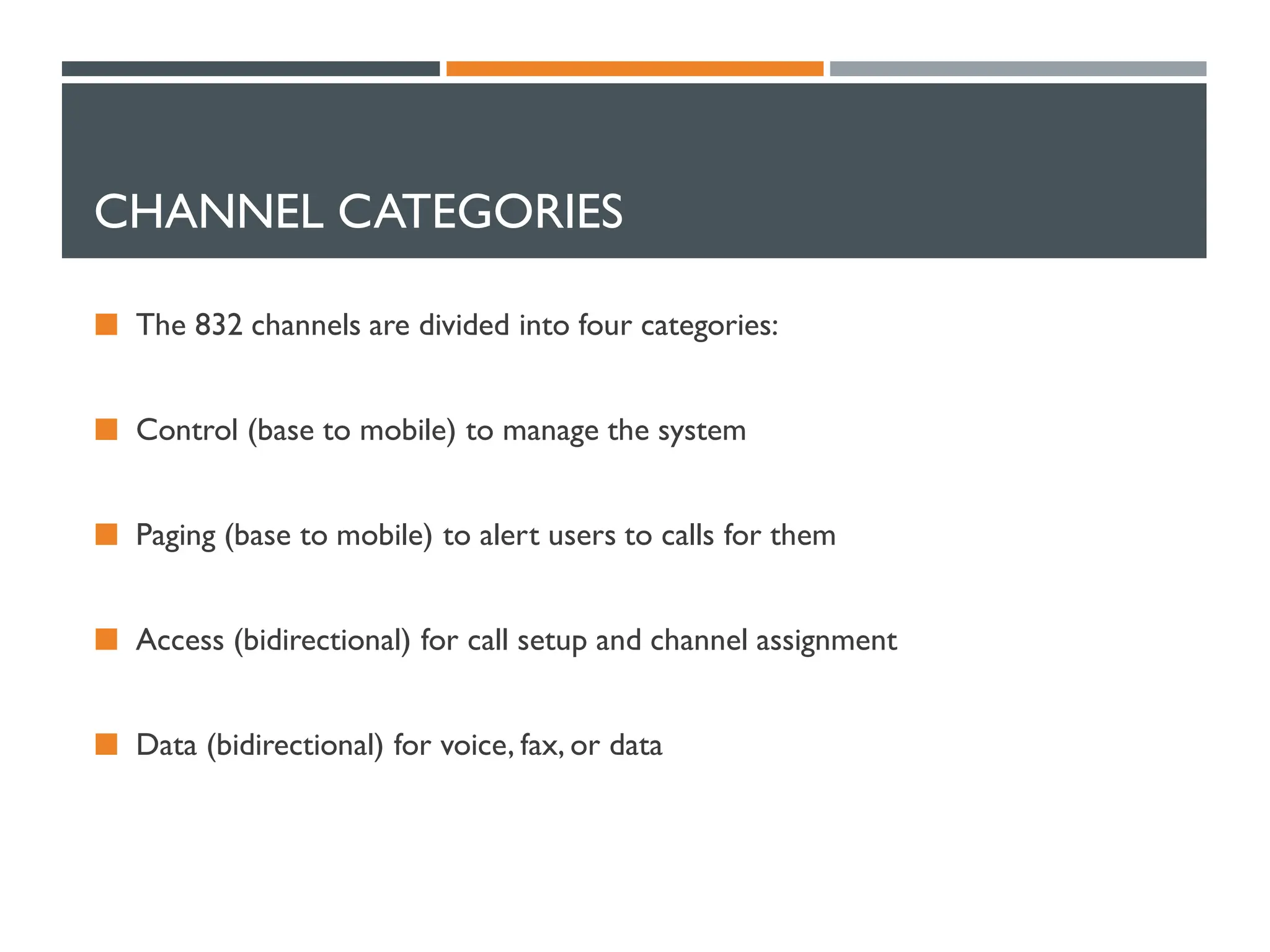
CHANNEL CATEGORIES
 The 832 channels are divided into four categories:
 Control (base to mobile) to manage the system
 Paging (base to mobile) to alert users to calls for them
 Access (bidirectional) for call setup and channel assignment
 Data (bidirectional) for voice, fax, or data
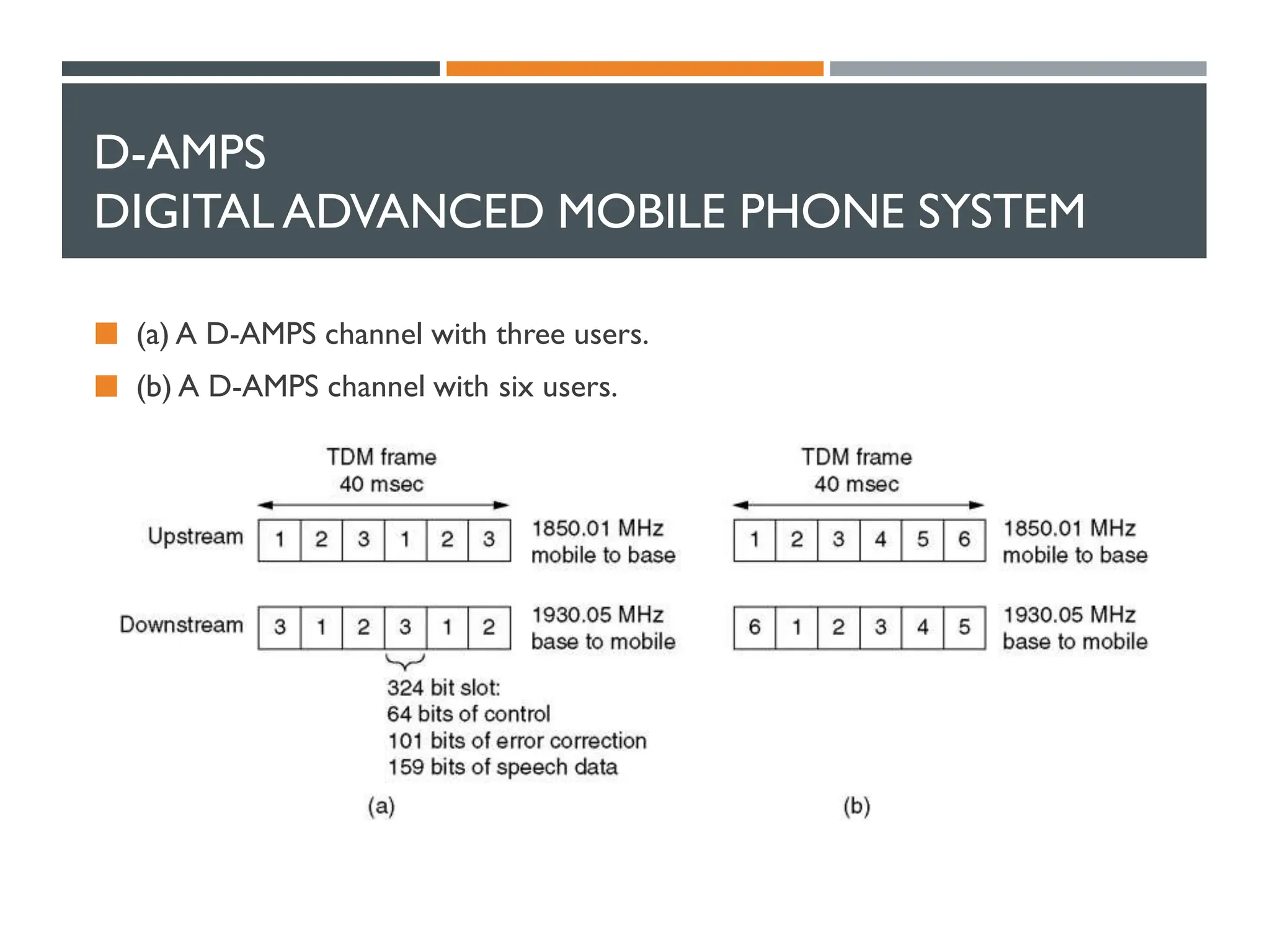
D-AMPS
DIGITAL ADVANCED MOBILE PHONE SYSTEM
 (a) A D-AMPS channel with three users.
 (b) A D-AMPS channel with six users.
GSM
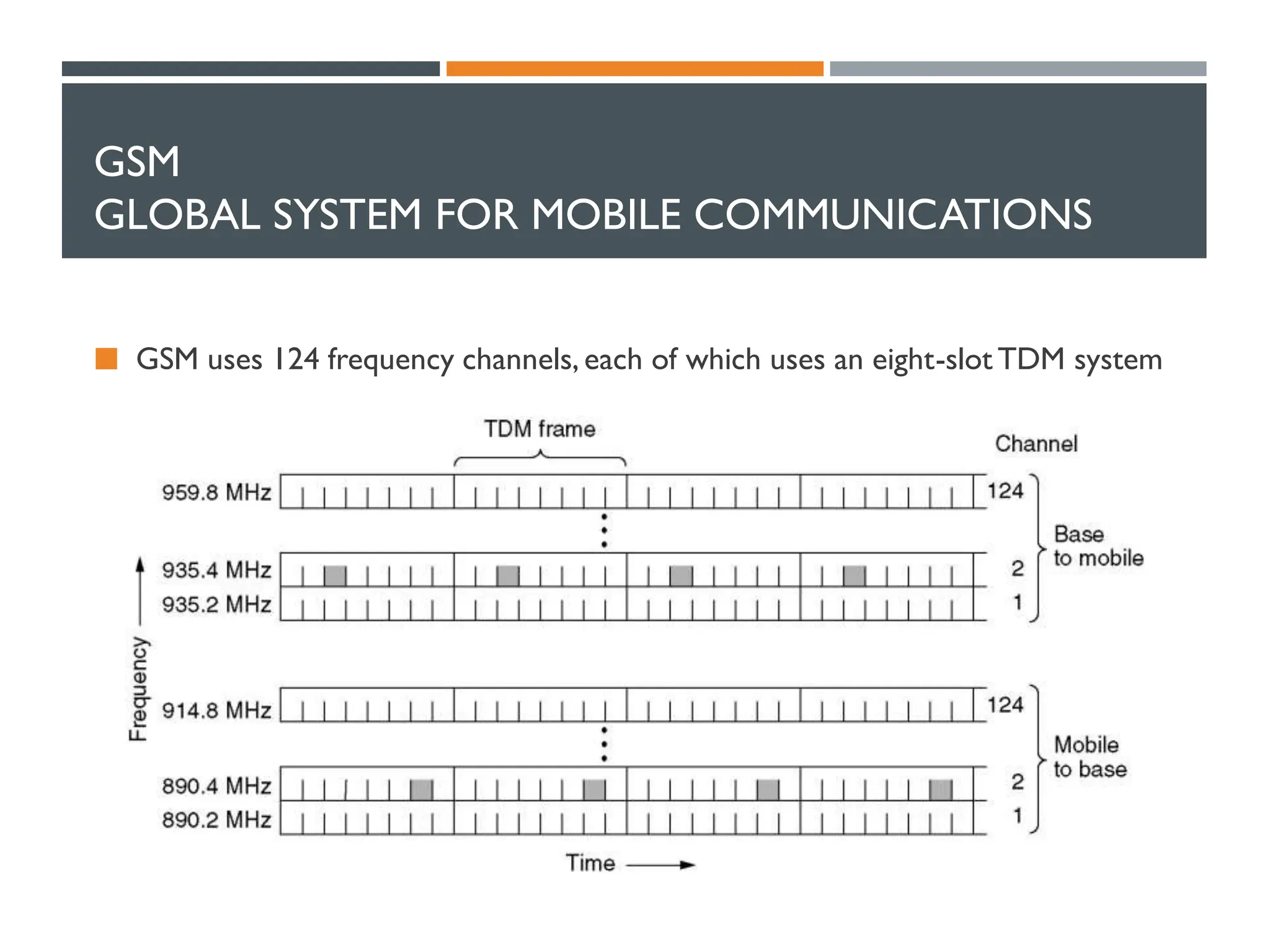
GLOBAL SYSTEM FOR MOBILE COMMUNICATIONS
 GSM uses 124 frequency channels, each of which uses an eight-slot TDM system
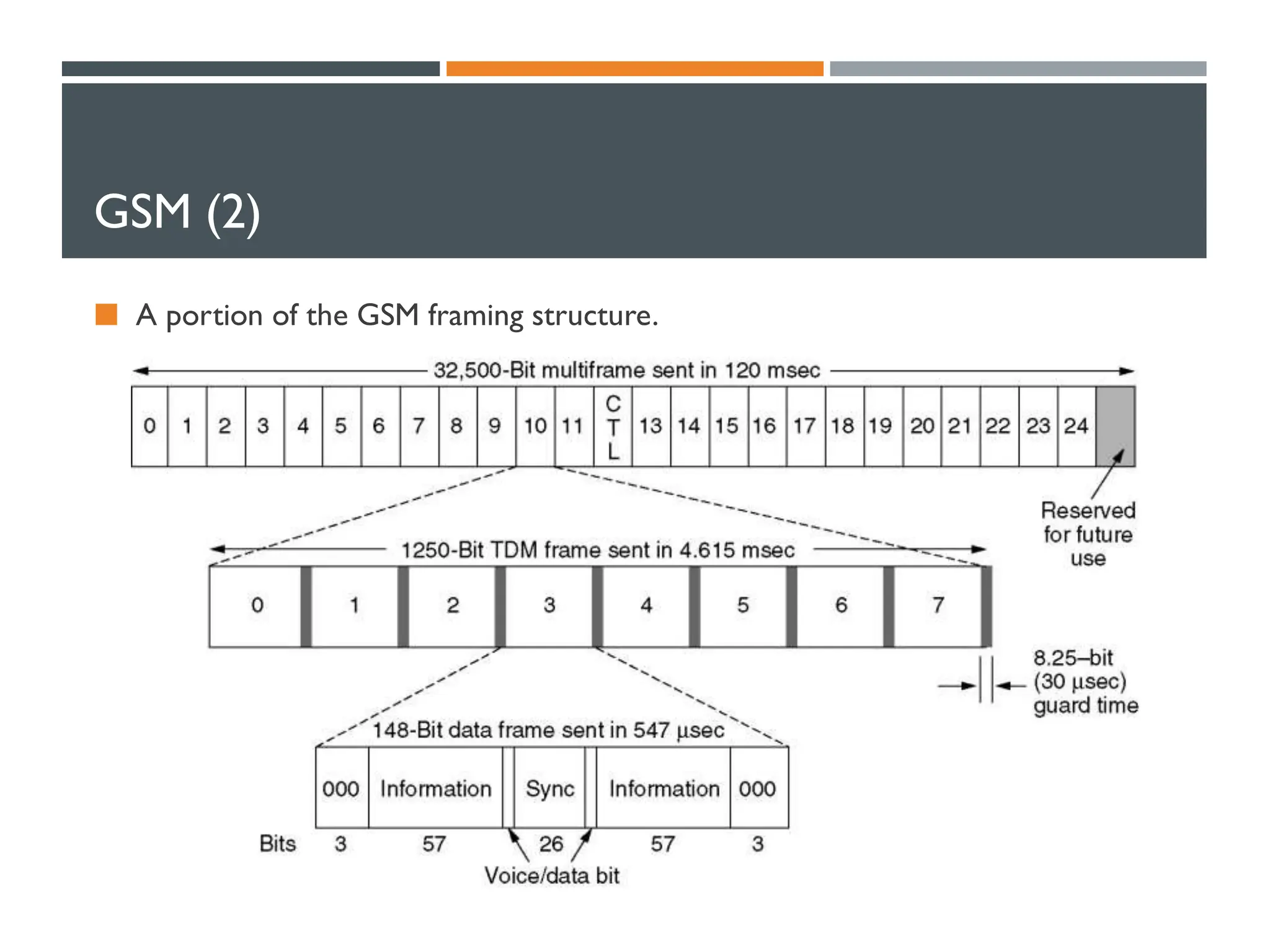
GSM (2)
 A portion of the GSM framing structure.
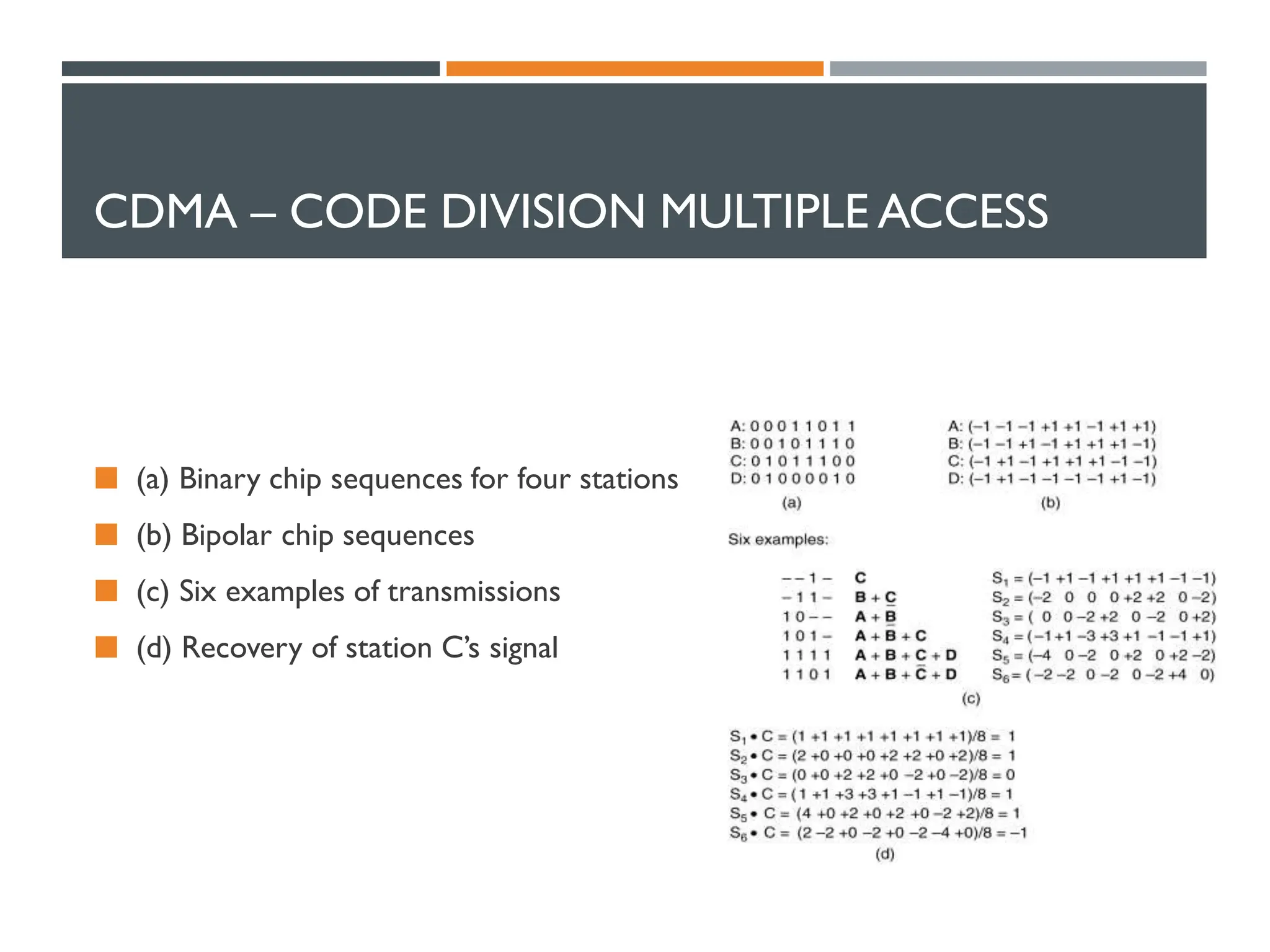
CDMA – CODE DIVISION MULTIPLE ACCESS
 (a) Binary chip sequences for four stations
 (b) Bipolar chip sequences
 (c) Six examples of transmissions
 (d) Recovery of station C’s signal
THIRD-GENERATION MOBILE PHONES:
DIGITALVOICE AND DATA
 Basic services an IMT-2000 network should provide
 High-quality voice transmission
 Messaging (replace e-mail, fax, SMS, chat, etc.)
 Multimedia (music, videos, films,TV, etc.)
 Internet access (web surfing, w/multimedia.)
CABLETELEVISION
 Community AntennaTelevision
 Internet over Cable
 Spectrum Allocation
 Cable Modems
 ADSL versus Cable
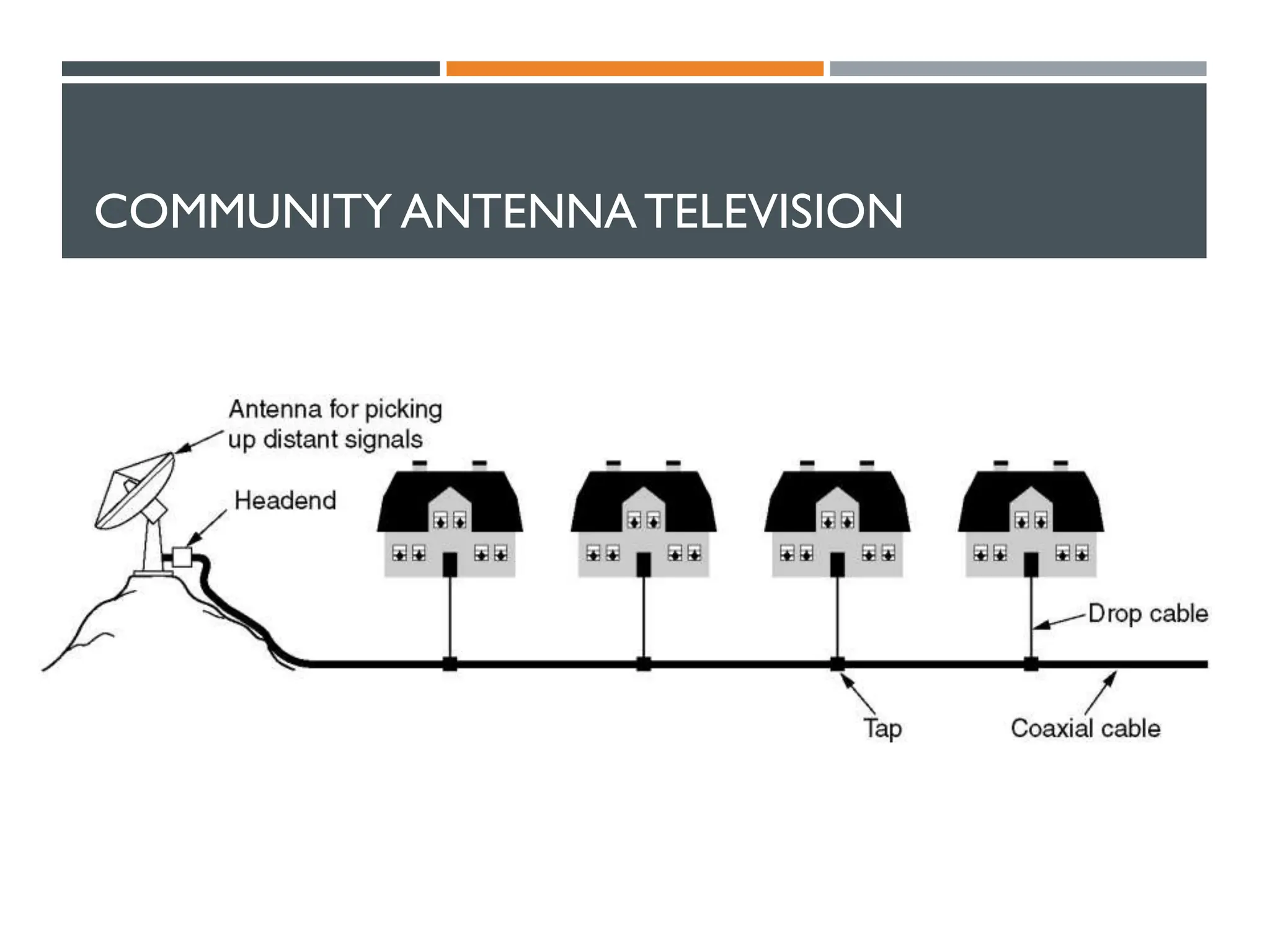
COMMUNITY ANTENNATELEVISION
 An early cable television system.
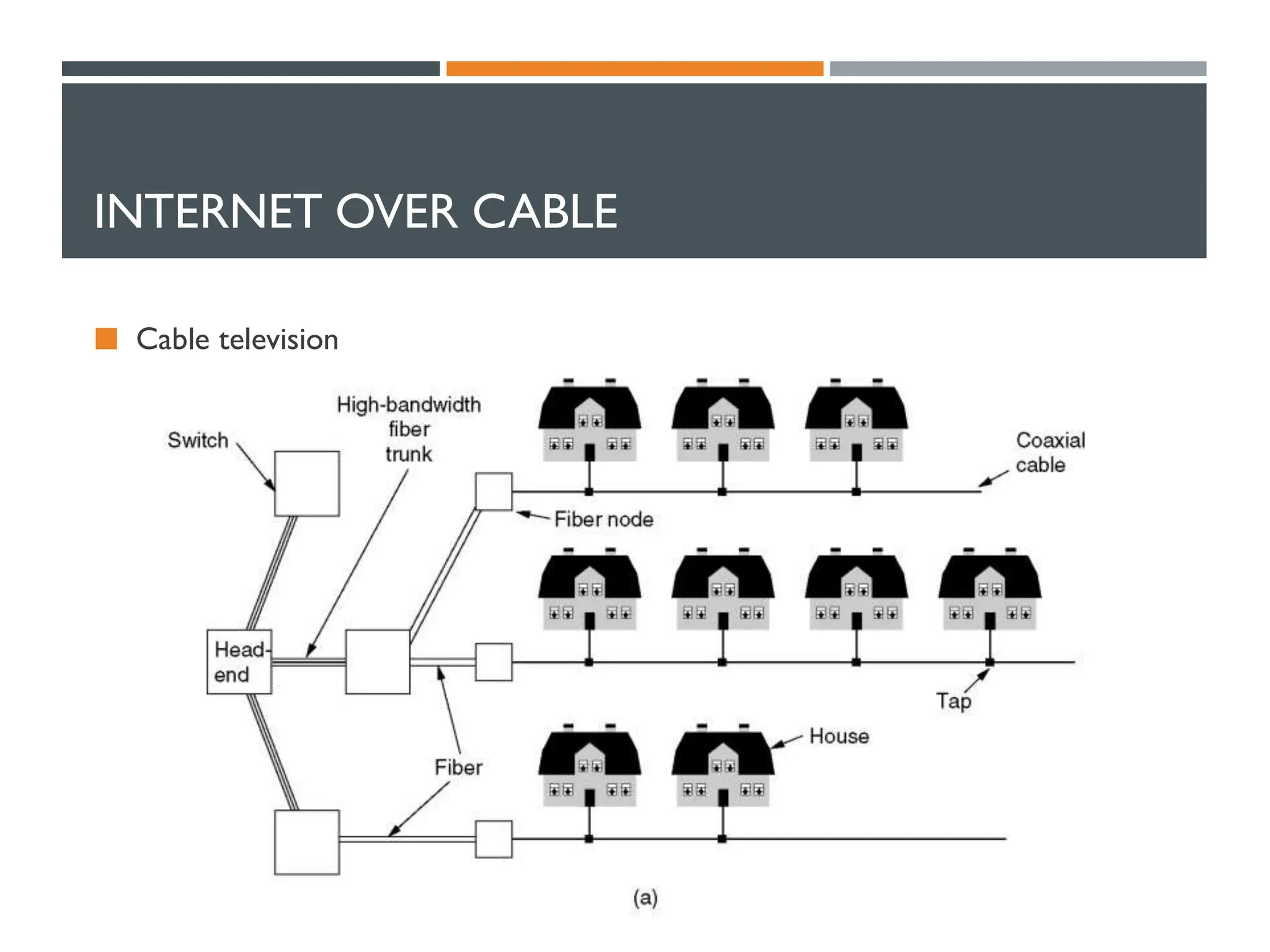
INTERNET OVER CABLE
 Cable television
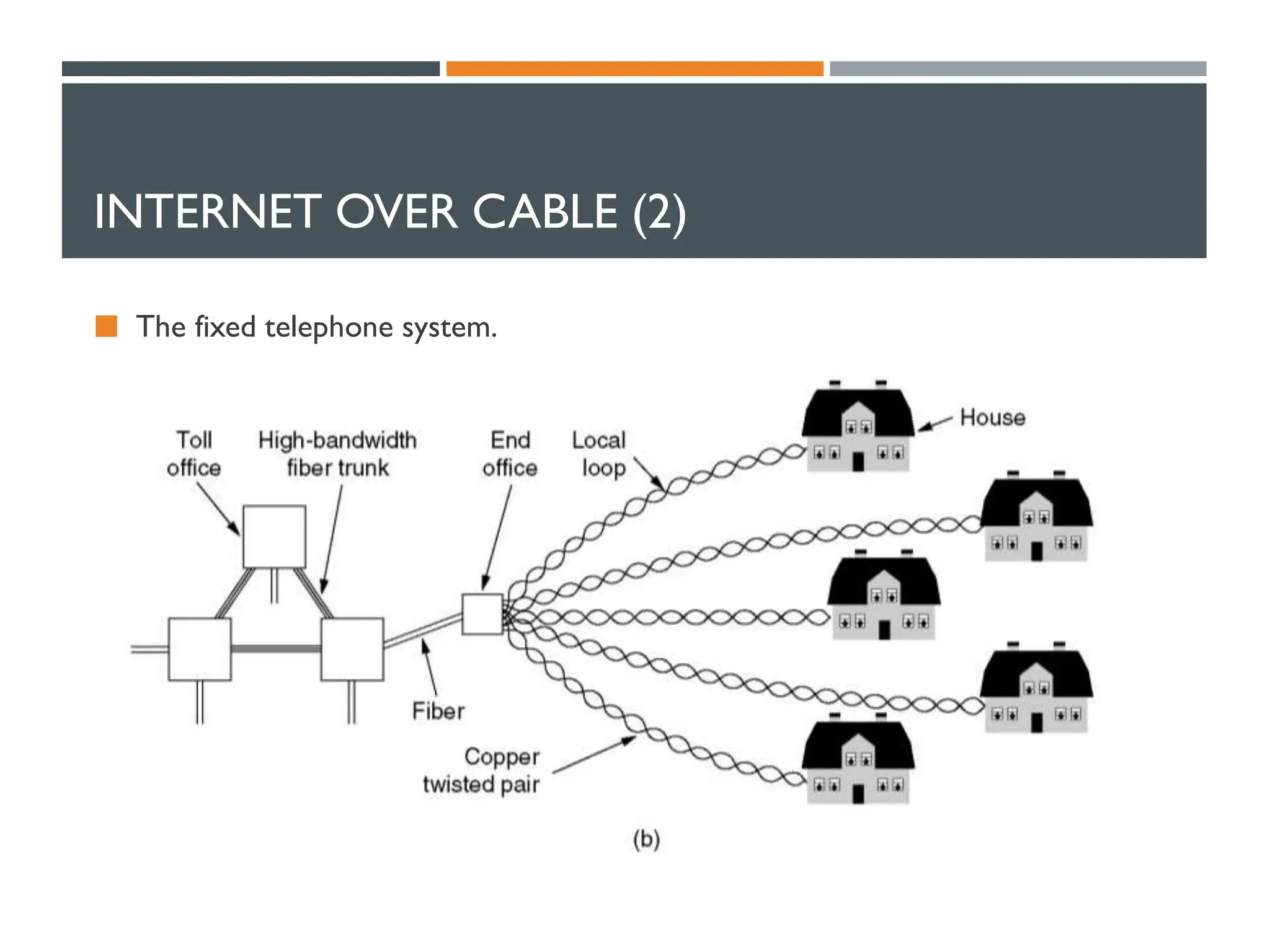
INTERNET OVER CABLE (2)
 The fixed telephone system.
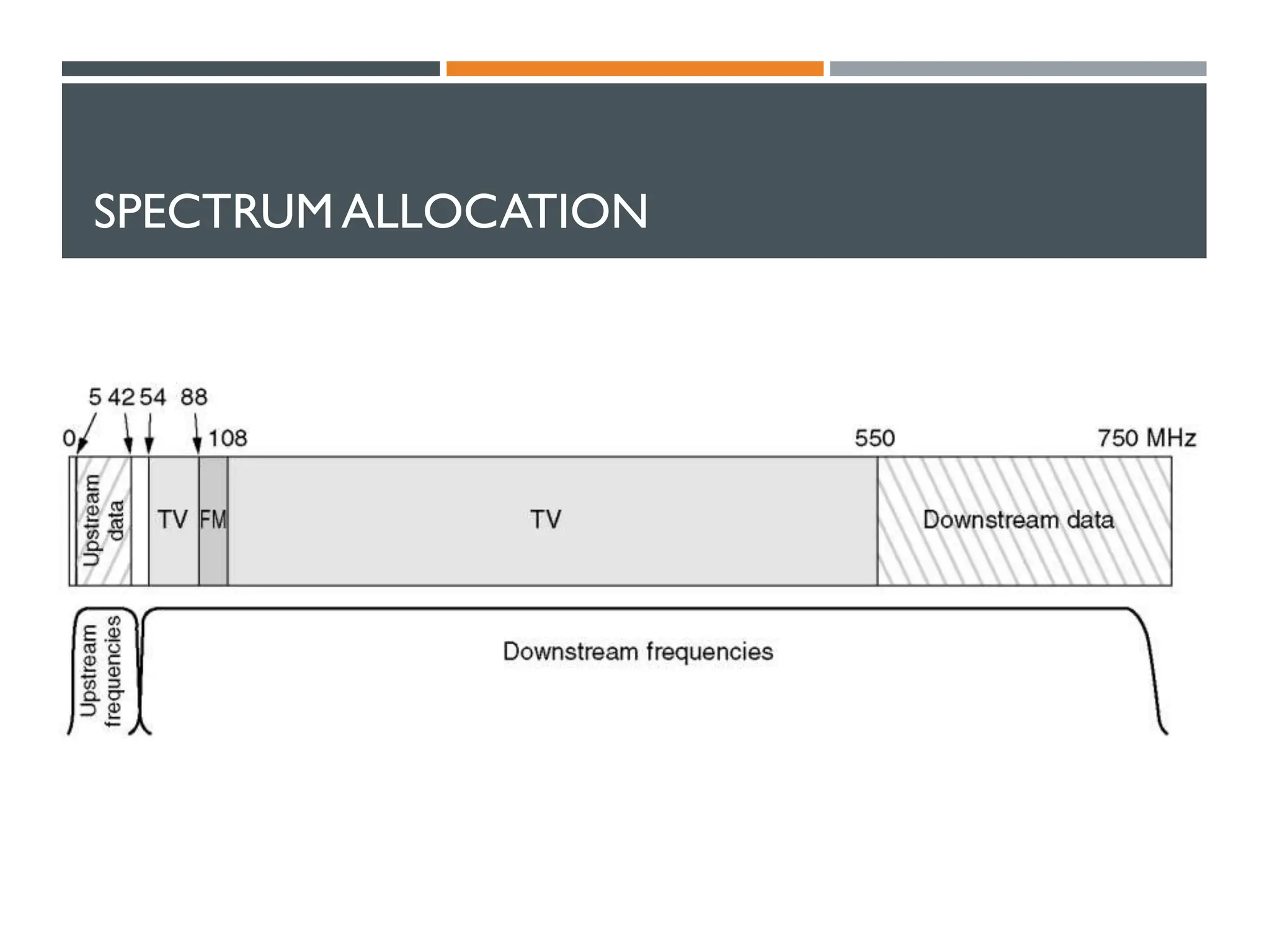
SPECTRUM ALLOCATION
 Frequency allocation in a typical cableTV system used for Internet access
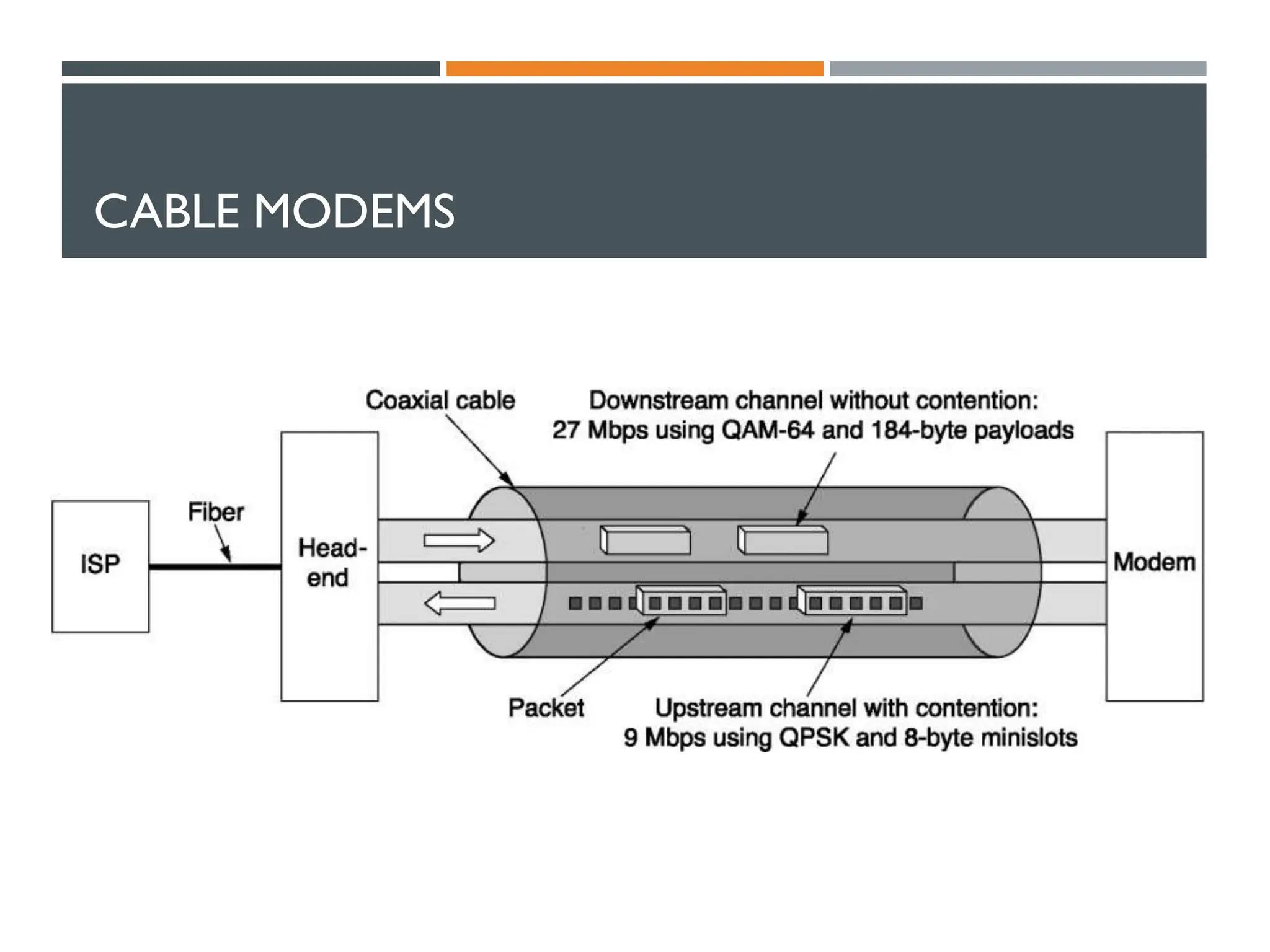
CABLE MODEMS
 Typical details of the upstream and downstream channels in North America.
Thank you
The content in this material are from the textbooks and reference books
given in the syllabus.

unit2 networks ppt.pdf for college studenst ang higher education