NOUNS
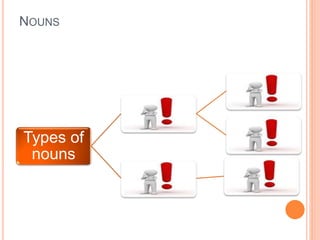
Types of
nouns
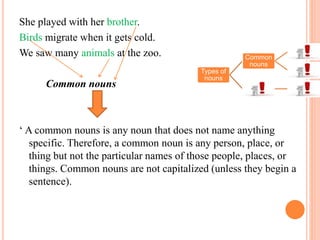
She played with her brother.
Birds migrate when it gets cold.
We saw many animals at the zoo.
Common nouns
‘ A common nouns is any noun that does not name anything
specific. Therefore, a common noun is any person, place, or
thing but not the particular names of those people, places, or
things. Common nouns are not capitalized (unless they begin a
sentence).
Types of
nouns
Common
nouns
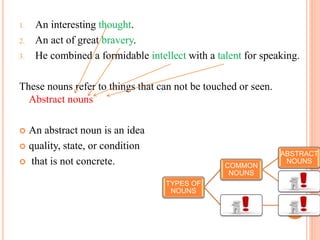
1. An interesting thought.
2. An act of great bravery.
3. He combined a formidable intellect with a talent for speaking.
These nouns refer to things that can not be touched or seen.
Abstract nouns
 An abstract noun is an idea
 quality, state, or condition
 that is not concrete.
TYPES OF
NOUNS
COMMON
NOUNS
ABSTRACT
NOUNS
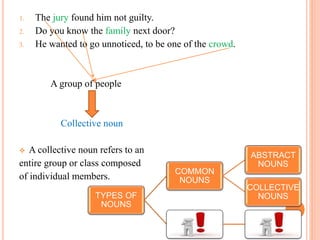
1. The jury found him not guilty.
2. Do you know the family next door?
3. He wanted to go unnoticed, to be one of the crowd.
A group of people
Collective noun
 A collective noun refers to an
entire group or class composed
of individual members.
TYPES OF
NOUNS
COMMON
NOUNS
ABSTRACT
NOUNS
COLLECTIVE
NOUNS
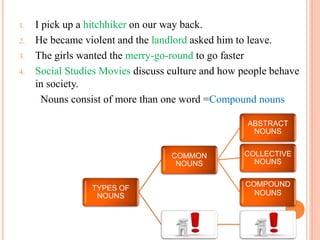
1. I pick up a hitchhiker on our way back.
2. He became violent and the landlord asked him to leave.
3. The girls wanted the merry-go-round to go faster
4. Social Studies Movies discuss culture and how people behave
in society.
Nouns consist of more than one word =Compound nouns
TYPES OF
NOUNS
COMMON
NOUNS
ABSTRACT
NOUNS
COLLECTIVE
NOUNS
COMPOUND
NOUNS
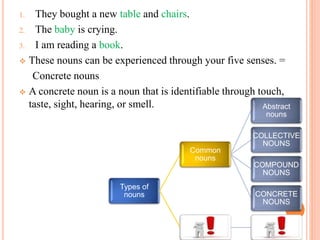
1. They bought a new table and chairs.
2. The baby is crying.
3. I am reading a book.
 These nouns can be experienced through your five senses. =
Concrete nouns
 A concrete noun is a noun that is identifiable through touch,
taste, sight, hearing, or smell.
Types of
nouns
Common
nouns
Abstract
nouns
COLLECTIVE
NOUNS
COMPOUND
NOUNS
CONCRETE
NOUNS
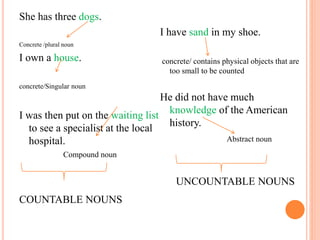
She has three dogs.
Concrete /plural noun
I own a house.
concrete/Singular noun
I was then put on the waiting list
to see a specialist at the local
hospital.
Compound noun
COUNTABLE NOUNS
I have sand in my shoe.
concrete/ contains physical objects that are
too small to be counted
He did not have much
knowledge of the American
history.
Abstract noun
UNCOUNTABLE NOUNS
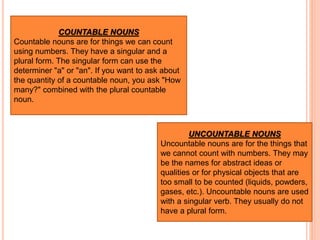
UNCOUNTABLE NOUNS
Uncountable nouns are for the things that
we cannot count with numbers. They may
be the names for abstract ideas or
qualities or for physical objects that are
too small to be counted (liquids, powders,
gases, etc.). Uncountable nouns are used
with a singular verb. They usually do not
have a plural form.
COUNTABLE NOUNS
Countable nouns are for things we can count
using numbers. They have a singular and a
plural form. The singular form can use the
determiner "a" or "an". If you want to ask about
the quantity of a countable noun, you ask "How
many?" combined with the plural countable
noun.
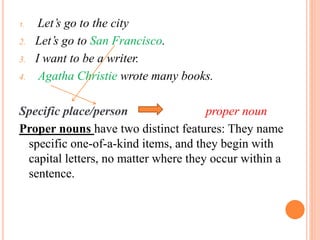
1. Let’s go to the city
2. Let’s go to San Francisco.
3. I want to be a writer.
4. Agatha Christie wrote many books.
Specific place/person proper noun
Proper nouns have two distinct features: They name
specific one-of-a-kind items, and they begin with
capital letters, no matter where they occur within a
sentence.
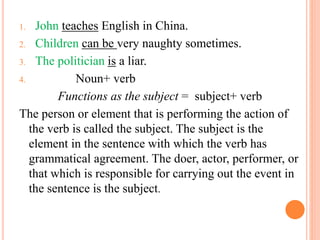
1. John teaches English in China.
2. Children can be very naughty sometimes.
3. The politician is a liar.
4. Noun+ verb
Functions as the subject = subject+ verb
The person or element that is performing the action of
the verb is called the subject. The subject is the
element in the sentence with which the verb has
grammatical agreement. The doer, actor, performer, or
that which is responsible for carrying out the event in
the sentence is the subject.
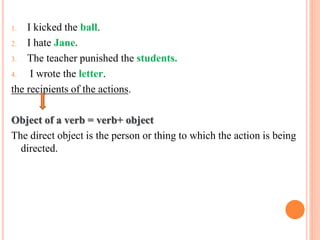
1. I kicked the ball.
2. I hate Jane.
3. The teacher punished the students.
4. I wrote the letter.
the recipients of the actions.
Object of a verb = verb+ object
The direct object is the person or thing to which the action is being
directed.
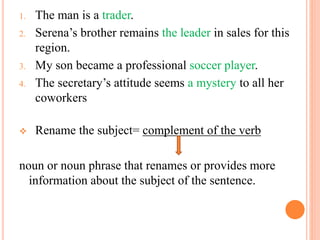
1. The man is a trader.
2. Serena’s brother remains the leader in sales for this
region.
3. My son became a professional soccer player.
4. The secretary’s attitude seems a mystery to all her
coworkers
 Rename the subject= complement of the verb
noun or noun phrase that renames or provides more
information about the subject of the sentence.
1. I will buy books for the children today when I visit
the bookstore.
2. I have to give it to the teacher.
3. They became frightened because of the lightning.
 Preposition + a noun object of the preposition
 A noun (or pronoun) connected into a sentence via a
preposition is called the object of a preposition. These
nouns can never be a subject, direct object or
predicate noun.
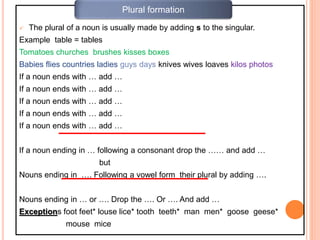
 The plural of a noun is usually made by adding s to the singular.
Example table = tables
Tomatoes churches brushes kisses boxes
Babies flies countries ladies guys days knives wives loaves kilos photos
If a noun ends with … add …
If a noun ending in … following a consonant drop the …… and add …
but
Nouns ending in …. Following a vowel form their plural by adding ….
Nouns ending in … or …. Drop the …. Or …. And add …
Exceptions foot feet* louse lice* tooth teeth* man men* goose geese*
mouse mice
Plural formation
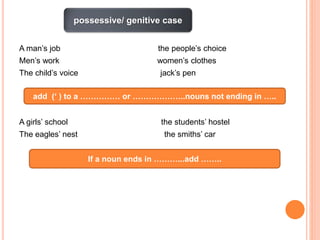
A man’s job the people’s choice
Men’s work women’s clothes
The child’s voice jack’s pen
A girls’ school the students’ hostel
The eagles’ nest the smiths’ car
possessive/ genitive case
add (‘ ) to a …………… or ………………..nouns not ending in …..
If a noun ends in ………...add ……..

Nouns

  • 1.
  • 2.
    She played withher brother. Birds migrate when it gets cold. We saw many animals at the zoo. Common nouns ‘ A common nouns is any noun that does not name anything specific. Therefore, a common noun is any person, place, or thing but not the particular names of those people, places, or things. Common nouns are not capitalized (unless they begin a sentence). Types of nouns Common nouns
  • 3.
    1. An interestingthought. 2. An act of great bravery. 3. He combined a formidable intellect with a talent for speaking. These nouns refer to things that can not be touched or seen. Abstract nouns  An abstract noun is an idea  quality, state, or condition  that is not concrete. TYPES OF NOUNS COMMON NOUNS ABSTRACT NOUNS
  • 4.
    1. The juryfound him not guilty. 2. Do you know the family next door? 3. He wanted to go unnoticed, to be one of the crowd. A group of people Collective noun  A collective noun refers to an entire group or class composed of individual members. TYPES OF NOUNS COMMON NOUNS ABSTRACT NOUNS COLLECTIVE NOUNS
  • 5.
    1. I pickup a hitchhiker on our way back. 2. He became violent and the landlord asked him to leave. 3. The girls wanted the merry-go-round to go faster 4. Social Studies Movies discuss culture and how people behave in society. Nouns consist of more than one word =Compound nouns TYPES OF NOUNS COMMON NOUNS ABSTRACT NOUNS COLLECTIVE NOUNS COMPOUND NOUNS
  • 6.
    1. They boughta new table and chairs. 2. The baby is crying. 3. I am reading a book.  These nouns can be experienced through your five senses. = Concrete nouns  A concrete noun is a noun that is identifiable through touch, taste, sight, hearing, or smell. Types of nouns Common nouns Abstract nouns COLLECTIVE NOUNS COMPOUND NOUNS CONCRETE NOUNS
  • 7.
    She has threedogs. Concrete /plural noun I own a house. concrete/Singular noun I was then put on the waiting list to see a specialist at the local hospital. Compound noun COUNTABLE NOUNS I have sand in my shoe. concrete/ contains physical objects that are too small to be counted He did not have much knowledge of the American history. Abstract noun UNCOUNTABLE NOUNS
  • 8.
    UNCOUNTABLE NOUNS Uncountable nounsare for the things that we cannot count with numbers. They may be the names for abstract ideas or qualities or for physical objects that are too small to be counted (liquids, powders, gases, etc.). Uncountable nouns are used with a singular verb. They usually do not have a plural form. COUNTABLE NOUNS Countable nouns are for things we can count using numbers. They have a singular and a plural form. The singular form can use the determiner "a" or "an". If you want to ask about the quantity of a countable noun, you ask "How many?" combined with the plural countable noun.
  • 9.
    1. Let’s goto the city 2. Let’s go to San Francisco. 3. I want to be a writer. 4. Agatha Christie wrote many books. Specific place/person proper noun Proper nouns have two distinct features: They name specific one-of-a-kind items, and they begin with capital letters, no matter where they occur within a sentence.
  • 11.
    1. John teachesEnglish in China. 2. Children can be very naughty sometimes. 3. The politician is a liar. 4. Noun+ verb Functions as the subject = subject+ verb The person or element that is performing the action of the verb is called the subject. The subject is the element in the sentence with which the verb has grammatical agreement. The doer, actor, performer, or that which is responsible for carrying out the event in the sentence is the subject.
  • 12.
    1. I kickedthe ball. 2. I hate Jane. 3. The teacher punished the students. 4. I wrote the letter. the recipients of the actions. Object of a verb = verb+ object The direct object is the person or thing to which the action is being directed.
  • 13.
    1. The manis a trader. 2. Serena’s brother remains the leader in sales for this region. 3. My son became a professional soccer player. 4. The secretary’s attitude seems a mystery to all her coworkers  Rename the subject= complement of the verb noun or noun phrase that renames or provides more information about the subject of the sentence.
  • 14.
    1. I willbuy books for the children today when I visit the bookstore. 2. I have to give it to the teacher. 3. They became frightened because of the lightning.  Preposition + a noun object of the preposition  A noun (or pronoun) connected into a sentence via a preposition is called the object of a preposition. These nouns can never be a subject, direct object or predicate noun.
  • 15.
     The pluralof a noun is usually made by adding s to the singular. Example table = tables Tomatoes churches brushes kisses boxes Babies flies countries ladies guys days knives wives loaves kilos photos If a noun ends with … add … If a noun ends with … add … If a noun ends with … add … If a noun ends with … add … If a noun ends with … add … If a noun ending in … following a consonant drop the …… and add … but Nouns ending in …. Following a vowel form their plural by adding …. Nouns ending in … or …. Drop the …. Or …. And add … Exceptions foot feet* louse lice* tooth teeth* man men* goose geese* mouse mice Plural formation
  • 16.
    A man’s jobthe people’s choice Men’s work women’s clothes The child’s voice jack’s pen A girls’ school the students’ hostel The eagles’ nest the smiths’ car possessive/ genitive case add (‘ ) to a …………… or ………………..nouns not ending in ….. If a noun ends in ………...add ……..